Escape Credit Card Cash Withdrawal Daily Interest Trap
Taking cash at an ATM on a credit card starts 40% to 45% yearly interest from Day 1 with zero grace days. Learn RBI billing rules, dispute illegal fee compounding, and settle inflated dues the legal way.
- Zero Grace Period Trap: Unlike store swipes, ATM cash advances get zero free days. Daily interest at 3.4% to 3.75% per month starts from Day 1.
- Instant Fee Plus 18% GST: Every ATM pull adds a 2.5% to 3.5% cash fee (or ₹500 minimum) plus 18% GST on both fees and daily interest.
- RBI Ban on Fee Compounding: Under RBI Card Directions, banks cannot charge compound interest on unpaid GST, taxes, or late fees.
- Supreme Court Rate Rule (2024): In HSBC v. Awaz, the Supreme Court held courts cannot cap 42% card rates, making RBI OTS your main exit.
- Legal Compromise OTS: Once unpaid dues cross 90 days into NPA status, banks waive steep interest and fines under Board-approved OTS plans.
1. How ATM Cash Withdrawals Trigger a Daily Debt Trap
During a hospital need, rent gap, or sudden job loss, many people put their credit card into an ATM for quick cash. Banks call this feature a cash advance and set it at 20% to 40% of your card limit. Most card users assume they get 45 free days to pay that cash back, just like normal store swipes.
That belief starts one of the fastest debt traps in Indian banking. The second cash leaves the ATM slot, HDFC, SBI Card, ICICI, Axis, and other issuers charge a flat fee of 2.5% to 3.5%, or ₹500 minimum. Taking five ₹2,000 notes in five separate pulls costs ₹2,500 in flat fees plus ₹450 in GST on the spot.
Worse still, ATM cash gets zero interest-free days. Finance charges of 3.4% to 3.75% per month (40.8% to 45% per year) begin from the exact minute of withdrawal. Every single day you wait for your monthly bill to print, daily interest plus 18% GST keeps piling up.
Within six to nine months of missed bills, late fines, over-limit fees, and 45% APR can easily double your original cash withdrawal. Understanding your RBI rights is the quickest way to halt this spiral.
2. RBI Master Direction Rules on Cash Advance Billing
Credit card cash advances in India follow the Reserve Bank of India (Credit Card and Debit Card - Issuance and Conduct) Directions, 2022 (Circular DoR.AUT.REC.No.27/24.01.041/2022-23, updated on March 7, 2024). While RBI does not fix a low rate cap, it enforces four strict billing rules that banks cannot break.
First, every issuer must print your exact cash limit, flat cash fee, monthly rate, and yearly APR inside the Most Important Terms and Conditions (MITC). They must also show clear math examples of how cash interest works. Any hidden charge left out of the MITC must be refunded in full.
Second, Paragraph 9 of the RBI Master Direction bans banks from charging interest on unpaid taxes, levies, or fees. A bank can charge interest on the cash principal you took, yet it cannot add unpaid 18% GST or late fees into principal to compound more interest.
Third, banks must use the adjusted balance rule after any part payment. If your bill is ₹50,000 and you pay ₹30,000 before the due date, future interest and late fees apply only on the remaining ₹20,000. Also, banks must give 3 grace days past the due date before adding late fees or reporting past-due marks to CIBIL.
3. Retail Swipes vs ATM Cash Advances: Fee Comparison
Many borrowers treat an ATM cash pull like an online bill payment or shop swipe. This comparison table shows why ATM cash advances cost far more from the very first day.
| Billing Parameter | Normal Retail / Online Swipe | Credit Card ATM Cash Advance |
|---|---|---|
| Upfront Transaction Fee | ₹0 on regular merchant spends | 2.5% to 3.5% or ₹500 min + 18% GST |
| Interest-Free Grace Window | 20 to 50 free days if prior bill cleared | Zero grace days (0 days free) |
| When Interest Starts | Only if Total Due stays unpaid on due date | Exact day & hour of ATM withdrawal |
| Typical Annual APR | 0% if paid in full; 36% to 45% if rolled | 40.8% to 45%+ p.a. from Day 1 |
| Reward Points & Perks | Earns normal reward points or cashback | Zero reward points on all cards |
| Impact on Credit Score | Normal if usage stays below 30% limit | Flags cash stress & spikes utilization |
4. Why Minimum Due & Trailing Interest Ruin Your Bill
Three hidden billing traps stop ordinary cardholders from clearing an ATM cash advance. First is the Minimum Amount Due (MAD) trap. Paying 5% MAD only prevents a late payment fee; the other 95% of your cash pull keeps drawing ~42% yearly interest plus 18% GST every day.
Second, rolling over any cash balance cancels your free grace period on the whole card. Once a balance carries forward, even a ₹500 milk or medicine swipe loses its free days and starts drawing 3.5% monthly interest from the day you swipe.
Third, bank MITC rules apply your payments in a strict order: 100% of GST and taxes first, EMIs second, fees third, finance interest fourth, and your cash principal last. Also, daily interest runs between your bill print date and the date you pay, leaving surprise trailing interest on next month's bill unless you clear unbilled interest right inside the bank app.
5. Visual Blueprint: Cash Advance Trap & RBI OTS Flow
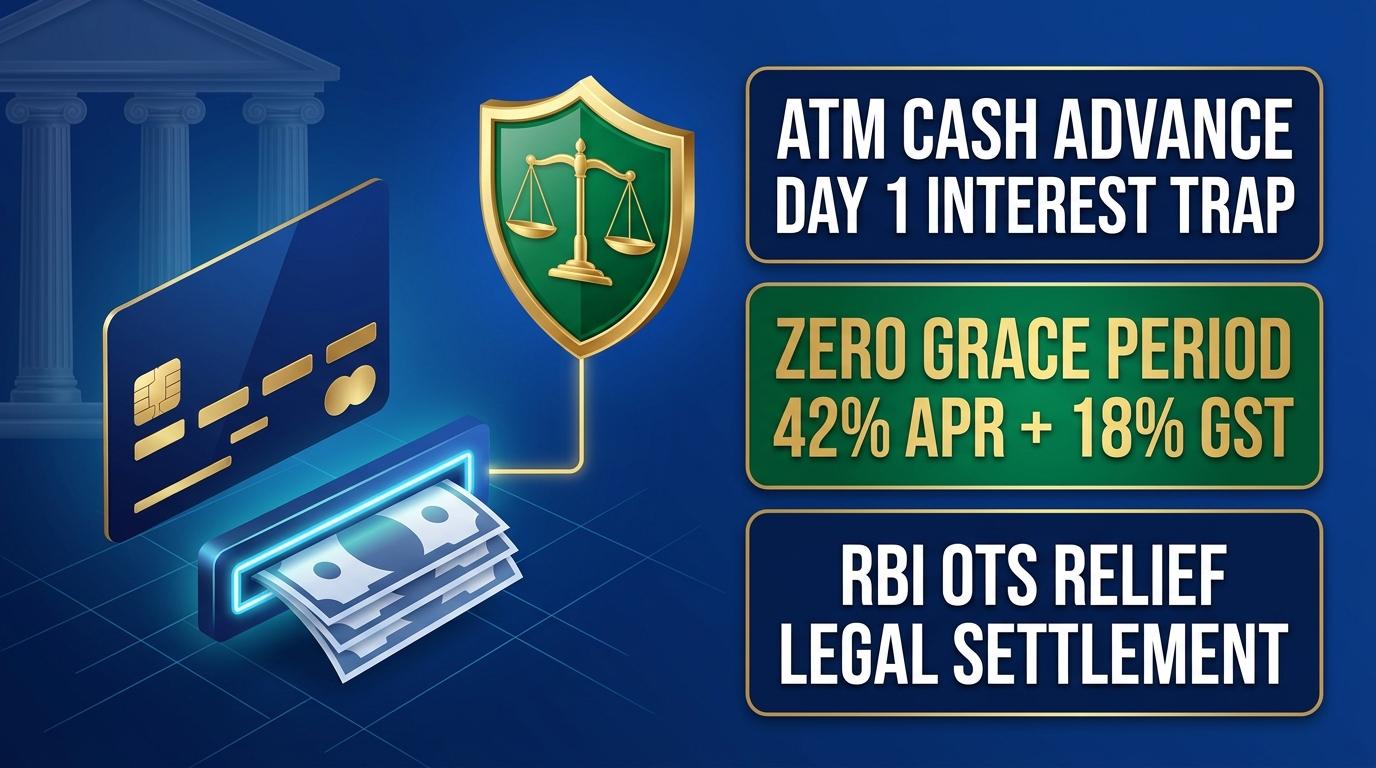
This visual guide shows how Day 1 cash fees, zero grace days, and 18% GST inflate small ATM pulls, and how an official RBI One-Time Settlement cuts away unfair penalties.
6. Cash Advance Inflation vs RBI OTS Settlement Math
When a cardholder cannot clear ATM cash pulls due to job loss, pay cuts, or medical bills, total dues swell fast. Because credit cards have no pledged collateral, banks classify unpaid cards past 90 days as Non-Performing Assets (NPAs).
Under RBI Circular DOR.STR.REC.20/21.04.048/2023-24 (June 8, 2023), every bank and NBFC maintains a Board-approved compromise settlement policy. In genuine hardship cases, banks waive 100% of accumulated daily interest, late fines, and GST on waived fees, as illustrated below.
| Statement Component | Inflated Bank Claim | RBI Policy OTS Treatment | Final OTS Payable |
|---|---|---|---|
| ATM Cash Taken & Retail Principal | ₹1,50,000 | 45% to 55% Hardship Haircut | ₹75,000 |
| 2.5% to 3.5% Upfront ATM Cash Fees | ₹6,500 | 100% Fee Waiver | ₹0 |
| Daily Cash Interest (42% to 45% APR) | ₹74,000 | 100% Suspense Interest Waiver | ₹0 |
| Late Payment & Over-Limit Penalties | ₹14,500 | 100% Penalty Waiver | ₹0 |
| 18% GST on Interest & Bank Fees | ₹17,100 | Dropped With Fee Reversal | ₹0 |
| Total Full & Final Closure | ₹2,62,100 | ~71% Total Debt Relief | ₹75,000 (Closed via OTS) |
7. Step-by-Step SOP: Stopping the Cash Advance Spiral
Whether your cash withdrawal happened last week or turned into an overdue NPA six months ago, follow these six steps to stop the bleeding and close the debt safely.
1Stage 1: Freeze ATM Withdrawals and All Card Swipes
Turn off ATM cash withdrawals in your card app right away. Stop swiping that card for daily groceries because every new swipe draws Day 1 interest while a cash balance remains unpaid.
2Stage 2: Clear Immediately or Convert Early if Solvent
If you have savings, do not wait for the bill date; pay the cash amount plus ₹600 extra right now to kill daily and trailing interest. If short on lump cash, check if a 14% personal loan can clear the 42% card balance.
3Stage 3: Shield Your Salary From Section 171 Bank Lien
If you cannot pay at all and your salary enters the same bank that issued your card, shift your salary credit to another bank. This prevents sudden Section 171 set-off cuts from taking your rent and food money.
4Stage 4: Audit Statements for Illegal Fee Compounding
Download your past six bills and separate pure principal from fees, interest, and GST. Flag any month where the bank charged interest on unpaid GST or late fees in breach of RBI Paragraph 9 rules.
5Stage 5: File Formal Hardship OTS Request Post-NPA
Once your card crosses 90 days past due, submit job loss, medical, or income-drop proof to the bank nodal settlement desk. Negotiate on your true cash principal rather than the doubled penalty bill.
6Stage 6: Verify Official OTS Letter and Collect NOC
Verify the official OTS sanction letter from the bank domain before paying a single rupee. Pay directly to your 16-digit card account and collect your No Dues Certificate within 30 days.
8. Supreme Court Precedents & Borrower Legal Shields
Recovery callers often scare cash-advance defaulters with false claims of police FIRs or criminal cheating cases. Knowing exact Supreme Court law separates real rules from empty threats.
On December 20, 2024, the Supreme Court set aside the 2008 NCDRC 30% rate cap. Under Section 21A of the Banking Regulation Act, courts cannot cut disclosed 42% card rates, making RBI OTS vital.
The Supreme Court barred banks from hiring abusive musclemen or intimidating borrowers. All credit card recovery must strictly follow lawful civil steps and RBI dignity rules.
Pulling cash inside your bank-approved ATM cash limit is a valid contract, not cheating under Section 318 of BNS 2023. Police cannot arrest you for an unpaid credit card bill.
A banker's general lien under Section 171 of the Contract Act applies only to funds held in that same bank. No bank can freeze your account in another bank without a court decree.
9. 3-Tier Escalation Matrix: Bank GRO to RBI Ombudsman
If your bank levies undisclosed ATM fees, compounds interest on unpaid GST, or allows recovery agents to call outside 8:00 AM to 7:00 PM, escalate through these three official tiers.
| Escalation Tier | Designated Authority | Turnaround Window | Relief & Enforcement Power |
|---|---|---|---|
| Level 1: GRO | Card Grievance Redressal Officer | 7 to 10 Working Days | Provides itemized cash fee ledger, reverses billing glitches, and logs harassment tickets. |
| Level 2: PNO | Principal Nodal Officer (Head Office) | 15 to 30 Days | Refunds compounded tax interest, halts rogue callers, and reviews formal hardship OTS offers. |
| Level 3: RBI Ombudsman | RBI CMS Portal (cms.rbi.org.in) | 30 Days Post-PNO | Awards compensation for RBI rule breaches, ₹100/day CIBIL delay fines, and missing NOCs. |
10. Delinquency Timeline: Day 1 Withdrawal to OTS NOC
Tracking how a credit card cash withdrawal moves from Day 1 interest to final NPA settlement helps you take the right legal step at every stage.
| Stage Window | Account Status | Bank Billing & Recovery Action | Recommended Borrower Action |
|---|---|---|---|
| ATM Withdrawal Day | Active (Zero Grace) | Charges ₹500+ cash fee + 18% GST; starts ~0.12% daily interest at once. | Repay cash early inside app if possible; stop fresh card swipes. |
| Due Date + 3 Days | RBI 3-Day Window | No late fee or CIBIL default mark allowed during first 3 grace days. | Clear full Total Amount Due (not Minimum Due) if funds exist. |
| Day 4 to Day 89 | SMA-0 / SMA-1 / SMA-2 | Late fees, 42% APR, and reminder calls rise; card limit gets blocked. | Stop paying 5% Minimum Due if insolvent; protect salary in separate bank. |
| Day 90+ Past Due | NPA Classification | Account turns NPA; eligible for Board-approved compromise OTS review. | File written hardship proofs and propose lump-sum principal settlement. |
| Day 120 to 180+ | OTS Closure & NOC | Issues formal OTS letter, waives interest/fees, and updates CIBIL in 15 days. | Verify OTS letter, pay card account directly, and save final NOC. |
11. Common Mistakes & Precautions in Cash Debt Relief
Avoid these four costly errors that trap borrowers deeper into high-interest debt or expose them to settlement scams.
Taking Cash From Card B to Pay Card A
Withdrawing ATM cash or rotating wallet loads on a second card to pay Minimum Due on your first card adds fresh 3% fees and 42% APR, doubling your total debt in months.
Paying Token Cash to Field Recovery Agents
Small ₹5,000 "hold" payments get swallowed by GST and billed interest without cutting a rupee of principal. Worse, token payments reset the 3-year civil suit clock under Section 19 of the Limitation Act.
Trusting Verbal or WhatsApp OTS Promises
Third-party telecallers cannot grant binding waivers. Only pay after receiving a signed OTS sanction letter from the bank's official email domain showing your exact 16-digit card number.
Leaving Active Auto-Debit Mandates Open
If your card has a linked NACH or auto-debit on an empty savings account, repeated hits trigger bounce fines and Section 25 Payment and Settlement Systems Act notices. Manage mandates cleanly early on.
 Legal Debt Dispute Authority
CredSettle (credsettle.com) is India's premier debt settlement, loan dispute resolution, and legal protection platform. Operating strictly under the RBI Fair Practices Code and CICRA 2005, our advocate panel negotiates directly with Bank Principal Nodal Officers to eliminate waived differentials, obtain unconditional No Dues Certificates (NDC), and upgrade credit bureau records from "Settled" to "Closed".
Frequently Asked Questions: Credit Card Cash Advances
Clear, verified answers on ATM cash withdrawal fees, Day 1 finance charges, trailing interest, Supreme Court rulings, and RBI One-Time Settlements in India.
Official Regulatory Citations & Statutory References
- RBI Credit Card Master Direction: RBI/2022-23/92, DoR.AUT.REC.No.27/24.01.041/2022-23 (April 21, 2022), amended via DOR.RAUG.AUT.REC.No.81/24.01.041/2023-24 (March 7, 2024) on MITC Disclosure, Adjusted Balance Interest, and Non-Capitalization of Taxes/Charges.
- RBI Compromise Settlement Framework: RBI/2023-24/40, DOR.STR.REC.20/21.04.048/2023-24 (June 8, 2023), Framework for Compromise Settlements and Technical Write-offs.
- Supreme Court Precedents: Hongkong and Shanghai Banking Corp. Ltd. v. Awaz & Ors., 2024 INSC 1044 (Dec 20, 2024); ICICI Bank Ltd. v. Prakash Kaur, (2007) 2 SCC 711; and Syndicate Bank v. Vijay Kumar, (1992) 2 SCC 330.
- Banking Regulation Act, 1949 & Indian Contract Act, 1872: Section 21A & Section 35A (RBI Interest Rate Domain) and Section 171 (Banker's Right of General Lien).
- Credit Information & Ombudsman Mandates: Reserve Bank - Integrated Ombudsman Scheme, 2021; RBI/2023-24/72 (₹100/Day Bureau Dispute Delay Penalty); and DoR.FIN.REC.32/20.16.056/2024-25 (15-Day Fortnightly CIC Reporting).