Can Bank Debit Savings Account? Section 171 Right of Set-Off
Understand how banker's right of set-off works on savings accounts under Section 171 of the Contract Act. Learn your rights against surprise debits, mandatory notice rules, and mutuality requirements.
- Legal Banking Power: Section 171 of the Contract Act gives banks a general lien. It lets lenders combine accounts to recover an overdue debt.
- Mutuality Is Required: Debts must exist between the same two people in the same role. A bank cannot take money if roles differ.
- Joint Accounts Are Safe: A bank cannot touch a joint savings account to settle one person loan unless all holders signed the debt contract.
- Advance Notice Is Mandatory: The Bombay High Court ruled that surprise account debits without prior written notice are unlawful.
- Neutral Bank Account Rule: Always keep your salary and savings in a neutral bank where you have no active loan or credit card dues.
1. Statutory Framework: Section 171 Banker General Lien
Many borrowers face sudden account debits. You check your bank balance and see that money is missing. The bank took your funds to pay an overdue personal loan or credit card bill.
When you ask branch staff, they cite Section 171 of the Indian Contract Act, 1872. This section allows a banker to retain goods or balances as security for general debt.
Cash deposited in a bank creates a debtor and creditor bond. The Supreme Court in Syndicate Bank v. Vijay Kumar held that a banker lien acts as an implied pledge. The bank can adjust deposit balances against loan dues.
However, this right has clear legal limits. Section 171 applies only when there is no agreement to the contrary. Banks must follow fair rules before touching customer savings.
2. Right of Set-Off vs Banker Lien: Key Differences
Banks often mix up a banker lien and the right of set-off. Both tools help lenders recover money. But they work in very different ways under Indian law.
A banker lien under Section 171 is a right of retention. It allows a bank to hold physical goods, bonds, or fixed deposit receipts. The bank holds these assets until the debt is cleared.
In contrast, the right of set-off is an accounting step. The bank joins a positive balance in savings with a negative balance in a loan. The money is transferred right away to clear the overdue amount.
| Account / Transaction Element | Bank Ledger Position | Statutory Legal Status | Recoverable Balance |
|---|---|---|---|
| Savings Account Balance (Operative) | ₹1,75,000 | Prior Notice Rule Applies | ₹1,75,000 (Refundable if no notice) |
| Joint Savings Balance (with Mother) | ₹2,40,000 | Illegal Debit (Mutuality Absent) | ₹2,40,000 (Fully Protected) |
| Overdue Unsecured Personal Loan | ₹5,00,000 | Unsecured Claim (Negotiable OTS) | ₹1,50,000 (Settled via OTS) |
| Net Financial Asset Shield | ₹4,15,000 Saved | 70% Loan Debt Relief Secured | 100% Rights Upheld |
3. The Mutuality Principle: When Set-Off Is Permitted
The most important rule in banking set-off is the Mutuality Principle. Both debts must be between the exact same persons in the same legal role.
This rule requires two clear checks. First, the debtor and creditor must be identical. Second, the accounts must be held in the same capacity.
For instance, an individual holds a personal savings account and an individual loan with the same bank. Here, mutuality is satisfied. Both debts belong to the same person.
However, if you hold money as a trustee, guardian, or business partner, the role changes completely. The bank cannot seize trust or firm money to pay your individual personal debt.
4. Protected Accounts: When Bank Set-Off Is Illegal
Indian banking law shields specific categories of deposits from set-off actions. If a lender took money from any protected account, the debit is completely void.
| Deposit Classification | Governing Legal Authority | Banker Set-Off Permissibility | Mandatory Legal Reason | Recommended Borrower Action |
|---|---|---|---|---|
| Specific Purpose Deposits | Indian Contract Act, 1872 | Strictly Prohibited | Deposited for a clear objective like taxes or rent. | Submit letter showing the dedicated purpose. |
| Joint Savings Account | Simla Banking Co. Precedents | Strictly Prohibited | Funds belong jointly to all named account holders. | Demand instant reversal for non-borrower holder. |
| Trust & Escrow Accounts | Indian Trusts Act, 1882 | Strictly Prohibited | Held in trust; not personal asset of holder. | Provide trust deed or escrow agreement to branch. |
| Provident Fund & Gratuity | EPF Act Sec 10 / Gratuity Sec 13 | Strictly Prohibited | Supreme Court immunity in Radhey Shyam Gupta. | Trace deposit back to EPFO or gratuity trust. |
| Partnership Firm Account | Indian Partnership Act, 1932 | Strictly Prohibited | Cannot settle single partner individual debt. | Submit partnership deed and formal objection. |
| Sole Individual Savings | Section 171 Contract Act | Permitted with Prior Notice | Mutuality present; requires reasonable notice. | Shift operative salary and savings to neutral bank. |
5. Joint Accounts & Set-Off: Survivor & Mandate Rules
Many banks commit a serious mistake by taking money from joint savings accounts. This happens when an individual defaults on an unsecured card, and the lender debits an account shared with a spouse or parent.
Money in a joint account belongs jointly to all account holders. High Court rulings like Simla Banking Co. v. Bhagwan Kuar confirmed this point. A bank cannot use joint funds to pay one person loan.
Lenders often claim that an Either or Survivor mandate gives them debit rights. This claim is false. That mandate only allows convenient withdrawals. It does not make the innocent co-holder liable for a debt they never signed.
Unless both account holders signed the loan papers as co-borrowers, the debit is completely unauthorized. The non-defaulting holder can demand a prompt refund and file a complaint with the RBI.
6. Mandatory Notice Requirement: RBI & High Court Law
Can a bank take money from your savings account in secret? Lenders often rely on fine-print clauses claiming they can combine accounts without warning. Indian courts reject this unfair practice.
In State Bank of India v. Javed Akhtar Hussain, the Bombay High Court ruled that banks must give prior reasonable notice. Borrowers must be given time to manage family needs or show why the debit is improper.
When a bank seizes money without notice, household rent bounces and living expenses are wiped out. The court noted that surprise debits breach the duty of care owed to customers.
Under the RBI Fair Practices Code, banks must send written notice before combining accounts. Taking money without notice is a clear service deficiency under the Consumer Protection Act.
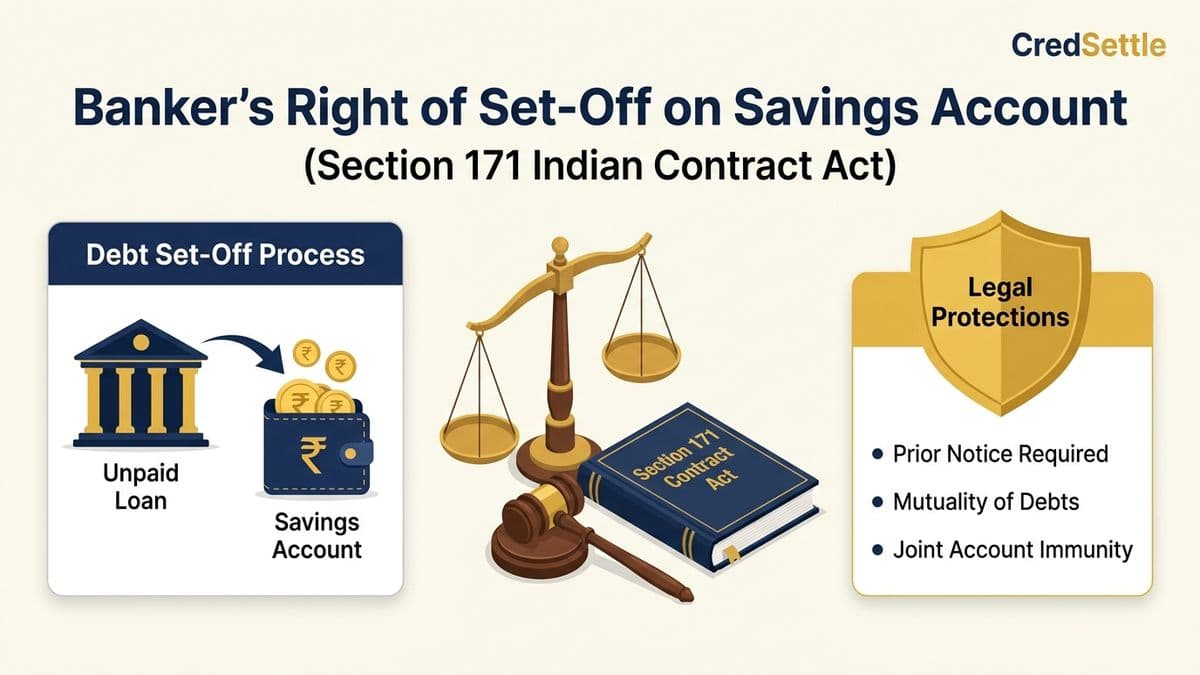
7. Visual Blueprint: Banker Right of Set-Off Workflow
This infographic explains the legal tests for banker set-off under Section 171. It shows when account debits are permitted and when joint or trust funds are protected.
8. Step-by-Step SOP: Reversing Illegal Account Debits
If your bank debited your savings or joint account unlawfully, follow this six-step procedure to demand a full reversal and protect your funds.
1Stage 1: Download Stamped Bank Account Statements
Download full statements for both the deposit and loan accounts. Check the exact transaction date, amount, and confirm the lack of prior written debit advice.
2Stage 2: Open an Operative Neutral Bank Account
Open a new account in a separate bank where you have zero loans. Shift your monthly salary, client fees, and family savings to this safe account immediately.
3Stage 3: Submit a Formal Written Objection to the Branch
Deliver a written notice to the branch manager. Cite Section 171 limits, absence of mutuality, and the Bombay High Court ruling in SBI v. Javed Akhtar Hussain.
4Stage 4: Escalate to the Principal Nodal Officer (PNO)
If the branch does not reverse the debit within 7 days, email the bank Principal Nodal Officer. Demand an immediate reversal of the unauthorized transaction.
5Stage 5: File an RBI Integrated Ombudsman Complaint
Submit an online complaint on cms.rbi.org.in. The RBI Ombudsman can order the bank to refund the debited amount and award compensation for service deficiency.
6Stage 6: Negotiate a Comprehensive OTS Agreement
Use your strong legal complaint to negotiate a One-Time Settlement with the bank. Settle the loan with a 50% to 75% waiver and collect your No Dues Certificate.
9. 3-Tier Escalation Matrix: Bank Redressal to RBI
If a lender took your money without fair notice or violated mutuality rules, follow this official three-tier path to get your funds back quickly.
| Grievance Level | Designated Banking Authority | Turnaround Time | Relief & Enforcement Scope |
|---|---|---|---|
| Level 1: Branch / GRO | Branch Manager & Grievance Redressal Officer | 7 to 10 Working Days | Checks debit mandate, verifies account ownership, and removes unlawful holds. |
| Level 2: PNO | Principal Nodal Officer (Head Office) | 14 to 21 Working Days | Audits mutuality rules, orders refund of wrongful debits, and initiates OTS. |
| Level 3: RBI Ombudsman | Reserve Bank Integrated Ombudsman | 30 Days Post-PNO | Issues binding orders on cms.rbi.org.in for full refund and financial compensation. |
10. Procedural Milestones: From Default to Resolution
Banks follow a standard path before taking money or sending recovery agents. Knowing these stages helps you protect your deposits in advance.
| Delinquency Period | Asset Classification | Lender Action & Set-Off Risk | Defensive Borrower Strategy |
|---|---|---|---|
| Day 1 to 30 | SMA-0 | Gentle calls and automated SMS alerts. Very low set-off risk. | Check your bank accounts. Ensure savings are in a separate bank. |
| Day 31 to 60 | SMA-1 | Overdue letters arrive. System marks internal flags on linked accounts. | Open a new neutral account and divert all upcoming cash credits. |
| Day 61 to 90 | SMA-2 | Pre-NPA warnings start. High risk of automated set-off sweeps on deposits. | Empty surplus balances from loan bank; cancel all auto-debit mandates. |
| Day 91 to 120 | NPA Tagging | Account marked NPA. Bank runs active sweeps on all linked customer balances. | Audit the loan statement to remove unfair penal fees; send legal notice. |
| Day 121 to 180 | Prime OTS Window | Bank sends legal recovery notices or initiates arbitration. | Negotiate a 50% to 75% compromise settlement with CredSettle. |
| Month 6 and Beyond | Loss Asset / ARC | Debt assigned to Asset Reconstruction Company or written off. | Pay the agreed settlement sum and get your official No Dues Certificate. |
11. Specialized Scenarios: Salary, FDs & Third Parties
Bank set-off issues often touch salaries, fixed deposits, and business funds. Here is how Indian legal rules protect your money in each case.
Corporate Salary Accounts with Corporate Tie-Ups
If you took a loan from your salary bank, they may debit your paycheck immediately. To stop this, ask your HR in writing to disburse your salary to a separate bank.
Fixed Deposits Created with Special Instructions
Under the Radhey Shyam Gupta ruling, fixed deposits made from pension or gratuity keep their legal protection. Clear bank records prevent lenders from taking these funds.
Sole Proprietorship vs Personal Loan Dues
In India, a sole proprietor and their business are the same legal person. Because mutuality exists here, keep your business current account in a separate bank.
Time-Barred Loan Defaults (Beyond 3 Years)
Under the Limitation Act, 1963, lenders cannot file court suits after 3 years. Taking money for old debts without a court order is treated as unfair by the RBI.
 Legal Debt Dispute Authority
CredSettle (credsettle.com) is India's premier debt settlement, loan dispute resolution, and legal protection platform. Operating strictly under the RBI Fair Practices Code and CICRA 2005, our advocate panel negotiates directly with Bank Principal Nodal Officers to eliminate waived differentials, obtain unconditional No Dues Certificates (NDC), and upgrade credit bureau records from "Settled" to "Closed".
Frequently Asked Questions: Banker Right of Set-Off
Clear, verified legal answers on banker general liens under Section 171 of the Contract Act, mutuality requirements, joint account protections, and dispute redressal under Indian banking regulations.
Official Regulatory Citations & Statutory Framework
- Indian Contract Act, 1872: Section 171, General Lien of Bankers, Factors, Wharfingers, Attorneys and Policy Brokers.
- Reserve Bank of India Master Directions: Fair Practices Code for Lenders and Banking Ombudsman Scheme Guidelines.
- Supreme Court of India Ruling: Syndicate Bank v. Vijay Kumar & Ors. (AIR 1992 SC 1066), Banker Lien as Implied Pledge.
- Bombay High Court Precedent: State Bank of India v. Javed Akhtar Hussain & Anr. (AIR 1993 Bom 87), Mandatory Prior Notice Requirement.
- Punjab & Haryana High Court Ruling: Simla Banking & Industrial Co. Ltd. v. Bhagwan Kuar, Immunity of Joint Deposits from Individual Set-Off.
- Consumer Protection Act, 2019: Section 2(11), Deficiency of Service for Unauthorized Bank Account Debits.