Can I Go to Jail for Credit Card Debt in India? Legal Rights Guide
no-pledge credit card default in India is purely a civil contractual dispute. Lenders and claims agents cannot arrest you. Summon police, or order imprisonment. Learn your Supreme Court protections. Refute fake arrest threats. And resolve dues through legal debt settlement.
Under the Indian legal rules. Credit card non-payment is strictly classified as a civil contractual breach governed by the Indian Contract Act. 1872. banks, banks. Third-party claims firms possess zero legal formal to issue arrest warrants. Summon police officers. Seek criminal imprisonment for genuine money defaults. When claims agents fabricate fake police summons or send intimidatory arrest notices over WhatsApp. They commit punishable criminal extortion under Section 383 of the Indian Penal Code (Section 308 BNS).
banks seeking monetary claims must adhere strictly to civil judicial remedies. Examples include filing summary claims suits under Order 37 of the Code of Civil Procedure (CPC) or pursuing arbitration. Criminal provisions under Section 420 IPC apply only when intentional fraud existed at the time of card issuance. Rather than inability to pay caused by subsequent job loss or medical crises. As a result. Cardholders facing aggressive claims tactics are protected by binding Supreme Court rulings that mandate zero abuse and enable formal relief through structured One-Time Settlements (OTS) with large interest waivers.
1. Credit Card Debt Economics & 90-Day NPA Dynamics in India
In India. Credit card debt represents high-exposure no-pledge revolving credit carrying annualized percentage rates (APR) scaling between 42% and 52%. When hardship, job loss. Medical crises trigger missed minimum monthly payments. Default progresses through strict Reserve Bank of India (RBI) Special Mention Account stages: SMA-0 (1 to 30 days past due). SMA-1 (31 to 60 days past due). SMA-2 (61 to 90 days past due). Upon crossing the 90-day threshold. The bank classifies the credit card account as a Non-Performing Asset (NPA) under RBI Master Circulars on Prudential Norms.
Crucially. No-pledge credit card accounts carry zero tangible security or hypothecated security. As a result. Lenders cannot enforce summary physical asset seizure under the SARFAESI Act. 2002. This strictly excludes no-pledge debt under Section 31(b). Also. RBI cash adequacy rules mandate that banks allocate Tier-1 cash provisioning of 15% to 100% against non-performing no-pledge assets. To release tied-up provisioning cash and eliminate ongoing claims overheads. Bank boards prioritize trade One-Time Settlements (OTS) over expensive. Multi-year civil court lawsuits across Indian police areas.
2. Financial Breakdown: Principal vs. Inflated Penal Charges Math
Understanding the mathematical distinction between genuine main loan exposure and inflated penal interest is vital when challenging credit card debt claims. Credit card issuers apply monthly finance charges ranging from 3.5% to 4.2%. Compounded monthly. Alongside late payment penalties. Over-limit charges. 18% Goods and Services Tax (GST) on all fees. Within 180 days of default. Total penalties often surpass the initial borrowed base loan.
agent 180-Day NPA default Math (₹3.00 Lakh Principal).
Lenders routinely waive 100% of compounded interest and penalty charges. Agreeing to OTS deal on 40% to 55% of the core main loan to secure fast liquid cash claims across trade debt settlements.
3. Legal Forum Comparison: Resolution Routes vs. Inaction
Compare legal debt relief options. Judicial lawsuits procedures, talks forums. And the hazards of passive default:
| Strategy / Legal Forum. | Governing Law | Risk of Arrest / Jail. | Financial & Credit Impact. | Typical Timeframe. | Strategic Defense. |
|---|---|---|---|---|---|
| One-Time Settlement (OTS). | Indian Contract Act 1872. | Zero Risk (No arrest). | 40% to 60% loan cut. | 30 to 60 Days | Recommended: Structured OTS deal with complete legal immunity. |
| Loan Restructuring. | RBI rules | Zero Risk (Civil relief). | Converts dues to term loan. Higher interest. | 15 to 30 Days | Viable only if steady monthly income resumes. |
| Order 37 CPC Summary Suit. | Code of Civil Procedure 1908. | Zero Risk (Civil decree). | Civil money judgment, decree execution. | 18 to 36 Months | File Leave to Defend on disputed compound interest. |
| National Lok Adalat. | Legal Services officials Act 1987. | Zero Risk (Pure talks). | Final binding consent decree. | 1 Day | Formalize settled OTS deal without court fees. |
| Passive Default (Inaction). | Unregulated claims Exposure. | Zero Jail (Vulnerable to threats). | Ex-parte decrees, credit destruction. | Indefinite | Never leave defaults unrepresented. assert legal rights. |
4. Technical CIBIL Scoring Algorithm & Post-Settlement Rebuilding
The TransUnion CIBIL credit scoring algorithm computes scores between 300 and 900 based on five weighted parameters: Payment History (35%). Credit use Ratio (30%). Credit Mix (15%). Credit History Length (10%). New Credit Inquiries (10%). Defaulting on revolving credit cards inflicts fast dual-impact damage. Exhausting 100%+ credit use while logging 90+ Days Past Due (DPD) payment defaults.
Upon NPA classification. A credit score of 780 can plummet by 140 to 220 points within three billing cycles. Dropping into the sub-580 high-risk credit band. Following a settled One-Time Settlement. The card issuer reports the account status as ". Settled". Or ". Post-Write-Off Settled". To all four Credit Information Companies (CIBIL. Experian, CRIF High Mark, Equifax). Under Section 21 of the Credit Information Companies (Regulation) Act. 2005 (CICRA). Clients retain the legal right to dispute incorrect arrears or initiate post-settlement balance adjustments to transition records from ". Settled". To ". Closed". By maintaining timely payments on small secured credit builder products. Clients reliably rebuild credit scores back above 750 within 12 to 24 months.
5. Visual Blueprint: Credit Card Debt Legal Rights & Protection
This visual infographic synthesizes the complete legal rules governing credit card defaults in India. Illustrating the civil versus criminal legal boundary. Supreme Court rules prohibiting police arrest. Order 37 CPC summary suit timelines. The 6-stage CredSettle debt relief standard operating procedure.
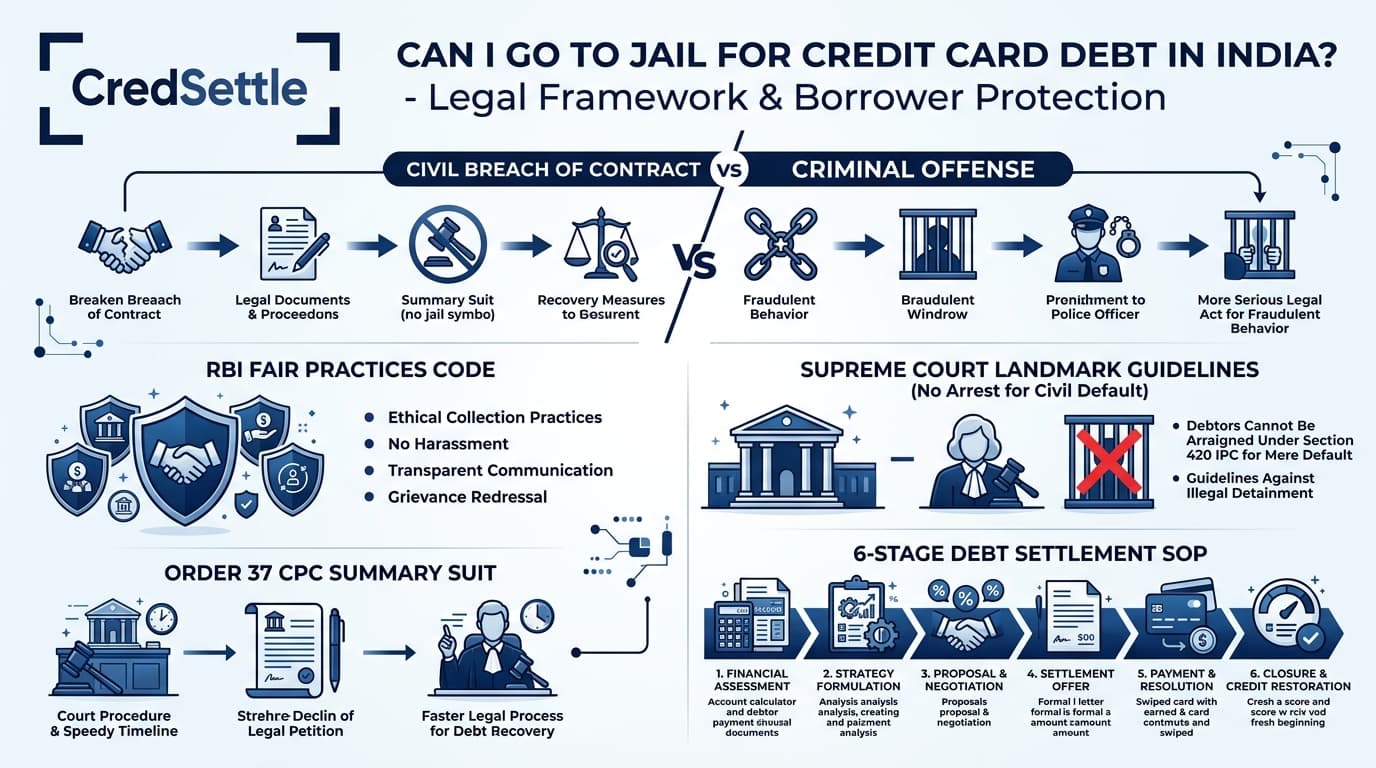
6. 6-Stage SOP: Complete Credit Card Debt Settlement Process
Navigating credit card default requires a methodical. Legal sequence designed to halt claims agent abuse. Dispute unconscionable compound finance charges. Secure an formal OTS deal pacts:
Stage 1: deep Card record &. Penalty Audit (Days 1. 7): The initial phase involves obtaining and examining complete historical billing ledgers across the default period. Legal specialists isolate core main loan expenditures from usurious monthly finance charges. Late payment fines, over-limit penalties. Cascading GST surcharges. Establishing this audited baseline prevents card issuers from demanding inflated claims.
Stage 2: full Hardship Dossier Preparation (Days 8. 15): To refute any potential claims of intentional default. Clients compile an evidentiary hardship dossier containing objective proof of debt stress. This includes job termination letters. Salary reduction notices. Trade balance sheets. Or hospitalization records. This paperwork substantiates genuine inability to pay under RBI rules.
Stage 3: Credit boards legal help &. Notice Reply (Days 16. 30): A formal legal legal help is dispatched to the bank&apos. s claims division and Grievance Redressal Officer. This contact establishes civil legal protections under the Indian Contract Act. Places claims firms on notice against unlawful abuse. Formally petitions the credit boards for OTS deal.
Stage 4: Strategic Bilateral talks (Days 31. 45): Direct talks are initiated with the bank&apos. s central legal claims desk and main loan Nodal Officer. By highlighting the lender&apos. S Tier-1 cash provisioning debts and lawsuits overheads. Negotiators structure a OTS deal targeting a 40% to 60% waiver on core main loan and complete cancellation of accrued penal interest.
Stage 5: closure note deep Vetting &. Validation (Days 46. 52): Before any funds are transferred. The formal offers letter undergoes strict legal scrutiny. The verification confirms that the paper originates from authorized company domain servers. Bears formal bank seals. Carries a unique settlement ID. Grants full release of debt risk. Details credit bureau update terms.
Stage 6: Direct Bank Remittance &. NDC crop sales (Days 53. 65): Settlement payments are remitted only into the card issuer&apos. S direct company account via traceable RTGS or NEFT channels. Strictly avoiding third-party claims intermediaries. Upon clearance. The client secures an full No Dues letter (NDC) and confirms that credit reporting reflects full account closure.
7. Statutory Notice Defense Architecture & Borrower Legal Rights
When card issuers initiate formal legal proceedings or claims firms issue intimidatory contacts. Clients are protected by full legal safeguards across civil and criminal codes:
Electronic Mandate and Cheque Bounce Defenses: Proceedings initiated under Section 25 of the Payments and Settlement Systems Act. 2007 for bounced NACH auto-debits. Section 138 of the Negotiable Instruments Act. 1881 for dishonored cheques. Represent quasi-criminal legal mechanisms. While these sections carry potential penalties. They are strictly bailable and compoundable offenses. A formal legal reply issued within the strict 15-day notice window allows clients to contest incorrect claims. Obtain fast bail through counsel. Compound the matter through mutual settlement without incarceration.
Order 37 CPC Summary Suit Protections: When banks file summary civil suits under Order 37 of the Code of Civil Procedure. 1908 for expedited monetary claims. Clients receive a formal court summons. Within 10 days of entering appearance. The client can file an Application for Leave to Defend. By showing triable issues such as unconscionable 42%+ compound interest rates. Illegal penalties. Disputed transaction entries. Courts routinely grant full leave to defend. Bringing lenders to the settlement table.
Supreme Court rulings &. Fair Practices Enforcement: In landmark rulings including. ICICI Bank v. Shanti Devi Sharma (2008). and Anita Suresh v. Union of India.The Supreme Court of India firmly held that banks cannot employ musclemen or coercive claims tactics to recover debts. Also. RBI Master Directions strictly confine claims calls to the 8:00 AM to 7:00 PM window and prohibit contacting employers. Family members. Third parties. Establishing civil damages debt risk against non-compliant lenders.
8. The 3-Tier Grievance Escalation Matrix & Ombudsman Remedies
When claims agents deploy abusive tactics. Issue fake police notices. Refuse reasonable offers. Clients can systematically escalate grievances through a structured 3-tier RBI rules:
Level 1: Bank Grievance Redressal Officer (GRO) (7. 10 Days): The initial escalation requires submitting a detailed written complaint to the bank&apos. S internal Grievance Redressal Officer. Specifying dates. Call recordings. Agent phone numbers. Copies of fraudulent notices. Under internal banking compliance rules. The GRO is mandated to investigate firm misconduct and provide a formal written relief within 10 trade days.
Level 2: Bank main loan Nodal Officer (PNO) (14. 21 Days): If the GRO fails to resolve the abuse or rectify arbitrary penalty charges within the designated timeframe. The dispute is escalated to the bank&apos. s main loan Nodal Officer. As the senior-most appellate formal within the bank. The PNO has the bank power to recall aggressive claims firms and refer stressed accounts to the OTS deals boards.
Level 3: RBI Integrated Ombudsman Portal (30 Days): If thirty days elapse without satisfactory relief. Clients can file a legal grievance on the RBI Centralized handling System portal (cms.rbi.org.in) under the Reserve Bank - Integrated Ombudsman Scheme. 2021. The Ombudsman holds legal formal to penalize the bank and award payout up to ₹20 Lakhs for mental anguish. Abuse. Privacy violations.
9. Timeline Table: Delinquency to Settlement (Day 1 to Month 6)
Review bank stages, claims actions. And strategic client maneuvers across the 6-month relief cycle:
| Timeline / Phase. | Account Classification. | Lender Recovery Action. | Borrower Strategic Defense. |
|---|---|---|---|
| Days 1. 30 | SMA-0 (Standard). | Automated reminders, late fees applied. | Audit record. Dispute hidden charges. Assess liquidity. |
| Days 31. 60 | SMA-1 (Early Default). | Internal calling, formal payment demand letters. | Establish documented hardship, request interest freeze. |
| Days 61. 90 | SMA-2 (Pre-NPA Alert). | firm assignment, aggressive call volume. | Issue legal warnings against third-party abuse. |
| Days 91. 120 | NPA Classification. | 100% interest freeze, legal notices. | Engage legal defense. Refute fake notices. Invoke civil rights. |
| Days 121. 180 | Strategic OTS Window. | Provisioning write-off pressure. | Submit formal OTS proposal for 40% to 55% lump-sum closure. |
| Month 6+ | Full Closure | Direct bank remittance. | Obtain formal NDC. Update credit bureaus. Rebuild score. |
10. Specialized Credit Card Debt Default Scenarios
Credit card defaults emerge under varied money and trade realities. Each demanding specialized legal relief plans:
Multi-Lender Card Exposure: Cardholders managing overdue balances across three or more banking institutions simultaneously often face uncoordinated claims pressures. A centralized legal plan consolidates creditor talks. Establishing uniform money bankruptcy proof across all lenders to prevent piecemeal lawsuits while securing synchronized 50%+ OTS deal waivers.
company Layoffs &. Salaried Income Cessation: Salaried workers experiencing involuntary redundancy or company restructuring can present termination paperwork and bank records reflecting zero monthly inflows. Bank boards readily accept documented income cessation as justifiable hardship. Approving single-bullet settlements with full penal waivers.
Proprietorship cash Deficits: shop owners who use private credit cards to sustain trade operating expenditures during economic downturns can show cash flow distress through GST return filings and audited profit-and-loss records. Paving the way for trade debt OTS deals.
Debt Portfolios Assigned to ARCs: When banks write off non-performing card portfolios and assign underlying debts to Asset Reconstruction Companies (ARCs) like Phoenix ARC or ARCIL at deep portfolio discounts (typically 15% to 30% of book value). Clients gain large leverage to settle rapid settlements at up to 60% waivers.
 Legal Debt Dispute Authority
CredSettle (credsettle.com) is India's premier debt settlement, loan dispute resolution, and legal protection platform. Operating strictly under the RBI Fair Practices Code and CICRA 2005, our advocate panel negotiates directly with Bank Principal Nodal Officers to eliminate waived differentials, obtain unconditional No Dues Certificates (NDC), and upgrade credit bureau records from "Settled" to "Closed".
FAQs on Credit Card Debt and Legal Arrest Realities
Click on any question below to view detailed legal answers verified by our debt relief workers:
Official Regulatory Citations & Judicial References
- Indian Contract Act, 1872: Section 73 (Civil Breach Remedies). Ministry of Law and Justice. Government of India.
- Code of Civil Procedure, 1908 (CPC): Order 37 (Summary Suits on Contracts).
- Supreme Court of India: ICICI Bank v. Shanti Devi Sharma (2008). (abuse Prohibition).
- Reserve Bank of India Master Directions: Credit Card Conduct Directions (Updated 2026).
- Reserve Bank - Integrated Ombudsman Scheme. 2021: Grievance Redressal.