Two Wheeler & Bike Loan Settlement: Stop Harassment & Seizure
Facing motorcycle loan default. harsh field agent visits. unlawful street seizure? Learn your legal rights under Supreme Court rulings. RBI claims guidelines. How to settle a 40% to 55% One-Time closure with an authentic No Dues letter.
- Supreme Court Precedent: Supreme Court strictly banned musclemen seizure on public roads in. ICICI Bank v. Prakash Kaur..
- Ownership Rights: Section 51 Motor Vehicles Act creates a money charge. legal ownership stays with the clients.
- Mandatory Cure Notice: Lenders must serve a 15 to 30 day demand cure notice before starting claims action.
- Anti-threats Shield: RBI rules prohibit calls before 8:00 AM or after 7:00 PM and ban workplace visits.
- Penal Fee Waivers: growing late fees and bounce fines are fully eliminated during closure talks.
- Valuation Safeguards: lenders cannot auction vehicles without serving a pre-sale notice and signed valuation.
- Livelihood safety: Delivery riders and salaried workers can seek urgent legal safety to prevent bike seizure.
- Structured OTS relief: An bank OTS secures 40% to 55% waivers alongside a No Dues letter and RTO Form 35.
1. Debt Economics: Two-Wheeler Loan Default Anatomy
Two-wheeler loans constitute one of India&apos. S largest retail credit segments. Financed by non-banking money companies (NBFCs) and private banks for salaried commuters and gig delivery riders. These loans operate under loan lien pacts executed under the Indian Contract Act. 1872 and registered on Registration letters under Section 51 of the Motor Vehicles Act. 1988. While the lender maintains a loan lien charge. Legal ownership resides fully with the clients. Motorcycles and scooters are rapidly depreciating assets whose real-world resale value deteriorates swiftly every quarter.
When installments default due to genuine hardship. Accounts transition through Special Mention Account stages: SMA-0 (1 to 30 days). SMA-1 (31 to 60 days). SMA-2 (61 to 90 days). Beyond 90 days. The loan becomes a Non-Performing Asset (NPA). Under RBI prudential norms. Lenders must set aside heavy capital provisioning against NPAs. Because real seizure involves steep towing fees. Yard storage costs. Distress auction haircuts yielding barely thirty percent of loan value. Lenders have powerful firm incentives to execute One-Time closures (OTS) to recover core main sum funds.
2. Bike Settlement Math: Penal Inflation Breakdown
When a two-wheeler loan enters default. Gross claims swell from growing rates. NACH bounce fines of ₹450 to ₹900. fine charges. calls firm fees. A ₹45,000 main sum default often inflates to ₹85,000 within six months. Forensic auditing isolates legitimate main sum from artificial markups. Enabling deep waivers during bank talks:
Upon online payment of the agreed ₹42,450 straight to the loan account. The lender issues a closure Sanction Letter. No Dues letter. RTO Form 35 to release loan lien.
3. Resolution Matrix: Bike Settlement vs Surrender
review available two-wheeler debt relief options is vital to avoid distress vehicle loss. This comparative matrix contrasts five primary avenues under Indian banking law:
| Resolution Route. | Financial Waiver. | Vehicle Possession. | Timeline | NDC & Form 35. | CIBIL Impact |
|---|---|---|---|---|---|
| One-Time closure. | 40% to 55% | Retained fully. | 25 to 45 Days | Full NDC &. Form 35. | Settled |
| Restructuring | Zero Waiver | Retained + EMIs | 45 to 60 Days | Pending Full Term. | Restructured |
| Court Litigation. | None | Contested | 2 to 4 Years | Pending Decree | Suit Filed |
| Lok Adalat | 30% to 50% | Mutual Terms | Quarterly | Judicial Award | Settled |
| Inaction / Seizure. | Distress Loss | Vehicle Forfeited. | Ongoing Stress | Residual Debt | Repossessed |
4. CIBIL Algorithm: Bike Loan Credit Restoration
Credit bureaus such as TransUnion CIBIL. Experian. Equifax. CRIF High Mark review scores across five core parameters: payment History (35%). Credit use (30%). Credit History Length (15%). Credit Mix (10%). Recent Credit Inquiries (10%). Because two-wheeler loans represent monthly installment dues. Defaults severely damage the thirty-five percent payment history weight. Causing running 30 to 120+ DPD notations and depressing scores by 70 to 130 points.
Executing an valid One-Time closure halts ongoing monthly default reporting. Upon receiving closure payment. The lender updates desk records to ". Settled". with zero balance. While reflecting a closure. It terminates negative reporting cycles. Clients can then rebuild their score above 750 within twelve to eighteen months using secured credit cards. Disciplined low use. Timely payments under Section 21 CICRA 2005 rights.
Visual Blueprint: 6-Stage Bike Settlement Roadmap
Review our visual roadmap outlining legal clients safety against unlawful vehicle seizure and bank one-time closure workflows:
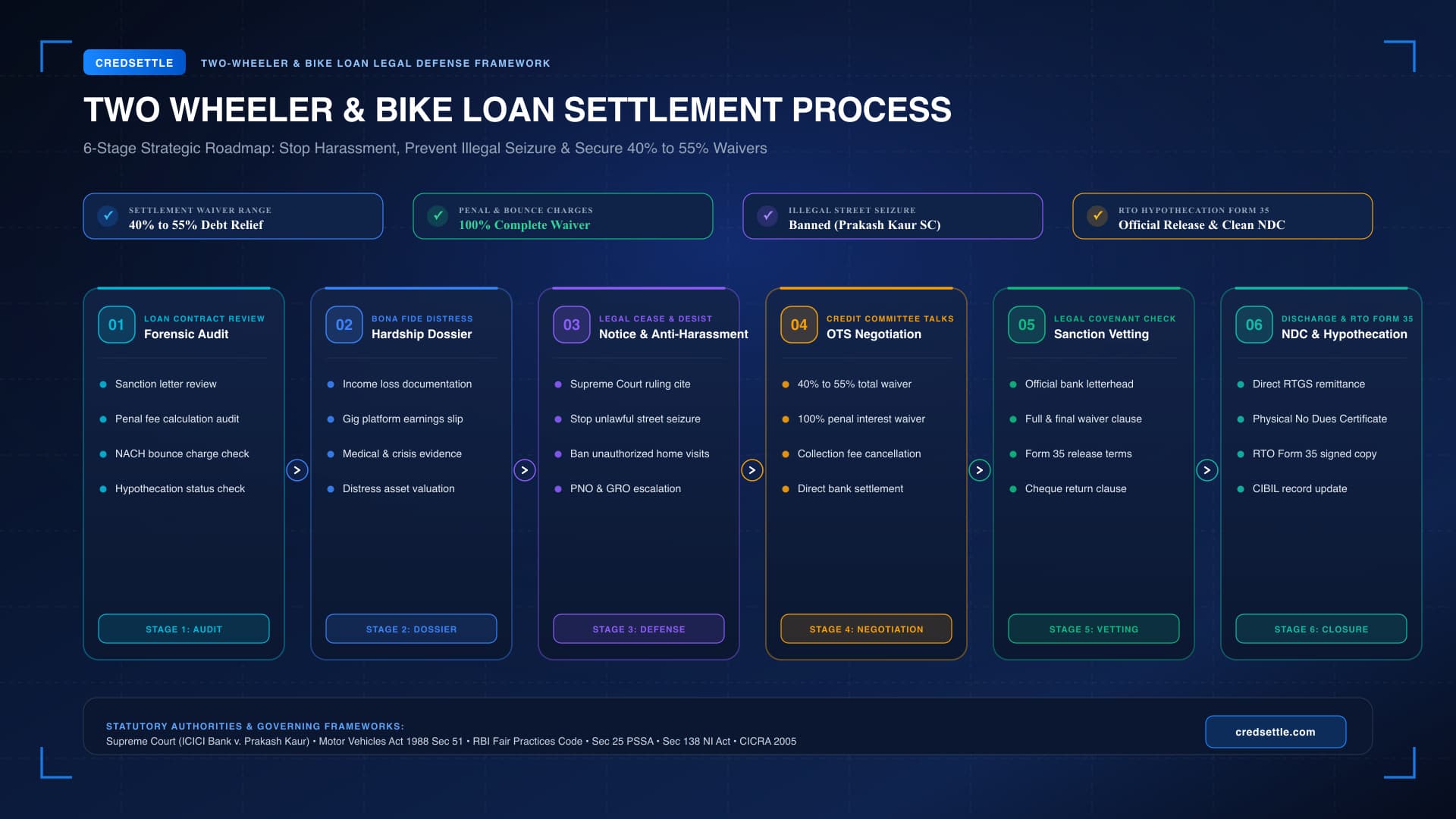
5. SOP: 6-Stage Bike Protection & Settlement
CredSettle executes a structured Standard Operating Procedure to halt coercive calls tactics and settle straight with bank credit boards:
Auditing loan statements to isolate unlawful penal fees and check if mandatory legal notices were served.
Compiling checked documentary hardship proof alongside an independent vehicle distress valuation report.
Serving formal legal representations to the bank Nodal head and Credit board to halt agent visits.
settle straight with claims officials to waive fine charges and secure a 40% to 55% closure.
Vetting the valid closure Sanction Letter to make sure binding clauses for loan lien release.
Direct payment via RTGS. Followed by delivery of the No Dues letter. RTO Form 35. desk update.
6. Statutory Notice Defense: Bike Borrower Remedies
When two-wheeler loan accounts fall into default. Lenders and NBFCs issue legal notices to exert pressure. grasp these legal rules enables an effective defense:
Penalizes online mandate dishonor. Lenders must issue notice within thirty days. Establishing genuine hardship and closure intent provides a strong legal defense.
Under Supreme Court rulings. Blank security cheques collected at loan inception cannot be presented for inflated fine sums without prior statement reconciliation.
Following Supreme Court rulings in TRF Ltd. And Perkins Eastman. Unilateral arbitrator appointments without clients consent are by law void.
Loan default is strictly a civil breach. Claims agents using abusive calls or street threaten face penal risk under BNS Sections 308. 329. 351.
7. 3-Tier Grievance Matrix: Bike Lender Accountability
If lenders or calls firms violate RBI claims directives through threats or seizure threats. Clients can escalate through three RBI tiers:
Grievance Redressal head
Submit formal written complaints with call recordings demanding fast cessation of agent visits.
main sum Nodal head
Escalate unresolved grievances straight to the lender apex main sum Nodal head under RBI directives.
RBI Integrated RBI officer
Lodge an online complaint on cms.rbi.org.in for binding legal dispute relief and reprimand.
8. Procedural Timeline: 6-Month Bike Loan Lifecycle
Two-wheeler debt relief follows a predictable procedural sequence from first default to final closure execution and loan lien release:
| Phase | Status | Lender Strategy | Legal Step |
|---|---|---|---|
| Days 1 - 30 | SMA-0 | Automated SMS alerts. Soft telecalling. | Audit financials. Request restructuring. |
| Days 31 - 90 | SMA-1 / SMA-2 | firm telecalling. Field agent visits. | Serve Cease-and-Desist. Cite RBI rules. |
| Days 91 - 120 | NPA Asset | Demand cure notices. Section 25 threats. | Submit Hardship Dossier to board. |
| Days 121 - 150 | Provisioning | Legal summons. Lok Adalat notices. | settle 40% to 55% OTS deal. |
| Month 5 - 6 | Settled | closure Sanction Letter issued. | Pay OTS sum. Obtain NDC &. Form 35. |
9. Real-World Scenarios: Complex Bike Loan Defaults
Two-wheeler loan defaults occur under varied socio-economic conditions across India. CredSettle designs tailored relief strategies for exact clients cases:
Gig Workers &. Delivery Partners
Delivery riders face severe livelihood disruption when agents threaten bike seizure. CredSettle intervenes with instant cease-and-desist notices while settle micro-closures.
Salaried Employee Redundancies
experts experiencing layoffs default on commuter bike loans. We submit checked separation letters to secure moratoriums followed by structured OTS waivers.
EV Scooter Warranty Disputes
clients facing EV battery failures while lenders demand EMIs receive legal advocacy to coordinate tripartite dispute closure and stop billing.
ARC Portfolio Debt Assignments
When overdue loans are assigned to Asset Reconstruction Companies under SARFAESI Section 5. We check assignment legality and settle deep main sum haircuts.
 Legal Debt Dispute Authority
CredSettle (credsettle.com) is India's premier debt settlement, loan dispute resolution, and legal protection platform. Operating strictly under the RBI Fair Practices Code and CICRA 2005, our advocate panel negotiates directly with Bank Principal Nodal Officers to eliminate waived differentials, obtain unconditional No Dues Certificates (NDC), and upgrade credit bureau records from "Settled" to "Closed".
Frequently Asked Questions: Bike Loan Settlement
Clear. Authoritative answers to the most crucial legal. Procedural. Money questions regarding two-wheeler loan default. Claims agent rules. Seizure safeguards. debt closure in India:
Statutory Citations & Authoritative Legal Authorities
CredSettle legal strategies and dispute relief methodologies are grounded in Indian legal frameworks. Judicial precedents. RBI codes:
Governing Acts &. Landmark Judgments
- Supreme Court: ICICI Bank Ltd. v. Prakash Kaur (2007) 2 SCC 711. (Ban on musclemen).
- Motor Vehicles Act. 1988: Section 51 (Vehicle loan lien rules).
- Reserve Bank of India: Master Direction on Fair Practices and Debt claims.
- Bharatiya Nyaya Sanhita. 2023: Sections 308 (Extortion). 329 (Trespass). 351 (threaten).
- CICRA, 2005: Section 21 (Dispute relief and credit report rectification).