Convert a Settled Loan to
"Closed" Status (Step-by-Step)
Want to clean up your credit report? Discover how paying your outstanding waiver amount can upgrade your loan status from Settled to Closed.
- Differential Payoff is the Only Legal Path: Simply raising automated dispute tickets will not erase an authentic "Settled" tag. Under Section 21 of CICRA 2005, you must pay the waived principal differential back to the original lender to legally upgrade the account status to "Closed".
- Mandatory Unconditional NDC: Upon clearing the differential balance, the bank must issue an unconditional No Dues Certificate (NDC / NOC) on official letterhead confirming zero remaining liability.
- Statutory 30-Day RBI Bureau Deadline: Under RBI Master Directions, lending institutions must upload the updated "Closed" status with ₹0 balance to CIBIL, Experian, Equifax, and CRIF High Mark within 30 calendar days of receiving full payoff.
- ₹100/Day Delay Penalty Under RBI Ombudsman: If the bank or credit bureau fails to update your record within 30 days of receiving your NDC and dispute, they are statutorily liable to pay you ₹100 compensation for each day of delay under RBI Circular RBI/2023-24/72.
- Restores 750+ Prime Credit Score: Converting to "Closed" immediately halts automated loan rejections, paving the way for complete credit score recovery back to prime 750+ within 6 to 12 months.
1. Difference Between "Settled", "Closed", and "Written Off"
When you check your credit report across India's four RBI-licensed credit information companies (TransUnion CIBIL, Experian India, Equifax India, and CRIF High Mark), loan accounts are categorized by distinct legal status flags. Understanding the exact banking terminology is essential before initiating any dispute or payoff.
| Account Status Flag | Financial Meaning | CIBIL Score Impact | Future Loan Impact | Legal Recovery Risk |
|---|---|---|---|---|
| CLOSED (Clean) | 100% of the principal, contractual interest, and charges were repaid per the loan agreement. Zero loss to lender. | Positive / Builds 750+ score | Eligible for prime home loans, car loans, and credit cards at competitive ROI. | Zero (Full NDC Issued) |
| SETTLED (Compromise / OTS) | Bank agreed to a discounted lump-sum (One-Time Settlement) and wrote off the unpaid balance as an operational loss. | Severe Drop (-50 to -120 pts) | Automated rejection on unsecured loans/cards; high risk premium (2-4% higher ROI) on secured loans. | Zero civil liability, but 7-year bureau stigma remains active. |
| WRITTEN OFF (Total Default) | Borrower stopped servicing debt. Bank classified account as NPA and moved balance off active ledger to bad debt provisions. | Catastrophic (-150+ pts) | Complete financial blacklisting across all scheduled commercial banks & NBFCs. | High (Active recovery, DRT, Section 138 / Section 25 PSS Act). |
Key Takeaway: A "Settled" status protects you from legal debt recovery, but it acts as a red flag for credit underwriting. The only legal path to remove this red flag is to upgrade the status to "Closed".
2. Why Banks Mark Accounts as "Settled" & The 7-Year Credit Damage
When a borrower undergoes financial hardship—such as job loss, medical emergency, or business failure—and negotiates a One-Time Settlement (OTS), the bank agrees to accept an amount lower than the total ledger balance.
For instance, if your outstanding personal loan balance is ₹5,00,000 and the bank accepts ₹2,50,000 to close the case, the remaining ₹2,50,000 is booked as a "Sacrifice / Loss" in the bank's Profit & Loss account. Under RBI reporting rules, the bank reports two critical data points to CIBIL:
This flag explicitly signals to any future lender evaluating your credit report that you failed to repay the contractually agreed amount, forcing the previous lender to absorb a financial loss.
Under Indian credit bureau operating rules, settled records remain visible on your report for up to 7 years (84 months), causing automated Loan Origination Systems (LOS) to reject pre-approved credit.
3. Legal & Regulatory Framework: CICRA 2005 & RBI Directives
Credit repair in India is not governed by discretionary bureau whims; it is governed by strict statutory enactments passed by the Parliament of India and directives issued by the Reserve Bank of India (RBI).
Credit Information Companies (Regulation) Act, 2005 (CICRA) §21
Section 21 of CICRA obligates all Credit Institutions (Banks and NBFCs) and Credit Information Companies (CIBIL, Experian, Equifax, CRIF) to ensure that credit data is accurate, authentic, and updated. When a borrower clears their dues in full, continuing to display a derogatory "Settled" flag constitutes a statutory violation under CICRA.
RBI Master Direction – Credit Information Companies (CIC) Guidelines
The RBI mandates that all credit institutions must furnish updated credit information to all four credit bureaus at least once a month (within 30 days of any material transaction or closure). Once the bank accepts the differential balance and issues an unconditional No Dues Certificate, it is legally required to upload the modified status as "Closed" in its next regular monthly reporting batch.
RBI ₹100/Day Delay Compensation Framework (Circular RBI/2023-24/72)
Under the landmark RBI framework on customer protection in credit reporting, if a bank or bureau fails to rectify or update customer credit information within 30 calendar days of receiving a valid grievance with proof of settlement/closure, the defaulting entity must pay compensation of ₹100 per day directly to the borrower.
4. Can You Convert "Settled" to "Closed"? The Legal Payoff Mechanism
Many borrowers are misled by fraudulent "CIBIL repair" agencies who claim they can erase a "Settled" status using insider contacts or automated hack dispute forms without paying the lender. This is completely false and illegal.
Under Indian banking law, the only lawful and permanent mechanism to convert a "Settled" account to "Closed" is the Differential Waiver Payoff:
How the Differential Payoff is Calculated
When approaching the bank to upgrade your loan, ensure you do not pay newly fabricated late payment charges or compounded penal interest accumulated after the settlement date. A specialized debt advocate negotiates with the bank's Principal Nodal Officer to freeze all post-settlement interest and accept solely the exact historical waived differential.
Convert Settled Loan to Closed: Summary & Process Overview
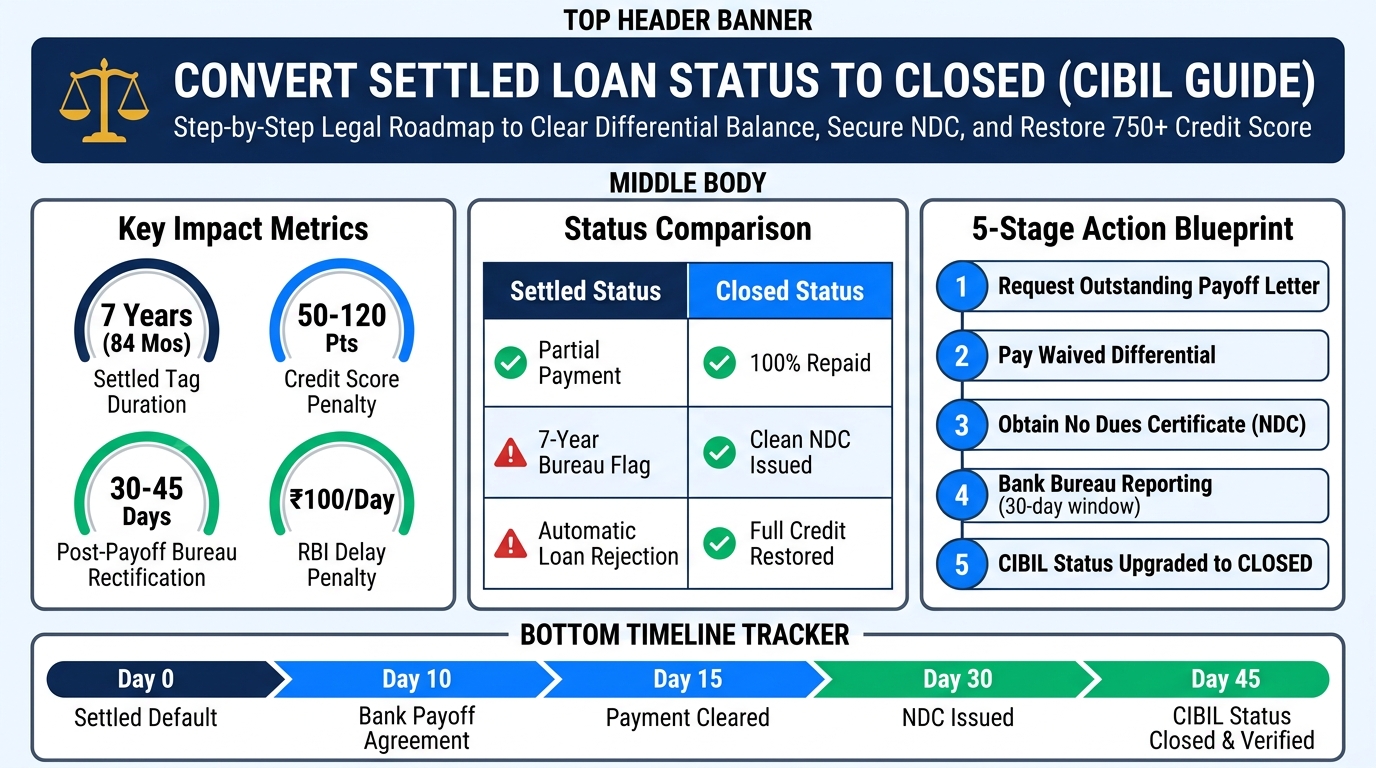
5. Step-by-Step Roadmap to Convert Settled Status to Closed
Executing a successful loan status upgrade requires following an exact 7-stage protocol recognized by banking compliance officers and credit bureaus:
Retrieve Historical Settlement Documentation
Locate your original One-Time Settlement (OTS) sanction letter, payment acknowledgment receipts, and the initial conditional settlement closure letter issued by the bank. Verify the exact loan account number, PAN number, and settlement date.
Submit a Formal "Reopening & Payoff" Request to the Bank Nodal Desk
Do not approach frontline bank tellers who lack the administrative authority to reopen settled NPA ledgers. Submit a formal representation to the Principal Nodal Officer (PNO) or Head of Retail Credit Recovery requesting a formal calculation of the waived differential balance.
Obtain Official Foreclosure / Payoff Letter with "Closed Status" Undertaking
Before making any payment, ensure the bank issues a written payoff letter stating: "Upon receipt of ₹[Amount], the bank will issue an unconditional No Dues Certificate and report the account status as CLOSED to all Credit Information Companies."
Remit the Differential Balance via Traceable Banking Channels
Pay the agreed amount directly into the bank's centralized collection account or via RTGS/NEFT/Demand Draft referencing your exact loan account number. Never pay cash or transfer funds to recovery agency personal accounts.
Collect the Unconditional No Dues Certificate (NDC / NOC)
Within 7–15 working days of payment clearance, obtain the original physical/digitally signed No Dues Certificate. The certificate must confirm that the loan stands 100% closed with zero outstanding liability.
Bank Submits Data Feed to CIBIL, Experian, Equifax & CRIF
The bank uploads its monthly reporting tape to all credit bureaus updating the account status from "Settled" (or Post-Write-off Settled) to "Closed" with Current Balance and Amount Overdue set to ₹0.
Raise an Online Bureau Dispute to Accelerate Verification
Log in to the official CIBIL Dispute Resolution Portal, open a dispute under the specific loan account, and upload your No Dues Certificate. CIBIL sends an automated validation request to the bank, expediting the update within 15–30 days.
6. Formal Legal Draft Template: Reopening & Full Payoff Request Letter
Use this formal legal notice template when addressing the Principal Nodal Officer and Retail Asset Operations department of your lending bank:
To,
The Principal Nodal Officer / Head of Retail Credit Operations,
[Bank / NBFC Name],
[Zonal Office Address / Registered Office],
Email: [nodalofficer@bankname.com]

Subject: Request for Payoff Statement to Clear Waived Differential Balance and Upgrade CIBIL Account Status from "Settled" to "Closed" for Loan Account No: [Insert Loan A/C No.]

Respected Sir/Madam,

I, [Borrower Full Name], residing at [Borrower Address], holding PAN: [Insert PAN] and Aadhaar: [Insert Aadhaar], was the borrower for the aforementioned Loan Facility [Account Number: XXXXXXXX] sanctioned by your institution.

1. That due to severe unforeseen financial hardship [briefly mention: e.g. medical emergency / job loss], I had entered into a One-Time Settlement (OTS) with your institution on [Date of Settlement], under reference letter no. [Insert Settlement Letter Reference No.].
2. That pursuant to the said settlement agreement, I duly paid the agreed settlement consideration of ₹[Amount Paid] on [Date of Payment], and your institution issued a conditional settlement acknowledgment.
3. That subsequent to the settlement, the said loan account has been reported to TransUnion CIBIL, Experian, Equifax, and CRIF High Mark with the derogatory status flag "SETTLED" / "POST-WRITE-OFF SETTLED", causing severe prejudice to my creditworthiness.
4. That I am now in a position to voluntarily extinguish the entire remaining waived differential amount (pure principal and contractual interest) to bring the total repayment to 100% of the loan obligation.
5. That I hereby request your competent authority to provide:
   a) An official statement of account indicating the exact net differential balance (excluding post-settlement penal charges and late fees).
   b) A formal written undertaking confirming that upon realization of the said differential amount, your institution will issue an unconditional No Dues Certificate (NDC) and report the account status as "CLOSED" to all four Credit Information Companies within 30 days pursuant to Section 21 of CICRA 2005.

Kindly process this request and issue the payoff calculation within 7 working days of receipt of this communication.

Thanking you,

Yours sincerely,

___________________________
[Signature]
[Borrower Name]
[Mobile Number]
[Email Address]
Date: [DD/MM/YYYY]
Place: [City, State]
7. Escalation Process When Banks Refuse or Delay Updating Status
Occasionally, bank branch managers claim that settled accounts cannot be reopened once written off in the core banking system (CBS). This is an internal administrative hurdle, not a legal barrier. Follow this 3-tier escalation matrix to enforce your rights:
Branch & Customer Care
Submit written representation to the Branch Manager and log a formal ticket on the bank's central CRM portal requesting payoff generation.
Principal Nodal Officer (PNO)
Escalate to the bank's apex grievance desk (PNO). The PNO has administrative override power to issue manual ledger payoff orders.
RBI Integrated Ombudsman
File a statutory complaint at cms.rbi.org.in. The Ombudsman orders immediate rectification and awards ₹100/day compensation for unjustifiable delays.
8. Credit Score Recovery Timeline & Post-Closure Strategy
Converting the status from "Settled" to "Closed" immediately eliminates the negative default tag that triggers automatic loan rejections. However, score recovery to 750+ (Prime Credit Zone) requires a disciplined rebuilding strategy over 6–12 months:
| Phase / Timeline | Credit Report Event | Expected Score Range | Actionable Rebuilding Steps |
|---|---|---|---|
| Month 1 (Day 1–45) | Status updated from "Settled" to "Closed"; Balance updated to ₹0; DPD historical count ceases. | 620 – 660 | Download fresh CIBIL CIR report; verify that all four bureaus reflect "Closed". |
| Months 2 – 6 | New positive trade-line reporting begins; credit utilization stabilized. | 680 – 720 | Open a Fixed Deposit-backed secured credit card (e.g. IDFC FIRST WOW or Kotak 811 DreamDifferent); keep utilization below 30%. |
| Months 6 – 12 | Consistent on-time repayment history established; aged default impact diminishes. | 750 – 790+ (Prime) | Eligible for prime home loan interest rates, balance transfers, and pre-approved premium credit cards. |
9. Special Scenarios: Credit Cards, ARCs & Fintech Loan Apps
Credit Card Settlements
Credit cards carry compounding 42%+ APR interest. When paying the balance to convert to "Closed", insist on calculating the waiver based on the principal at default, stripping out all accumulated finance charges.
Debt Sold to ARCs
If your loan was assigned to an Asset Reconstruction Company (ARCIL, Phoenix, CFM, Edelweiss ARC) under SARFAESI Section 5, you must settle the differential with the ARC directly, as the ARC now owns the legal right to issue the NDC.
Digital Fintech NBFC Apps
For app-based digital loans (KreditBee, MoneyView, CASHe, PaySense), obtain the NDC from the underlying RBI-registered NBFC lender, not the digital lending front-end app.
 Legal Debt Dispute Authority
CredSettle (credsettle.com) is India's premier debt settlement, loan dispute resolution, and legal protection platform. Operating strictly under the RBI Fair Practices Code and CICRA 2005, our advocate panel negotiates directly with Bank Principal Nodal Officers to eliminate waived differentials, obtain unconditional No Dues Certificates (NDC), and upgrade credit bureau records from "Settled" to "Closed".
Frequently Asked Questions on Converting Settled Status to Closed
Click on any question below to view detailed legal and banking answers verified by our debt settlement experts:
All legal procedures, timelines, and rights described on this page are grounded in official Indian statutory frameworks: