Does RuPay UPI Credit Card Default Block Savings UPI?
Missed your RuPay credit card bill after daily UPI QR scans? See why your other bank UPI apps stay safe. Learn how to avoid same-bank account holds and settle debt under RBI rules.
- Other Bank UPI Stays Safe: Missing a RuPay card bill blocks only that card line. Your savings accounts in other banks keep working on Google Pay, PhonePe, and BHIM.
- Same-Bank Hold Risk: If your salary or savings account is in the same bank, that lender can hold funds under Section 171 of the Indian Contract Act, 1872.
- Civil Debt Only: Shop QR spends on a RuPay card create civil debt. Section 25 of the PSS Act applies only if a separate e-NACH or AutoPay debit bounces.
- RBI Settlement Rules: Under RBI Circular DOR.STR.REC.20 dated June 8, 2023, banks can close unpaid card debt via One-Time Settlement (OTS) after 90 days.
- Fast 15-Day CIBIL Sync: Since January 1, 2025, RBI requires banks to send credit bureau updates every 15 days so settled dues show zero balance fast.
1. Does RuPay Credit Card Default Block Savings UPI?
The short answer is no. Missing your RuPay credit card bill does not ban your phone number on UPI. Recovery callers often claim that NPCI will lock all your UPI apps across India. That threat is false.
The Reserve Bank of India approved RuPay credit cards on UPI in June 2022. NPCI then set the operating rules in Circular NPCI/2022-23/RuPay/019 and Circular 019-A. Inside BHIM, PhonePe, Paytm, and Google Pay, your credit card and your savings account run on two separate tracks.
Each account uses its own bank link and its own UPI PIN. RuPay credit cards on UPI work only when you scan a shop or merchant QR code. NPCI blocks peer-to-peer transfers, cash withdrawals, and card-to-card transfers on this card link.
When your card bill goes unpaid, the bank blocks only the RuPay card limit. QR scans using that card will fail. Yet your savings accounts in other banks will keep sending and receiving UPI money as normal.
2. Same-Bank Savings UPI Risk: Section 171 Set-Off Law
There is one major trap you must watch out for. Suppose your RuPay credit card and your main salary or savings account sit in the exact same bank. Then UPI payments from that savings account can stop working.
Banks do this using Section 171 of the Indian Contract Act, 1872. This law gives a bank a general lien and a right of set-off. It lets the bank hold or deduct cash from your savings balance in the same bank to clear overdue card bills.
Still, a bank's lien power has strict legal limits. A lender cannot touch money kept in a different bank without a civil court order. Even inside the same bank, three key rules protect you:
- Same Owner Rule: Both accounts must belong to the same person in the same role. A bank cannot freeze a joint savings account held with your spouse or parent unless they signed for the card.
- Fair Notice Rule: Consumer courts hold that banks must send clear notice before sweeping money from a salary account.
- Protected Subsistence Pay: Basic wages, pensions, and provident fund payouts have strong legal shields under Section 60 of the Code of Civil Procedure, 1908.
3. Legal Framework: RBI Credit Card & Settlement Rules
Small ₹100 and ₹500 QR scans feel easy at local shops. Under NPCI rules, RuPay card UPI spends up to ₹2,000 carry zero merchant fee, so nearly every shop accepts them. When a job loss or illness strikes, 36% to 45% yearly card interest fast doubles the bill.
Even though you paid via UPI, your debt follows two core Reserve Bank of India rulebooks. First is the RBI Master Direction on Credit Card and Debit Card Issuance and Conduct, 2022, updated on March 7, 2024. Second is RBI Circular DOR.STR.REC.20 dated June 8, 2023 on Compromise Settlements.
These RBI rules curb unfair bank charges and set clear settlement rights for borrowers:
- 3-Day Free Grace Window: Banks cannot add late fees or report a default unless a bill stays unpaid for more than three days past the due date.
- No Compounding on Fees: Card issuers cannot fold unpaid late fees or taxes into principal to charge extra interest on top of fees.
- Fair Balance Interest: Under the March 2024 update, banks can charge interest only on the left-over unpaid balance after counting part payments and refunds.
- Board-Approved OTS Policy: The June 8, 2023 RBI circular directs every bank and NBFC to maintain a board-approved policy for lump-sum cash settlements.
4. Civil Debt vs Section 25 PSS Act: Criminal Myth Check
Recovery agents often scare RuPay card users by naming Section 25 of the Payment and Settlement Systems (PSS) Act, 2007. They claim that because you used UPI, an unpaid card bill is a crime like a cheque bounce.
Here is the clear legal truth. When you scanned a shop QR code with your RuPay card, your bank paid the shop right away. That UPI payment did not fail. Missing your monthly card bill later is a pure civil debt. Police cannot arrest you for an unpaid credit card bill.
Section 25 of the PSS Act applies only when an electronic auto-debit set up to pay your bill bounces due to low bank balance. Even then, the bank must send a written notice within 30 days and give you 15 days to pay before going to court.
| Default Scenario | Legal Nature | Section 25 PSS Act Risk | Actual Bank Remedy |
|---|---|---|---|
| Unpaid Monthly RuPay UPI Card Statement | 100% Civil Debt | Zero criminal bounce liability | CIBIL reporting, civil suit, arbitration, or OTS |
| Unbilled UPI Purchase EMIs After Card Block | 100% Civil Debt | Zero criminal bounce liability | EMIs cancel and merge into card principal for OTS |
| Active e-NACH or Auto-Debit Mandate Dishonor | Bounce Notice Trigger | Only after 30-day notice & 15-day pay window | Bounce fee, legal notice, or closure via OTS |
| Pre-Sanctioned Bank Credit Line on UPI Overdue | Civil Loan Debt | Zero unless repayment NACH fails | Follows bank KFS loan terms and OTS policy |
5. Visual Blueprint: RuPay UPI Default & OTS Shield
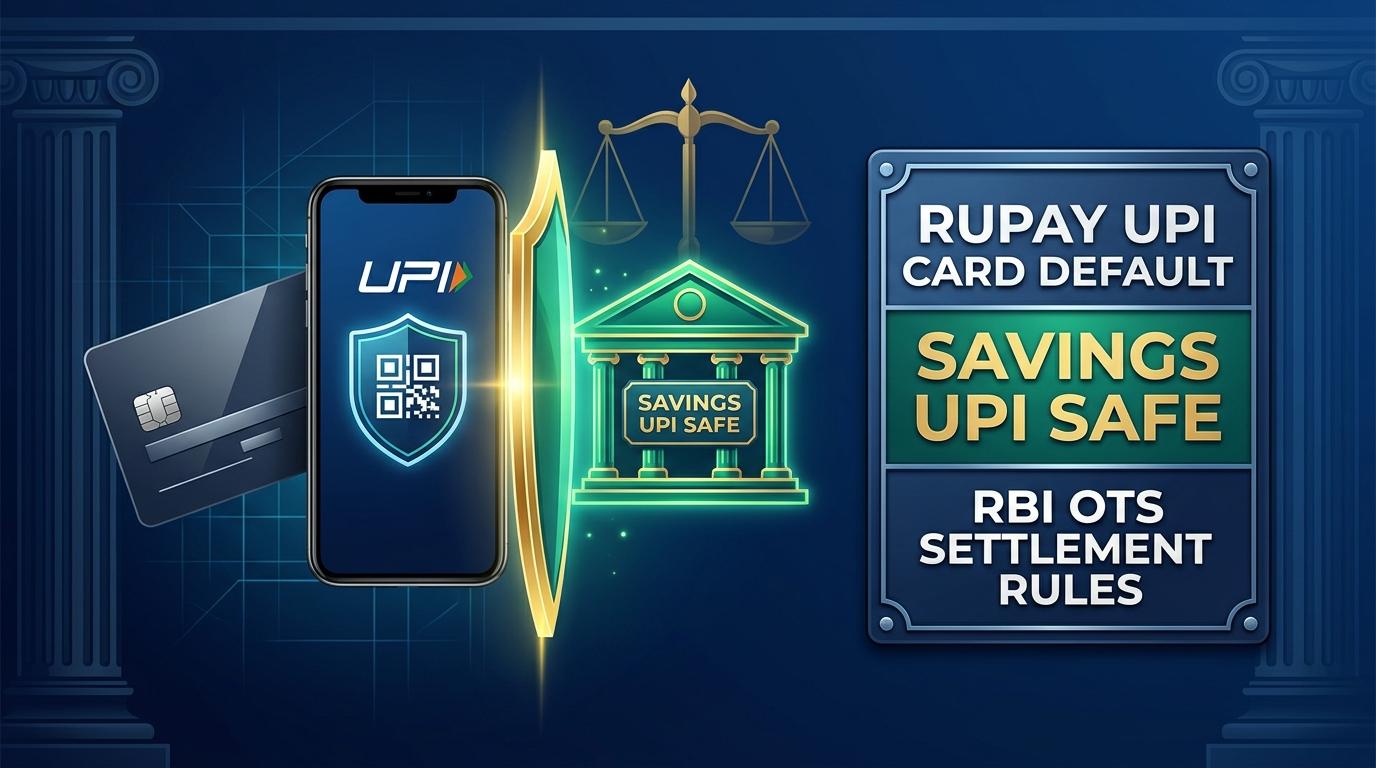
This visual chart shows how NPCI keeps your RuPay credit card separate from other savings UPI accounts. It also maps how RBI settlement rules help you clear overdue card bills for less.
6. OTS Math: Principal vs Interest & GST Waivers
Paying only the Minimum Amount Due ends your interest-free grace days. Every new ₹200 tea or grocery QR scan starts adding daily interest from day one. On top of that, 18% GST applies to every rupee of interest and late fee.
After 90 days of non-payment, the card becomes a Non-Performing Asset (NPA). In a One-Time Settlement, banks often waive 100% of unpaid interest, late fees, and related GST, plus a cut on principal.
| Bill Component | Inflated Bank Demand | Typical OTS Treatment | Estimated Payable in OTS |
|---|---|---|---|
| Actual Merchant QR Spend & EMI Principal | ₹1,20,000 | Negotiated Principal Cut | ₹72,000 to ₹85,000 |
| Revolving Finance Charges (42% APR) | ₹46,800 | 100% Waiver Targeted | ₹0 (Waived) |
| Late Payment & Overlimit Fees | ₹14,500 | 100% Waiver Targeted | ₹0 (Waived) |
| 18% GST on Unpaid Interest & Fees | ₹11,034 | Reversed With Waived Dues | ₹0 (Reversed) |
| Total Final Liability | ₹1,92,334 | 55% to 62% Total Relief | ₹72,000 to ₹85,000 |
Note: Banks grant settlements under their own board-approved RBI policy. Final savings depend on your hardship proof, overdue age, and lump-sum cash offer.
7. Supreme Court Rulings & Borrower Recovery Rights
Unpaid card debt never takes away your right to dignity and peace. Both the Supreme Court of India and RBI Circular DOR.ORG.REC.65 dated August 12, 2022 hold banks strictly liable for rogue recovery agents.
The Supreme Court ruled that banks cannot use musclemen, threats, or force to collect money. Lenders must follow lawful court steps at all times.
The Supreme Court defined the limits of Section 171 bank liens. Banks can hold funds only when accounts share the same owner and role, and never against clear contract terms.
Under RBI's August 2022 circular, agents cannot call you before 8:00 AM or after 7:00 PM. The bank must also text or email you the agent's name first.
Agents cannot call your boss, friends, or relatives. Also, a bank cannot mark you as a CIBIL defaulter while a valid billing dispute is still open.
8. Step-by-Step SOP: Settling RuPay UPI Credit Card Debt
Follow these six clear steps to keep your daily UPI safe, stop endless late fees, and close your RuPay card debt legally.
1Stage 1: Delink Card & Cancel AutoPay Mandates
Remove the overdue RuPay card from your UPI app so you avoid overlimit fees. Also stop recurring AutoPay or e-NACH debits so your bank account does not rack up bounce fees.
2Stage 2: Keep Salary & Daily UPI in Another Bank
Keep your monthly pay and home bill money in a bank where you owe zero loans or cards. This keeps your family's daily UPI safe from Section 171 holds.
3Stage 3: Check Bills, QR Refunds & Unbilled EMIs
Download your last six card statements. Separate your true shop spends from added interest, GST, and UPI EMIs. Flag any failed QR double-charges on UPIHelp right away.
4Stage 4: Send Hardship Proof After 90-Day NPA Stage
Write to the bank's nodal settlement desk with proof of job loss, pay cuts, or medical bills. Skip tiny token payments to agents because small sums only get eaten by interest.
5Stage 5: Check Official Bank OTS Letter Before Paying
Never pay cash or send money to an agent's private UPI ID. Always check the official OTS letter from the bank's real email domain and pay straight to your 16-digit card number.
6Stage 6: Collect No Dues Letter & Check CIBIL Update
Collect your written No Dues Certificate (NDC) once your OTS payment clears. Check that CIBIL and Experian show ₹0 overdue within the 15-day RBI reporting cycle.
9. Default Timeline: Due Date to NPA & Bureau Update
Knowing exact RBI timelines helps you track when late fees start, when card blocks happen, and when banks open settlement talks.
| Days Past Due (DPD) | Account Stage | Bank & UPI Action | Recommended Borrower Step |
|---|---|---|---|
| Day 1 to Day 3 | RBI Grace Window | Zero late fee and zero CIBIL hit allowed under RBI Card Rules. | Pay total bill within 3 days to avoid all charges. |
| Day 4 to Day 30 | SMA-0 Stage | Late fees and daily interest start; bank blocks RuPay card UPI PIN. | Delink card from UPI apps and stop recurring debits. |
| Day 31 to Day 89 | SMA-1 & SMA-2 | Call volume rises; bank sends prior notice before bureau default report. | Gather hardship proof and record any odd-hour agent calls. |
| Day 90 and Above | NPA Stage | Card closes permanently; unbilled UPI EMIs merge into one balance. | Start formal One-Time Settlement under RBI June 2023 rules. |
| OTS + 15 to 30 Days | Closure & Sync | Bank gives No Dues Letter and sends 15-day update to all bureaus. | Check ₹0 balance on CIBIL or claim ₹100/day delay pay. |
10. Escalation Matrix & Specialized UPI Debt Traps
If a bank freezes your salary account without notice, delays your NOC, or allows recovery agent harassment, use this official three-tier RBI complaint path.
| Escalation Tier | Authority / Portal | Turnaround Time | Issues Resolved |
|---|---|---|---|
| Level 1: GRO & UPIHelp | Card Grievance Officer / NPCI ODR | 5 to 10 Working Days | Failed QR double-debits, wrong late fees, and agent call complaints. |
| Level 2: PNO | Principal Nodal Officer (Head Office) | 15 to 21 Working Days | Unfair salary or joint account holds, OTS review, and late NOCs. |
| Level 3: RBI Ombudsman | Integrated Ombudsman (cms.rbi.org.in) | 30 Days Post-PNO | Binding orders for compensation, CIBIL fixes, and harassment relief. |
Credit Card vs Credit Line on UPI
Do not mix up a RuPay card with a Credit Line on UPI. Bank credit lines work like direct overdrafts without a card network and may charge daily interest from day one.
Avoid Shop QR Cash Rotation
Scanning a friend's shop QR code to pull cash and pay another card breaks bank end-use rules. Banks spot circular transfers fast, block the card, and demand full payment.
Check Merged UPI EMIs in OTS
Make sure your OTS letter covers all cancelled UPI shop EMIs. That way, no hidden EMI sub-loan stays active on your CIBIL report after you pay.
Post-OTS Cooling-Off Rule
Under RBI's June 2023 circular, the settling bank sets a cooling-off wait (often 12 months) before giving new loans. You can use an FD-backed card to rebuild your score faster.
 Legal Debt Dispute Authority
CredSettle (credsettle.com) is India's premier debt settlement, loan dispute resolution, and legal protection platform. Operating strictly under the RBI Fair Practices Code and CICRA 2005, our advocate panel negotiates directly with Bank Principal Nodal Officers to eliminate waived differentials, obtain unconditional No Dues Certificates (NDC), and upgrade credit bureau records from "Settled" to "Closed".
Frequently Asked Questions: RuPay UPI Card Settlement
Clear, plain-English answers on RuPay UPI credit card defaults, savings account safety, Section 25 notices, and RBI settlement rules.
Official Regulatory Citations & Legal Authorities
- RBI Credit Card Directions: DoR.AUT.REC.No.27/24.01.041/2022-23 (Credit Card and Debit Card Issuance and Conduct Directions, 2022), updated via DOR.RAUG.AUT.REC.No.81 dated March 7, 2024.
- RBI Settlement Circular: RBI/2023-24/40, DOR.STR.REC.20/21.04.048/2023-24 dated June 8, 2023 (Framework for Compromise Settlements and Technical Write-offs).
- NPCI RuPay on UPI Rules: Circular NPCI/2022-23/RuPay/019 dated October 4, 2022 and Circular NPCI/2022-23/RuPay/019-A dated December 7, 2022.
- RBI Recovery & CIBIL Rules: Circular DOR.ORG.REC.65/21.04.158/2022-23 dated August 12, 2022 and Circular RBI/2024-25/60, DoR.FIN.REC.No.32 (15-Day Credit Bureau Reporting).
- Acts & Supreme Court Cases: Section 171 of the Indian Contract Act, 1872. Section 25 of the Payment and Settlement Systems Act, 2007. ICICI Bank Ltd. v. Prakash Kaur (2007) 2 SCC 711. Syndicate Bank v. Vijay Kumar (1992) 2 SCC 330.