Settling Insta & Jumbo Loans on Credit Cards in India
Jumbo and Insta Loans often open a second loan account next to your credit card. Learn how RBI cross-default rules work, stop NACH bounce fines, and settle both accounts the right way.
- Second Loan Account: Over-limit Jumbo Loans (like HDFC Insta Jumbo Loan, SBI Encash, and ICICI Insta Loan) create a new loan number and bill outside your 16-digit card.
- UCIC Cross-Default Rule: Under RBI rules, if your credit card or your Jumbo Loan stays unpaid past 90 days, the bank marks both accounts as NPA.
- Auto-Debit & Bounce Risk: Jumbo Loans often link an auto-debit or e-NACH mandate to your bank account. Failed debits bring bounce fees and Section 25 notices.
- Joint OTS Strategy: Settling only your 16-digit card leaves a separate Jumbo Loan still open. Always ask for one joint One-Time Settlement (OTS) for both.
- Dual NOC Check: Before you pay any OTS sum, make sure the bank letter prints both account numbers and promises a No Dues Certificate (NOC) for each.
1. Dual Account Structure: Card vs Jumbo & Insta Loans
Big Indian banks offer quick cash loans to credit card users with one OTP click. Common names are HDFC Insta Jumbo Loan, SBI Card Encash, ICICI Insta Loan, and Axis Instant Loan. Most users think this loan is just a normal swipe on their card.
In truth, banks run two very different loan models behind the app screen. Small Insta Loans taken inside your credit limit block your shopping limit. The bank adds those monthly EMIs straight to your normal card bill.
A Jumbo Loan works in a different way because it gives cash above your card limit. The bank opens a new Alternate Account Number (AAN) or Loan Account Number (LAN). You get a second monthly bill and a second loan line on CIBIL.
This split catches many people off guard after a job loss or hospital bill. Paying your 16-digit card bill does not pay your Jumbo Loan AAN. Worse still, settling one account alone leaves half your debt active.
2. RBI UCIC Rules: Why One Default Triggers Dual NPA
Many users try to save their card by paying the Minimum Amount Due while skipping a big Jumbo Loan EMI. Others pay the Jumbo Loan EMI on time and skip the card bill. Sadly, neither plan works past three months.
RBI Income Recognition and Asset Classification (IRAC) norms set one strict rule. Banks must tag Non-Performing Assets (NPAs) by the person, not just by one single loan. Every bank ties your card, bank account, and Jumbo Loan to one Unique Customer Identification Code (UCIC).
If your card bill or your Jumbo Loan EMI stays unpaid past 90 days, that account turns into an NPA. Since both share one UCIC, the bank computer tags your second account as an NPA too, even if you paid every EMI on it.
On Day 91, the bank blocks your card spending limit right away. That is why you should treat both accounts together instead of wasting scarce cash on half payments.
3. Within Limit vs Over-Limit Loans: CIBIL & Billing
Before you speak with your bank for debt relief, check which loan type you hold. Match your latest card bill against your CIBIL report using this simple table.
| Loan Feature | In-Limit Insta Loan (Blocked Limit) | Over-Limit Jumbo Loan (Separate AAN) |
|---|---|---|
| Card Limit Effect | Blocks part of your card shopping limit | Given above your card spending limit |
| Account & Bill | Billed inside your 16-digit card bill | Gets its own AAN or LAN and own bill |
| How You Pay EMIs | Paid with your normal monthly card bill | Often cut via bank auto-debit or e-NACH |
| CIBIL Entry | Raises card balance use or adds sub-line | Shows as a separate Personal Loan entry |
| At 90-Day Default | Future EMIs stop and merge into card dues | Stays a second recalled loan next to card |
| OTS Closure Rule | One card OTS closes merged card balance | Needs joint OTS or two separate letters |
4. Auto-Debit Bounces, Section 25 & Salary Set-Off Law
Normal credit card bills are plain civil debts unless you gave a cheque or auto-pay form. Yet over-limit Jumbo Loans work like personal loans. Most banks turn on an auto-debit or e-NACH link on your bank account within seven days.
When your account balance is low, each failed debit adds bounce fees plus 18% GST. Also, bounced e-NACH debits come under Section 25 of the Payment and Settlement Systems Act, 2007.
Under Section 25, a failed auto-debit lets the bank send a written demand notice within 30 days. You then get 15 days from getting that notice to pay the bounced EMI sum before the bank can file a court case.
Watch out for a second risk if your pay comes into that same bank. Under Section 171 of the Indian Contract Act, 1872, the bank can hold or cut money from your account in that same bank to clear late card or Jumbo Loan dues. Keeping your household cash in another bank keeps rent and food money safe while you save for OTS.
5. Visual Blueprint: Dual Account Default & OTS Flow
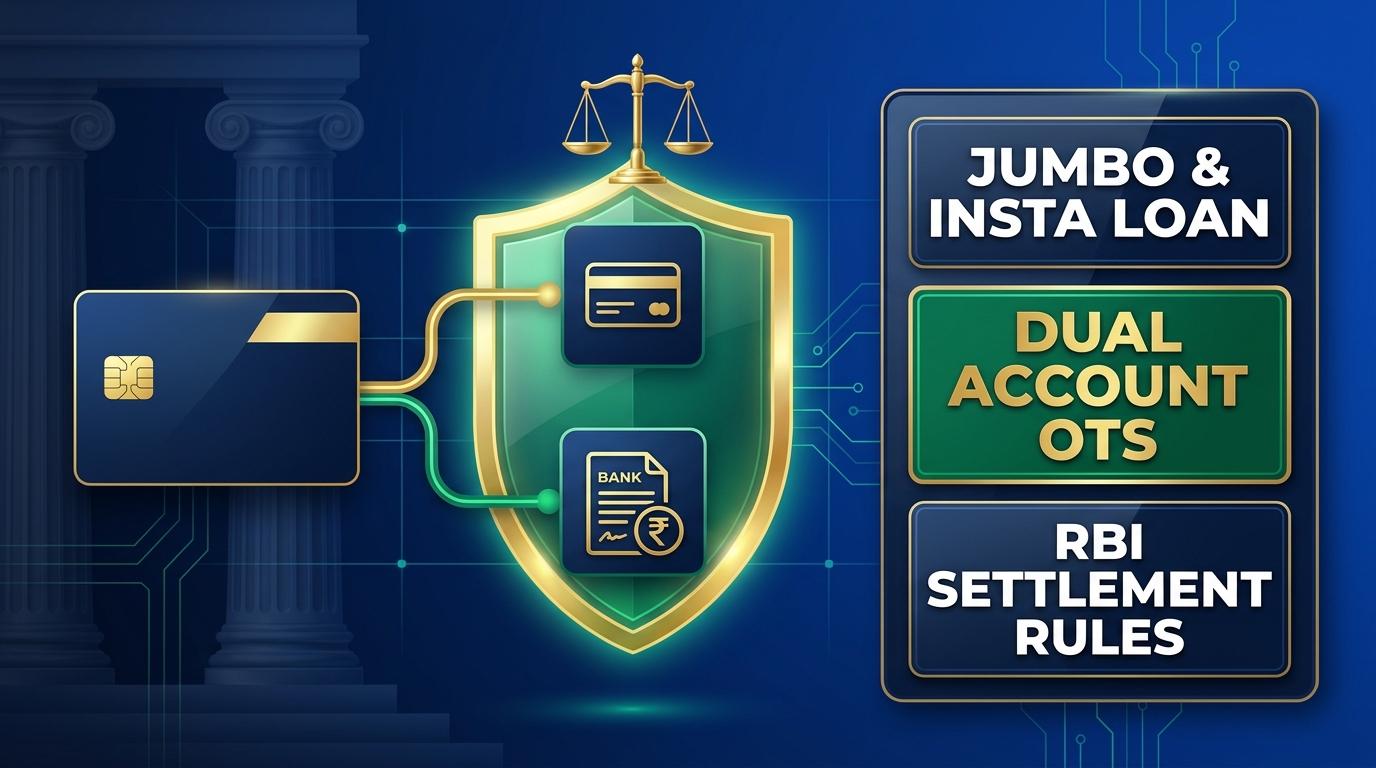
This clear chart shows how one credit card splits into two separate debts on default. It also shows how one joint RBI settlement shields you from split recovery claims.
6. Combined OTS Math: Settling Card & Loan Together
When both accounts run late, bank fees grow fast. Credit cards add 36% to 45% yearly interest, late fees, and 18% GST. At the same time, the Jumbo Loan adds late fines, 3% recall fees, and auto-debit bounce charges.
Under RBI Circular DOR.STR.REC.20/21.04.048/2023-24 (June 8, 2023), every bank must keep a Board-approved OTS policy. Once both accounts cross 90 days into NPA status, you can ask for a joint lump-sum deal like the example below.
| Bill Part | Bank Claim | Joint OTS Relief | OTS Amount |
|---|---|---|---|
| Primary Credit Card Spent Principal | ₹1,40,000 | 45% to 55% Principal Cut | ₹65,000 |
| Jumbo Loan Unpaid Principal | ₹2,60,000 | 45% to 55% Principal Cut | ₹1,25,000 |
| Card Interest (42% APR) & Late Fees | ₹92,000 | 100% Interest Waiver | ₹0 |
| Jumbo Loan Fines & Bounce Fees | ₹58,000 | 100% Fee Waiver | ₹0 |
| 18% GST on Interest & Late Fees | ₹27,000 | Dropped With Fee Waiver | ₹0 |
| Total Dual Account Closure | ₹5,77,000 | ~67% Total Relief | ₹1,90,000 (Both Closed) |
7. Step-by-Step SOP: Dual Account Settlement Protocol
Follow these six clear steps to close both your credit card and your Jumbo or Insta Loan with zero leftover dues.
1Stage 1: Check Your CIBIL Report and List Every Number
Pull your latest credit report and count every open line from your bank. Write down your 16-digit card number and every separate AAN or LAN loan number.
2Stage 2: Protect Your Salary From Same-Bank Cuts
If your pay goes into that same bank, ask HR to route future pay to an account in another bank. This stops sudden auto-debits and Section 171 holds while you save for OTS.
3Stage 3: Check EMI Merger on In-Limit Card Loans
For in-limit Insta Loans, wait until the bank stops future EMIs and merges the balance into your card bill. For over-limit Jumbo Loans, ask for a clear principal statement.
4Stage 4: Send One Joint Hardship Request Under Your UCIC
Share proof of job loss, pay cuts, business loss, or hospital bills with the bank central OTS desk. Ask them to link both accounts under your UCIC for one joint deal.
5Stage 5: Check Both Account Numbers on the OTS Letter
Never pay based on phone calls or chat messages. Check the official OTS letter sent from a real bank email and confirm both numbers are printed cleanly.
6Stage 6: Pay Exact Split Sums and Take Both NOCs
Pay each agreed sum straight into the exact card number and Jumbo Loan AAN named in the letter. Collect No Dues Certificates for both accounts within 30 days.
8. Borrower Legal Shields & Landmark Court Rulings
Holding two late accounts in one bank often doubles the calls you get each day. Indian courts and RBI rules strictly shield borrowers from unfair threats during hard times.
The Supreme Court banned banks from sending rude agents or using threats and force. Every loan recovery step must follow fair legal rules.
The Supreme Court held that a bank lien under Section 171 works only on money kept inside that same bank. A bank cannot freeze accounts in other banks on its own.
Under RBI Circular DoR.MCS.REC.28/01.01.001/2023-24, banks cannot add extra penal rates to your loan rate or charge interest on late fines.
Agents cannot call before 8:00 AM or after 7:00 PM, shame you before family or boss, or mark default without a 7-day prior notice.
9. 3-Tier Escalation Matrix: Bank GRO to RBI Ombudsman
If two agencies harass you at once, or if the bank closes your card after OTS while leaving your Jumbo Loan open on CIBIL, use these three steps.
| Tier | Bank Office | Reply Time | How They Help You |
|---|---|---|---|
| Level 1: GRO | Card & Loan Grievance Officer | 7 to 10 Working Days | Links card and AAN tickets, shares loan breakup, and logs call complaints. |
| Level 2: PNO | Principal Nodal Officer (Head Office) | 15 to 30 Days | Stops split call harassment, reviews joint OTS deals, and issues missing NOCs. |
| Level 3: RBI Ombudsman | RBI Portal (cms.rbi.org.in) | 30 Days Post-PNO | Orders CIBIL fixes, pays ₹100/day delay fines, and stops unfair agent acts. |
10. Default Timeline: Day 1 Missed EMI to Dual NOC
Knowing each stage after missing a credit card bill or Jumbo Loan EMI helps you stay calm and avoid costly mistakes.
| Days Late | Bank Stage | What Happens to Card & Loan | Your Best Next Step |
|---|---|---|---|
| Day 1 to Day 3 | RBI Grace Days | Card gets 3 grace days; Jumbo Loan auto-debit hits on due date. | Pay full due if cash allows, or prevent repeat NACH bounces. |
| Day 4 to Day 30 | SMA-0 Stage | Late fees, card interest, and bounce fines start adding up. | Save both bills and move future pay to another bank. |
| Day 31 to Day 89 | SMA-1 & SMA-2 | Card swipes blocked; bank sends call alerts and demand letters. | Reply in writing to any legal or Section 25 bounce notice. |
| Day 90+ | Dual UCIC NPA | Both card and Jumbo Loan turn NPA; in-limit EMIs merge into card. | Send hardship proof and start joint OTS talks. |
| Day 120 to 180+ | OTS & Dual NOC | Bank grants joint waiver; both lines close once OTS sum is paid. | Check dual OTS letter, pay bank direct, and check CIBIL in 15 days. |
11. Common Mistakes & Bank-Specific Dual Loan Traps
Avoid these four common traps that hurt card users even after they pay hard-earned settlement cash.
Settling Only the 16-Digit Card Number
A card agent may offer a big cut on your 16-digit card while leaving out your HDFC Jumbo AAN or SBI Encash LAN. Months later, a second team claims full Jumbo Loan dues.
Sending Jumbo OTS Cash to the Card Number
If you send your Jumbo Loan OTS cash to your 16-digit card number by mistake, the loan stays unpaid and the OTS deal breaks. Always match the exact AAN or LAN number.
Making Split Deals With Field Agents
Banks send card bills and loan lines to different call teams. Do not strike side deals with field callers; ask the bank nodal desk for one joint letter.
Skipping 30-Day Credit Bureau Checks
Under RBI 15-day update rules, check CIBIL, Experian, Equifax, and CRIF 30 days after paying OTS. Make sure both entries show zero balance left.
 Legal Debt Dispute Authority
CredSettle (credsettle.com) is India's premier debt settlement, loan dispute resolution, and legal protection platform. Operating strictly under the RBI Fair Practices Code and CICRA 2005, our advocate panel negotiates directly with Bank Principal Nodal Officers to eliminate waived differentials, obtain unconditional No Dues Certificates (NDC), and upgrade credit bureau records from "Settled" to "Closed".
Frequently Asked Questions: Jumbo & Insta Loan Default
Plain, verified answers on Jumbo Loan AAN numbers, UCIC cross-default rules, Section 25 auto-debit notices, and joint One-Time Settlements in India.
Official Regulatory Citations & Statutory References
- RBI Card Master Direction: DoR.AUT.REC.No.27/24.01.041/2022-23, Credit Card and Debit Card - Issuance and Conduct Directions, 2022 (EMI Rules, Billing & Agent Conduct).
- RBI Compromise OTS Circular: RBI/2023-24/40, DOR.STR.REC.20/21.04.048/2023-24 (June 8, 2023), Framework for Compromise Settlements and Technical Write-offs.
- RBI IRAC Norms: Master Circular on Prudential Norms on Income Recognition, Asset Classification and Provisioning (Borrower-Wise UCIC NPA Rule).
- Payment and Settlement Systems Act, 2007: Section 25 (e-NACH Bounce Rules, 30-Day Demand Notice & 15-Day Pay Window).
- Indian Contract Act, 1872 & Supreme Court Cases: Section 171 (Bank Lien), Syndicate Bank v. Vijay Kumar (1992) 2 SCC 330, and ICICI Bank Ltd. v. Prakash Kaur (2007) 2 SCC 711.
- RBI Penal Charges & CIBIL Rules: DoR.MCS.REC.28/01.01.001/2023-24 (No Penal Interest Compounding) and RBI/2023-24/72 (₹100/Day CIBIL Fix Delay Rule).