How to Get Your NOC &
No Dues Certificate After Settlement
Your settlement isn't complete until you receive an NOC. Learn how to legally force your bank to issue a No Dues Certificate after a settlement.
- Settlement Without NOC is Legally Incomplete: Paying your One-Time Settlement (OTS) amount does not automatically extinguish your legal liability. Under Indian banking jurisprudence, only an unconditional No Dues Certificate (NDC) on the lender's official letterhead legally discharges the borrower under Section 63 of the Indian Contract Act, 1872.
- Strict 30-Day RBI Issuance Mandate: Under RBI Master Direction RBI/2023-24/60, all scheduled commercial banks, NBFCs, and Housing Finance Companies must issue the final loan closure documents and release original security/property documents within 30 calendar days of settlement payment receipt.
- Statutory ₹5,000/Day & ₹100/Day Delay Penalties: If a bank delays releasing your secured loan NOC/documents past 30 days, they are legally obligated to pay you ₹5,000 per day of delay. Delays in updating credit bureau records past 30 days attract an additional ₹100 per day penalty under RBI Circular RBI/2023-24/72.
- Essential for Bureau Rectification: TransUnion CIBIL, Experian, Equifax, and CRIF High Mark require the official NDC as primary documentary proof to stop ongoing default flags, eliminate Days Past Due (DPD) accumulation, and upgrade your credit profile.
1. Debt Discharge Documents: NDC vs OTS Letter vs Statement
Thousands of Indian borrowers fall into a dangerous legal trap: they negotiate a One-Time Settlement (OTS), remit the agreed amount to the bank, and mistakenly assume their debt is extinguished. Months or years later, they are shocked to discover active recovery notices, legal threats, or wrecked credit scores.
To protect yourself, you must distinguish between the four fundamental documents generated during a debt resolution lifecycle:
| Document Type | Legal Purpose & Definition | Extinguishes Debt? | CIBIL Bureau Power | Future Recovery Risk |
|---|---|---|---|---|
| Unconditional No Dues Certificate (NDC / NOC) | Final legal discharge instrument signed by bank authorized signatory certifying full payment and zero remaining liability. | YES (100% Final) | Conclusive proof to mandate status update to Settled / Closed | Zero (Complete Estoppel) |
| OTS Sanction / Settlement Letter | Conditional offer letter specifying discounted settlement amount, installment schedules, and validity cut-off date. | NO (Only an Offer) | Not accepted by bureaus as proof of final closure | High if payment timeline is missed even by 24 hours |
| Loan Account Statement (Showing ₹0 Balance) | Internal banking ledger extract showing balance write-off or technical adjustment entries in the core banking system. | NO (Internal Accounting) | Secondary supporting evidence; requires NDC confirmation | Medium (Bank can adjust ledger for unbooked penal charges) |
| Conditional / Interim Acknowledgment Receipt | Cash / RTGS receipt issued by collection agency or teller stating "Subject to clearing and management approval". | NO (No Discharge) | Zero bureau acceptance | Severe (Recovery agents can demand full original balance) |
Legal Rule of Thumb: Never treat a settlement as closed based on an email confirmation, a WhatsApp message from a recovery agent, or a bank deposit slip. Demand an unconditional No Dues Certificate printed on the bank's physical letterhead bearing an authorized signatory stamp.
2. Why Banks Delay NOCs and the Risks of Unresolved Ledgers
Why do Indian banks and NBFCs frequently delay or withhold No Dues Certificates after receiving settlement funds? The root cause lies in bureaucratic friction, internal accounting bottlenecks, and structural banking incentives:
When a loan is settled for a discounted amount, the waived portion must be written off through a manual "Sacrifice / Loss Provisioning Voucher" approved by Credit Committee authorities. Frontline branch staff cannot generate the final NDC until this backend voucher is cleared.
If an account is not formally closed with an NDC, the bank's automated delinquent portfolio system may inadvertently bundle the residual unadjusted balance into a bad-debt pool and assign it to an Asset Reconstruction Company (ARC) or collection agency.
What Happens If You Don't Obtain Your NDC Immediately:
- Unlawful Reactivation of Residual Debt: Without an NDC, the bank can claim that your OTS terms lapsed, revive the waived principal plus compounded penal interest at 24–36% per annum, and initiate legal proceedings under Section 138 of the Negotiable Instruments Act or Section 25 of the Payment and Settlement Systems Act.
- SARFAESI & Lien Entanglement on Secured Assets: For auto loans or home loans, the bank will refuse to release original property title deeds or issue Form 35 to cancel vehicle hypothecation at the RTO, preventing you from selling, transferring, or refinancing your asset.
- Continuous 7-Year CIBIL Bleeding: The bank's monthly data feed will continue reporting the account as "Overdue", "Post-Write-off", or accumulating 900+ Days Past Due (DPD), permanently locking your credit score in the sub-600 rejection zone.
3. Legal Protections: Section 63 Contract Act & RBI Norms
Borrowers in India are shielded by robust statutory protections. When a bank attempts to stall or deny your NDC after receiving full settlement payments, they violate core statutory provisions:
Section 63 of the Indian Contract Act, 1872 (Doctrine of Remission)
Section 63 establishes that every promisee (the bank) may dispense with or remit, wholly or in part, the performance of the promise made to them, or may accept instead of it any satisfaction which they think fit. Once the bank accepts your settlement payment under a sanctioned OTS, the original contract is legally extinguished by operation of law. The bank is legally barred (doctrine of estoppel) from claiming another rupee or refusing the closure certificate.
RBI Master Direction on Release of Movable/Immovable Property Documents (RBI/2023-24/60)
Issued on September 13, 2023, this landmark RBI directive mandates that all Regulated Entities (REs) must release all original property/movable documents and issue the No Dues Certificate within 30 calendar days following full payment of loan dues/settlement. If the RE fails to comply, it must pay the borrower compensation of ₹5,000 for each day of delay.
CICRA 2005 Section 21 & RBI Bureau Compensation Circular (RBI/2023-24/72)
Under Section 21 of the Credit Information Companies (Regulation) Act, 2005, lenders must update credit information with all four credit bureaus (CIBIL, Experian, Equifax, CRIF) within 30 days. Under RBI Circular RBI/2023-24/72, failure to rectify or update credit information within 30 days of receiving valid proof of settlement obligates the defaulting entity to pay ₹100 per calendar day compensation to the borrower.
RBI Integrated Ombudsman Scheme, 2021
Non-issuance of NDC, unreasonable delay in releasing title documents, or inaccurate credit reporting constitutes a specific ground of deficiency in banking service under Clause 10 of the RBI Integrated Ombudsman Scheme. The Ombudsman possesses quasi-judicial powers to order immediate document release and award damages for mental harassment.
4. Technical Credit Scoring Math: How an NDC Halts Bureau Degradation
Credit scoring engines in India (TransUnion CIBIL, Experian, Equifax, CRIF) calculate your 3-digit score (300–900) using weighted multivariate proprietary algorithms. Understanding the mathematical impact of a missing vs. submitted NDC is crucial:
DPD counts, default records, write-offs
Credit Utilization Ratio (CUR) & overdue
Vintage of active trade-lines
Secured vs. unsecured loan balance
Hard bureau pulls in past 12 months
Score Deduction = -120 to -180 pts. Monthly batch feeds flag account as ongoing NPA. CUR calculated on unadjusted overdue amount. Algorithmic rejection on 100% of prime retail loan underwriting filters.
Overdue Balance = ₹0. Ongoing DPD accumulation frozen immediately. Negative severity multiplier neutralized. Trajectory established for score recovery to 750+ over subsequent 6–12 months.
How to Get Your NOC & No Dues Certificate: Process Roadmap
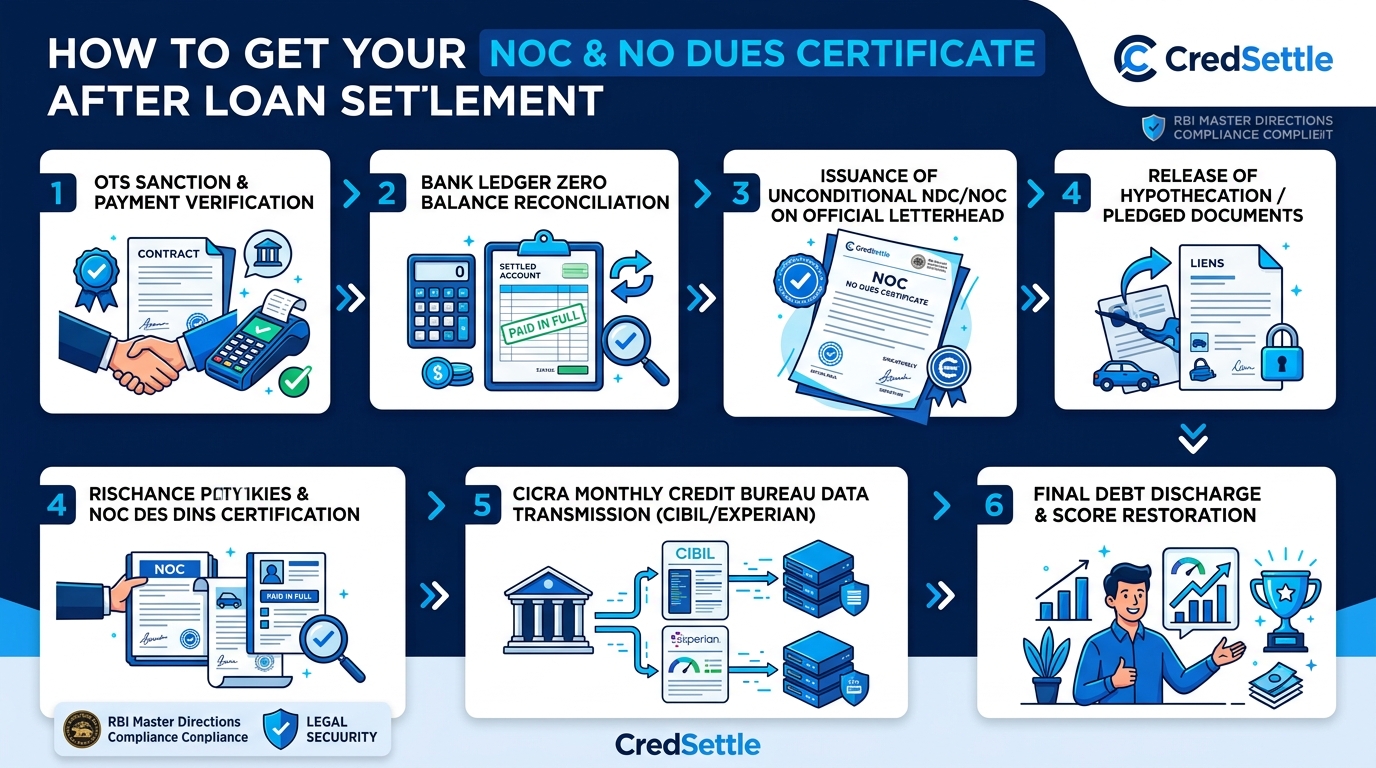
5. 6-Stage SOP to Secure and Enforce Your NDC
To guarantee that your loan settlement is completed without legal vulnerabilities, follow this rigorous 6-stage operational roadmap established by our debt resolution professionals:
Audit the Original OTS Sanction Letter & Validity Deadlines
Verify that your payment strictly honored the terms of the official OTS sanction letter. Ensure that the payment date was prior to the offer expiration date, the amount paid matched the exact single/tranche figures, and payment was deposited directly into the bank's designated collection ledger (not a recovery agent's personal UPI).
Assemble Traceable Proof of Remittance & Account Statement
Collate bank-stamped deposit counterfoils, RTGS/NEFT transaction UTR numbers, and your bank account debit statement. Download the latest loan account statement showing that the funds were credited to your loan ledger.
Submit a Formal Written Request for NDC to Loan Operations & Branch Manager
Submit a formal representation by registered post and registered email to the Branch Manager, Central Retail Asset Operations, and the Principal Nodal Officer citing the OTS sanction letter and RBI Master Direction RBI/2023-24/60.
Rigorous Verification of the Physical / Electronic No Dues Certificate
Upon receiving the NDC, inspect it to ensure it contains zero conditional clauses. It must state unequivocally: "The bank has received ₹[Amount] in full and final settlement of Loan Account [Number]. There are zero outstanding dues, and the borrower stands fully discharged of all obligations."
Release of Collateral & Revocation of Standing Mandates (NACH / e-Mandates)
For secured loans, collect all original title deeds, share certificates, and signed Form 35. Ensure the bank issues written confirmation that all NACH auto-debit mandates and post-dated cheques (PDCs) have been cancelled and destroyed.
Upload NDC to CIBIL, Experian, Equifax & CRIF Dispute Portals
Do not wait passively for the bank's monthly tape submission. Log in to the official CIBIL Dispute Resolution Portal, create an account dispute ticket, and upload the scanned NDC to trigger automated cross-verification within 30 days.
6. Formal Legal Demand Notice Template for Delayed No Dues Certificate
If your bank or NBFC has exceeded the statutory 30-day timeline without delivering your NDC, issue this formal statutory demand notice to the Principal Nodal Officer:
To,
The Principal Nodal Officer / Head of Retail Loan Operations,
[Bank / NBFC Name],
[Zonal Office Address / Corporate Headquarters],
Email: [nodalofficer@bankname.com]

Subject: STATUTORY DEMAND FOR IMMEDIATE ISSUANCE OF UNCONDITIONAL NO DUES CERTIFICATE (NDC) & RELEASE OF SECURITY FOR LOAN ACCOUNT NO: [Insert Loan A/C No.] UNDER RBI DIRECTIVE RBI/2023-24/60 & SECTION 63 OF THE INDIAN CONTRACT ACT, 1872

Respected Sir/Madam,

I, [Borrower Full Name], residing at [Borrower Full Address], holding PAN: [Insert PAN] and Aadhaar: [Insert Aadhaar], was the borrower for the captioned Loan Facility [Account No: XXXXXXXX] sanctioned by your esteemed institution.

1. That pursuant to financial difficulties, your institution and the undersigned entered into a formal One-Time Settlement (OTS) under Sanction Letter Ref No: [Insert OTS Letter Ref No.] dated [DD/MM/YYYY], agreeing upon a full and final settlement consideration of ₹[Amount Paid].
2. That in absolute compliance with the terms and validity of the said OTS Sanction Letter, the undersigned remitted the total agreed settlement sum of ₹[Amount Paid] via [RTGS / NEFT / Demand Draft] under UTR / Reference No: [Insert UTR No.] on [DD/MM/YYYY], which was duly acknowledged and realized in your bank's collection ledger.
3. That by virtue of the realization of the agreed settlement consideration, the original loan agreement stands fully discharged by operation of law under Section 63 of the Indian Contract Act, 1872, and the doctrine of promissory estoppel strictly prohibits your institution from raising any further claims.
4. That despite the lapse of [Number of Days] calendar days from the date of realization, your institution has failed to issue the physical/electronic unconditional No Dues Certificate (NDC) and failed to update the credit information with TransUnion CIBIL, Experian, Equifax, and CRIF High Mark.
5. That this inexcusable failure constitutes a direct statutory breach of:
   a) RBI Master Direction RBI/2023-24/60 (mandating issuance of NDC and release of documents within 30 days, failing which compensation of ₹5,000 per day is statutorily payable).
   b) Section 21 of the Credit Information Companies (Regulation) Act, 2005 (CICRA).
   c) RBI Compensation Framework Circular RBI/2023-24/72 (mandating ₹100/day compensation for delayed credit bureau rectification).

DEMAND:
You are hereby called upon to:
i) Issue and dispatch the physical/digitally signed unconditional No Dues Certificate (NDC) with ₹0 balance within 7 (seven) days of receipt of this notice.
ii) Immediately transmit the revised data tape to all four Credit Information Companies reflecting the account as SETTLED / CLOSED with zero overdue.
iii) Cancel and destroy all remaining NACH mandates, ECS instructions, and post-dated cheques.

Take notice that if you fail to comply within the stipulated 7 days, the undersigned shall escalate the matter to the RBI Integrated Ombudsman (cms.rbi.org.in) claiming the accrued statutory delay compensation of ₹5,000/day and ₹100/day, alongside filing for damages before the appropriate Consumer Disputes Redressal Commission for mental agony and financial injury.

Yours sincerely,

___________________________
[Signature]
[Borrower Name]
[Mobile Number]
[Email Address]
Date: [DD/MM/YYYY]
Place: [City, State]
7. 3-Tier Escalation Matrix to Obtain Your Bank NDC
When a local branch manager stalls your request by citing "system maintenance" or "head office approvals," do not waste months arguing at branch counters. Execute this formal 3-tier escalation hierarchy:
Branch CRM & Loan Ops
Submit written representation to the Branch Manager and log a formal service ticket on the bank's official CRM portal attaching your OTS letter and payment receipt.
Principal Nodal Officer (PNO)
Escalate to the bank's apex grievance desk (PNO). The PNO has administrative authority to approve loss vouchers and order immediate manual NDC dispatch.
RBI Integrated Ombudsman
File a statutory complaint at cms.rbi.org.in. The Ombudsman orders immediate delivery of the NDC and awards ₹5,000/day & ₹100/day delay compensation.
8. Chronological Milestone Resolution Table: Institutional Timelines
The lifecycle from making your final settlement payment to securing clean credit bureau records follows a precise institutional timeline:
| Timeline Phase | Banking / Legal Event | Document Generated | Borrower Action Required |
|---|---|---|---|
| Day 0 (Payment Day) | Settlement consideration deposited in bank collection account. | Bank deposit slip / RTGS UTR receipt | Preserve timestamped transaction proof; email copy to settlement officer. |
| Days 1 – 7 | Central operations reconciles ledger; passes sacrifice/loss write-off entry. | Internal Accounting Voucher | Download updated loan ledger statement confirming ₹0 balance. |
| Days 8 – 20 | Authorized signatory generates official physical / digitally signed NDC. | Unconditional No Dues Certificate (NDC) | Collect original certificate; verify all account & PAN details. |
| Days 21 – 30 | Security released; Form 35 issued for auto loans; property deeds handed over. | Form 35 / Original Title Deeds | Submit Form 35 to RTO; cancel NACH mandates with your savings bank. |
| Days 31 – 45 | Bank transmits monthly data tape to CIBIL, Experian, Equifax & CRIF. | Updated Credit Bureau Report (CIR) | Download fresh CIBIL report; raise online dispute with NDC if tape is delayed. |
9. Special Scenarios: Credit Cards, ARCs & Fintech Apps
Credit Card Settlements
Credit cards are revolving lines of credit. Upon settlement, the bank card operations division must cancel the plastic card, extinguish accumulated reward point encumbrances, and issue a dedicated electronic NDC confirming zero current balance on both primary and add-on cards.
Debt Sold to ARCs
If the bank assigned your NPA to an Asset Reconstruction Company (e.g. ARCIL, Phoenix, Edelweiss ARC) under SARFAESI Section 5, you must obtain the NDC directly from the ARC. Ensure the ARC provides a copy of the Deed of Assignment to confirm their legal authority.
Digital Fintech NBFC Apps
For instant app loans (KreditBee, MoneyView, CASHe), the NDC must be issued by the RBI-registered NBFC lender, not the tech front-end LSP. Ensure the NBFC confirms cancellation of all e-mandates and revokes app data permissions.
 Legal Debt Dispute Authority
CredSettle (credsettle.com) is India's premier debt settlement, loan dispute resolution, and legal protection platform. Operating strictly under the RBI Fair Practices Code and CICRA 2005, our advocate panel negotiates directly with Bank Principal Nodal Officers to eliminate waived differentials, obtain unconditional No Dues Certificates (NDC), and upgrade credit bureau records from "Settled" to "Closed".
Frequently Asked Questions on Getting NOC After Loan Settlement
Click on any question below to view detailed legal and banking answers verified by our debt resolution experts:
All legal procedures, timelines, and rights described on this page are grounded in official Indian statutory frameworks: