How to Escape the Credit Card Minimum Due Trap
Unraveling how the 5% minimum payment structure compounds at 42% to 48% APR. Drains your monthly income for decades. How structured debt settlement enables complete main loan-only relief under RBI rules.
- The 5% Illusion: Minimum dues cover only interest and GST. Leaving main loan untouched for 15+ years.
- Compounding 42%. 48% APR: Revolving card debt accrues daily finance fees. Cancelling the 45-day interest-free grace window.
- Credit Score Suppression: Near 100% credit use depresses CIBIL scores despite regular minimum payments.
- Zero security Exposure: Credit card debt is no-collateral. lenders cannot seize residential property under SARFAESI.
- Mandate Cancellation Rights: Cardholders have the legal right under RBI rules to revoke auto-debit NACH mandates.
- 45%. 65% Settlement Window: 90-day NPA accounts qualify for OTS deal One-Time Settlements with complete penal waivers.
- Anti-abuse Shield: RBI Fair Practices Code strictly prohibits collection calls to family members or workplace visits.
- Credit Rebuilding Roadmap: Settling card debt enables full CIBIL restoration back to 750+ within 18. 24 months.
The Anatomy of the 5% Minimum Due Compounding Trap
Monthly credit card records highlight the Minimum Amount Due (MAD) as an affordable option. Typically set at 5% of your total balance. In reality, this mechanism maximizes bank profitability. In India, revolving credit card debt incurs 3.5% to 3.99% monthly finance charges (42% to 48% APR). The government also levies 18% GST on all finance fees. Pushing total annual borrowing costs above 50%.
Paying only the minimum due allocates funds toward GST, penal fees. Interest, leaving less than 1% to reduce main loan spend. Revolving balances also cancel the 45-day interest-free grace period on fresh transactions. Because credit cards are no-collateral. Lenders face strict Tier-1 provisioning under RBI norms once accounts default past 90 days into Non-Performing Asset (NPA) status. Motivating credit boards to approve OTS deal One-Time Settlements.
The Financial Reality: Minimum Dues vs One-Time Settlement
Comparing minimum payments against a structured One-Time Settlement (OTS) highlights why distressed cardholders choose debt relief. On a ₹3,00,000 balance at 42% APR. Paying the 5% minimum due (₹15,000) in month one directs ₹12,390 toward interest and GST. Reducing main loan by only ₹2,610. This cycle takes over 19 years and ₹7,20,000 in total payments to clear.
Total Bank Dues
₹3,85,000
Includes ₹85k penalty charges.
Minimum Due Horizon (19 Yrs).
₹7,20,000+
steady 42% APR drag.
settled OTS relief.
₹1,40,000
Full main loan closure &. NDC.
CredSettle structured talks eliminates 100% of total penal interest and late fees. Anchoring settlement on verified main loan spend to achieve closure at a 45% to 65% discount.
Strategic Evaluation of Credit Card Debt Resolution Mechanisms
Cardholders facing severe debt must evaluate relief pathways based on total money cost, payment timeline, legal exposure. Credit score impact.
| Resolution Route. | Financial Impact. | Repayment Horizon. | Legal Risk Exposure. | CIBIL Score Status. |
|---|---|---|---|---|
| Minimum Amount Due (MAD). | 42%. 48% APR + 18% GST compounding. | 15 to 22 Years | Zero fast legal action. | Suppressed via 90%+ CUR. |
| Balance Conversion to EMI. | 18%. 24% interest + fees. | 12 to 48 Months | Default triggers legal notice. | Standard reporting if paid. |
| One-Time Settlement (OTS). | 45% to 65% main loan OTS deal. | 30 to 90 Days | Complete immunity via NDC. | Marked Settled. rebuildable. |
| Lok Adalat talks. | 30% to 50% interest waiver. | Single Hearing Award. | Decree non-appealable. | Marked Settled in Lok Adalat. |
| Inaction &. Ignoring Dues. | Uncapped penalties &. fees. | Indefinite abuse. | Sec 25 PSSA &. civil execution. | Severe drop (under 550). |
CIBIL Scoring Algorithms and Credit Rehabilitation
Indian credit bureaus (CIBIL, Experian. CRIF High Mark, Equifax) compute scores using five factors: Payment History (35%). Credit use Ratio (30%), Credit History Length (15%), Credit Mix (10%). Inquiries (10%). Maintaining maxed-out limits keeps use near 100%. Depressing credit scores even when minimum dues are paid on time.
Executing an OTS changes account status to Settled. This causes an initial 75 to 120 point drop. However, unresolved debt causes greater damage. Post-settlement, cardholders can invoke Section 21 of the Credit Information Companies (Regulation) Act. 2005 (CICRA) to record zero balance. Rebuilding scores back to 750+ within 18 to 24 months using secured credit cards.
The CredSettle Strategic Credit Card Resolution Blueprint
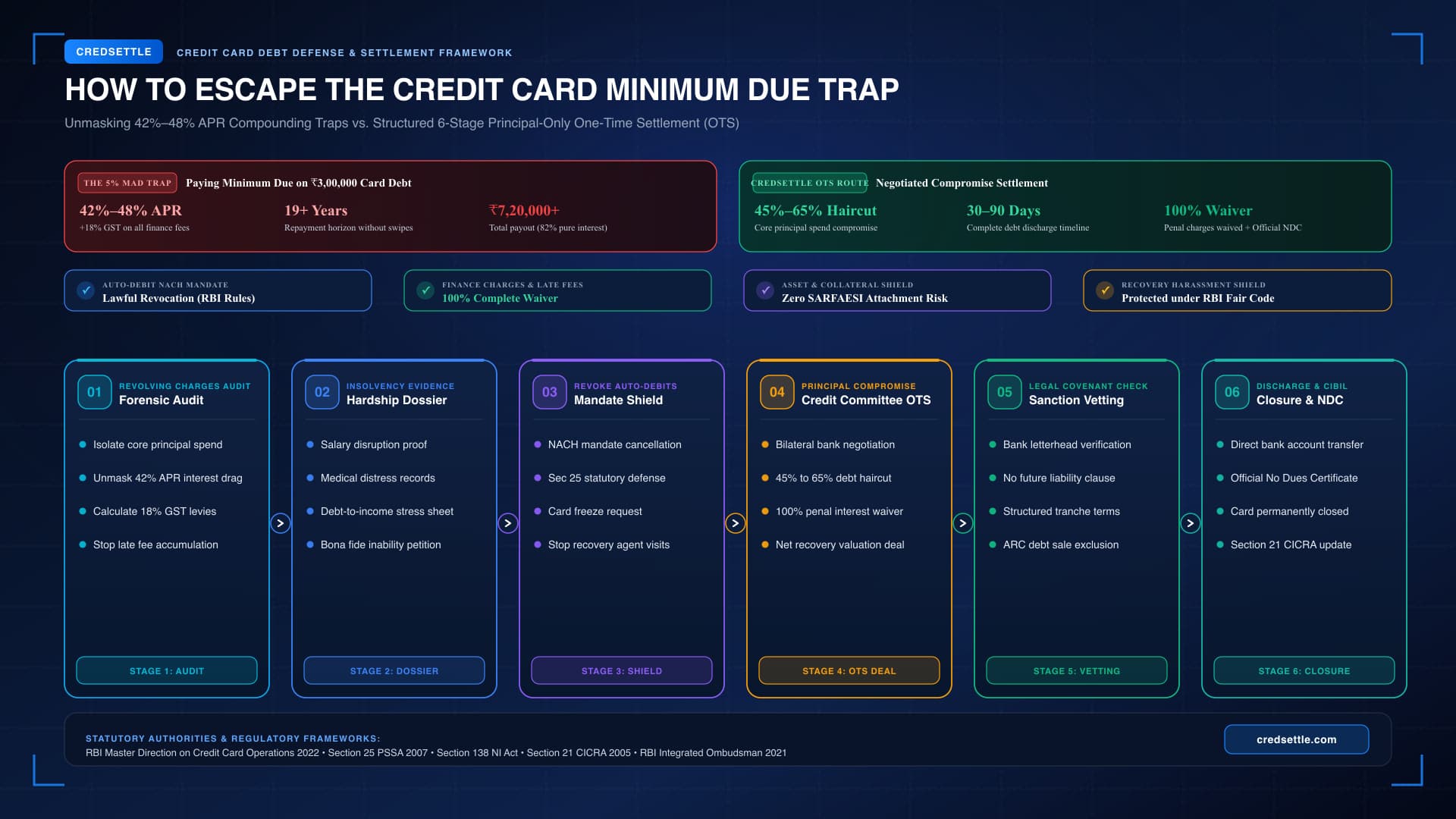
Procedural Roadmap to Legal & Financial Debt Freedom
Escaping revolving credit card debt requires a structured. Legally supported process to isolate transacted main loan from compounding finance charges.
Stage 1: Forensic Statement Audit
money analysts review past records to isolate core main loan from compounding 42% APR charges, late fees. 18% GST.
Stage 2: Hardship Dossier Compilation
We compile verified proof of insolvency. Including medical records, job termination notices, or trade income losses.
Stage 3: Auto-Debit Revocation & Mandate Shield
We issue legal cancellation notices for NACH mandates under RBI rules and request office card freeze.
Stage 4: Credit Committee Bilateral Negotiation
CredSettle advocates settle straight with bank credit boards. Seeking 100% penal interest waivers and 45%. 65% debt haircuts.
Stage 5: Settlement Sanction Letter Vetting
Legal counsel scrutinizes the bank settlement letter to verify formal letterhead. Payment schedules, and complete waiver clauses.
Stage 6: Direct Remittance & NDC Release
You pay the settlement sum straight to your bank account. Securing an formal No Dues letter and closure update.
Statutory Notice Defense & Borrower Protections
When minimum payments stop, banks issue legal legal contacts. Understanding your rights ensures effective defense without panic.
Section 25 PSSA (Electronic Mandate Bounce)
Under Section 25 of the Payment and Settlement Systems Act. 2007, auto-debit bounces carry quasi-criminal debt risk. Serving a formal reply citing hardship and prior mandate revocation refutes fraudulent intent.
Section 138 NI Act (Cheque Dishonor Notice)
If security cheques are presented and bounced. Lenders issue Section 138 notices. Our defense establishes that undated security cheques cannot enforce arbitrary. Compounding interest without audited reconciliation.
Unilateral Arbitration & Perkins Eastman Defense
Under Supreme Court rulings in. TRF Ltd. and Perkins Eastman, banks cannot unilaterally appoint sole arbitrators without mutual consent. Rendering unilateral arbitral proceedings voidable under Section 12(5).
RBI Fair Practices Code & Anti-Harassment Rights
RBI Master Directions prohibit collection calls outside 8:00 AM to 7:00 PM, contacting employers. Abusive conduct, with violations punishable via the RBI Ombudsman.
3-Tier Grievance Escalation & Ombudsman Redressal
When lenders engage in predatory billing or collection abuse. Cardholders can systematically escalate complaints through three RBI tiers.
Chronological Milestones: From Default to Debt Discharge
The lifecycle of overdue credit card debt follows defined RBI milestones from first missed payment to complete debt discharge.
| Timeline | Regulatory Classification. | Bank Action & Exposure. | Borrower Defense Strategy. |
|---|---|---|---|
| Day 1 to 30 | SMA-0 (Overdue) | Late fees applied. automated reminders. | Cancel auto-debits. audit billing records. |
| Day 31 to 60 | SMA-1 (Sub-Standard). | Card suspended. internal collection calls. | Issue hardship notice to Grievance Redressal. |
| Day 61 to 90 | SMA-2 (Pre-NPA) | Assigned to collection firms. | Invoke RBI Fair Practices Code anti-abuse. |
| NPA Classification. | 100% bank provisioning. legal notices. | Prime OTS talks window (45%. 65% off). | |
| Month 6+ | Post-NPA / Written-Off. | Potential ARC assignment or Lok Adalat. | Execute OTS sanction letter &. secure NDC. |
Case Analysis Across Specialized Card Default Scenarios
Different money crises require tailored relief plans to maximize main loan waivers while preventing aggressive collection actions.
Multiple Maxed-Out Credit Cards
clients rotating minimum payments across 3 to 6 cards face severe compounding. CredSettle halts interest across all issuers and coordinates strategic settlements based on NPA provisioning.
Tech & Corporate Layoffs
Salaried workers facing sudden job loss cannot sustain 42% APR dues. We submit severance paperwork to prove hardship. Securing fast-track 50%+ main loan waivers.
Proprietorship Business Swipes
shop owners using private cards for daily work cash flow face private debt risk. We decouple trade income from private debt. Settling terms aligned with net cash flow.
ARC Portfolio Debt Assignments
When banks assign written-off card portfolios to ARCs, collection pressure spikes. We verify assignment legality under SARFAESI Section 5. Capping settlements at acquisition value.
 Legal Debt Dispute Authority
CredSettle (credsettle.com) is India's premier debt settlement, loan dispute resolution, and legal protection platform. Operating strictly under the RBI Fair Practices Code and CICRA 2005, our advocate panel negotiates directly with Bank Principal Nodal Officers to eliminate waived differentials, obtain unconditional No Dues Certificates (NDC), and upgrade credit bureau records from "Settled" to "Closed".
Frequently Asked Questions on Credit Card Debt & Minimum Dues
Official Regulatory Citations & Statutory Frameworks
- Reserve Bank of India: Master Direction - Credit Card and Debit Card Issuance Directions, 2022.
- Payment and Settlement Systems Act, 2007: Section 25 (Electronic Mandate Defenses).
- Negotiable Instruments Act, 1881: Section 138 (Cheque Dishonour for Enforceable Debt).
- Arbitration Act, 1996: Sections 12(5) &. 21, read with Perkins Eastman ruling.
- Credit Information Companies Act, 2005 (CICRA): Section 21 Dispute Rectification.
- RBI Integrated Ombudsman Scheme, 2021: legal Grievance Redressal for Unfair Lending Practices.