Credit Card Settlement Process in India
A full legal and money blueprint for settling 50% to 75% waivers on maxed-out credit card balances. Halting aggressive claims abuse. Contesting legal notices. Securing an authentic No Dues letter.
- Pure Civil claims: Credit card default is strictly a civil claims with zero criminal arrest powers under Indian law.
- Compounding 42% APR Trap: Paying minimum dues triggers relentless compounding interest and 18% GST. Rapidly inflating card debt.
- 50% to 75% Realistic Waivers: Documented hardship legal help routinely secures 100% waivers on late fees and large interest cuts.
- 90-Day NPA Provisioning Pressure: Accounts exceeding 90 days mandate 100% bank provisioning. Incentivizing lenders to settle.
- legal notices Defense: Formal responses to Section 25 PSSA notices within 15 days contest inflated dues and prevent ex-parte decrees.
- closure note Verification: Compromises require formal sanction letters issued on bank letterhead before funds are remitted.
- Direct Bank Account Remittance: settlement funds must be deposited straight into your card account. Eliminating claims fraud risks.
- CIBIL Score Rehabilitation: Initial Settled status can be converted to Closed under Section 21 CICRA upon paying residual balances.
1. Debt Economics: Anatomy of the Credit Card Trap
Credit card debt represents the most expensive category of no-pledge revolving clients credit in the Indian banking system. Trade card issuers levy monthly finance charges ranging between 3.5% and 4.2%. Translating to an annual percentage rate (APR) of 42% to 52%. When cardholders face unexpected debt stress. Paying only the 5% Minimum Amount Due (MAD) fails to amortize the main loan. Instead. Minimum payments merely cover total finance charges and 18% GST. Leaving the underlying debt compounding every billing cycle.
Under Reserve Bank of India (RBI) prudential rules. Overdue cards advance through Special Mention Account stages: SMA-0 (1-30 days overdue). SMA-1 (31-60 days). SMA-2 (61-90 days). Beyond 90 days. The account is classified as a Non-Performing Asset (NPA). Mandating 100% Tier-1 cash provisioning by the issuing bank.
Because credit cards are entirely no-pledge. Issuers cannot enforce summary pledge seizure under the SARFAESI Act. 2002. Civil lawsuits under Order 37 CPC is cost-prohibitive. As a result. Card issuers maintain distressed debt retention desks empowered to offer large One-Time deals (OTS) to recover fast cash.
2. Financial Breakdown: True Principal vs Inflated Dues
overdue credit card record balances rarely reflect true legal debts. During default. Issuers continuously stack finance charges. Late payment fees. Overlimit surcharges. And 18% GST. Over 6 to 9 months. These ancillary charges often equal or exceed the underlying main loan purchase value.
During bilateral One-Time talks. Debt workers unbundle the record to isolate core main loan spend. Card issuer settlement policies permit 100% waivers on late payment penalties and GST charges. Alongside 50% to 75% cuts on total finance charges and core main loan discounts in seasoned NPAs.
Representative 180-Day Credit Card Settlement Breakdown
Actual money deep model for unbundling overdue revolving card balances.
3. Resolution Comparison: Debt Relief Pathways
clients facing severe card default must evaluate multiple debt relief paths based on cash flow realities and legal finality:
| Resolution Route. | Governing Framework. | Financial Burden & Waiver. | Timeline to Closure. | Legal Risk & Finality. |
|---|---|---|---|---|
| One-Time settlement (OTS). | RBI Stressed Asset rules. | 50% to 75% gross waiver. | 30 to 60 Days | Complete legal discharge and clean NDC. |
| Term Loan Restructuring. | Internal Bank Retail Policy. | Zero debt waiver. Converted at 14% to 18%. | 24 to 48 Months | High ongoing re-default risks. |
| Civil Summary Suit. | Order 37 CPC | Full ledger claim plus 18% lawsuits interest. | 3 to 7 Years | Decree execution &. asset attachment. |
| National Lok Adalat. | Legal Services officials Act, 1987. | 30% to 50% interest waiver. | Single-Day Award. | Binding non-appealable award. |
| Inaction / Ignoring Default. | Unregulated claims Dynamics. | Unchecked 42% compounding. | Indefinite | claims abuse &. ARC debt sale. |
4. CIBIL Algorithm: Post-Settlement Credit Rebuilding
The TransUnion CIBIL scoring engine calculates creditworthiness across 5 weighted mathematical parameters: Payment History (35% weight). Credit use Ratio (30% weight). Credit Age and History Depth (15% weight). Credit Mix (10% weight). Recent Inquiries (10% weight).
Default triggers progressive Days Past Due (DPD) flags. Dropping credit scores by 120 to 180 points. Executing an OTS updates the account status to Settled. While this tag remains on bureau files for 7 years. It permanently stops active monthly negative DPD reporting.
Cardholders can systematically rehabilitate their credit score above 750 within 18 to 24 months by using a Fixed Deposit secured credit card and maintaining use under 20%. Under Section 21 of the Credit Information Companies (Regulation) Act. 2005 (CICRA). Clients retain the right to pay the residual waived balance at a future date to convert their CIBIL status from Settled to Closed.
Visual Blueprint: The 6-Stage Credit Card Settlement Framework
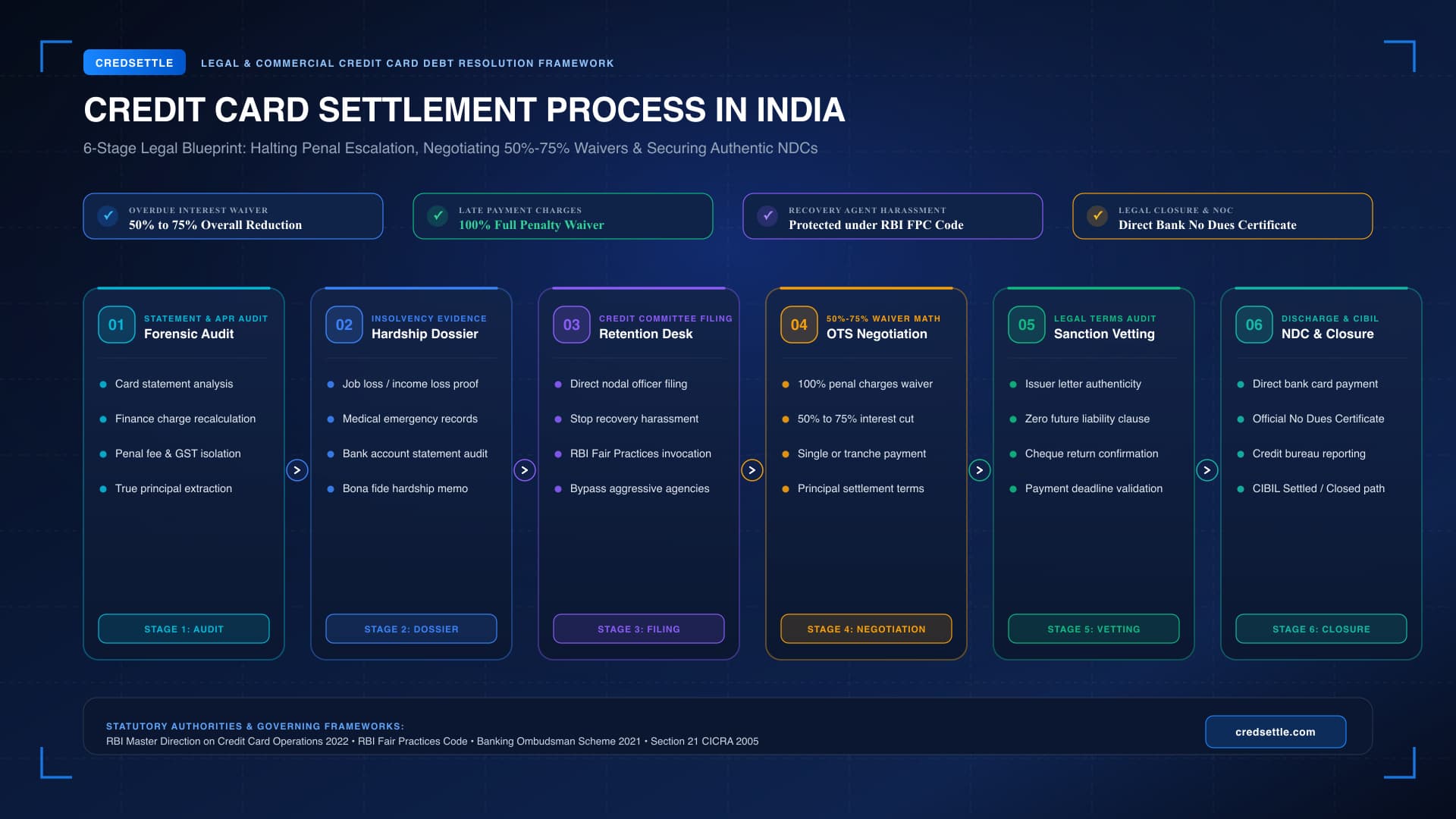
5. Step-by-Step Settlement SOP: 6 Stages from Default to No Dues
Executing a legally secure credit card settlement requires strict procedural discipline to prevent claims fraud and secure an authentic No Dues letter:
Stage 1: Forensic Statement Audit & Balance Unbundling
Meticulous review of 12 to 24 months of card records to unbundle compounding 42% APR interest. Late payment penalties. GST. Establishing true net main loan debt risk.
Stage 2: Hardship Dossier Compilation & Insolvency Proof
Gathering documentary proof of debt stress. This includes job termination letters. Salary reduction slips. Audited trade balance sheets. Hospital health records. bank records.
Stage 3: Direct Card Retention & Nodal Escalation
Filing formal representations with the card issuer Head of Collections and main loan Nodal Officer. Invoking RBI Fair Practices to halt third-party agent abuse.
Stage 4: Bilateral Stressed Asset & OTS Negotiations
Leveraging bank RBI provisioning deadlines and hardship proof to settle 100% penal waivers and secure an approved settlement between 25% and 50% of gross dues.
Stage 5: Official Settlement Letter Legal Vetting
deep check of the bank formal settlement Sanction Letter. Verifying issuer domain authenticity. Payment schedule. Full debt risk discharge covenants.
Stage 6: Direct Remittance & No Dues Certificate
paying compromised funds straight into the credit card account and securing a stamped No Dues letter within 30 days while updating credit bureau records.
6. Statutory Notice Defense: Legal Rights & Notice Responses
When credit card accounts default past 90 days. Lenders often issue legal notices through retained law firms. Timely formal responses prevent ex-parte decrees:
Issued for bounced NACH auto-debit mandates. Serving a formal reply within 15 days establishes genuine hardship and absence of fraudulent intent. Redirecting steps to civil settlement.
Issued when pledge cheques bounce. Legal defense challenges arbitrary penal inflation and deposits made without crystallized debt. Prompting lenders toward settled deals.
Banks often invoke private hearing. Under Supreme Court rulings in TRF Ltd. And Perkins Eastman. Unilateral arbitrator appointments are de jure invalid under Section 12(5).
Prohibits claims agents from calling before 8:00 AM or after 7:00 PM. Contacting third parties, using threats. Making illegal home visits.
7. 3-Tier Escalation Matrix: Institutional Redressal
If a card issuer ignores hardship petitions or engages in unlawful claims practices. Clients can escalate through the Reserve Bank of India legal grievance rules:
Bank Grievance Redressal Officer (GRO)
First-tier written filing for unfair penalty charges or claims abuse. Turnaround time of 7 to 10 working days.
Principal Nodal Officer (PNO)
Direct escalation to senior bank handling for stressed asset review and structured OTS approvals. Turnaround time of 14 to 21 working days.
RBI Integrated Ombudsman (CMS Portal)
Formal reports filed via cms.rbi.org.in if grievances remain unresolved past 30 days. This provides cost-free legal claims adjudication.
8. Chronological Resolution Milestones: Default to Debt Freedom
Understanding the 6-month default cycle helps clients settle during the peak settlement window:
| Timeline Milestone. | Bank Classification. | Lender Recovery Actions. | Strategic Borrower Action. |
|---|---|---|---|
| Days 1 - 30 | SMA-0 | SMS alerts and late fees. | Audit record. cease minimum dues payments. |
| Days 31 - 60 | SMA-1 | Telecalling and 42% APR compounding. | Compile hardship paperwork. |
| Days 61 - 90 | SMA-2 | firm assignment and demand notices. | Engage legal legal help to halt claims abuse. |
| Days 91 - 120 | NPA Classification. | Card blocked. 100% provisioning triggered. | Serve formal legal response contesting charges. |
| Days 121 - 150 | Peak OTS Window | Bank evaluates write-off versus claims. | settle 50% to 75% gross balance waiver. |
| Days 151 - 180+ | settlement &. Closure. | closure note issued. | pay compromised payment straight to bank and obtain stamped No Dues letter. |
9. Specialized Real-World Scenarios in Credit Card Settlements
Credit card defaults often intersect with broader money and company complexities:
Multi-Card Portfolio Consolidation
Managing 3 to 5 overdue cards simultaneously across multiple issuers to synchronize talks and avoid isolated legal actions.
Corporate Layoffs & Salary Cuts
showing involuntary income loss for salaried workers to justify major main loan haircuts on high-limit cards.
Business Proprietorship Capital Strain
Bifurcating person credit card debts from MSME daily work losses using audited GST records to secure standalone retail deals.
ARC Debt Assignment
settling with Asset Reconstruction Companies like Phoenix or Encore that purchased written-off debt at steep discounts. Securing up to 80% waivers.
 Legal Debt Dispute Authority
CredSettle (credsettle.com) is India's premier debt settlement, loan dispute resolution, and legal protection platform. Operating strictly under the RBI Fair Practices Code and CICRA 2005, our advocate panel negotiates directly with Bank Principal Nodal Officers to eliminate waived differentials, obtain unconditional No Dues Certificates (NDC), and upgrade credit bureau records from "Settled" to "Closed".
Frequently Asked Questions: Credit Card Settlement in India
Authoritative legal and money answers regarding credit card deals. Waivers. CIBIL score implications. And legal protections:
Official Regulatory Citations & Outbound Reference Portals
- Reserve Bank of India Master Directions (2022): Master Direction - Credit Card Issuance and Conduct Directions. 2022 (RBI/2022-23/92). Governing billing transparency and claims codes.
- Reserve Bank - Integrated Ombudsman Scheme. 2021: legal claims relief options providing cost-free adjudication for unfair banking and credit card claims practices.
- Credit Information Companies (Regulation) Act. 2005 (CICRA): Section 21 and Section 22 governing credit reporting accuracy and conversion of Settled records.
- Supreme Court of India Jurisprudence: Perkins Eastman Architects DPC (2020). and TRF Ltd. (2017) regarding the invalidity of unilateral arbitrator appointments.
- Payments and settlement Systems Act. 2007 (PSSA): Section 25 rules and judicial defenses concerning electronic auto-debit bounce notices.