How to Verify Bank OTS Sanction Letter & Avoid Fake Scams
Protect your money from loan settlement fraud. Learn how to verify official bank OTS sanction letters, check CBS reference numbers, and spot fake recovery agent claims.
- Mandatory Bank CBS Reference: A valid OTS sanction letter must come from the bank Core Banking System. It carries a unique dispatch number.
- The Golden Rule of Payment: Never pay settlement money to an agent or private company. Payments must go directly into your own loan account.
- WhatsApp & Email Red Flags: Real banks never send letters from free Gmail or Yahoo accounts. They only use verified corporate email domains.
- Competent Approving Authority: Collection agents cannot approve debt waivers. Approvals require formal sign-off by the bank credit committee.
- Guaranteed Closure Protocol: An authentic settlement letter guarantees a formal No Dues Certificate within 15 to 30 days.
1. Anatomy of an Authentic Bank OTS Sanction Letter
A loan settlement is an official compromise deal. The lender agrees to accept a discounted sum to close an overdue loan account. The bank issues a formal sanction letter as legal proof of this agreement.
Many borrowers fall for fake letters made by rogue recovery agents. You must know how to spot real bank papers. Every genuine bank OTS letter in India has strict security markers.
The document features the bank official logo. It shows the zonal office address, branch IFSC code, and branch phone numbers.
A distinct dispatch reference number is generated on the Core Banking System. Any branch officer across India can check this number.
The letter lists the total debt. It shows the overdue sum, waived interest, and the agreed final payment.
The letter carries the signature of an authorized officer. It also displays the officer employee code and official bank stamp.
2. 6 Critical Security Checkpoints to Spot Fake Letters
Fake settlement letters can look real at first glance. However, scammers make clear mistakes when forging papers. Check these six points to spot a fake letter right away.
1Beneficiary Account Details (The Big Red Flag)
Check where the letter tells you to pay. If it asks for payment to a private agency, an individual name, or a UPI ID, it is a scam. Real settlements require payment straight into your own loan account.
2Missing Core Banking System (CBS) Approval Number
Every real settlement is logged in the bank core software. If a letter has no CBS reference number, it is not genuine.
3Informal Delivery via WhatsApp or Free Webmail
Official letters arrive by registered post or from verified bank email domains. Reject any letter sent from a free Gmail or Yahoo account.
4Blurry Logos, Spelling Errors, and Bad Layout
Look closely at the document layout. Fake letters often have blurry logos, spelling mistakes, and bad font alignment. Real bank letters use clean corporate formats.
5False Promises to Clean Your CIBIL Score Fast
Scammers often promise to wipe your CIBIL record clean in 48 hours. Under RBI rules, settled loans are marked as Settled. An instant clean score promise is a scam.
6False Urgency & High-Pressure Threats
Scammers create false panic. They claim the offer ends in two hours or threaten police action. Real bank letters give you 7 to 30 days to pay.
3. Modus Operandi: How Recovery Agent Settlement Scams Work
Rogue recovery agents steal delinquent borrower lists. They look for people who are stressed about debt.
The agent calls the borrower pretending to be from the bank legal desk. They offer an easy deal to clear the debt for a small sum.
The agent creates a fake letter using computer software. They share a personal QR code or ask for cash. Once you pay, the agent disappears.
Weeks later, the real bank sends a new notice. You learn that your money was stolen. The loan default is still active.
4. Financial Comparison: Real Bank Settlement vs Fake Scam
Use this simple comparison table to check any settlement letter. It shows the clear differences between real bank papers and fake scam letters.
| Check Item | Real Bank OTS Sanction Letter | Fake Settlement Scam Letter | Safety Result |
|---|---|---|---|
| Approving Officer | Bank Credit Committee or Branch Head | Collection Agent or Unknown Broker | 100% Genuine Authority |
| CBS Reference Code | Trackable on Bank Core Computer System | Missing, blank, or fake number | Can be verified at branch |
| Payment Account | Borrower Own Loan Account Number | Private company account or UPI ID | Scam Alert if not loan account |
| Delivery Channel | Official bank email or registered post | WhatsApp chat or free Gmail address | Must be official domain |
| Time to Pay | Standard 7 to 30 days window | High pressure (pay within 2 hours) | Gives time to check facts |
| No Dues Certificate | Guaranteed NDC within 15 to 30 days | No official NDC; loan stays active | Permanent debt freedom |
| CIBIL Bureau Status | Reported as Settled under RBI rules | Fake promise of clean score in 24 hours | Meets official credit rules |
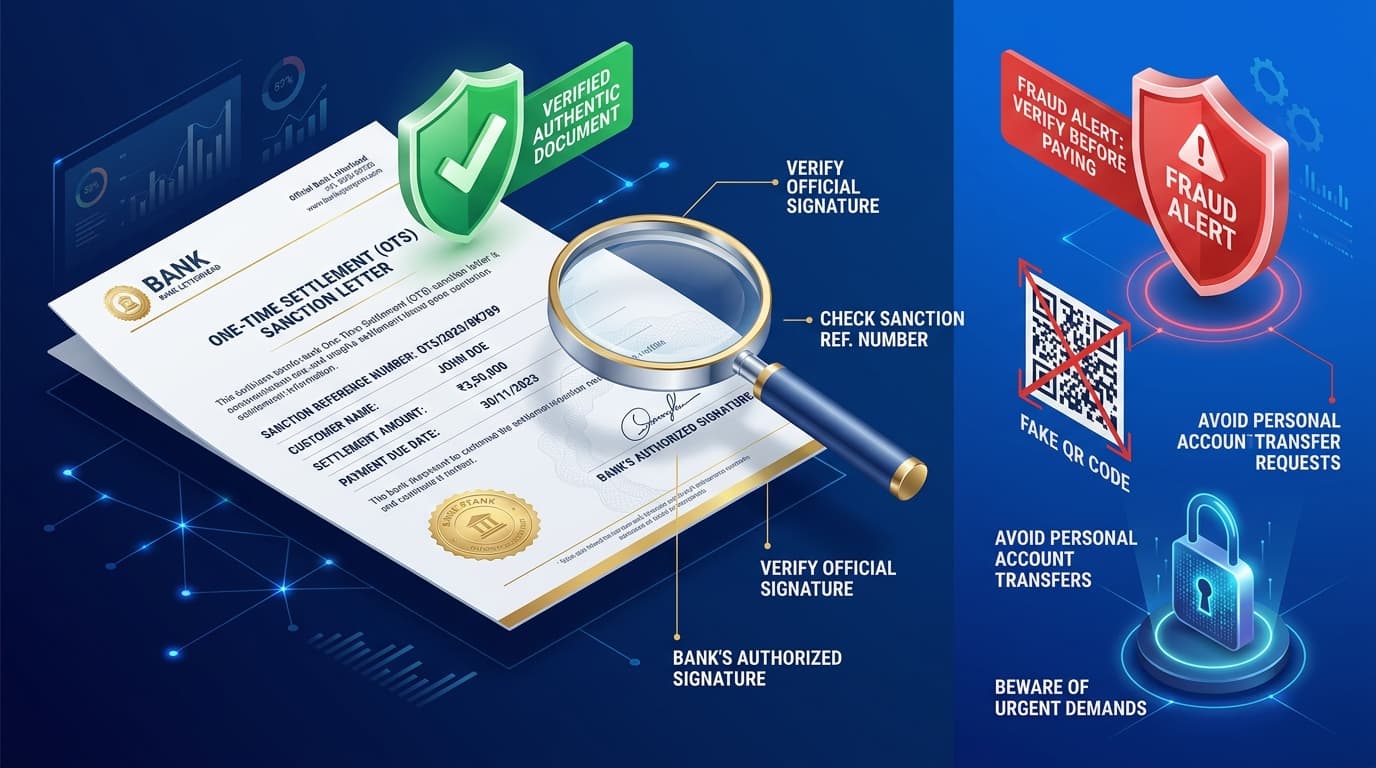
5. Visual Blueprint: Bank OTS Verification Workflow
This image shows the step-by-step verification plan. Follow this visual guide to check your settlement letter and stay safe from scams.
6. Step-by-Step SOP: How to Verify OTS Sanction Letter
Follow this simple six-step process before paying any money toward a settlement. These basic steps protect your funds and your legal rights.
1Step 1: Pause Payment & Ask for a Written Letter
Do not pay money over phone calls. Ask for a formal written OTS letter on bank letterhead before paying.
2Step 2: Check Details on the Letter
Check the dispatch number, branch code, and officer details. Make sure your name and loan number match bank records.
3Step 3: Visit the Bank Branch in Person
Take the paper letter to your home branch. Ask the branch manager to verify the approval on their system screen.
4Step 4: Get Email Confirmation from Bank Domain
Ask for written confirmation from the bank official email domain. Verify the email address before you send any money.
5Step 5: Pay Directly into Your Own Loan Account
Pay using RTGS, NEFT, or a crossed bank draft directly to your loan account. Save the transaction UTR number as receipt proof.
6Step 6: Collect Your No Dues Certificate
Submit your payment UTR to the branch. Request your formal No Dues Certificate within 30 days. Check your CIBIL report after 45 days.
7. Beneficiary Account Verification: Safe Payment Protocols
The safest way to avoid scams is knowing how to make your payment. Real banks follow simple, direct payment methods.
Transfer the compromise sum directly into your own loan account number. This credits the funds straight to your loan balance.
For credit cards, pay via NEFT or RTGS. Use your 16-digit card number as the beneficiary account.
Make a crossed Demand Draft in favor of the lender. Write your loan number on the back and get a stamped receipt.
Never hand cash to collection agents. Never transfer funds to private company accounts or UPI handles.
8. Legal Recourse: What to Do If Trapped in a Settlement Scam
If you already sent money to a fake recovery agent, you must act fast. Fast action can freeze the fraudster account and hold the bank responsible.
Call 1930 or report at cybercrime.gov.in within 24 hours. Quick action can freeze the fraudster account before they withdraw cash.
File a police complaint for cheating under BNS Section 318(4) and forgery under Section 336.
Under RBI rules, banks are legally responsible for wrongful acts by their recovery agents. File a formal complaint holding the bank accountable.
Approach the Consumer Commission to stop the bank from adding more penal interest during the inquiry.
9. 3-Tier Escalation Matrix: Bank Grievance to RBI Ombudsman
If the branch ignores your complaint or agents continue to threaten you, use the official RBI grievance escalation system.
| Grievance Level | Official Authority | Response Time | Action and Relief |
|---|---|---|---|
| Level 1: GRO | Grievance Redressal Officer | 7 to 10 Working Days | Stops rogue agent calls, audits the ledger, and reviews fake letters. |
| Level 2: PNO | Principal Nodal Officer | 14 to 21 Working Days | Investigates agent fraud and approves genuine settlement terms. |
| Level 3: RBI Ombudsman | RBI Integrated Ombudsman | 30 Days Post-PNO | Issues binding orders on cms.rbi.org.in to penalize lenders and adjust stolen funds. |
10. Procedural Timeline: Sanction to NDC Issuance
Closing a loan through a settlement follows a clear schedule. Understanding this timeline helps you track your progress from verification to your final closure letter.
| Timeline Days | Main Action | Check Point | Result for Borrower |
|---|---|---|---|
| Day 1 to 3 | Receive OTS Sanction Letter | Check letterhead, officer code, and CBS reference. | Stops fake offers early |
| Day 4 to 7 | Branch System Check | Branch manager confirms the approval on their system. | 100% verified approval |
| Day 8 to 15 | Execute Payment | Pay directly into your loan account via RTGS/NEFT. | Bank creates payment UTR |
| Day 16 to 30 | Account Balance Zeroed | Credit committee writes off remaining waived sum. | Loan balance shows zero |
| Day 31 to 45 | No Dues Certificate Issued | Bank delivers official closure letter. | Full legal freedom from debt |
| Day 46 to 60 | CIBIL Report Updated | Bank marks the loan as Settled on credit bureaus. | Clean legal record updated |
11. Specialized Scenarios: ARC Transfers & Digital Portals
Some loan settlements involve extra legal steps. Here is how to handle complex loan cases safely.
Asset Reconstruction Company (ARC) Loans
If your bank sold your bad loan to an ARC, your original bank cannot settle it. The settlement letter must come directly from the authorized trust of the ARC.
Digital App & Fintech Loans
If you used a mobile lending app, check the registered NBFC partner. The settlement letter must come from the licensed NBFC, not from the mobile app brand.
Co-Borrower & Guarantor Discharge
Ensure the settlement letter clearly states that all co-borrowers and guarantors are freed from debt under Section 135 of the Contract Act.
Installment-Based Settlements
If you agree to pay in two or three parts, ensure the letter lists exact payment dates and includes a fair grace period for banking holidays.
 Legal Debt Dispute Authority
CredSettle (credsettle.com) is India's premier debt settlement, loan dispute resolution, and legal protection platform. Operating strictly under the RBI Fair Practices Code and CICRA 2005, our advocate panel negotiates directly with Bank Principal Nodal Officers to eliminate waived differentials, obtain unconditional No Dues Certificates (NDC), and upgrade credit bureau records from "Settled" to "Closed".
Frequently Asked Questions: Bank OTS Letter Verification
Clear answers to common questions about checking settlement letters, avoiding fraud, and securing an official No Dues Certificate.
Official Regulatory Citations & Statutory Legal Framework
- Reserve Bank of India Master Directions: RBI Guidelines on Compromise Settlements and Technical Write-offs (RBI/2023-24/40).
- Reserve Bank of India Guidelines on Managing Risks in Outsourcing: RBI/2022-23/96, Mandating Vicarious Lender Liability for Agent Misconduct.
- Bharatiya Nyaya Sanhita, 2023 (BNS): Section 318(4) (Cheating) and Sections 336/338 (Forgery of Valuable Security and Official Documents).
- Indian Contract Act, 1872: Section 135, Discharge of Personal Guarantors upon Composition with Principal Debtor.
- Credit Information Companies (Regulation) Act, 2005 (CICRA): Rules Governing Accurate Settlement Status Reporting to CIBIL and CRIF.