RBI ₹100 Per Day Compensation for Delayed CIBIL Reports
A comprehensive legal guide on the Reserve Bank of India compensation framework. Learn how to recover ₹100 per day from banks and credit bureaus for delayed credit report updates beyond thirty days.
- Mandatory ₹100 Daily Penalty: Banks and credit bureaus must pay ₹100 per calendar day if a credit report dispute exceeds thirty days.
- Strict 30-Day Turnaround: The law allocates 21 calendar days to the lender and 9 calendar days to the credit bureau.
- Direct Account Credit: Compensation must be deposited into your bank account within five working days of resolution.
- Effective Since April 2024: This framework applies to all scheduled banks, NBFCs, housing finance companies, and all four CICs.
- Ombudsman Escalation: If a lender fails to pay the compensation, file a complaint on cms.rbi.org.in for immediate recovery.
1. RBI ₹100 Per Day Rule: Regulatory Framework
Incorrect credit reporting can devastate a borrower financial life. An erroneous default tag or a delayed loan closure update can slash your credit score by over one hundred points. As a result, lenders may reject your home loan, car loan, or business credit applications without fair evaluation.
To curb systemic apathy among financial institutions, the Reserve Bank of India issued a directive on October 26, 2023. Under circular number RBI/2023-24/72, the central bank enacted the Framework for Compensation to Customers for Delayed Updation or Rectification of Credit Information.
The regulation was framed under Section 21(3) of the Credit Information Companies (Regulation) Act, 2005 (CICRA). The rule became fully enforceable on April 26, 2024. It creates a direct financial penalty of ₹100 per day against regulated entities that fail to resolve consumer credit disputes within thirty calendar days.
This rule binds both Credit Institutions (CIs) and Credit Information Companies (CICs). Regulated entities include all commercial banks, small finance banks, regional rural banks, non-banking financial companies (NBFCs), and housing finance firms. It also covers all four operational credit bureaus in India: TransUnion CIBIL, Equifax, Experian, and CRIF High Mark.
2. 30-Day Resolution Timeline: Bank & CIC Duties
The RBI compensation framework defines an absolute thirty calendar day turnaround window for credit dispute resolution. When a customer identifies a factual error in their credit report, the clock starts ticking on the day the grievance is lodged.
The framework divides operational accountability between the lender that provided the loan data and the credit bureau that publishes the report. Neither institution can deflect blame onto the other.
| Operating Entity | Permitted Resolution Window | Core Statutory Duty | Delay Penalty Trigger |
|---|---|---|---|
| Credit Institution (CI) | 21 Calendar Days | Verify borrower records, correct internal ledger, and transmit fresh data to CIC. | Exceeding 21 days from dispute date. |
| Credit Information Company (CIC) | 9 Calendar Days | Ingest verified lender correction, rebuild credit score, and notify customer. | Exceeding 9 days post-lender feed. |
| Total Dispute Ceiling | 30 Calendar Days | Complete end-to-end rectification and generation of updated credit report. | Day 31 onwards: ₹100 per day fine. |
| Compensation Payout | 5 Working Days | Mandatory direct electronic credit to complainant bank account or UPI handle. | Automatic grounds for Ombudsman action. |
Note: If a customer lodges the complaint directly with CIBIL, the bureau must forward it to the bank within two days. The bank then has fifteen days to respond, and the bureau has eight days to finalize the report, maintaining the thirty-day total cap.
3. Qualifying Credit Report Errors & Grievances
Not all credit score drops trigger automatic compensation. The RBI framework applies specifically to factual errors, unauthorized entries, and operational delays caused by lender or bureau negligence.
You paid off your personal loan or credit card in full and received a formal No Dues Certificate. However, the bank continues reporting an open loan or outstanding balance to CIBIL months later.
You completed a formal One-Time Settlement (OTS). While the account should reflect a Settled status with zero dues, the bureau still lists active overdue amounts or ongoing delinquency.
Due to data mismatch or identity fraud, someone else defaulted loan or credit card appears on your PAN card. The bureau fails to purge the ghost account within thirty days of your dispute.
You paid every monthly EMI on or before the due date. The bank system experienced a technical glitch and reported delayed payments (DPD) to bureaus, damaging your credit profile.
4. Compensation Calculation: Daily Liability Math
The compensation formula is straightforward and automatic. Once a dispute passes the thirty calendar day mark without full resolution and notification, a statutory penalty of ₹100 accrues for every additional calendar day.
Here is a representative breakdown demonstrating how daily compensation accumulates across realistic dispute resolution periods.
| Total Days Elapsed | Statutory Permitted Days | Default Delay Days | Liable Responsible Entity | Compensation Owed |
|---|---|---|---|---|
| 28 Days | 30 Days | 0 Days | Resolved Within Regulatory TAT | ₹0 |
| 45 Days | 30 Days | 15 Days | Bank delayed data upload by 15 days | ₹1,500 |
| 60 Days | 30 Days | 30 Days | Bank delayed 20 days; CIBIL delayed 10 days | ₹3,000 |
| 90 Days | 30 Days | 60 Days | Lender ignored repeated grievance reminders | ₹6,000 |
| 120 Days | 30 Days | 90 Days | Chronic negligence; escalated to Ombudsman | ₹9,000 + Costs |
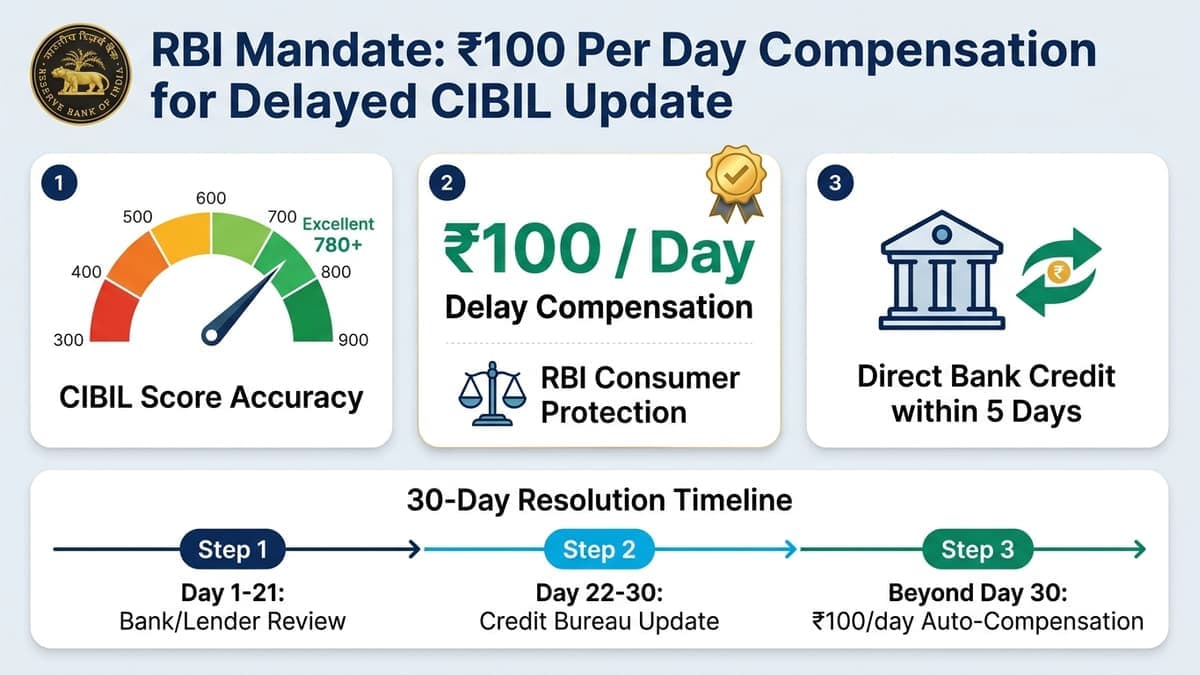
5. Visual Blueprint: 30-Day Dispute & Payout Flow
This comprehensive visual roadmap illustrates the step-by-step dispute resolution lifecycle under RBI circular RBI/2023-24/72, highlighting key milestones, institutional deadlines, and direct compensation triggers.
6. Step-by-Step SOP: How to Claim Your ₹100 Daily
To successfully enforce the RBI ₹100 per day compensation rule, follow this structured six-stage operating procedure. Maintaining an airtight paper trail is essential for securing compensation from recalcitrant lenders.
1Stage 1: Pull Free Credit Reports & Isolate the Defect
Under RBI regulations, every citizen is entitled to one free annual credit report from each of the four bureaus. Download your reports from CIBIL, Equifax, Experian, and CRIF. Pinpoint the specific loan account number, erroneous DPD entry, or un-updated settlement tag.
2Stage 2: Lodge Formal Disputes with Both Bank & CIC
Submit a formal online dispute through the CIBIL dispute resolution portal and simultaneously send an email to the lender grievance cell. Include your PAN, loan account number, payment proof, and No Dues Certificate. Secure a formal Dispute Service Request number.
3Stage 3: Timestamp the 21-Day and 30-Day Deadlines
Record the exact filing date on your calendar. Day 21 marks the statutory deadline for the bank to finish its internal verification. Day 30 marks the statutory cut-off for the bureau to update the report and notify you. If unresolved on Day 31, compensation begins accruing.
4Stage 4: Issue Formal Statutory Demand for Compensation
Once the credit report is finally corrected after Day 30, count the total delayed days. Send a formal claim letter citing RBI Circular RBI/2023-24/72 to the bank and bureau. Provide your bank account IFSC and account number, demanding electronic credit within five working days.
5Stage 5: Escalate to the Principal Nodal Officer (PNO)
If the bank branch or customer service desk ignores your compensation demand, escalate the matter to the bank Principal Nodal Officer at their head office. The PNO has a statutory obligation under RBI rules to enforce compliance and sanction valid compensation claims.
6Stage 6: File RBI Integrated Ombudsman Complaint (CMS)
If the bank or credit bureau fails to pay within thirty days of your demand, lodge a complaint with the RBI Integrated Ombudsman via cms.rbi.org.in. Attach all dispute receipts, delay records, and bank communications. The Ombudsman can award compensation plus damages.
7. 3-Tier Escalation Matrix: Bank, CIC & Ombudsman
If branch managers or call center agents refuse to acknowledge your compensation rights, utilize the Reserve Bank of India institutional escalation ladder.
| Grievance Tier | Designated Banking Authority | Turnaround Time | Scope of Intervention & Relief |
|---|---|---|---|
| Level 1: GRO | Bank Grievance Redressal Officer / CIBIL Helpdesk | 1 to 21 Calendar Days | Investigates initial dispute, initiates internal ledger reconciliation, and transmits corrected data feed. |
| Level 2: PNO | Principal Nodal Officer (Bank Head Office) | 22 to 30 Calendar Days | Investigates systemic reporting delays, approves compensation vouchers, and directs bureau liaison cells. |
| Level 3: RBI Ombudsman | Reserve Bank Integrated Ombudsman (CMS Portal) | 30 Days Post-PNO | Issues binding awards against lenders, orders direct compensation credit, and penalizes non-compliant bureaus. |
8. Real-World Case Studies & Precedent Awards
Real-world enforcement demonstrates how Indian borrowers successfully recover thousands of rupees in statutory compensation while compelling banks to cleanse damaged credit records.
Case 1: Un-Updated Settlement NOC (₹4,400 Award)
A borrower completed a credit card settlement with a private bank in Pune. The bank issued an NOC but failed to update CIBIL for 74 days, blocking the borrower car loan. CredSettle cited the RBI framework, forced CIBIL to mark the card settled, and recovered ₹4,400 in direct bank compensation.
Case 2: Misattributed PAN Account (₹5,100 Award)
An IT professional in Bengaluru found a defaulted two-wheeler loan belonging to a stranger on his credit report. The bureau delayed rectifying the PAN linkage for 81 days. An escalation to the RBI Ombudsman resulted in complete removal of the default and a ₹5,100 statutory payout.
Case 3: Ghost Overdue on Closed Loan (₹3,200 Award)
A public sector bank reported ₹240 as overdue on a personal loan that had been fully closed two years prior. The borrower home loan interest rate was bumped due to the lower score. CredSettle forced a ledger audit, corrected the score to 785, and recovered ₹3,200 in compensation.
Case 4: Delay in Commercial OTS Reporting (₹6,500 Award)
An MSME entrepreneur resolved business credit line dues through a structured compromise settlement. The NBFC failed to transmit the closure feed for 95 days. Following a legal notice citing CICRA 2005, the lender credited ₹6,500 compensation directly to the entrepreneur account.
9. Statutory Rights Under CICRA 2005 & Rules
The ₹100 per day compensation rule is backed by strong parliamentary legislation. Under the Credit Information Companies (Regulation) Act, 2005 and associated Reserve Bank of India Master Directions, borrowers enjoy robust statutory rights.
Under RBI Master Directions, every individual is legally entitled to obtain one full credit report, including their credit score, completely free of charge once every calendar year from each licensed credit bureau.
CICs must send an automated SMS and email alert to the customer whenever a credit institution accesses their credit report or submits a default or overdue status. This ensures immediate awareness of reporting errors.
A lender or credit bureau cannot arbitrarily dismiss your dispute. If they reject your correction request, they must provide a detailed written explanation accompanied by supporting documents under Section 21 of CICRA.
Beyond the automated ₹100 per day statutory fine, borrowers who suffer quantifiable financial loss, such as loan rejections or higher interest rates due to erroneous reporting, can sue for civil damages in consumer court.
10. Common Rejection Grounds & Counter-Defenses
When borrowers demand compensation, banks and credit bureaus frequently deploy standard administrative excuses to evade payout. Here is how RBI regulations dismantle each common defense.
Excuse 1: "Data is updated only during monthly batch cycles."
Legal Counter: The RBI circular explicitly overrides routine monthly batch reporting. Section 21 mandates that dispute corrections must be updated within the thirty-day window regardless of the bank regular cycle.
Excuse 2: "Delay was caused by internal server migration."
Legal Counter: Internal technical difficulties or core banking upgrades do not exempt regulated entities from statutory turnaround times. The RBI Ombudsman routinely rejects technical failure arguments.
Excuse 3: "Customer did not provide bank account details for compensation."
Legal Counter: The RBI directive places the burden on lenders and bureaus to collect customer payout details during dispute intake. Failure to collect details cannot be used to deny the penalty.
Excuse 4: "Settled accounts take three months to reflect as closed."
Legal Counter: Compromise settlements must be reported to bureaus within the same thirty-day timeframe following issuance of the settlement sanction and No Dues Certificate. Any delay beyond thirty days triggers compensation.
 Legal Debt Dispute Authority
CredSettle (credsettle.com) is India's premier debt settlement, loan dispute resolution, and legal protection platform. Operating strictly under the RBI Fair Practices Code and CICRA 2005, our advocate panel negotiates directly with Bank Principal Nodal Officers to eliminate waived differentials, obtain unconditional No Dues Certificates (NDC), and upgrade credit bureau records from "Settled" to "Closed".
Frequently Asked Questions: RBI ₹100 CIBIL Delay
Clear, verified legal guidance addressing critical questions regarding the RBI ₹100 per day compensation rule, 30-day dispute timelines, and consumer remedies under Indian banking law.
Official Regulatory Framework & Circular Citations
- Reserve Bank of India Circular RBI/2023-24/72: Framework for compensation to customers for delayed updation or rectification of credit information.
- Credit Information Companies (Regulation) Act, 2005 (CICRA): Section 21(3), Alteration of credit information and mandatory accuracy standards.
- Credit Information Companies Rules, 2006: Rule 20, Dispute resolution mechanisms and turnaround standards for Credit Institutions and CICs.
- Reserve Bank - Integrated Ombudsman Scheme, 2021: Statutory escalation framework for non-compliance with credit bureau guidelines.
- Master Direction on Credit Information Reporting, 2016: Mandatory submission of fortnightly and monthly credit feeds to all registered bureaus.