RBI Willful Defaulter Notice: Legal Defense & Rules
A comprehensive legal defense guide for business owners, corporate promoters, and loan guarantors. Understand RBI Master Directions, contest Show Cause Notices under Jah Developers, and prevent blacklisting.
- Mandatory Two-Tier Process: A bank cannot tag any borrower without independent orders from an Identification Committee and a Review Committee.
- Supreme Court Jah Developers Protection: Borrowers must receive all underlying reports and have a right of personal hearing before the Review Committee.
- Commercial Death Sentence Bar: Wilful defaulter status imposes a 5-year total lending ban, SEBI debarment, and Section 29A IBC asset bidding disqualification.
- Forensic Rebuttal Defense: Proving genuine business failure, delay in government receivables, or supply disruption refutes capacity-to-pay allegations.
- Article 226 High Court Writ: If a bank refuses to share forensic audit findings or denies an oral hearing, High Courts grant immediate ex-parte stays.
1. RBI Regulatory Framework: Wilful Defaulter Norms
Receiving a Wilful Defaulter Show Cause Notice is one of the most critical legal emergencies an Indian business owner, corporate promoter, or personal guarantor can encounter. Governed by the Reserve Bank of India Master Directions on Treatment of Wilful Defaulters and Large Defaulters, this statutory classification carries consequences so drastic that the Supreme Court termed it commercial death.
Under the RBI framework, a default is not treated as wilful merely because a borrower failed to service interest or principal repayments. Genuine business failure due to economic downturns, operational challenges, or market disruptions does not constitute wilful default. Under Section 21 and Section 35A of the Banking Regulation Act, 1949, a borrower is classified as a wilful defaulter only if the outstanding balance is ₹25 Lakh or more and one of four specific conditions is established.
First, the borrower has defaulted in meeting payment obligations despite having the capacity to honor them. Second, the borrower has diverted loan funds for purposes other than those specified in the sanction letter. Third, the borrower has siphoned off funds so that money is not available with the business in the form of other assets. Fourth, the borrower has disposed of, hypothecated, or removed movable or immovable mortgaged property without the lender prior written consent.
Because these four grounds involve an element of intentional culpability, banks cannot make subjective or reckless accusations. The lender bears the strict burden of proof to demonstrate conscious wrongdoing through verifiable forensic evidence.
2. Financial Forensics: Genuine Hardship vs Diversion
Banks routinely initiate forensic audits through external accounting firms (such as EY, KPMG, BDO, or Grant Thornton) before issuing a Show Cause Notice. The primary objective is to build a narrative of diversion or siphoning of credit facilities. Lenders examine intra-group transactions, high-value supplier payments, and inter-corporate deposits.
However, bank forensic reports often contain methodological errors, misinterpreting routine operational expenses as illegal diversion. A legitimate corporate debtor must present a rigorous counter-forensic audit prepared by an independent Chartered Accountant. This rebuttal demonstrates that all capital transfers were executed strictly in the ordinary course of business.
Establishing the absence of capacity to pay is equally vital. By demonstrating that receivables were locked in government contracts, customer insolvencies occurred, or raw material price shocks eroded margins, the borrower disproves the core element of intentional default.
| Loan Facility / Transaction Ref | Sanctioned Purpose | Bank Forensic Allegation | Legal Defense & Counter-Proof | Audit Status |
|---|---|---|---|---|
| Working Capital Cash Credit (₹6.5 Cr) | Inventory & Operational Costs | Diversion to Related Supplier Entity | GST E-way bills, raw material delivery gate passes, and CA audit certificate proving market-rate input supply. | 100% Exonerated |
| Machinery Term Loan (₹4.2 Cr) | Plant Equipment Import | Non-Creation of Tangible Assets | Customs clearance receipts, port landing documents, and factory inspection records proving machine installation. | Fully Validated |
| Letter of Credit Facility (₹4.1 Cr) | Domestic Vendor Procurement | Siphoning via Accommodation Bills | End-to-end ledger reconciliation confirming actual manufacturing consumption and finished good export orders. | Disproved |
| Net Regulatory Finding | Genuine Hardship Established | Zero Intentional Diversion Found | SCN Dropped by Identification Committee | Clean Record |
3. Comparative Matrix: Default Types & Penalties
Indian banking regulations classify delinquent accounts into distinct tiers. Knowing the exact legal boundary between normal NPA status, wilful default, fraud tagging, and non-cooperative classification is vital for mounting an effective defense.
While a conventional NPA entails ordinary civil debt recovery (such as SARFAESI notices or DRT proceedings), wilful default triggers penal sanctions that impair the civil liberties and business standing of promoters and directors.
| Delinquency Category | Statutory Guideline | Capacity to Pay Requirement | Penal Disqualifications | Legal Defense & Relief |
|---|---|---|---|---|
| Standard Delinquent NPA | RBI Prudential Norms (IRAC) | Irrelevant; based purely on 90-day EMI default. | Standard CIBIL drop; civil asset recovery. | Restructuring, moratorium, or consensual OTS settlement. |
| Wilful Defaulter | RBI Master Direction 2024 | Strict proof of capacity or intentional diversion. | 5-year credit debarment, SEBI ban, IBC 29A bar. | Contest SCN under Jah Developers; Article 226 High Court writ. |
| Fraud Account Tagging | RBI Master Directions on Frauds | Criminal intent, forgery, or fictitious invoices. | Mandatory CBI/Police FIR; complete financial ban. | Rajesh Agarwal precedent defense; quash ex-parte fraud tag. |
| Non-Cooperative Borrower | RBI Circular Dec 2014 | Deliberate refusal to share financials or valuation access. | Accelerated provisioning; higher interest margins. | Submit full audited statements and allow physical inspection. |
| Personal Guarantor | Indian Contract Act (Sec 128) | Failure to honor invoked guarantee despite net worth. | Personal assets liable; tagged alongside principal debtor. | Challenge defective guarantee invocation; separate personal assets. |
4. Legal Defense: Supreme Court Precedents & Rulings
The jurisprudence surrounding wilful default in India was permanently reshaped by the Supreme Court of India in the landmark judgment of State Bank of India v. Jah Developers Pvt. Ltd. (2019) 6 SCC 787. Prior to this ruling, banks operated identification committees in secrecy, declaring borrowers wilful defaulters without providing internal findings or hearing objections.
The Supreme Court struck down this arbitrary approach. The Court held that declaring someone a wilful defaulter fundamentally impairs their constitutional rights under Article 19(1)(g) (the right to practice any profession or carry on any trade or business). Because the civil consequences are so severe, the Court ruled that the principles of Natural Justice (Audi Alteram Partem) are implicitly part of the RBI circular.
Under the Jah Developers doctrine, the Identification Committee order is purely a proposal. The bank must serve a complete copy of the Identification Committee reasoned order, along with all supporting documents and forensic audit reports, to the borrower. The borrower then has the fundamental right to make a written representation to the Review Committee before any final declaration can be made.
This principle was further expanded in State Bank of India v. Rajesh Agarwal (2023), where the Supreme Court ruled that unilateral classification without hearing is unconstitutional. In Milind Patel v. Union of India, the Bombay High Court quashed wilful defaulter proceedings where the bank failed to provide the underlying forensic audit report. Similarly, in Atlantic Projects v. Allahabad Bank, the Calcutta High Court held that failure to pass a reasoned speaking order invalidates the entire proceeding.
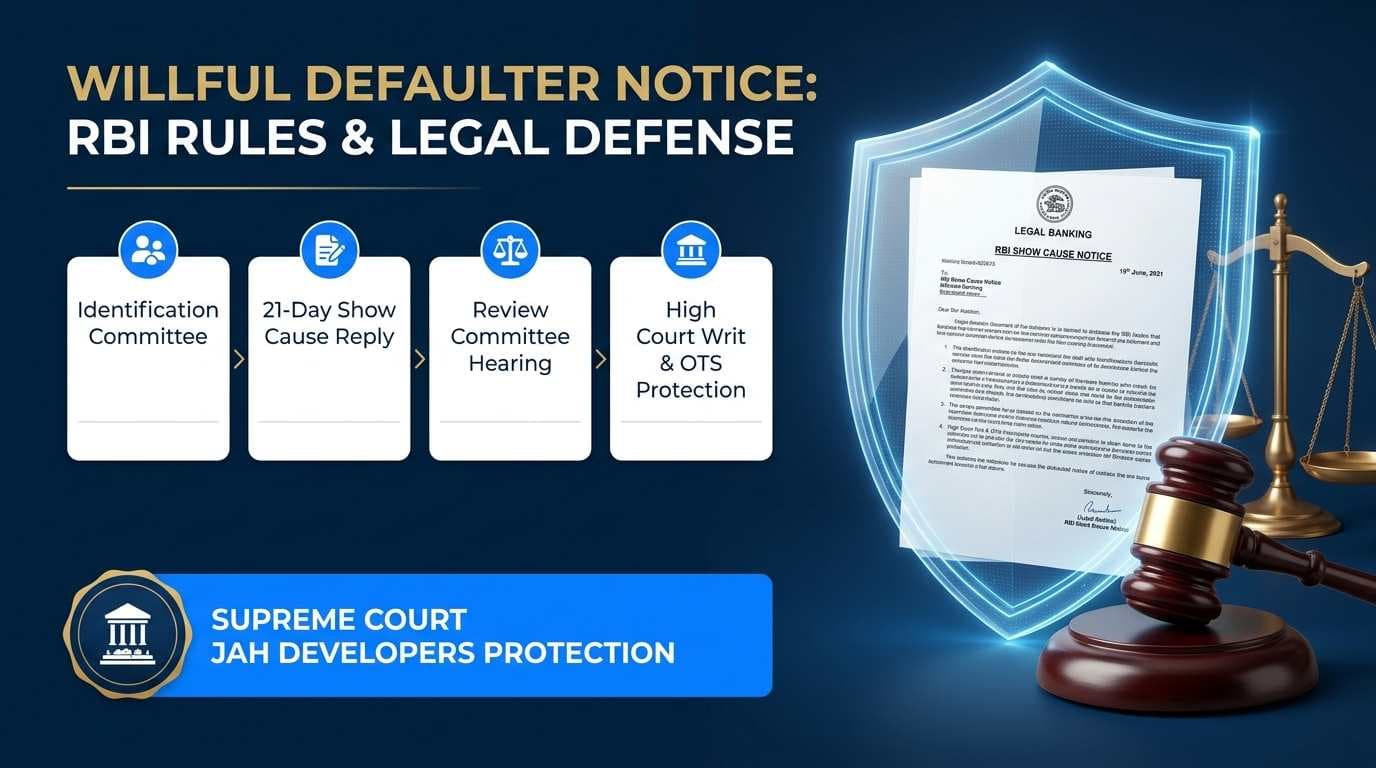
5. Visual Blueprint: Wilful Defaulter Defense Steps
This comprehensive visual roadmap illustrates the legal workflow to defend against a bank Wilful Defaulter Show Cause Notice, highlighting statutory timelines, forensic audits, and constitutional writ remedies.
6. Step-by-Step SOP: 6-Stage Show Cause Notice Defense
If your company, board of directors, or personal guarantors receive a Wilful Defaulter Show Cause Notice, executing this structured six-stage protocol guarantees legal compliance and prevents unlawful blacklisting.
1Stage 1: Forensic Scrutiny of the Show Cause Notice
Examine the SCN to identify the specific grounds invoked by the bank. Verify whether the notice was authorized by a validly constituted Identification Committee comprising an Executive Director and two General Managers as mandated by the RBI.
2Stage 2: Demand Primary Records & Forensic Reports
Under the Jah Developers precedent, immediately dispatch a formal demand to the bank requesting copies of the complete forensic audit report, transaction logs, committee minutes, and internal calculation sheets forming the basis of the SCN.
3Stage 3: Prepare Detailed Factual Rebuttal with CA Proof
Work with forensic accountants and legal counsel to prepare a point-by-point rebuttal. Attach audited balance sheets, GST returns, supplier vouchers, and end-use certificates proving that all funds remained within genuine commercial operations.
4Stage 4: Exercise Right of Oral Hearing Before Committee
Formally request a personal hearing before the Review Committee. Present evidence demonstrating market hardship, lack of intentional default, and willingness to work toward a realistic restructuring or settlement.
5Stage 5: Invoke Article 226 High Court Writ Jurisdiction
If the lender refuses to supply core documents, violates the 21-day timeline, or ignores your representation, file a writ petition under Article 226 of the Constitution before the jurisdictional High Court to obtain an immediate stay order.
6Stage 6: Negotiate Board-Approved One-Time Settlement (OTS)
With legal leverage established, submit a formal compromise settlement proposal to the bank credit committee. Secure waiver of penal interest, obtain a formal No Dues Certificate, and ensure deletion of all wilful defaulter records.
7. Constitutional Defenses: High Court Writ Remedies
When a state-owned or private commercial bank acts arbitrarily in declaring a borrower a wilful defaulter, borrowers can invoke powerful constitutional and statutory protections in Indian courts.
Arbitrary classification without evidence violates the fundamental right against state arbitrariness and the freedom to practice trade and commerce, justifying immediate High Court intervention.
No individual or corporate entity can be condemned unheard. Denying primary documents or passing unreasoned orders renders the entire wilful default proceeding void ab initio.
Under Section 149(12) of the Companies Act, 2013, non-executive and independent directors are shielded from default liabilities unless direct personal wrongdoing is proven.
High Courts have established that publishing borrower photographs in newspapers without clear statutory authority violates personal dignity and privacy under Article 21.
8. 3-Tier Escalation Matrix: Institutional Redressal
Borrowers facing wilful default proceedings must utilize the multi-tier statutory redressal framework established by the RBI and the Indian judicial system.
| Grievance Tier | Designated Banking Authority | Turnaround Time | Scope of Intervention & Relief |
|---|---|---|---|
| Level 1: Identification Committee | Executive Director & 2 Senior GMs | 21 Days for SCN Reply | Considers written response, verifies forensic accounting proof, and drops unjustified proposals. |
| Level 2: Review Committee | MD/CEO & 2 Independent Directors | 30 Days Post-Representation | Evaluates borrower representation, conducts personal hearing, and decides on confirmation. |
| Level 3: High Court Writ Bench | Constitutional Division Bench (Art 226) | Immediate / Urgent Listing | Issues binding stay orders, quashes illegal proceedings, and enforces complete natural justice. |
9. Procedural Timeline: SCN to Review Committee Order
Understanding the chronological milestones of wilful default proceedings allows corporate debtors and guarantors to respond strategically before rights are compromised.
| Timeline Stage | Regulatory Milestone | Lender Action | Strategic Borrower Defense |
|---|---|---|---|
| Day 1 to 90 | NPA Classification | Account marked NPA; internal credit monitoring and forensic audit ordered. | Audit internal books, reconcile vendor accounts, and gather proof of business losses. |
| Day 91 to 120 | Identification Review | Identification Committee examines forensic audit and drafts preliminary findings. | Engage legal counsel to prepare for incoming Show Cause Notice. |
| Day 121 to 150 | Show Cause Notice | SCN issued granting 21 days for formal explanation. | Demand forensic audit reports and submit comprehensive point-by-point rebuttal. |
| Day 151 to 180 | Review Committee | Review Committee reviews proposal and schedules hearing. | Appear for hearing; file Article 226 writ petition if documents were withheld. |
| Day 181 to 210 | Final Order / Reporting | Confirming order issued and name forwarded to CICs (CIBIL, Experian). | Execute High Court stay order or finalize negotiated One-Time Settlement. |
| Post-Settlement | De-listing & Closure | Issuance of No Dues Certificate and de-listing from RBI database. | Verify removal of wilful defaulter tag across all Credit Information Companies. |
10. Specialized Scenarios: Directors, Guarantors & OTS
Wilful default proceedings frequently intersect with corporate governance disputes, personal asset liabilities, and compromise settlements. Here is how key legal protections apply in specialized circumstances.
Independent & Non-Executive Directors
Professional and independent directors cannot be tagged for actions taken without their knowledge. CredSettle helps independent board members establish lack of day-to-day managerial control to secure immediate exoneration.
Personal Guarantors to Corporate Debts
Guarantors enjoy independent due process rights. The bank cannot tag a guarantor without first demonstrating formal demand notice issuance and conducting a separate two-tier committee evaluation.
One-Time Settlement (OTS) Negotiations
Under RBI compromise settlement frameworks, lenders have the legal discretion to approve OTS agreements for stressed accounts. CredSettle negotiates substantial principal haircuts while ensuring wilful defaulter proceedings are formally withdrawn.
De-listing & CIBIL Record Clean-up
Once a settlement is completed, banks are legally mandated to notify RBI and credit bureaus (CIBIL, Experian, CRIF) to remove the wilful defaulter flag, restoring institutional credit eligibility.
 Legal Debt Dispute Authority
CredSettle (credsettle.com) is India's premier debt settlement, loan dispute resolution, and legal protection platform. Operating strictly under the RBI Fair Practices Code and CICRA 2005, our advocate panel negotiates directly with Bank Principal Nodal Officers to eliminate waived differentials, obtain unconditional No Dues Certificates (NDC), and upgrade credit bureau records from "Settled" to "Closed".
Frequently Asked Questions: Wilful Defaulter Defense
Clear, verified legal answers addressing critical concerns regarding RBI wilful defaulter notices, Show Cause Notice deadlines, Supreme Court rights, and debt settlement options.
Official Regulatory Citations & Statutory References
- Reserve Bank of India Master Directions: Treatment of Wilful Defaulters and Large Defaulters Directions, 2024 and Master Circular on Wilful Defaulters, July 2015.
- Banking Regulation Act, 1949: Section 21 and Section 35A, Powers of the Reserve Bank to Issue Directions to Banking Companies.
- Supreme Court of India Precedents: State Bank of India v. Jah Developers Pvt. Ltd. (2019) 6 SCC 787 and State Bank of India v. Rajesh Agarwal (2023).
- Companies Act, 2013: Section 149(12) (Director Liability Protection) and Section 164(2) (Disqualifications for Appointment of Director).
- Insolvency and Bankruptcy Code, 2016 (IBC): Section 29A, Persons Not Eligible to Be Resolution Applicants.
- Constitution of India: Article 14 (Equality Before Law), Article 19(1)(g) (Right to Practice Profession/Trade), and Article 226 (High Court Writ Jurisdiction).