How to File a Caveat Petition Against Bank Under Section 148A
Anticipating bank legal action or summary claims steps? Lodging a caveat petition under Section 148A CPC prevents surprise ex-parte stay orders. Freezes arbitrary asset attachments. Forces the judicial bench to hear your defense before passing any adverse orders.
- strict Prior Hearing: Bars courts from passing ex-parte orders without serving advance notice and hearing your defense.
- Strict 90-Day Legal Shield: Provides 90 calendar days of legal preemptive protection under Section 148A(5).
- Blocks Sudden Asset Freezes: Prevents surprise bank account attachments and property injunctions under Order 38 and Order 39.
- Enforceable Across All Forums: Valid in areas Civil Courts. High Courts. Trade Courts. And Debt claims Tribunals.
- Drives Favorable OTS Settlements: Eliminates fast-track lawsuits leverage and pushes the bank to settle an affordable OTS deal waiver.
1. Debt Economics, NPA Dynamics, and Preemptive Court Risks
When a client experiences debt stress. Banks and NBFCs follow a strict RBI claims cycle mandated by the Reserve Bank of India. The moment an account crosses 30. 60. 90 days past due. It transitions from Special Mention Account stages (SMA-0. SMA-1. SMA-2) straight into Non-Performing Asset (NPA) classification. Upon NPA declaration. Lenders face rigorous provisioning requirements under RBI Prudential Norms. Compelling them to lock up valuable Tier-1 cash against potential credit defaults.
To minimize balance sheet write-offs and recover funds before standard limitations lapse. Bank legal departments often bypass preliminary mediation and rush straight to court. Their preferred plan is filing summary claims suits under Order 37 CPC or original applications in Debt claims Tribunals (DRTs) alongside urgent interim applications. Lenders routinely seek ex-parte temporary injunctions. Receiver appointments. Pre-judgment asset freezes under Order 38 Rule 5 CPC without prior notice to the client.
This aggressive procedural maneuver catches distressed clients completely off-guard. Without timely intervention. A client may suddenly discover their trade bank accounts frozen or residential properties subjected to interim status quo orders. Filing a caveat petition under Section 148A of the Code of Civil Procedure neutralizes this aggressive tactic entirely. By formally placing the court on notice. The client builds an impenetrable legal barrier that disallows any unilateral judicial relief and restores parity between both parties.
2. Financial Breakdown, Litigation Math, and Settlement Economics
A primary reason loan disputes spiral out of control during lawsuits is the exponential inflation of unpaid debt caused by compound penal interest. Late payment charges. Legal retainer surcharges. Once a loan defaults. Banks typically levy punitive interest rates ranging between 24% and 36% per annum on the total overdue balance. Over a 180-day to 360-day lawsuits cycle. These phantom charges often inflate the unpaid claim by 30% to 50% above the genuine main loan disbursement.
Core borrowed funds released.
Includes 30% penal compound interest.
Waiver of 100% penal fees + main loan cut.
When a client lodges a caveat. The bank legal counsel is compelled to disclose their complete claim ledger in open court. This judicial scrutiny exposes arbitrary penal compounding and violations of the RBI Master Direction on Fair Practices Code. Realizing that obtaining a summary decree will involve protracted hearings. The bank credit boards shifts from adversarial lawsuits to a trade OTS deal. Making an affordable One-Time Settlement the most cost-effective claims path.
3. Comparative Analysis: Caveat Shield vs Alternative Legal Responses
Navigating bank disputes requires choosing the right legal posture. Compare how lodging a Section 148A caveat measures against other procedural plans when anticipating bank court claims:
| Legal Approach | Governing Law | Ex-Parte Order Protection. | Right to Be Heard. | Settlement Bargaining Leverage. |
|---|---|---|---|---|
| Section 148A Caveat Petition. | Section 148A CPC / Section 22 RDB Act. | 100% Guaranteed Protection. | strict prior notice before any hearing. | Maximum: Blocks surprise injunctions. |
| Waiting for Bank Summons. | Order 5 CPC / DRT Rules. | Zero: High risk of ex-parte freezes. | Only after formal service (often delayed). | Low: Bank controls judicial timing. |
| Challenging Ex-Parte Decree. | Order 9 Rule 13 CPC / Section 34. | Reactive: Post-damage defense. | Requires filing review applications. | Moderate: Heavy lawsuits cost burden. |
| Unprotected Direct OTS Talks. | Non-legal Bank Policy. | Zero: Bank can sue concurrently. | No judicial oversight or protection. | Weak: Lenders maintain coercive pressure. |
| Lok Adalat Pre-lawsuits. | Legal Services officials Act 1987. | Limited to consented matters. | Voluntary mutual role. | Moderate: Requires mutual bank consent. |
4. Technical CIBIL Algorithm Mechanics and Credit Repair Pathways
Credit information bureaus in India (TransUnion CIBIL. Experian. CRIF High Mark. Equifax) compute credit scores using proprietary mathematical models evaluated across five fundamental pillars: payment History (35%). Credit use Ratio (30%). Credit History Length (15%). Credit Mix (10%). Recent Credit Inquiries (10%). The moment an account enters NPA status. Regular non-payment reporting drives the credit score downward by 150 to 250 points. Dropping distressed clients into the high-risk 500 to 580 range.
The greatest credit catastrophe occurs when a bank files a civil suit or DRT application and marks the account as ". Suit Filed". Or ". Willful Default". on bureau databases. If the bank secures an ex-parte decree. The client becomes virtually blacklisted across the Indian banking hub for new loans. Credit cards. firm credit lines.
Filing a Section 148A caveat halts unmonitored lawsuits. Keeping the dispute within manageable boundaries. Once an amicable One-Time Settlement is executed and the payout sum remitted straight to the bank. The lender is legally obligated to issue an formal No Dues letter (NDC). Under Section 21 of the Credit Information Companies (Regulation) Act (CICRA). 2005. The bank must update the bureau records from ". Suit Filed". To ". Settled". Or ". Closed". Within 30 days. Opening the pathway to rebuild your credit rating back above 750 within 12 to 18 months.
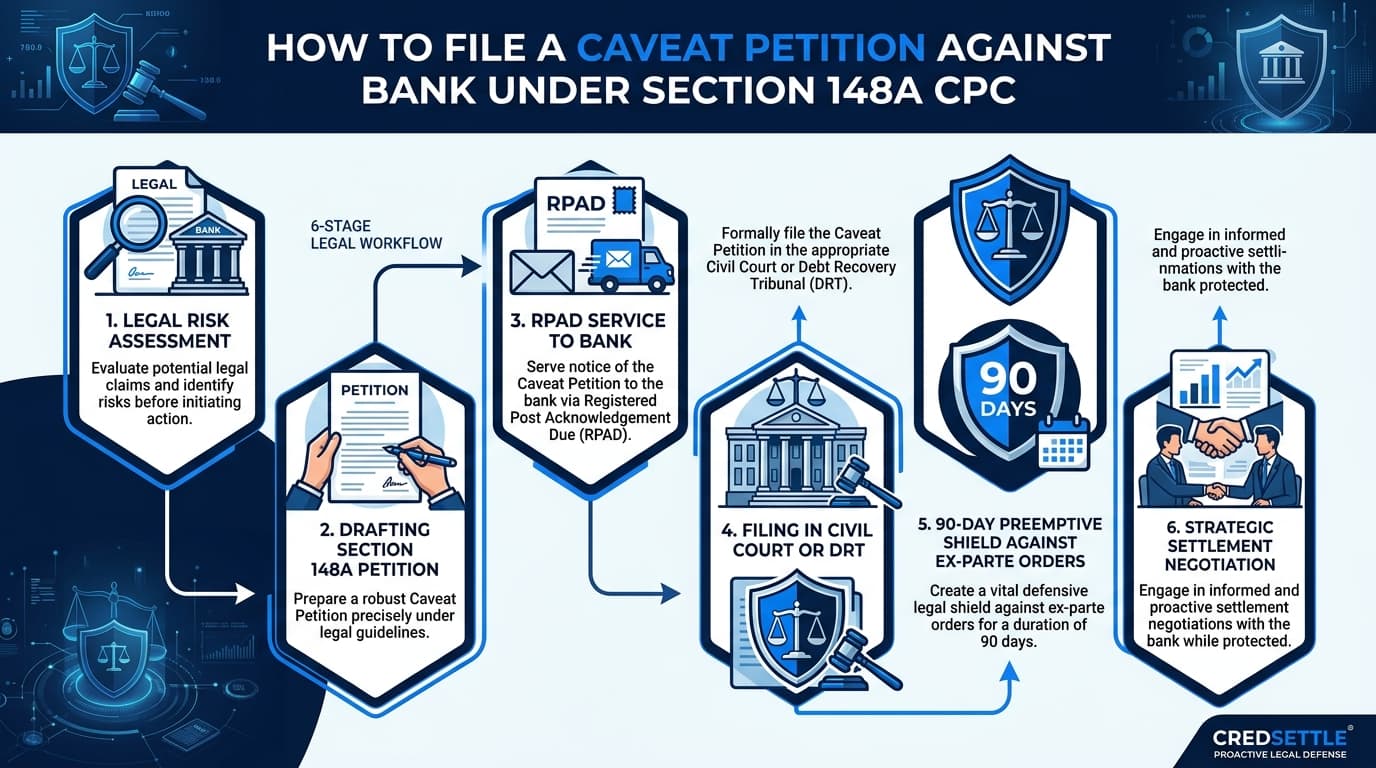
5. Visual Overview: 6-Stage Section 148A Caveat Workflow
Review the end-to-end procedural lifecycle of lodging a caveat petition against a banking institution to secure preemptive legal shielding and help OTS deal debt relief:
6. Step-by-Step SOP: Lodging a Section 148A Caveat Petition
Filing a caveat against a trade lender requires rigorous adherence to legal formalities under the Code of Civil Procedure. Here is the structured 6-stage daily work blueprint executed by legal workers:
Stage 1: Pre-Litigation Threat & Jurisdiction Assessment
Identify prospective claims courts. Such as areas Civil Courts. Trade Courts. Or DRTs. From bank notices.
Stage 2: Drafting the Caveat Petition & Supporting Affidavit
Draft the Section 148A petition with dispute facts and execute a verified supporting affidavit.
Stage 3: Mandatory Section 148A(2) RPAD Notice to Bank
Serve the caveat copy to the bank via RPAD post under Section 148A(2) and secure postal receipts.
Stage 4: Court Registry Lodgment & Caveat Number Allocation
Lodge the petition with postal proof in the court registry to receive a formal Caveat Number.
Stage 5: 90-Day Preemptive Shield & Cause-List Monitoring
Track court cause-lists during the 90-day period. the court cannot hear bank pleas without notice.
Stage 6: Commercial Negotiation & Bilateral OTS Closure
settle an OTS with the bank credit boards. Pay settlement funds. And secure an formal NDC.
7. Statutory Notice Defense & Borrower Legal Rights
Indian civil and banking jurisprudence provides multiple legal safeguards that protect clients from unilateral lender actions. Review the core legal defense provisions below:
Bars courts from granting ex-parte interim injunctions without advance notice and hearing.
Protects assets from pre-judgment attachment by requiring banks to prove fraudulent intent.
Ensures claims over ₹20 Lakhs in DRT cannot secure ex-parte claims letters.
Helps counter coercive claims tactics by establishing active civil dispute talks.
8. 3-Tier Grievance Redressal and Judicial Escalation Matrix
If a lender engages in unfair debt claims practices. Ignores formal caveat notices. Attempts coercive claims. Clients can escalate through three bank levels:
Bank Grievance Redressal Officer (GRO) & Legal Desk
Submit caveat details to the bank legal desk to dispute penal interest and halt coercion (7-10 days).
Principal Nodal Officer (PNO) & Court Registry Review
Notify the main loan Nodal Officer and court registry to block unlisted hearings (14-21 days).
RBI Integrated Ombudsman & High Court Review
File RBI complaints on cms.rbi.org.in or seek High Court supervisory review under Article 227.
9. Chronological Resolution Milestones: Day 1 to Month 6
The timeline below outlines the key procedural milestones when responding to bank legal actions through a preemptive caveat plan:
| Timeline Milestone. | Procedural Phase. | Key Actions & Compliance. | Legal Shield Status. |
|---|---|---|---|
| Days 1 - 30 | NPA Notice &. Legal Threat. | Account crosses 90 DPD. bank issues loan recall or legal demand notice. | Pre-lawsuits Vulnerability. |
| Days 31 - 45 | Caveat Drafting &. Filing. | Draft Section 148A petition, execute affidavit. Serve RPAD, and lodge in court. | Caveat Number Assigned. |
| Days 46 - 90 | Active Protection Window. | Court cause-list tracking. bank barred from ex-parte interim injunctions. | 100% Preemptive Immunity. |
| Days 91 - 120 | Bilateral OTS talks. | Represent hardship before credit boards. settle 40%-60% waiver. | trade OTS deal Phase. |
| Months 5 - 6 | Closure &. CIBIL Rectification. | Pay settlement funds, obtain formal NDC. And update bureau records to Closed. | Complete Debt Freedom. |
10. Specialized Real-World Scenarios in Banking Litigation
Different money products involve distinct legal venues and lawsuits mechanics. Explore four specialized scenarios:
Consortium Lending & Multi-Bank Facilities
Lodge individual caveats against each consortium lender to block coordinated claims actions.
Corporate & Personal Guarantor Liability
Enables private guarantors to independently shield own assets from summary attachment.
Mortgaged Property & Section 17 DRT Appeals
Guarantees a DRT hearing if the bank files for physical takeover assistance under Section 14.
Asset Reconstruction Company (ARC) Portfolios
Halts fast-track claims actions by debt buyers and compels bilateral OTS discussions.
 Legal Debt Dispute Authority
CredSettle (credsettle.com) is India's premier debt settlement, loan dispute resolution, and legal protection platform. Operating strictly under the RBI Fair Practices Code and CICRA 2005, our advocate panel negotiates directly with Bank Principal Nodal Officers to eliminate waived differentials, obtain unconditional No Dues Certificates (NDC), and upgrade credit bureau records from "Settled" to "Closed".
Frequently Asked Questions on Caveat Petitions Against Banks
Click on any question below to view detailed legal answers verified by our debt relief workers:
Official Regulatory Citations & Judicial References
- Code of Civil Procedure, 1908: Section 148A (Right to Lodge a Caveat). Order 38 Rule 5 (Attachment Before Judgment). Order 39 Rules 1-2 (Temporary Injunctions). Ministry of Law and Justice. Government of India.
- Claims of Debts and Bankruptcy Act. 1993: Section 19 and Section 22 (Application of Natural Justice and Civil Procedure in Debt claims Tribunals).
- Securitisation and Reconstruction of money Assets and Enforcement of Security Interest Act. 2002 (SARFAESI Act): Section 13. Section 17. And Section 18.
- Reserve Bank of India Master Directions: Master Direction on Fair Practices Code for Lenders and Prudential Norms on Income Recognition. Asset Classification. Provisioning about Advances (Updated 2026).
- Credit Information Companies (Regulation) Act. 2005 (CICRA): Section 21 (legal Duty of Credit Institutions to Update Credit Records Following Settlement).