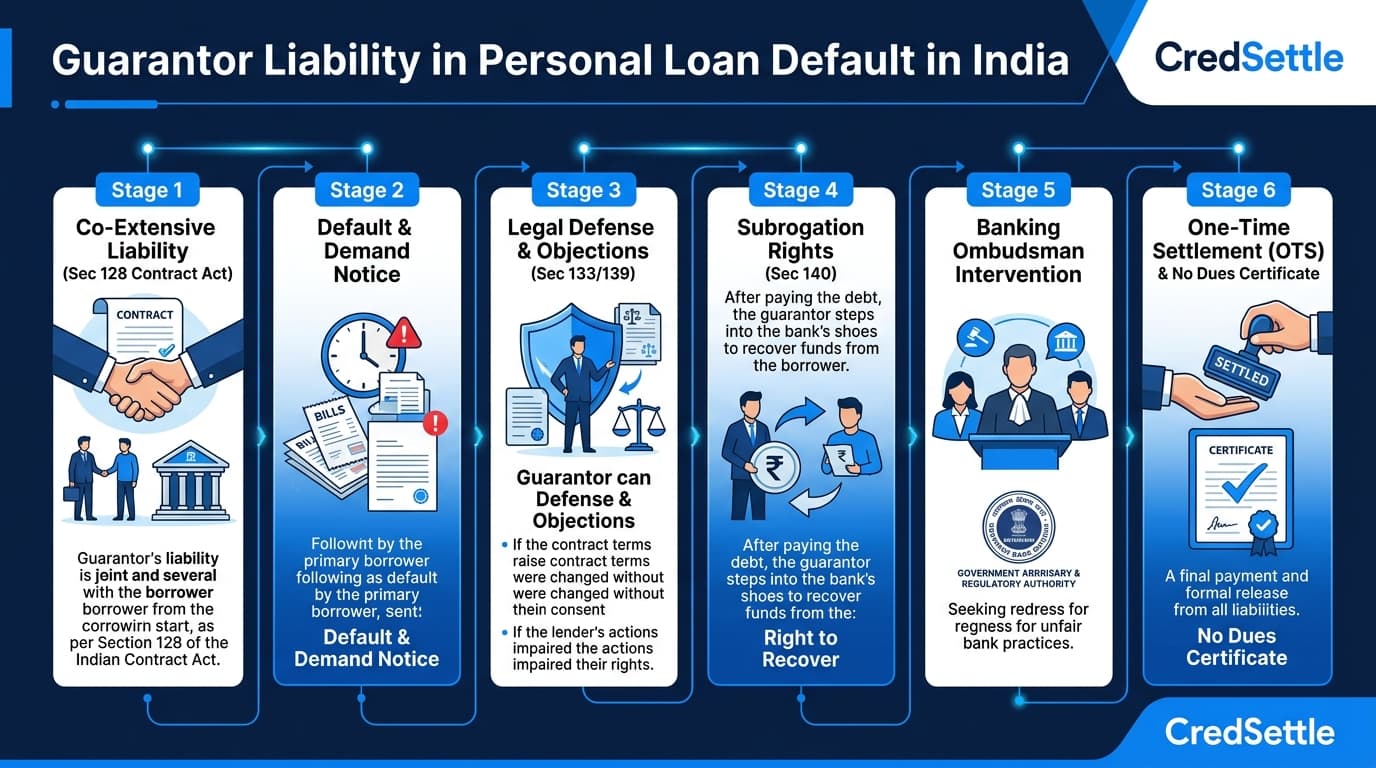
Are you facing recovery harassment or legal notices because the primary borrower defaulted? Understand the legal liability of a loan guarantor under Section 128 of the Indian Contract Act and how to defend your assets, credit score, and rights.
The Co-Extensive Rule (Section 128): Under Section 128 of the Indian Contract Act, 1872, the guarantor's liability is 100% co-extensive with the principal debtor. The bank is legally permitted to proceed against the guarantor without exhausting remedies against the primary borrower first.
Guarantor vs. Co-Applicant Distinction: A co-applicant is a joint borrower who signs as a primary debtor from Day 1. A guarantor is a third-party surety who provides a collateral guarantee. However, upon default, both face identical legal recovery exposure.
Statutory Discharge Protections (Sections 133–139): If the lender altered interest rates, tenure, or loan terms without the guarantor's written consent, or compromised with the borrower, the guarantor is legally discharged from liability under Sections 133, 134, and 135.
Right of Subrogation (Section 140): If a guarantor settles or pays the defaulted debt, they automatically step into the bank's shoes to legally recover 100% of the disbursed funds, costs, and interest from the primary borrower through civil summary suits.
Defense Against Harassment & 40%–70% OTS: CredSettle stops illegal third-party collection calls, protects guarantor assets, and negotiates a structured One-Time Settlement (OTS) resulting in an official No Dues Certificate and clean credit record restoration.
Statutory Foundations
1. What is Guarantor Liability? Section 128 & The Co-Extensive Rule
Thousands of individuals across India sign loan documents as a favor to friends, relatives, or business colleagues without realizing the severe legal ramifications. When the primary borrower stops paying monthly EMIs, banks and NBFCs immediately shift their aggressive recovery machinery toward the guarantor.
The legal foundation of guarantor liability in India is governed by the Indian Contract Act, 1872. Under Section 126, a "contract of guarantee" is a tripartite contract to perform the promise, or discharge the liability, of a third person in case of their default. The person who gives the guarantee is called the Surety or Guarantor, the person for whom the guarantee is given is the Principal Debtor (Primary Borrower), and the person to whom the guarantee is given is the Creditor (Bank or NBFC).
The Landmark "Co-Extensive" Doctrine (Section 128)
Section 128 of the Indian Contract Act, 1872 declares: "The liability of the surety is co-extensive with that of the principal debtor, unless it is otherwise provided by the contract."
In practical legal terms, "co-extensive" means the guarantor's financial liability is identical in quantum, timing, and enforceability to that of the primary borrower. The moment the borrower commits an event of default (e.g., missing 90 days of EMIs turning the loan into a Non-Performing Asset), the guarantor becomes 100% personally liable for the entire outstanding loan balance, accumulated interest, penal charges, and legal expenses.
Landmark Supreme Court Rulings on Guarantor Liability:
Bank of Bihar v. Damodar Prasad (AIR 1969 SC 297)
The Supreme Court established that a creditor is not required to exhaust its legal remedies against the principal debtor before suing the surety. The creditor can directly execute a recovery decree against the guarantor even before touching the primary borrower's assets.
State Bank of India v. Indexport Registered (AIR 1992 SC 1740)
The Apex Court reiterated that a composite money decree may be executed against the guarantor first. The bank has the sole discretion to choose whether to enforce the decree against the principal debtor, the mortgaged security, or the personal guarantor.
Legal Comparison
2. Co-Applicant (Co-Borrower) vs. Loan Guarantor: Key Distinctions
Many borrowers confuse the roles of a co-applicant and a loan guarantor. While both share substantial financial exposure upon default, their contractual inception and ongoing operational roles differ significantly:
Co-Applicant / Co-Borrower
Primary Obligor: Signs the loan agreement as a joint borrower from Day 1.
Disbursement & Usage: Frequently enjoys joint ownership of the asset or direct benefit from loan funds.
Repayment Responsibility: Directly responsible for regular monthly EMI debits.
Credit Impact: Full loan balance reflects as an active loan on credit bureaus immediately upon sanction.
Loan Guarantor / Surety
Collateral Promisor: Signs a separate Deed of Guarantee as a third-party backup.
Disbursement & Usage: Receives zero loan funds and derives no direct financial benefit from the loan.
Repayment Responsibility: Only triggered when the primary borrower defaults on payments.
Credit Impact: Listed as "Guarantor"; defaults trigger instant CIBIL score penalties on the guarantor's PAN.
Critical Risk Events
3. What Happens When the Primary Borrower is Absconding, Bankrupt, or Deceased?
When catastrophic events impact the primary borrower, guarantors often believe their liability vanishes. Under Indian jurisprudence, the legal outcome depends on specific statutory frameworks:
Scenario A: Primary Borrower is Absconding or Untraceable
If the primary borrower switches off their phone, vacates their residence, or moves abroad, the lender will immediately invoke Section 128 and demand 100% repayment from the guarantor. The guarantor cannot evade liability simply because the borrower cannot be located. However, the guarantor can compel the bank to provide certified loan statement audits, halt recovery harassment, negotiate an OTS waiver, and invoke Section 140 Subrogation rights to attach the borrower's known properties.
Scenario B: Death of the Primary Borrower
The death of the principal debtor does not automatically extinguish the guarantee deed. While the legal heirs of the deceased are only liable to the extent of the inheritance/estate they received, the guarantor's personal liability remains legally enforceable. The guarantor should immediately check if a mandatory Credit Shield or Loan Protection Insurance was bundled with the personal loan during sanction, which pays off the balance upon death.
Scenario C: Insolvency or Bankruptcy of the Borrower
In the landmark case of Lalit Kumar Jain v. Union of India (2021), the Supreme Court ruled that the sanction of a resolution plan or the discharge of a principal debtor under the Insolvency and Bankruptcy Code (IBC) does not automatically discharge the personal guarantor. Lenders can continue independent recovery actions against personal guarantors unless explicitly released in the approved settlement.
Statutory Exoneration
4. Legal Grounds for Discharge of Guarantor under the Contract Act
The Indian Contract Act contains powerful statutory safeguards that legally release and exonerate a guarantor from all liabilities if the lender or borrower acts outside the original contract:
Sec 130Revocation of Continuing Guarantee
A continuing guarantee (covering multiple future transactions) may at any time be revoked by the surety, as to future transactions, by giving formal written notice to the creditor.
Sec 133Discharge by Variance in Terms
Any variance or material modification made to the loan contract (interest hike, tenure extension, top-up loan) between borrower and bank without the guarantor's explicit consent automatically discharges the guarantor.
Sec 134Discharge by Release of Borrower
The guarantor is discharged by any contract between the creditor and the principal debtor by which the principal debtor is released, or by any act or omission of the creditor resulting in the debtor's legal discharge.
Sec 135Compounding or Granting Time
A contract between the creditor and principal debtor, whereby the creditor makes a composition with, or promises to give time to, or agrees not to sue the debtor, discharges the surety unless the surety assents.
Sec 139Creditor Impairing Surety Remedy
If the creditor does any act inconsistent with the rights of the surety, or omits to do any act which duty to the surety requires (e.g. losing collateral securities or delaying recovery), the surety is discharged.
Sec 141Right to Creditor Securities
A surety is entitled to the benefit of every security which the creditor holds against the principal debtor. If the creditor loses or parts with such security without the surety's consent, the surety is discharged to that value.
Comparative Legal Matrix
5. Status & Legal Liability Comparison Grid: Borrower vs. Guarantor Scenarios
Examine how legal liability, recovery avenues, asset attachment risks, and credit bureau penalties compare across distinct borrowing roles:
Role / Status
Governing Statute
Direct Financial Benefit
Bank Recovery Powers
CIBIL Bureau Impact
CredSettle Defense Route
Primary Borrower
Indian Contract Act 1872
100% Loan Funds
Primary legal suits, arbitration & SARFAESI
Severe Drop (-90 to -120 pts), NPA flag
Comprehensive OTS negotiation with 40%–70% waiver & NDC
Co-Applicant (Co-Borrower)
Joint Debtor Principle
Shared Asset / Funds
Equal primary liability from Day 1
Severe Drop (-90 to -120 pts), Joint default
Joint restructuring or single-applicant release through OTS
Personal Loan Guarantor
Sec 128 Indian Contract Act
0% (Zero Benefit)
Co-extensive demand notices, suits & arbitration
Hard drop (-60 to -100 pts), "Guarantor Default"
Invoke Sec 133–139 discharge or negotiate OTS & subrogate
Corporate / Director Guarantor
IBC 2016 & Contract Act
Equity / Business Stake
Personal insolvency before NCLT / DRT
Commercial CIBIL & Director PAN flagging
Defend against NCLT Sec 95 petitions & structure debt resolution
When a primary borrower defaults, the guarantor experiences an immediate, compounding cascade of credit destruction and underwriting blocks across the Indian banking ecosystem:
CIBIL Score Destruction & Multiplier Penalties
Payment History Weightage (CIBIL):35% of total score
Immediate Score Plunge (90 DPD Default):-60 to -110 Points
Refer to this visual blueprint outlining the 6-stage procedural sequence to protect yourself as a loan guarantor, challenge unlawful bank demands, and achieve an amicable debt settlement:
Request complete, certified copies of the Loan Sanction Letter, Loan Agreement, and the executed Deed of Guarantee from the lending institution. Verify whether your signature was obtained with proper witness attestation, whether the guarantee was specific or continuing, and whether any specific limitation clauses exist.
Stage 02Timeline: Days 6–12
Statutory Examination for Discharge Grounds (Sections 133–139)
Audit loan statements to discover if the bank altered interest rates, granted repayment holidays/moratoriums to the borrower, extended loan tenure, or disbursed top-up facilities without your written approval. Any unauthorized variance constitutes an immediate legal ground for complete discharge of the surety under Section 133 of the Indian Contract Act.
Stage 03Timeline: Days 13–20
Formal Legal Reply & Cease-and-Desist to Recovery Agencies
Issue a formal statutory response notice through CredSettle to the Bank's Branch Manager and Principal Nodal Officer. Demand an immediate halt to unlawful recovery visits, phone calls before 8 AM / after 7 PM, and calls to family members under the RBI Master Directions on Recovery Agents (RBI/2022-23/108).
Stage 04Timeline: Days 21–35
Asset Protection & Rerouting of Bank Accounts
If your personal savings or salary account is held in the same bank where you signed as a guarantor, immediately open an account in a separate banking institution and reroute your funds. This eliminates the risk of an extrajudicial "Right of Set-Off" sweep against your personal deposits under Section 171 of the Contract Act.
Stage 05Timeline: Months 2–4
Structured One-Time Settlement (OTS) Negotiation
CredSettle engages with the bank's Compromise Settlement Committee. Leveraging the lack of borrower recovery, statutory defense objections, and genuine financial hardship, we negotiate a 40% to 70% waiver on accumulated interest, penalties, and outstanding balance, securing an official written OTS Sanction Letter.
Upon settlement remittance, we ensure receipt of an official No Dues Certificate (NDC) and cancellation of the Guarantee Deed. We verify that credit bureaus update your status to "Closed". Simultaneously, we assist you in exercising Section 140 Subrogation rights to initiate legal proceedings against the primary borrower to recover 100% of your money.
Recovering Your Money
8. The Right of Subrogation (Section 140): How to Recover Money from the Borrower
One of the most potent legal rights available to a loan guarantor who pays or settles a defaulted debt is the Right of Subrogation under Section 140 of the Indian Contract Act, 1872.
What Does Section 140 Provide?
"Where a guaranteed debt has become due, or default of the principal debtor to perform a guaranteed duty has taken place, the surety, upon payment or performance of all that he is liable for, is invested with all the rights which the creditor had against the principal debtor."
In simple terms: The moment you pay off the bank or execute a settlement, you legally step into the shoes of the bank. You become the new creditor and inherit all legal claims, security liens, and enforcement rights against the defaulting primary borrower.
Step-by-Step Legal Process to Recover Settlement Funds from the Borrower:
Step 1: Collect Bank Proofs
Secure certified bank receipts, the official OTS sanction letter, bank payment vouchers, and the No Dues Certificate establishing the exact amount you paid on behalf of the borrower.
Step 2: Statutory Demand Notice
Serve a formal statutory legal demand notice on the primary borrower demanding 100% reimbursement of the settled sum along with legal costs and interest under Section 145 Contract Act (Implied Promise to Indemnify).
Step 3: Summary Suit (Order 37 CPC)
File an expedited Summary Suit under Order 37 of the Code of Civil Procedure (CPC) for liquidated debt recovery, or seek attachment before judgment of the borrower's bank accounts and properties under Order 38 Rule 5 CPC.
Exit Strategies
9. How to Legally Remove Your Name as a Loan Guarantor
Many individuals ask: "Can I simply write a letter to the bank and cancel my guarantee?" Once a personal loan is disbursed, a guarantee cannot be unilaterally cancelled without the lender's formal written agreement. However, there are three established legal pathways to remove your name:
Mechanism 1: Guarantor Substitution (Replacement)
The primary borrower introduces a new, creditworthy guarantor (with equal or higher income and CIBIL score) or offers additional tangible collateral (such as a fixed deposit or property lien) to the lending institution. Upon approval by the bank credit committee, the bank executes an Addendum & Release Deed, officially releasing you from all liabilities.
Mechanism 2: Loan Refinancing / Balance Transfer by Borrower
The primary borrower applies for a balance transfer or fresh personal loan from another bank solely in their individual name without requiring a guarantor. The new loan proceeds are used to fully prepay and foreclose the original loan, automatically extinguishing the original guarantee deed.
Mechanism 3: Full Foreclosure or One-Time Settlement (OTS)
If the loan is in default, negotiating a formal One-Time Settlement (OTS) with a substantial waiver and remitting the agreed compromised sum results in an official No Dues Certificate and complete discharge of both the borrower and guarantor.
If the lending bank or its recovery agents have served you with a loan default demand notice as a guarantor, dispatch this formal statutory reply to the Bank Principal Nodal Officer and Branch Manager:
To,
The Branch Manager & Principal Nodal Officer (PNO),
[Bank / NBFC Name],
[Zonal Office Address / Branch Address],
Email: [nodalofficer@bankname.com]

Subject: FORMAL STATUTORY REPLY TO DEMAND NOTICE DATED [DD/MM/YYYY], OBJECTION TO UNLAWFUL HARASSMENT, AND ASSERTION OF STATUTORY DEFENSES UNDER SECTIONS 128, 133, 134 & 139 OF THE INDIAN CONTRACT ACT, 1872 IN RE: LOAN A/C NO: [Insert Loan A/C No.]

Respected Sir/Madam,

Under instructions from and on behalf of my client / the undersigned, [Guarantor Full Name], residing at [Guarantor Full Address], this formal statutory representation is submitted in response to your demand notice dated [DD/MM/YYYY]:

1. That the undersigned executed a Deed of Guarantee in respect of Personal Loan Facility [A/C No: XXXXXXXX] sanctioned in favor of Principal Debtor [Primary Borrower Full Name].

2. TAKE NOTICE that while Section 128 of the Indian Contract Act, 1872 provides that surety liability is co-extensive, such liability is strictly subject to the covenants of the contract and the mandatory statutory protections codified under Chapter VIII of the Indian Contract Act, 1872.

3. STATUTORY OBJECTIONS & GROUNDS OF DISCHARGE:
   a) Unauthorized Variance (Section 133): That your institution restructured the loan facility, altered interest rates, and granted repayment moratoriums to the primary debtor without the prior written knowledge or consent of the undersigned. Under Section 133 of the Indian Contract Act, the undersigned stands legally discharged from all liabilities.
   b) Impairment of Surety Remedy (Section 139): That your institution omitted to take timely recovery steps against the primary debtor while they were solvent and available, thereby impairing the eventual subrogation remedy of the undersigned.
   c) Unlawful Penal Compounding: The total demanded sum reflects exorbitant penal levies, bounced auto-debit surcharges, and unapproved interest compounding in gross violation of the Reserve Bank of India Master Directions on Fair Practices Code.

4. MANDATE AGAINST RECOVERY AGENT HARASSMENT:
   TAKE NOTICE that your collection agencies and recovery representatives have been subjecting the undersigned and their family members to aggressive, harassing phone calls outside prescribed hours (8:00 AM to 7:00 PM) and threatening workplace visits. This constitutes a severe regulatory violation under RBI Master Direction on Recovery Agents (RBI/2022-23/108) and is actionable under Sections 503 and 506 of the Indian Penal Code / Bharatiya Nyaya Sanhita.

DEMAND:
You are hereby called upon to:
i) Immediately cease and desist all third-party recovery agent calls, home visits, and defamatory communications targeting the undersigned.
ii) Provide a certified, itemized statement of accounts showing principal, regular interest, and all penal waivers applied since account opening.
iii) Refer the matter to the Bank's Compromise Settlement Committee to negotiate an amicable One-Time Settlement (OTS) with appropriate interest waivers.
iv) Confirm in writing the discharge of the guarantee deed upon execution of the settlement agreement.

Failure to comply within 15 (fifteen) calendar days of receipt shall compel the undersigned to initiate formal regulatory proceedings before the Reserve Bank of India Integrated Ombudsman (cms.rbi.org.in) alongside civil and criminal complaints before appropriate judicial forums at your sole cost and consequence.

Yours sincerely,

___________________________
[Signature]
[Guarantor Name]
[Mobile Number]
[Registered Email ID]
Grievance Escalation Framework
11. The 3-Tier Escalation Matrix & Judicial Remedies for Guarantors
If the lending bank refuses to consider statutory discharge grounds or allows recovery agents to harass you, follow this 3-tier regulatory escalation path:
Level 1: Branch Manager & Bank Legal DeskTurnaround: 7–14 Days
Submission of Statutory Reply & Audit Request
Submit the written statutory response directly to the lending branch and the bank's centralized customer redressal cell. Request account statements and obtain a stamped acknowledgement receipt.
Level 2: Principal Nodal Officer (PNO) & Internal OmbudsmanTurnaround: 15–30 Days
Escalation for Arbitrary Recovery & Unfair Practices
If the branch does not resolve the issue within 14 days, escalate to the Principal Nodal Officer (PNO). The PNO has direct authority to examine Section 133 contract variances, halt rogue recovery agents, and refer the file to the OTS Compromise Committee.
Level 3: RBI Integrated Ombudsman (CMS Portal)Turnaround: 30 Days
Regulatory Complaint via cms.rbi.org.in
If 30 days elapse without resolution, file a formal complaint on the RBI CMS portal (cms.rbi.org.in) under the Reserve Bank - Integrated Ombudsman Scheme, 2021. The Ombudsman can award compensation up to ₹20 Lakhs for harassment and order the bank to rectify wrongful credit bureau reporting.
Procedural Timelines
12. Chronological Milestone Resolution Timeline (Day 0 to Month 6)
Understand the key institutional and legal milestones involved in resolving guarantor liabilities from the first default notice to full closure:
Milestone Phase
Key Legal / Banking Event
Statutory Limitation Window
Guarantor Strategic Action
Day 0
Primary Borrower Misses EMI
1 to 30 DPD (Special Mention Account 0)
Contact borrower & verify reason for missed EMI
Days 30–60
Bank Recovery Contact with Guarantor
SMA-1 / SMA-2 stage
Review loan deed copies & ensure bank accounts are segregated
Guarantor liability dynamics vary significantly across modern lending models and specialized legal forums:
1. Digital Fintech NBFC Apps & OTP-Based Guarantees
Instant loan applications often attempt to bind relatives as guarantors through SMS OTP verifications or simple checkbox consents. Under the Information Technology Act, 2000 and the Indian Contract Act, a valid contract of guarantee requires free consent, explicit consideration, and clear acknowledgment of surety terms. Vague digital references or emergency contact permissions do NOT constitute enforceable guarantee deeds.
2. Asset Reconstruction Companies (ARCs) & Bad Loan Assignment
When banks sell stressed loan portfolios to Asset Reconstruction Companies (e.g., ARCIL, Edelweiss ARC, Phoenix ARC) under Section 5 of the SARFAESI Act, the ARC acquires all contractual rights against both the borrower and guarantor. However, ARCs purchase bad loans at steep discounts (20% to 40% of face value) and are highly motivated to execute quick, cash-based OTS settlements with substantial waivers.
Private lenders frequently issue arbitration notices appointing a sole arbitrator unilaterally to pass ex-parte awards against guarantors. Under the Supreme Court ruling in Perkins Eastman Architects DPC v. HSCC (India) Ltd. (2020), unilateral appointment of arbitrators by lenders is illegal and void ab initio. We challenge such biased proceedings before the High Court under Section 11/14 of the Arbitration Act.
4. Debt Recovery Tribunal (DRT) Proceedings for High-Value Debts
For cumulative loan defaults exceeding ₹20 Lakhs, banks file Original Applications (OA) before the Debt Recovery Tribunal (DRT) under the Recovery of Debts and Bankruptcy Act, 1993. Personal guarantors have the right to appear, file written statements contesting debt calculations, raise Section 133/139 discharge pleas, and participate in Lok Adalat or court-annexed mediation for compromise settlement.
Legal Debt Dispute Authority
CICRA 2005 & RBI Compliant
CredSettle (credsettle.com) is India's premier debt settlement, loan dispute resolution, and legal protection platform. Operating strictly under the RBI Fair Practices Code and CICRA 2005, our advocate panel negotiates directly with Bank Principal Nodal Officers to eliminate waived differentials, obtain unconditional No Dues Certificates (NDC), and upgrade credit bureau records from "Settled" to "Closed".
Institutional Resolution Programs: Success-Fee Model
Frequently Asked Questions on Guarantor Liability in Personal Loans
Click on any question below to view detailed legal answers verified by our debt resolution professionals:
Statutory Citations & Legal Authorities
Official Regulatory Citations & Judicial References
Indian Contract Act, 1872: Sections 126–147 (Contract of Guarantee, Surety Rights, Discharge of Surety, Subrogation), Ministry of Law and Justice, Government of India.
Reserve Bank of India (RBI): Master Direction on Fair Practices Code for Lenders & Circular RBI/2022-23/108 on Recovery Agents.
Reserve Bank - Integrated Ombudsman Scheme, 2021: Redressal Mechanism for Unfair Bank Practices & Harassment (cms.rbi.org.in).
Credit Information Companies (Regulation) Act, 2005 (CICRA): Rules on Reporting Guarantor Obligations to CIBIL, Experian, and Equifax.
Code of Civil Procedure, 1908 (CPC): Order 37 (Summary Suits for Debt Recovery) and Order 38 Rule 5 (Attachment Before Judgment).