MSME Loan Default Legal Action: Defense Under MSMED Act, CGTMSE & RBI
Facing Section 138 summons, SARFAESI notices. Or claims lawsuits on your trade credit facility? Learn your legal protections under the MSMED Act 2006. CGTMSE guarantee rules. RBI revival rules to protect your firms.
- Civil Dispute Character: MSME loan default is strictly a civil contractual matter with zero criminal arrest powers.
- CGTMSE Asset Protection: For credit guarantee loans. Lenders cannot attach unmortgaged assets under SARFAESI.
- strict RBI boards: Lenders must evaluate viable restructuring at SMA stages before initiating adversarial claims.
- Section 138 Defense: Cheque bounces are bailable. Compoundable proceedings that can be resolved through structured settlement.
- Guarantor Rights: Section 128 co-extensive debt risk can be defended against coercive escalation via credit boards.
- MSEFC Payment Offsets: Unpaid receivables under Chapter V MSMED Act justify trade cash-flow restructuring.
- 40% to 60% OTS Window: Fully provisioned NPA debt creates strong bank room for settled penal waivers.
- Credit Bureau relief: A verified No Dues letter enables trade and private CIBIL status conversion to Closed.
1. MSME Debt Economics: Regulatory Stress & NPA Dynamics
Micro, Small. Medium firms operate on tight working cash cycles where delayed buyer payments or macroeconomic downturns trigger sudden liquidity distress. When an firms defaults on trade cash credit. Overdraft. Term loan facilities. Lenders evaluate the debt under strict Reserve Bank of India prudential norms. Accounts transition through Special Mention Account stages: SMA-0 (1 to 30 days overdue). SMA-1 (31 to 60 days). SMA-2 (61 to 90 days).
Crossing the 90-day threshold triggers Non-Performing Asset (NPA) classification under RBI Master Directions on Income Recognition and Asset Classification. This mandates compulsory Tier-1 cash provisioning. Scaling from 15% for sub-standard assets to 40% for doubtful assets and 100% for loss assets. For security-free loans backed by CGTMSE. Lenders cannot enforce SARFAESI property seizures against non-existent mortgages. Under the RBI Prudential rules for relief of Stressed Assets. Banks are incentivized to resolve stressed exposure through bilateral settlement rather than lawsuits. This heavy cash provisioning burden provides strong trade rationale for bank credit boards to accept pragmatic One-Time Settlements (OTS) to purge non-performing assets and release RBI cash.
2. Financial Breakdown: MSME Debt & Settlement Math
Following default. Bank claims escalate rapidly due to compounding penal interest. Monthly commitment surcharges, cheque return fees. office claims costs. Under RBI Fair Lending Practice circulars. Lenders are strictly prohibited from capitalizing penalty charges or compounding penalty rates into loan main loan. A deep ledger audit under the Bankers&apos. Books proof Act strips away these unapproved additions. Establishing the true baseline main loan debt risk for OTS deal talks.
Representative MSME Loan Ledger Breakdown (180 Days NPA)
By eliminating capitalized penal fees and establishing genuine distress through audited money records. Firms routinely settle provisioned no-pledge and CGTMSE debts at 40% to 55% of the gross bank demand.
3. Resolution Matrix: Legal Pathways for Stressed MSMEs
Stressed MSMEs must evaluate trade continuity. Legal timelines. And money outcomes across available claims and settlement avenues:
| Forum | Governing Law | Business Impact | Timeline | Financial Outcome. |
|---|---|---|---|---|
| OTS deal OTS | RBI Master Directions. | High (fast full discharge). | 45-90 Days | 40% to 60% waiver. CIBIL Closed. |
| RBI MSME Restructuring. | RBI Revival rules. | Moderate (Realigns cash flows). | 60-120 Days | Tenure extension. zero loan cut. |
| DRT / Civil lawsuits. | RDBFI Act / Order 37 CPC. | Strained (Attachment risks). | 18-36 Months | Protracted defense. creates OTS leverage. |
| National Lok Adalat. | Legal Services officials Act. | High (Binding consent award). | Single Sitting | Expedited OTS deals decree. |
| Inaction / Default. | SARFAESI / NI Act. | Critical (Asset auctions &. summons). | Uncontrolled | Total CIBIL ruin, private guarantees enforced. |
4. CIBIL Commercial Algorithm: Scoring Math & Rectification
firm credit reporting in India operates under CICRA 2005 across two dimensions: the firms Company Credit Report (CCR) ranked from CMR-1 to CMR-10 (high risk) and the private credit scores of directors and guarantors (300 to 900).
Credit Bureau Algorithmic Weight Distribution
At 90+ DPD. The company rank drops to CMR-9/10 while director scores fall by 120-180 points. Under Section 21 CICRA. Executing an OTS mandates lenders to submit updated data within 30 days. This lets clients to convert adverse remarks to Closed status. clients can also file a legal grievance with credit bureaus if lenders fail to report full settlement data within the prescribed 30-day turnaround.
Visual Defense Roadmap: 6-Stage MSME Legal Protection Workflow
Review this structured visual flowchart illustrating the 6-stage procedural sequence to audit debt. Assert legal defenses. Execute an OTS:
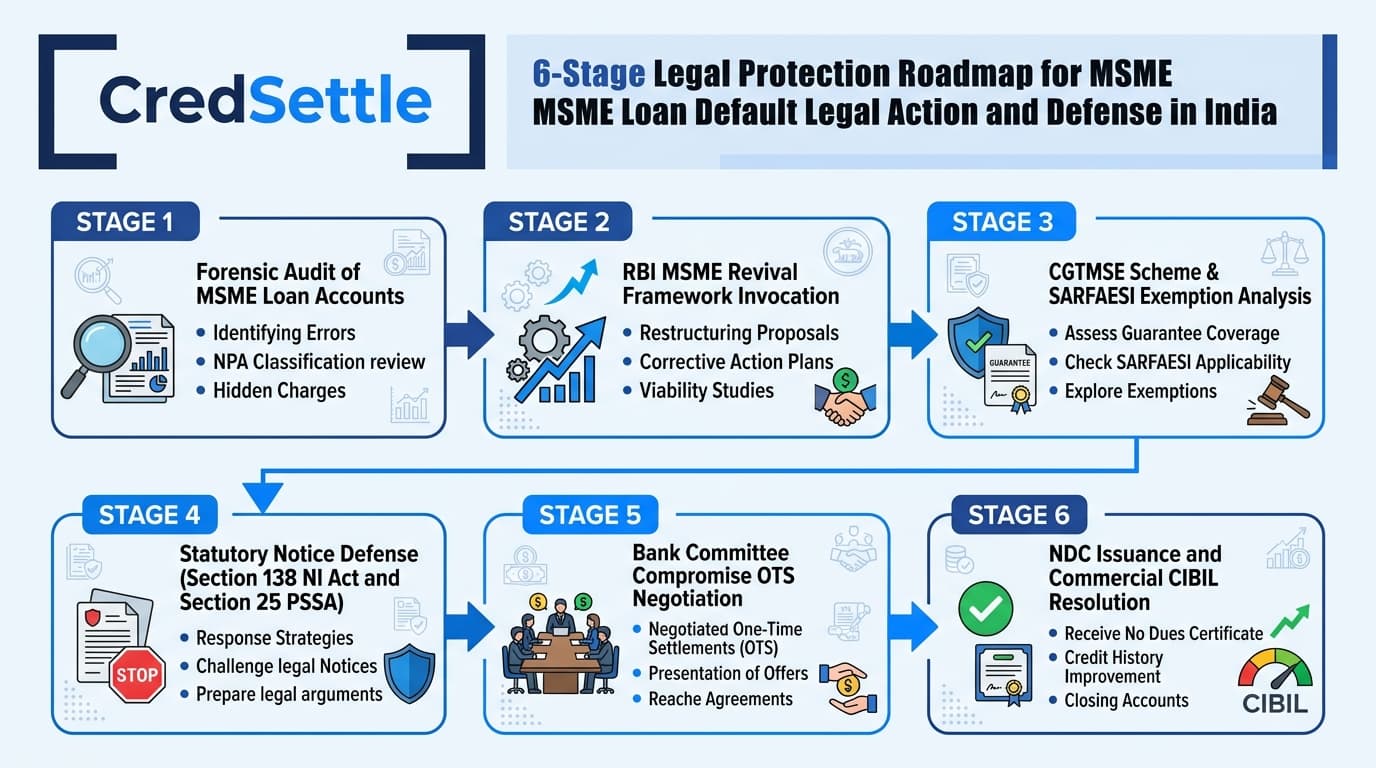
5. Standard Operating Procedure (SOP): 6 Stages of MSME Legal Defense
Execute this sequential 6-stage daily work protocol to safeguard trade assets and settle an amicable relief:
Forensic Loan & Security Ledger Audit
Audit the sanction letter, hypothecation deeds. And CGTMSE guarantee fee deductions. Identify illegal compound penalty charges and calculate baseline main loan debt risk under the Bankers&apos. Books proof Act.
Hardship Dossier & MSEFC Claims
Assemble a trade hardship file documenting canceled contracts and delayed buyer receivables. File claims before the MSEFC under Chapter V MSMED Act to establish external cash-flow distress.
Invocation of RBI Stressed MSME Committee
Serve a formal legal help to the bank Branch Manager under the RBI MSME Revival rules. Requesting an fast freeze on coercive legal claims and referral for restructuring.
Credit Committee Compromise Negotiations
Engage bank Circle and Head Office credit boards with an actuarially verified OTS proposal. Securing a 40% to 60% waiver on total penal interest and office charges.
Legal Vetting of OTS Sanction Letter
Vet the bank&apos. S OTS approval letter to verify strict withdrawal of all pending Section 138. Section 25 PSSA. DRT. SARFAESI proceedings without residual money debt risk.
Remittance, No Dues Certificate & Bureau Update
pay settlement funds straight to the loan pool account. Obtain the original No Dues letter. Retrieve unencumbered papers. Submit updates under Section 21 CICRA to mark accounts Closed.
6. Statutory Notice Defense: MSME Legal Protections
Lenders issue notices across criminal. Quasi-criminal. And civil forums. firms leadership must address each action under its governing statute:
Issued for bounced auto-debits under Payment and Settlement Systems Act 2007. It is a bailable proceeding that can be compounded promptly upon executing an OTS or discharging main loan dues. Filing a formal reply refuting intentional default establishes a crucial contemporaneous defense record before the magistrate.
Carries a 30-day notice and 15-day cure window. Promoters can contest security cheque misuse. Challenge penal interest claims. Seek judicial compounding under Section 147 citing the Supreme Court ruling in. Damodar S. Prabhu..
Under Supreme Court rulings in TRF Ltd. And Perkins Eastman. Banks cannot unilaterally appoint sole arbitrators. Giving clients Section 12(5) grounds to challenge tainted proceedings.
DRT hears debts above ₹20 Lakhs. For CGTMSE security-free loans. SARFAESI property seizure is statutorily barred. DRT suits can be defended by auditing inflated compound ledgers. Promoters can file interim applications praying for restraint against coercive attachment of essential operating machinery.
7. The 3-Tier Grievance Redressal Matrix & Regulatory Escalation
When claims wings violate rules. Ignore revival applications. Or levy illegal penalty charges. Escalate through this 3-tier matrix:
Submit a written grievance detailing accounting errors and request referral to the bank&apos. s Stressed MSME boards.
Escalate unresolved disputes to the Head Office PNO with cash-flow viability reports and formal OTS proposals.
File complaints on cms.rbi.org.in for Fair Practices Code breaches. Abuse. Or unlawful denial of MSME rules relief.
8. Procedural Timeline: Default to Resolution Milestones
Understand RBI milestones from initial default to final debt discharge:
| Phase | Regulatory Event. | Limitation | Strategic Defense. |
|---|---|---|---|
| Days 1. 30 | SMA-0: Incipient Stress. | Cure window | Audit cash flows &. file MSEFC claims. |
| Days 31. 60 | SMA-1: Stress Recognition. | 30-day window | Invoke RBI Stressed MSME rules. |
| Days 61. 90 | SMA-2: Imminent NPA. | Pre-NPA period | Present restructuring proposal. |
| Days 91. 180 | NPA &. Demand Notices. | legal notices. | Defend Sec 138 &. open OTS dialogue. |
| Months 6+ | Provisioned Bad Debt. | OTS policy window. | Execute 40%-60% OTS, secure NDC. |
9. Specialized Business Scenarios: Shocks & ARCs
Legal plans must adapt to the company structure and facility architecture:
Multi-Lender Consortium & Multiple Banking
When carrying limits across multiple lenders. Defense requires settling an Inter-Creditor pacts (ICA) or harmonizing parallel OTS offers to prevent bankruptcy filings under IBC.
Enterprise Liquidity Shocks & Supply Chain Disruptions
Documenting external breaks in an economic hardship dossier proves to credit boards that non-payment is circumstantial rather than willful default.
Sole Proprietorship vs. Private Limited Liabilities
In proprietorships. Own assets are exposed to civil execution. In contrast, in Private Limited companies. Debt risk is restricted unless private guarantees were executed under Section 128.
MSME Debt Assignment to Asset Reconstruction Companies (ARCs)
When banks sell MSME debt to ARCs at 20% to 35% discounts under SARFAESI Section 5. Clients gain large leverage for deep OTS deal OTS settlements.
 Legal Debt Dispute Authority
CredSettle (credsettle.com) is India's premier debt settlement, loan dispute resolution, and legal protection platform. Operating strictly under the RBI Fair Practices Code and CICRA 2005, our advocate panel negotiates directly with Bank Principal Nodal Officers to eliminate waived differentials, obtain unconditional No Dues Certificates (NDC), and upgrade credit bureau records from "Settled" to "Closed".
Frequently Asked Questions on MSME Loan Default Legal Action
Click on any question below to view detailed legal answers verified by our banking and debt relief workers:
Official Regulatory Citations & Judicial References
- MSMED Act 2006: Chapter V. Sections 15 to 21. Ministry of MSME.
- RBI Master Directions: rules for Revival and Rehabilitation of MSMEs.
- CGTMSE rules: daily work Rules on Default Guarantee Coverage.
- NI Act 1881 &. PSSA 2007: Section 138 (Cheques) &. Section 25 (NACH).
- CICRA 2005: Section 21 Rules for strict Credit Information Closure.
- Supreme Court: Perkins Eastman (2020). &. TRF Ltd. (2017).