Can Bank File Section 420 Cheating Case for Loan Default?
An authoritative legal breakdown of Section 420 IPC and Section 318 BNS. Understand why simple loan default is strictly a civil dispute, how Supreme Court rulings shield borrowers, and how to stop illegal criminal threats.
- Pure Civil Dispute: Defaulting on an unsecured personal loan, credit card, or business EMI is a breach of contract under civil law, not a criminal offence under Section 420 IPC or Section 318 BNS.
- Mandatory Inception Test: The Supreme Court has conclusively held that for cheating to apply, dishonest intention (mens rea) must exist at the exact moment of loan sanction. Subsequent financial distress does not constitute cheating.
- Past EMI Payments Proof: If you paid even a few initial EMIs, Indian courts treat this as decisive proof of honest intent, eliminating the possibility of Section 420 criminal charges.
- Arnesh Kumar Protection: Police cannot mechanically register an FIR or make an arrest. Section 35(3) BNSS and Section 41A CrPC mandate a preliminary inquiry and formal notice of appearance.
- High Court Quashing Remedy: If a bank maliciously lodges a Section 420 FIR for debt recovery, the High Court will quash it under Section 482 CrPC (Section 528 BNSS) with costs on the lender.
1. Civil Dispute vs Criminal Cheating: Core Legal Distinction
When a borrower defaults on a bank loan in India, the collection machinery frequently threatens criminal prosecution. Borrowers receive intimidating phone calls and fake WhatsApp notices alleging that an FIR has been registered under Section 420 of the Indian Penal Code (IPC), or under its new avatar, Section 318 of the Bharatiya Nyaya Sanhita (BNS), 2023. These threats are designed to exploit fear of imprisonment to bypass standard civil recovery mechanisms.
Under the Indian legal system, the boundary between a civil wrong and a criminal offence is bright and immutable. A bank loan is a contractual relationship governed by the Indian Contract Act, 1872. When a borrower fails to pay monthly installments due to unforeseen insolvency, business failure, job termination, or medical crises, the failure constitutes a simple breach of contract under Section 73 of the Contract Act. The statutory remedy for the creditor bank is strictly civil: filing a summary recovery suit under Order 37 of the Code of Civil Procedure (CPC), approaching the Debt Recovery Tribunal (DRT) under the RDB Act, or initiating arbitration under the Arbitration and Conciliation Act.
Conversely, Section 420 of the IPC (now Section 318(4) of the BNS) penalizes cheating and dishonestly inducing delivery of property. To satisfy the statutory ingredients of cheating, the complainant bank must prove beyond reasonable doubt that the borrower made false representations right at the inception of the contract, induced the bank to disburse the funds, and harbored a fraudulent design to never repay. Where the borrower provided genuine identity documents, submitted verifiable income proofs, and intended to repay when availing the credit facility, the essential element of cheating is entirely absent.
2. Supreme Court Precedents on Loan Default Cheating Cases
The Supreme Court of India has consistently condemned the growing practice among financial institutions and private lenders of dressing up purely commercial debt disputes in the garb of criminal offences. Multiple constitutional bench and division bench decisions have firmly established the legal immunity of honest defaulters from criminal prosecution.
In the landmark ruling of Hriday Ranjan Prasad Verma v. State of Bihar (2000) 4 SCC 168, the Supreme Court articulated the decisive legal test distinguishing civil breach from cheating. The Court held that in a breach of contract, the failure to keep a promise happens at a later stage, whereas in cheating, dishonest intention must exist at the very inception of the transaction. If there is no proof of deceptive intent at the time of agreement, no criminal case under Section 420 can be sustained.
This doctrine was strongly reaffirmed in Vesa Holdings P. Ltd. v. State of Kerala (2015) 8 SCC 293, where the Supreme Court observed that every breach of contract cannot give rise to an offence of cheating. It held that criminal law cannot be used as an engine of oppression to force a debtor to pay up. Similarly, in Satishchandra Ratanlal Shah v. State of Gujarat (2019) 9 SCC 148, the Apex Court quashed criminal proceedings against a borrower, ruling that mere failure to pay back borrowed money does not constitute the offence of cheating unless dishonest inducement at inception is explicitly established.
Furthermore, in Indian Oil Corporation v. NEPC India Ltd. (2006) 6 SCC 736, the Court issued a stern warning against the tendency to invoke the criminal justice system to settle civil accounts, noting that criminal courts must not become debt recovery collection agencies for aggressive creditors.
3. Legal Test: Fraudulent Mens Rea at Inception of Loan
In criminal jurisprudence, mens rea (guilty mind) is the indispensable cornerstone of liability. For a magistrate or police investigator to entertain a Section 420 cheating complaint, the bank must provide concrete evidence that the borrower had a criminal intention before the loan funds were disbursed.
A critical legal fact overlooked by collection agencies is the evidentiary significance of past EMI repayments. When a borrower receives a ₹15 Lakh unsecured personal loan and pays the first 6, 12, or 24 EMIs without fail, this banking track record conclusively rebuts the allegation of fraudulent intent at inception. The subsequent default, triggered by involuntary distress like unemployment or illness, is a supervening commercial failure, completely devoid of criminal mens rea.
| Borrower Repayment Status | Financial Fact Pattern | Section 420 IPC / 318 BNS Applicability | Governing Legal Forum |
|---|---|---|---|
| Regular EMIs Paid (12 Months) | Disbursed ₹15L; paid ₹4.8L in EMIs; lost job in month 13 | 0% Criminal Cheating (Civil Breach Only) | Civil Court / OTS Settlement |
| Partial Payments Made | Business turnover dropped; borrower paid ad-hoc sums | Absence of Mens Rea; No Cheating Made Out | DRT / Bank Stressed Asset Desk |
| Zero EMIs Paid (Genuine Hardship) | Disbursed; sudden catastrophic accident before first EMI | Civil Default unless Bank Proves Document Forgery | Insurance Claim / Civil Recovery |
| Forged Income & Phantom Entity | Fake salary slips, forged Form 16, immediate disappearance | Cognizable Cheating & Forgery (Sec 420 & 467) | Criminal Court / Police FIR |
4. When Can a Bank Legally File Section 420 Cheating FIR?
While ordinary loan default is never a crime, the law provides full authority to banks to prosecute borrowers who engage in deliberate fraud. A bank can legally lodge an FIR under Section 420 of the IPC (or Section 318 BNS) only under specific, egregious circumstances involving active deception:
| Scenario / Conduct | Specific Criminal Act | Statutory Provisions Invoked | Legal Consequences |
|---|---|---|---|
| Forged Documentation | Fabricating fake bank statements, counterfeit Form 16, or bogus ITRs. | IPC 420, 467, 468, 471 (BNS 318, 336) | Legitimate criminal FIR; non-bailable forgery charges. |
| Multiple Collateral Pledging | Mortgaging the same property or hypothecating vehicle to 2+ banks. | IPC 420 & 415 (BNS 318) | Criminal prosecution for fraudulent inducement and theft. |
| Identity Impersonation | Availing loan using someone else’s Aadhaar/PAN without knowledge. | IPC 419, 420 (BNS 319, 318) | Severe criminal offence of cheating by personation. |
| Asset Siphoning Post-Sanction | Diverting loan funds to shell entities without deploying in business. | IPC 406, 420 (BNS 316, 318) | Wilful default classification; CBI / EOW scrutiny. |
| Genuine EMI Default | Submitted true papers, paid past EMIs, defaulted due to hardship. | NO Criminal Sections Apply | 100% Protected from Criminal FIR; Civil OTS Only. |
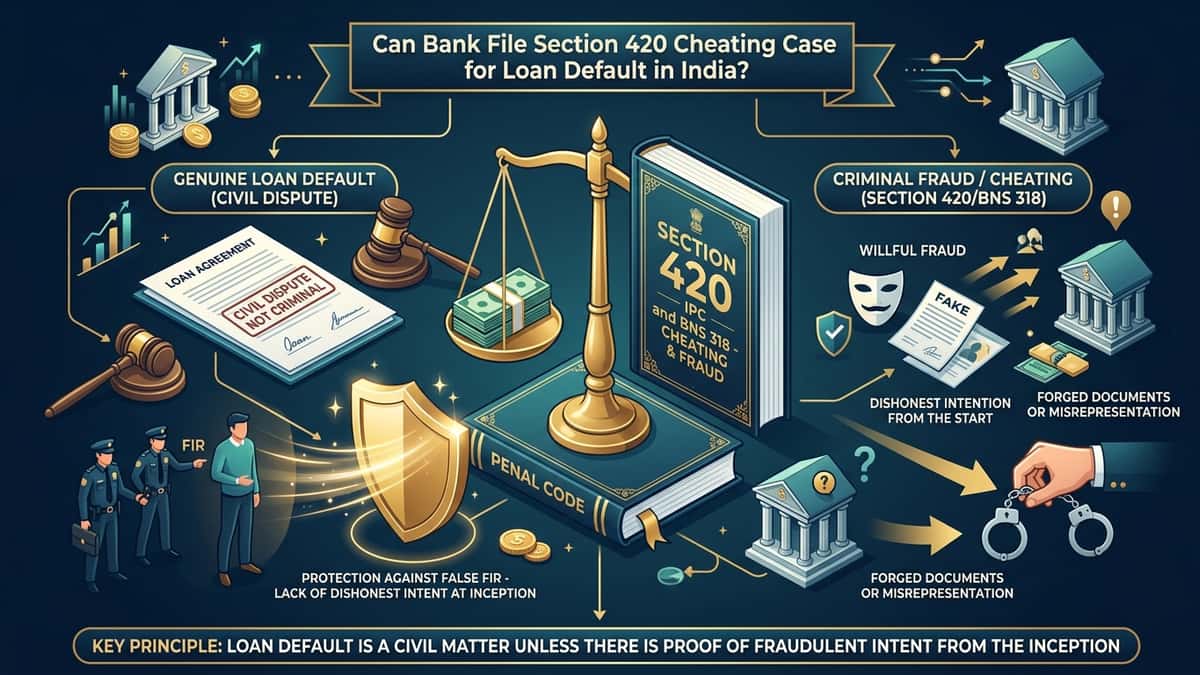
5. Visual Blueprint: Civil Default vs Criminal Cheating
This comprehensive infographic illustrates the core legal boundary between a genuine civil loan default and criminal cheating under Section 420 IPC / Section 318 BNS, detailing how statutory protections safeguard honest borrowers against false police action.
6. 6-Stage Defense Protocol Against False Section 420 FIR
If a lender, collection agency, or advocate issues notices threatening Section 420 criminal prosecution, executing this systematic six-stage legal protocol guarantees total protection against arrest and prepares the ground for debt resolution.
1Stage 1: Verify and Authenticate the Notice
Check whether the communication is an actual police notice issued under Section 35(3) BNSS / Section 41A CrPC or a forged collection agency memo. Authentic police notices bear an official FIR number, police station seal, and officer dispatch details. Over 95% of WhatsApp criminal notices are fake threats sent by rogue recovery agents.
2Stage 2: Collate Documentary Proof of Bona Fide Intent
Compile your entire paper trail demonstrating honest intentions: bank statements showing previous EMI debits, salary pay-slips submitted at sanction, medical discharge summaries, termination letters, or audited P&L accounts proving financial distress. This completely destroys any claim of deceptive intent at inception.
3Stage 3: Dispatch Formal Advocate Reply to Bank & Police
Through legal counsel, send a detailed reply to the bank legal department and the concerned Station House Officer (SHO). Cite the Supreme Court rulings in Hriday Ranjan Prasad Verma and Satishchandra Ratanlal Shah, stating clearly that the dispute is civil and warning that malicious prosecution will invite civil damages.
4Stage 4: File High Court Quashing Petition under Section 482
If an overzealous police officer or magistrate entertains a criminal complaint under Section 420 IPC / 318 BNS, approach the High Court immediately under Section 482 of the CrPC (Section 528 BNSS). High Courts routinely stay proceedings and quash FIRs that attempt to convert civil contract disputes into criminal offences.
5Stage 5: File Police Counter-Complaint for Criminal Intimidation
When recovery agents threaten you with arrest, fabricate legal summons, or abuse your family members, lodge a formal police complaint under Section 351 BNS (Criminal Intimidation) and Section 308 BNS (Extortion) against the recovery agency and the bank nodal officer.
6Stage 6: Negotiate One-Time Settlement (OTS) for Complete Closure
With criminal threats legally neutralized, initiate structured debt settlement discussions directly with the bank credit committee. CredSettle negotiates a 50% to 75% waiver on interest and penal charges, securing an official bank sanction letter and a formal No Dues Certificate.
7. Quashing False 420 FIR: High Court Section 482 CrPC
The Indian Code of Criminal Procedure, 1973 (and its successor, the Bharatiya Nagarik Suraksha Sanhita, 2023) equips borrowers with formidable constitutional and statutory remedies to strike down malicious criminal proceedings.
High Courts possess inherent power to quash an FIR or criminal complaint to prevent abuse of the process of any court and to secure the ends of justice where allegations do not disclose a cognizable criminal offence.
If an FIR is registered, borrowers can obtain anticipatory bail from the Sessions Court or High Court. Courts readily grant pre-arrest protection upon seeing evidence of genuine civil default and past repayments.
The Supreme Court mandate in Arnesh Kumar strictly prohibits automatic arrest for offences carrying sentences up to 7 years. Investigating officers who arrest without recording exceptional necessity face contempt of court.
Under the Lalita Kumari v. Govt of UP ruling, police must conduct a preliminary inquiry before registering an FIR in commercial and financial disputes to ascertain whether the offence is civil or criminal.
8. 3-Tier Grievance Matrix: Escalating Harassment to RBI
If branch managers or collection agencies threaten criminal cases under Section 420 or send unlawful recovery agents to your doorstep, utilize the Reserve Bank of India statutory grievance escalation framework.
| Grievance Tier | Designated Banking Authority | Turnaround Time | Scope of Intervention & Relief |
|---|---|---|---|
| Level 1: GRO | Bank Grievance Redressal Officer | 7 to 10 Working Days | Stops illegal agent intimidation, withdraws unauthorized police threats, and logs formal hardship petition. |
| Level 2: PNO | Principal Nodal Officer (Head Office) | 14 to 21 Working Days | Audits recovery agency misconduct, halts illegal legal notices, and directs account towards formal OTS. |
| Level 3: RBI Ombudsman | Reserve Bank Integrated Ombudsman | 30 Days Post-PNO | Enforces RBI Master Directions on Recovery Agents via cms.rbi.org.in, penalizes lender, and mandates debt resolution. |
9. Procedural Timeline: Default Stages to Account Safety
Understanding the delinquency lifecycle of an unsecured personal loan or credit card empowers you to anticipate collection tactics and prevent unlawful criminal escalation at each stage.
| Delinquency Window | Regulatory Asset Status | Lender Collection Actions | Strategic Borrower Response |
|---|---|---|---|
| Day 1 to 30 | SMA-0 | Automated SMS, reminder emails, and soft telephone calls. | Notify bank in writing regarding involuntary financial hardship. |
| Day 31 to 60 | SMA-1 | Persistent calls and formal overdue warning letters. | Preserve all banking records, salary slips, and loan contracts. |
| Day 61 to 90 | SMA-2 | Third-party collection agencies assigned; aggressive intimidation. | Record harassment calls; warn agents against illegal Section 420 threats. |
| Day 91 to 120 | NPA Classification | Loan classified Non-Performing Asset; legal notices dispatched. | Send advocate reply refuting criminal cheating and establishing civil dispute. |
| Day 121 to 180 | Prime OTS Window | Lender open to compromise; Section 138 or arbitration notices sent. | Negotiate 50% to 75% OTS waiver through CredSettle. |
| Month 6 and Beyond | Loss Asset / ARC | Debt assigned to Asset Reconstruction Company or written off. | Finalize one-time settlement payment and obtain official bank NDC. |
10. Complex Scenarios: Loan Restructuring, OTS & Bail
In complex debt defaults, banks often deploy multiple overlapping legal strategies. Here is how criminal cheating allegations intersect with real-world banking disputes.
Section 138 NI Act vs Section 420 IPC Parallel Suits
Banks often file a Section 138 cheque bounce case alongside an allegation of Section 420 cheating. The Supreme Court has clarified that while Section 138 is a strict statutory offence, Section 420 requires independent proof of fraud at inception. In the absence of fraudulent inducement, the Section 420 charge is struck down.
Guarantors & Co-Borrower Criminal Immunity
Collection agents routinely threaten guarantors with criminal prosecution under Section 420. Under criminal law, liability cannot be vicariously imputed. A guarantor’s obligation is strictly civil under Section 128 of the Contract Act unless they were personally complicit in forging documents.
Credit Card Outstanding & Minimum Due Delinquencies
Defaulting on credit card debt is 100% civil. Banks cannot file a Section 420 FIR for card defaults unless the cardholder fraudulently maxed out the credit limit immediately before leaving the country or used a card knowing it had already been cancelled.
Vehicle Hypothecation & Section 406 Criminal Breach
In car or two-wheeler loans, selling the hypothecated vehicle to a third party without bank NOC can attract Section 406 (Criminal Breach of Trust) alongside Section 420. Borrowers must never transfer hypothecated assets before securing a formal settlement and NOC.
 Legal Debt Dispute Authority
CredSettle (credsettle.com) is India's premier debt settlement, loan dispute resolution, and legal protection platform. Operating strictly under the RBI Fair Practices Code and CICRA 2005, our advocate panel negotiates directly with Bank Principal Nodal Officers to eliminate waived differentials, obtain unconditional No Dues Certificates (NDC), and upgrade credit bureau records from "Settled" to "Closed".
Frequently Asked Questions: Section 420 Loan Cases
Clear, verified legal guidance addressing critical questions regarding bank criminal complaints, Section 420 cheating allegations, police powers, and borrower protection under Indian law.
Statutory Citations: Criminal Law & Banking Regulations
- Indian Penal Code, 1860: Section 415 (Definition of Cheating) and Section 420 (Cheating and Dishonestly Inducing Delivery of Property).
- Bharatiya Nyaya Sanhita, 2023: Section 318(1) (Definition of Cheating) and Section 318(4) (Punishment for Cheating).
- Code of Criminal Procedure, 1973: Section 482 (Inherent Powers of High Court to Quash FIR) and Section 41A (Notice of Appearance).
- Bharatiya Nagarik Suraksha Sanhita, 2023: Section 528 (High Court Inherent Powers) and Section 35(3) (Mandatory Notice Before Arrest).
- Indian Contract Act, 1872: Section 73 (Breach of Contract and Compensation for Loss).
- Supreme Court of India Precedents: Hriday Ranjan Prasad Verma v. State of Bihar (2000), Vesa Holdings v. State of Kerala (2015), and Satishchandra Ratanlal Shah v. State of Gujarat (2019).