Executing a One-Time Settlement (OTS) is often the most pragmatic legal remedy for borrowers trapped in genuine financial distress. While it immediately shields you from recovery harassment and legal actions under Section 138 of the Negotiable Instruments Act or Section 25 of the Payment and Settlement Systems Act, it leaves an indelible footprint on your credit profile. Your CIBIL score experiences an immediate drop of 70 to 120 points, and the loan account is designated with a derogatory "Settled" remark.
However, this score reduction is neither permanent nor unresolvable. Under Indian credit bureau reporting architecture, credit scoring models evaluate risk dynamically—placing far greater statistical emphasis on your recent 12 to 24 months of payment conduct than on historical defaults. By enforcing statutory reporting rights under the Credit Information Companies (Regulation) Act, 2005 (CICRA), deploying secured credit instruments, and maintaining strict credit utilization thresholds below 30%, borrowers routinely restore their CIBIL score to prime 750+ territory within 12 to 18 months.
1. Legal & Financial Realities of Post-Settlement Credit in India
To formulate an effective credit recovery strategy, you must first understand the fundamental differences between how Indian banking institutions handle loan compromises and how credit bureaus report them. When you execute an OTS with a scheduled commercial bank or Non-Banking Financial Company (NBFC), the transaction represents a contractually binding compromise. The lender agrees to accept a lump-sum amount—frequently 30% to 60% of the total claim—and waives the remaining principal, contractual interest, and penal charges.
From a strictly legal standpoint, once the agreed consideration is credited to the bank and an unconditional No Dues Certificate (NDC) is issued, your debt is completely extinguished. The bank cannot initiate civil recovery suits, drag you before the Debts Recovery Tribunal (DRT), or dispatch third-party recovery agents. However, from a credit reporting perspective, the bank reports the unpaid portion as an operational write-off, prompting TransUnion CIBIL, Experian, Equifax, and CRIF High Mark to stamp the trade-line with the remark "Settled".
The table below outlines the precise ledger treatment, score implications, and institutional underwriting responses across the four primary loan termination classifications in India:
| Account Status Flag | Ledger Balance Treatment | Immediate CIBIL Impact | Future Loan Underwriting | Score Recovery Velocity |
|---|---|---|---|---|
| SETTLED (OTS Compromise) | Compromise amount received; waived balance written off as bank loss. Outstanding ledger becomes ₹0. | -70 to -120 Points Drop | Automated rejection on unsecured loans for 12–24 months; secured loans accessible with risk margin. | Moderate (6–18 Months with Active Rebuilding) |
| CLOSED (Standard Closure) | 100% of principal, contractual interest, and agreed fees paid. Zero loss to lending institution. | Neutral to Highly Positive | Full eligibility for prime home loans, vehicle loans, and premium credit cards at lowest ROI. | Fastest (Continuous Positive Weighting) |
| RESTRUCTURED (Rescheduled Tenor) | Tenor extended or EMI reduced under RBI Resolution Framework; principal repaid over lengthened period. | -40 to -70 Points Drop | Profile viewed with caution; fresh credit requires 12 months of clean restructured repayment. | Gradual (12–24 Months of Extended Tenor) |
| WRITTEN OFF (Total Default / NPA) | Account classified as Non-Performing Asset (NPA). Bank booked 100% loss. Outstanding remains unpaid. | -150+ Points Drop (Severe Crash) | Complete blacklisting across all financial institutions; high active legal recovery exposure. | Frozen (No recovery until resolved) |
As demonstrated in the matrix above, settling a loan is vastly superior to leaving an account in active default or written-off status. While a written-off account continues to accumulate penal interest and compounds your Days Past Due (DPD) default string month after month, a settlement permanently halts negative aging. It sets your Current Balance to zero, enabling you to begin rebuilding your credit profile from a stable baseline.
2. CIBIL Scoring Impact & Bank Provisioning Under RBI Norms
When an account is settled, the credit bureau scoring algorithm responds to two distinct data signals: the immediate loss penalty and the historical default narrative. Under the Reserve Bank of India's Prudential Norms on Income Recognition, Asset Classification and Provisioning pertaining to Advances (IRACP), banks are required to classify non-performing loans into Sub-standard, Doubtful, or Loss assets, setting aside between 15% and 100% of the loan amount as capital provisioning.
When a compromise settlement is concluded, the bank reports the absorbed haircut as a credit loss. The credit bureau's mathematical model translates this write-off into a sharp score contraction, deducting between 70 and 120 points. Furthermore, under Indian reporting conventions, this trade-line history remains recorded in your Comprehensive Credit Information Report (CIR) for up to 7 years (84 months).
How Institutional Loan Origination Systems (LOS) Filter Applicants
Tier-1 commercial banks in India—including HDFC Bank, ICICI Bank, State Bank of India, Axis Bank, and Kotak Mahindra Bank—rely on automated Loan Origination Systems (LOS) for preliminary credit underwriting. These automated rule engines evaluate applicant credit profiles against pre-configured risk parameters. If an LOS engine detects a "Settled" or "Written-Off" status within the preceding 12 to 24 months, it typically generates an automated rejection for unsecured products such as personal loans and premium credit cards.
However, manual credit underwriting desks and secured lending verticals (such as gold loans, secured home loans, and fixed-deposit backed facilities) operate under distinct risk parameters. When an underwriter sees that the default was legally resolved, the current balance is ₹0, and the borrower has maintained 12+ months of flawless repayment on fresh credit lines, credit approvals are granted with minimal risk premiums.
3. Statutory Protections: CICRA 2005 & Central Banking Directives
Many borrowers operate under the false assumption that credit bureaus and banks hold unilateral, unchecked power over their credit histories. In reality, credit reporting in India is strictly regulated by parliamentary statute and binding RBI Master Directions designed to protect consumer rights and guarantee data accuracy.
Section 21 of the Credit Information Companies (Regulation) Act, 2005 (CICRA)
Section 21 of CICRA places an absolute legal obligation on all Credit Institutions (banks, NBFCs, and housing finance companies) and Credit Information Companies to maintain accurate, authenticated, and complete credit records. If a lending institution continues to report an outstanding balance, overdue amount, or active default after receiving the agreed settlement amount, it constitutes an actionable statutory violation under CICRA.
RBI Master Direction on Credit Information Reporting
The Reserve Bank of India mandates that all lenders must submit updated monthly data tapes to all four licensed credit bureaus within a strict 30-day reporting window. Following the execution of an OTS and issuance of the NDC, the lender is legally required to update the loan status to "Settled" (or "Closed" if the differential is cleared), setting the Current Balance and Amount Overdue to exactly ₹0.
RBI ₹100/Day Delay Compensation Framework (Circular RBI/2023-24/72)
Under the landmark RBI consumer protection directive on credit data rectification, if a bank or credit bureau fails to update or correct disputed credit records within 30 calendar days of receiving a formal grievance with supporting documentation, the defaulting entity must pay mandatory statutory compensation of ₹100 per calendar day directly into the borrower's bank account until the record is rectified.
4. Financial Strategy: Credit Scoring Math & Utilization
Credit score recovery is not a matter of luck or waiting passively for time to pass; it is an exact algorithmic calculation. By understanding the relative mathematical weights assigned to each component of your credit profile, you can deploy your monthly cash flow with surgical precision to maximize score recovery velocity.
In Indian credit bureau scoring models, your 3-digit score (ranging from 300 to 900) is determined by five primary pillars:
Mathematical Architecture of the Post-Settlement CIBIL Algorithm
The single largest driver of your score. Flawless on-time clearing of new monthly statements rapidly outweighs older negative remarks.
Calculated as total revolving balance divided by total assigned credit limits. Maintaining CUR under 20%–30% delivers immediate algorithmic score boosts.
The average age of all open and closed accounts. Retaining older active trade-lines anchors your credit maturity.
A healthy balance between revolving credit lines (credit cards) and installment facilities (consumer durable loans or auto loans).
Each formal credit application initiates a hard inquiry, deducting 5 to 10 points. Minimizing fresh loan applications protects your score momentum.
By understanding that 65% of your total credit score is determined strictly by two variables—Payment History (35%) and Credit Utilization (30%)—the path forward becomes clear. You do not need dozens of complex financial products; you simply need one or two well-managed secured credit instruments with strict repayment discipline.
How to Rebuild & Improve CIBIL Score After Loan Settlement
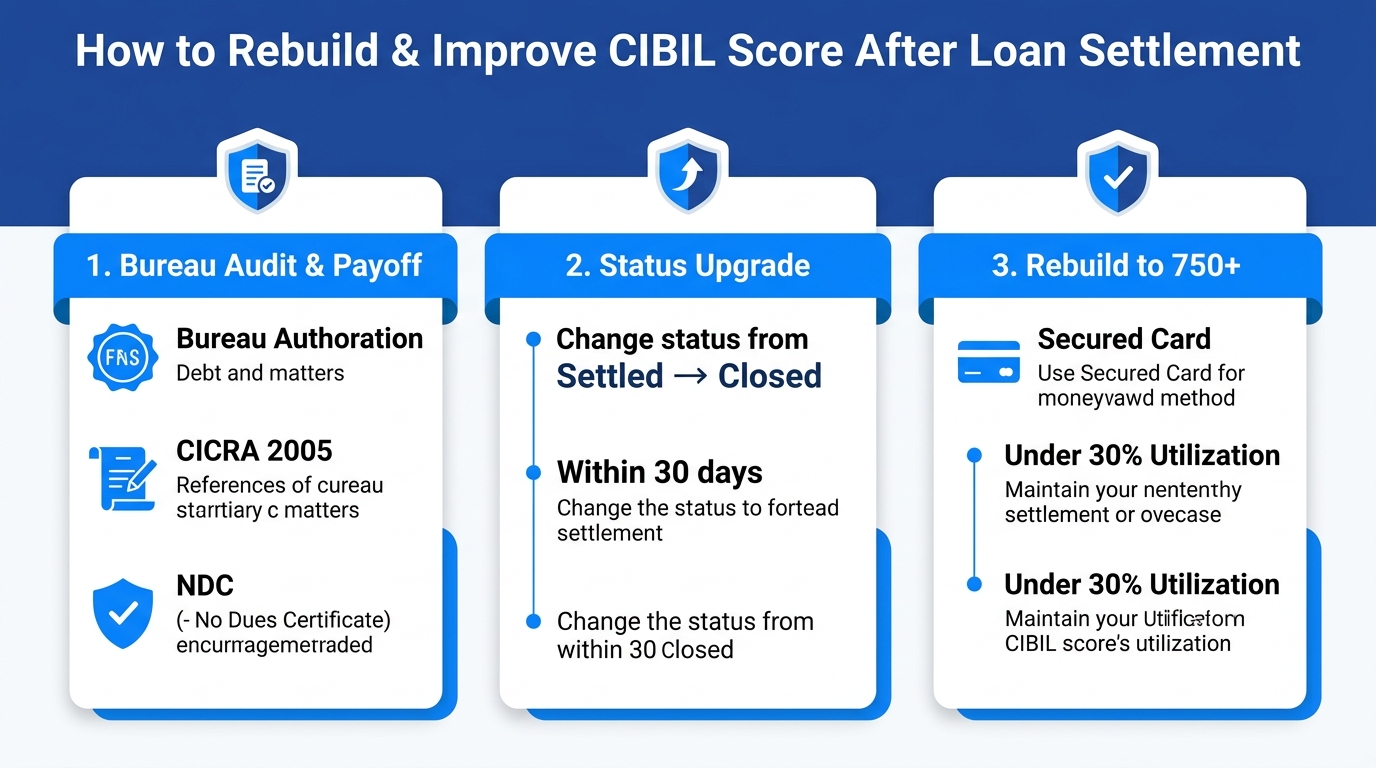
5. The 7-Stage Standard Operating Procedure for Credit Restoration
Rebuilding a damaged credit profile requires methodical execution. Our debt resolution specialists have distilled the entire recovery process into an actionable, 7-stage Standard Operating Procedure (SOP) engineered for maximum efficiency and full statutory compliance:
Stage 1: Multi-Bureau Audit Across CIBIL, Experian, Equifax & CRIF
The journey begins by pulling official CIR reports from all four licensed credit bureaus. It is essential to verify that the settled loan account is correctly labeled as "Settled" or "Post-Write-off Settled", and that both the Current Balance and Amount Overdue are recorded as ₹0. Ensure that the monthly Days Past Due (DPD) strings have halted and no ongoing late marks are being recorded post-settlement.
Stage 2: Secure and Authenticate the Unconditional No Dues Certificate
Never consider a loan settlement finalized until you hold an original physical or digitally signed No Dues Certificate (NDC / NOC) issued on official bank letterhead. The document must explicitly identify the loan account number, confirm full receipt of the agreed settlement sum, and declare that the bank retains zero further monetary or legal claims against the borrower.
Stage 3: Strategic Assessment of Status Upgrade (Settled to Closed)
Evaluate your financial roadmap for the next 1 to 3 years. If you anticipate applying for a major loan—such as a home mortgage, commercial property loan, or large business expansion facility—it is highly advantageous to negotiate with the lender to clear the historical waived differential and convert your status to "Closed". This permanently expunges the settlement tag from underwriting algorithms.
Stage 4: Activate a Fixed Deposit-Backed Secured Credit Card
Because automated underwriting systems will reject unsecured credit card applications immediately after a settlement, you must establish new credit lines via a secured credit card backed by a 100% lien Fixed Deposit (e.g., IDFC FIRST WOW, Kotak 811 DreamDifferent, SBI Unnati, or Axis Bank Insta Easy). These cards require no minimum credit score, involve no hard bureau inquiries, and report fresh, positive trade-lines to all four bureaus monthly.
Stage 5: Enforce Strict 15%–25% Credit Utilization & Full Auto-Debit
Use your secured credit card exclusively for regular, budgeted expenses such as utility bills, fuel, and groceries, ensuring your balance never exceeds 20% to 30% of the assigned limit. Crucially, activate an automated bank mandate to settle 100% of the Total Amount Due before the payment due date. Never pay just the Minimum Amount Due, as revolving balances incur steep interest charges and signal ongoing financial strain to the scoring algorithm.
Stage 6: Diversify Credit Mix with a Micro Consumer Durable EMI Loan
After 6 consecutive months of timely secured card payments, purchase a small household appliance or electronic gadget through a 6-to-9 month zero-cost EMI installment plan (via Bajaj Finserv, TVS Credit, or Home Credit). Introducing a small installment loan diversifies your credit mix, demonstrating that you can handle both revolving credit lines and fixed monthly EMI obligations concurrently.
Stage 7: Conduct Quarterly Bureau Audits & Exercise Dispute Rights
Review your credit reports on a quarterly basis. If you identify phantom overdue balances, duplicate trade-lines, or unapproved hard inquiries, lodge immediate formal dispute tickets through the official CIBIL Dispute Portal. Hold institutions strictly to the 30-day resolution deadline, leveraging the RBI ₹100/day delay compensation rule to ensure prompt compliance.
6. Legal Rectification Notice for CIBIL Ledger Correction
One of the most frequent administrative breakdowns in Indian banking occurs when branch staff fail to transmit settlement updates to their central credit bureau operations team. As a consequence, your CIBIL report continues to display an active overdue balance, severely depressing your score. When informal branch visits yield no results, dispatching a formal legal rectification notice under CICRA 2005 immediately triggers statutory compliance workflows.
Below is a battle-tested template that you can customize and serve to the Principal Nodal Officer of the lending institution via Registered Post and Email:
To,
The Principal Nodal Officer / Head of Credit Bureau Operations,
[Bank / NBFC Name],
[Zonal Office Address / Registered Corporate Office],
Email: [nodalofficer@bankname.com]

CC: TransUnion CIBIL Limited / Experian Credit Information Co.

Subject: Formal Demand for Immediate Credit Bureau Data Rectification and Elimination of Erroneous Overdue Balances for Settled Loan Account No: [Insert Loan A/C No.]

Respected Sir/Madam,

I, [Borrower Full Name], residing at [Borrower Full Address], holding PAN: [Insert PAN] and Aadhaar: [Insert Aadhaar], was the borrower for the aforementioned Loan Facility [Account Number: XXXXXXXX] sanctioned by your institution.

1. That pursuant to a mutually agreed One-Time Settlement (OTS) sanctioned vide letter reference no. [Insert OTS Sanction Letter Ref No.] dated [Date of Sanction], I have remitted the full and final settlement consideration of ₹[Amount Paid] on [Date of Payment].
2. That your institution acknowledged receipt of the agreed consideration and issued a formal Settlement / No Dues Certificate (NDC) dated [Date of NDC].
3. That upon auditing my recent Comprehensive Credit Information Report (CIR) from TransUnion CIBIL / Experian, it has come to my notice that your institution is erroneously reporting:
   a) An active Current Balance of ₹[Erroneous Amount] instead of ₹0.
   b) An Amount Overdue of ₹[Erroneous Overdue] instead of ₹0.
   c) Ongoing monthly Days Past Due (DPD) aging marks post the settlement execution date.
4. That such erroneous reporting is in direct contravention of Section 21 of the Credit Information Companies (Regulation) Act, 2005 (CICRA) and the Reserve Bank of India Master Directions on Credit Information Reporting.
5. That I hereby call upon your competent authority to submit an updated monthly correction tape to all four Credit Information Companies (TransUnion CIBIL, Experian, Equifax, and CRIF High Mark) reflecting the account status as "SETTLED" with ₹0 Current Balance and ₹0 Amount Overdue within 15 calendar days of receipt of this notice.
6. Please take note that under RBI Circular RBI/2023-24/72, failure to rectify customer credit information within thirty (30) calendar days of receiving this grievance obligates your institution to pay statutory compensation of ₹100 per calendar day of delay directly to the undersigned complainant.

Enclosures:
1. Copy of OTS Sanction Letter
2. Copy of Payment Receipt / Bank Statement Proof
3. Copy of No Dues Certificate (NDC)
4. Copy of Erroneous CIBIL Report Extract

Thanking you,

Yours sincerely,

___________________________
[Signature]
[Borrower Name]
[Mobile Number]
[Email Address]
Date: [DD/MM/YYYY]
Place: [City, State]
7. 3-Tier Grievance Redressal & RBI Ombudsman Escalation Mechanism
If a lender proves uncooperative or delays updating your bureau records beyond the statutory window, you should never engage in endless verbal back-and-forth with branch representatives. Instead, execute this structured 3-tier escalation framework:
Branch CRM Desk
Submit your NDC and rectification request to the Branch Manager and log a formal ticket on the bank's online grievance portal to secure a unique Tracking Token Number.
Principal Nodal Officer
Escalate the unresolved ticket to the Bank's Principal Nodal Officer (PNO). The PNO possesses dedicated operational authority to order off-cycle CIBIL data corrections.
RBI Integrated Ombudsman
File a statutory complaint at cms.rbi.org.in. The Ombudsman mandates instant bureau correction and enforces the ₹100/day compensation award.
8. The 12-Month Post-Resolution Score Recovery Timeline
Restoring a CIBIL score after an OTS follows a predictable three-phase trajectory when paired with disciplined financial practices. Understanding these milestone intervals prevents unnecessary anxiety and helps you pace your credit applications appropriately:
| Phase / Timeline | Credit Report Milestone | Expected Score Range | Actionable Strategic Steps |
|---|---|---|---|
| Phase 1: Month 1 (Days 1–45) | Status updated to "Settled"; Overdue balance corrected to ₹0; DPD default string stops growing. | 580 – 630 (Base Stabilization) | Download CIR across all 4 bureaus; verify ₹0 balance; open a ₹25k–₹50k FD-backed secured credit card. |
| Phase 2: Months 2 – 6 | Consistent on-time monthly payments reported; positive trade-line weight starts offsetting historical default. | 640 – 700 (Momentum Phase) | Maintain strictly <20% CUR; set auto-debit for full bill; add a small 6-month consumer durable EMI loan. |
| Phase 3: Months 6 – 12 | Aged settlement penalty drops in algorithmic importance; flawless 12-month track record establishes creditworthiness. | 720 – 780+ (Prime Zone) | Eligible for prime vehicle loans, unsecured credit lines, and home loan balance transfers at standard interest rates. |
9. Complex Scenarios: Credit Cards, ARCs & Instant Loans
Different financial products involve distinct legal frameworks and recovery conventions. Here is how to navigate three of the most complex post-settlement credit environments in India:
Settled Credit Card Accounts (Revolving Debt)
Credit cards are unsecured revolving facilities carrying exorbitant annual percentage rates (APR) of 42% to 52%, along with compounding late fees. When negotiating a credit card settlement, ensure that the settlement letter explicitly states that the entire card account is permanently canceled with ₹0 balance. This prevents banks from continuing to assess residual finance charges post-compromise.
Debts Assigned to Asset Reconstruction Companies (ARCs)
If your default was sold by the original lender to an Asset Reconstruction Company (e.g., ARCIL, Phoenix, CFM, or Edelweiss ARC) under Section 5 of the SARFAESI Act, the ARC becomes the sole legal owner of the debt. The original bank cannot negotiate settlements or issue NDCs. You must execute the OTS directly with the ARC and ensure the ARC submits the required correction tape to CIBIL.
App-Based Instant Digital Fintech Loans
Borrowers who settle digital loans on mobile apps (e.g., KreditBee, PaySense, MoneyView, or CASHe) often find that their CIBIL score fails to update. This occurs because the app is merely a technology intermediary; the actual loan was originated by an underlying RBI-registered NBFC. Always obtain your formal NDC directly from the registered NBFC entity and verify that they submit the bureau update.
 Legal Debt Dispute Authority
CredSettle (credsettle.com) is India's premier debt settlement, loan dispute resolution, and legal protection platform. Operating strictly under the RBI Fair Practices Code and CICRA 2005, our advocate panel negotiates directly with Bank Principal Nodal Officers to eliminate waived differentials, obtain unconditional No Dues Certificates (NDC), and upgrade credit bureau records from "Settled" to "Closed".
Expert Answers on Improving CIBIL After Loan Settlement
Explore comprehensive legal and banking clarifications verified by our debt settlement experts:
All legal procedures, timelines, and consumer rights described in this guide are anchored in official Indian statutory frameworks and central banking directives: