How to File a Police Complaint Against a Bank Recovery Agent
Facing unlawful threats. Abusive phone calls. Or physical abuse from debt claims agents? Learn your constitutional rights. How to file a criminal FIR under Bharatiya Nyaya Sanhita (BNS) and IPC. How to permanently halt claims abuse through formal RBI escalation and structured debt relief with CredSettle.
- Zero Criminal Power: no-pledge loan default is strictly a civil claims. claims agents have zero formal to arrest or seize assets without a civil court decree.
- Criminal Offenses: Abusive language, doorstep threats. Threats violate Section 351 BNS (506 IPC) and Section 308 BNS (383 IPC). Triggering criminal debt risk.
- Direct Police FIR Remedy: clients can register a cognizable FIR at the local police station or Cyber Crime Cell against rogue claims agents and lenders.
- BNSS 173(3) Escalation: If the local SHO refuses FIR registration. Submit a petition to the Superintendent of Police or Commissioner under Section 173(3) BNSS.
- Strict RBI Calling Hours: Lenders cannot contact clients before 8:00 AM or after 7:00 PM. Nor contact relatives or workplace colleagues under RBI norms.
- Vicarious Bank debt risk: The Supreme Court holds banks straight accountable for civil damages and criminal acts committed by their claims firms.
- Digital Blackmail safety: Threatening WhatsApp messages or contact scraping trigger non-bailable penalties under Section 66D of the Information Technology Act.
- Permanent Closure via OTS: Neutralize lawsuits threats and eliminate abuse by settling a structured OTS deal One-Time settlement with a No Dues letter.
1. Debt Economics: Recovery Agency Aggression Drivers
When clients suffer genuine debt stress due to sudden job loss. Trade downturns. health crises and default on no-pledge private loans EMIs. Lenders execute a strict classification sequence. Under RBI prudential norms. Overdue accounts advance through Special Mention Account tiers: SMA-0 (1 to 30 days overdue). SMA-1 (31 to 60 days overdue). SMA-2 (61 to 90 days overdue). Upon crossing 90 days default. The loan becomes a Non-Performing Asset (NPA).
This classification triggers strict Tier-1 cash provisioning between 15% and 100% of the loan value. Because no-pledge private loans lack mortgage pledge. Lenders cannot invoke summary takeover powers under Section 31(i) of the SARFAESI Act. 2002. Pressured by audit disclosures. Banks assign claims files to aggressive third-party firms on commission models. However. Recognizing that formal civil claims suits require 3 to 6 years of expensive lawsuits. Bank credit boards maintain major trade flexibility to approve One-Time settlement (OTS) OTS deal proposals to recover cash while releasing cash reserves.
claims agents are third-party contractors hired strictly to communicate and help voluntary payment. They hold no judicial or executive police powers under Indian law.
Any agent attempting forceful doorstep entry. Abusive phone calls. Physical asset confiscation commits Criminal Trespass (Sec 329 BNS) and Extortion (Sec 308 BNS).
Only a court bailiff executing a valid Civil Court decree under Order 21 CPC can attach assets. Private claims agents have zero legal formal to seize property.
2. Financial Breakdown: Actual Principal vs Recovery Charges
When a client defaults. Banks inflate the ledger balance by compounding contractual interest with penal interest rates (often 24% to 36% per annum). Bounce fees. claims charges. This accounting practice often swells the claimed debt risk by 35% to 65% above the genuine base loan. Creating psychological panic designed to force distressed clients into hasty payments.
Understanding the real mathematical anatomy of an NPA loan empowers clients to settle effectively during One-Time settlement discussions. Consider a agent ₹10,00,000 no-pledge private loans at 180 days default. While the genuine unpaid base loan is ₹7,80,000. Compounded penal interest, late fees. Claims charges artificially swell the demand to ₹11,80,000. Through structured bilateral talks. Credit boards approve full waivers on penalty charges and interest. This results in a realistic final OTS deals of ₹4,50,000 to ₹5,20,000 (a 45% to 55% settlement target). Payable in structured installments with an full No Dues letter.
Inflated Bank Ledger Breakdown (180 DPD NPA)
Structured OTS Compromise Target Math
3. Comparative Resolution Matrix: Legal & Financial Paths
When facing claims pressure. Clients must choose the right legal plan to protect their assets. Halt abuse. Minimize total payout. This comparative table outlines the five standard debt claims pathways available under Indian law:
| Resolution Pathway. | Harassment & Legal Risk. | Financial Waiver / Haircut. | Resolution Timeline. | Asset Protection & Closure. |
|---|---|---|---|---|
| One-Time settlement (OTS). | fast cessation upon filing. | 40% to 75% main loan/Penal Waiver. | 30 to 90 Days | 100% Asset safety. full NDC. |
| Loan Restructuring / Moratorium. | Paused temporarily. resumes on lapse. | 0% (Tenure extended, interest increases). | 60 to 120 Days | Tenure extended. EMI re-structured. |
| Civil Court lawsuits (Sec 37/Order 21). | High stress. formal court summons. | 0% (High lawyers fees + court costs). | 3 to 6 Years | Money decree risks. execution petitions. |
| Lok Adalat OTS deal. | Non-adversarial, amicable forum. | 30% to 50% settled Haircut. | Single Sitting Award. | Final non-appealable civil decree. |
| Inaction / Ignoring Notices. | Severe abuse &. doorstep visits. | 0% (Compounding penal inflation). | Perpetual Hardship. | Severe CIBIL damage. ex-parte legal risks. |
4. CIBIL Algorithm: Section 21 CICRA Conversion Remedy
Credit Information Companies in India (TransUnion CIBIL. Experian. Equifax. CRIF High Mark) evaluate client creditworthiness using a strict 5-factor mathematical weighting model:
When an account defaults past 90 DPD. The payment history component suffers severe impairment. This causes a 120 to 180 point drop in credit score. Following a settled One-Time settlement. The account is initially marked as Settled in the credit report.
clients can then invoke Section 21 of the Credit Information Companies (Regulation) Act (CICRA). 2005. Under Section 21 CICRA. Clients have the legal right to pay off the residual settlement difference at a later date when finances stabilize and demand that the lender update their credit bureau status from Settled to Closed. Paving the way for a full credit score claims above 750 within 12 to 24 months through disciplined secured credit card usage.
5. Visual Defense Blueprint: 6-Step SOP to Stop Recovery Harassment
Review this formal 6-stage procedural roadmap designed by CredSettle legal experts. Illustrating the complete legal trajectory from proof claims and police FIR drafting to RBI Ombudsman escalation and OTS deals. View the high-relief vector blueprint for full details.
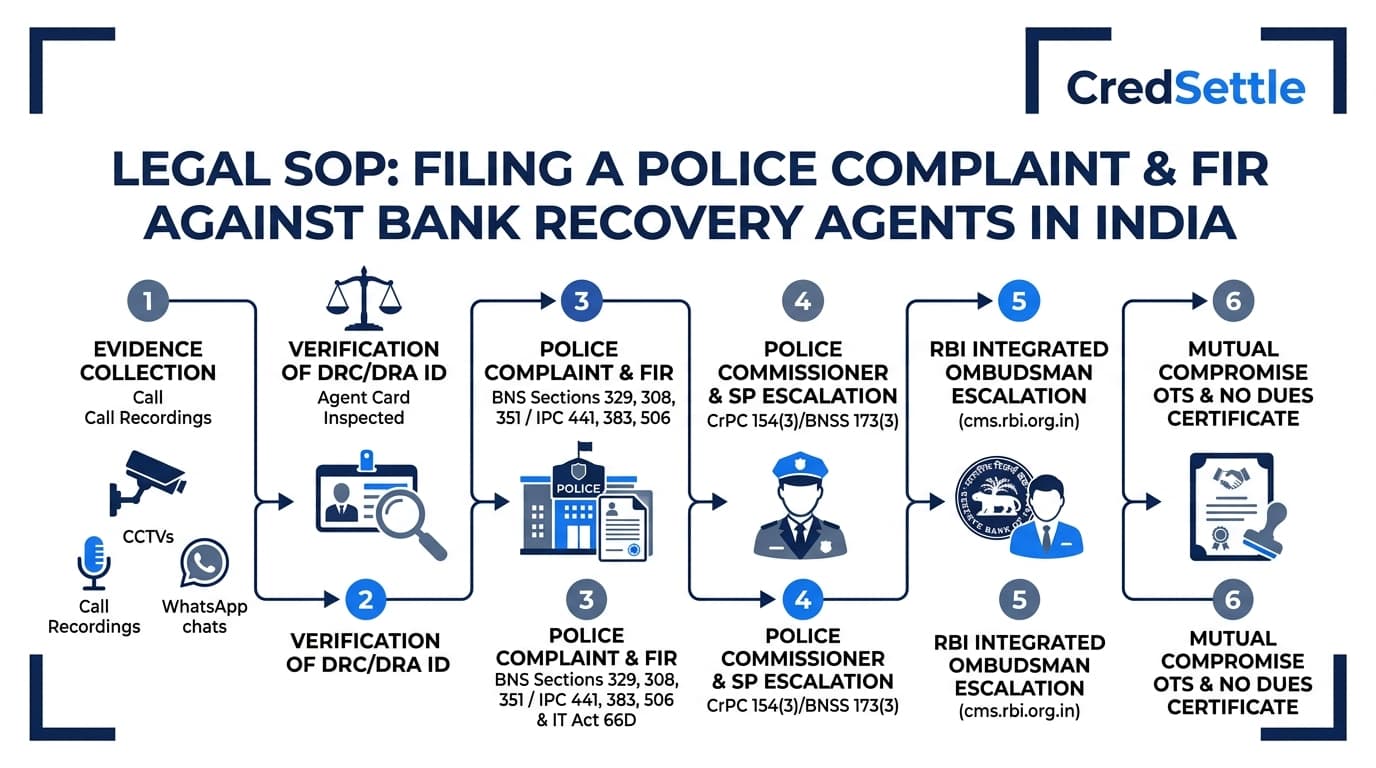
6. Actionable SOP: Filing Police Complaint & FIR
If third-party claims agents violate legal boundaries or threaten you. Follow this step-by-step Standard Operating steps to enforce your legal rights:
Stage 1: Forensic Evidence Audit & Agent ID Verification
Record all incoming claims calls with timestamps. Demand the visiting agent formal bank ID card and DRA approval letter. Preserve abusive SMS, WhatsApp messages. And CCTV recordings without signing handwritten slips.
Stage 2: Compile Formal Hardship Dossier & Cease-Desist Notice
Assemble documentary proof of hardship (health summaries. Termination letters). Issue a formal Cease and Desist notice to the bank Grievance Redressal Officer detailing unlawful agent threats and privacy violations.
Stage 3: Jurisdictional Police Complaint & FIR Registration
Submit a written reports to the local police Station House Officer (SHO) citing Section 351 BNS (506 IPC) for threats. Section 308 BNS (383 IPC) for extortion. Section 329 BNS (441 IPC) for trespass.
Stage 4: Supervisory Police Escalation under BNSS Section 173(3)
If the local police station refuses to register an FIR within 72 hours. Send the reports petition via registered speed post to the Superintendent of Police or Commissioner under Section 173(3) BNSS.
Stage 5: Escalation to RBI Integrated Ombudsman (cms.rbi.org.in)
If the lender fails to resolve the abuse within 30 days. Lodge an online reports on the RBI CMS portal. The Ombudsman can penalize the bank and order fast file recall.
Stage 6: Bilateral Negotiations, Letter Vetting & NDC Issuance
With abuse halted. Initiate One-Time talks with the bank credit boards. Verify the closure note on formal bank letterhead. Pay funds straight to the loan account. Collect your NDC.
7. Statutory Notice Defense: PSSA, NI Act & Arbitration
claims firms often deploy automated legal notices under Section 25 of the Payment and settlement Systems Act (PSSA). 2007 or Section 138 of the Negotiable Instruments Act. 1881 to intimidate clients. Understanding your exact legal defense rights neutralizes these threats tactics:
NACH or cheque bounce notices require a formal 15-day legal reply window. Establishing genuine hardship and absence of fraudulent intent prevents summary criminal steps.
Under Supreme Court rulings in. Perkins Eastman and TRF Ltd.Unilateral arbitrator appointments by lenders are void ab initio. Invalidating unilateral ex-parte awards.
no-pledge loans are exempt from SARFAESI repossession under Section 31(i). Section 19 of the claims of Debts and Bankruptcy Act mandates a ₹20 Lakh threshold for DRT claims.
Lenders face severe RBI sanctions for contacting clients outside 8 AM to 7 PM. Calling third parties. Deploying unverified claims personnel without formal ID.
Summary of legal Defense Principles:
- Unilateral arbitrator appointment without mutual consent is legally invalid.
- no-pledge loans cannot be subject to SARFAESI property attachment.
- legal replies to Section 25 / Section 138 notices preserve civil defense rights.
- main loan banks are held vicariously liable for all claims firm actions.
8. 3-Tier Institutional Grievance Redressal Escalation Matrix
When encountering claims agent misconduct. Escalate systematically through the legal 3-tier grievance mechanism mandated by the Reserve Bank of India:
Grievance Redressal Officer (GRO)
Submit a formal written reports with audio/video proof to the bank designated Grievance Redressal Officer. Obtain a unique reports Ticket Number to establish the initial audit trail.
Principal Nodal Officer (PNO)
Escalate unresolved reports to the bank main loan Nodal Officer. The PNO has executive formal to suspend rogue firms. Freeze claims activity. And initiate settlement discussions.
RBI Integrated Ombudsman
File an online petition on the RBI CMS portal (.cms.rbi.org.in). The Ombudsman holds legal formal to penalize errant banks. Award money payout. And order fast file recall.
9. Procedural Timeline: Loan Default to No Dues Certificate
The progression of a defaulted loan from early default to final debt settlement follows a predictable banking lifecycle. Milestones and defense plans from Day 1 to Month 6:
| Timeline Milestone. | Account Classification. | Bank Recovery Strategy. | Borrower Protection Action. | Credit & Legal Status. |
|---|---|---|---|---|
| Days 1. 30 | SMA-0 (Standard Account). | Automated SMS, reminder phone calls. | Notify bank in writing of temporary hardship. | Minor late fee. standard credit status. |
| Days 31. 60 | SMA-1 (Early default). | Tele-calling collections, payment demands. | Request formal EMI restructuring or pause. | 30+ DPD reported to credit bureaus. |
| Days 61. 90 | SMA-2 (Pre-NPA Alert). | Third-party firm assignment, doorstep visits. | Demand agent ID. record visits. issue warning. | 60+ DPD flag. credit freeze across lenders. |
| Days 91. 120 | NPA (Non-Performing Asset). | Legal demand notices, intense abuse. | File police reports / Cease &. Desist notice. | NPA status reported. bank creates provisioning. |
| Days 121. 180 | Sub-Standard / Loss Asset. | hearing summons or Lok Adalat notice. | Initiate One-Time settlement (OTS) talks. | Waiver of 40% to 75% on penal claims offered. |
| Post-settlement | Debt Extinguished. | All claims work permanently halted. | Obtain full No Dues letter (NDC). | Marked Closed/Settled. complete asset immunity. |
10. Specialized Case Studies: Real-World Debt Harassment Defense
Different loan categories and private situation present unique claims challenges. Here is how specialized defense plans apply in practice:
Coordinating Simultaneous Multi-Agency Harassment Defense
Coordinating centralized Cease and Desist notices across multiple credit cards and private loans shields clients from fragmented abuse.
Establishing Bona Fide Hardship Defense for Salaried Professionals
Serving legal notices asserting privacy violations under RBI norms protects company reputations and secures deep settlement waivers.
Shielding Commercial Operations and Personal Guarantors
Filing an fast FIR for criminal trespass (Section 329 BNS) neutralizes extra-judicial trade coercion.
Negotiating Steep Compromise Discounts with Bad Debt Buyers
ARCs acquire debts at 15% to 30% of face value under SARFAESI Section 5. Making them prime candidates for deep OTS deals.
 Legal Debt Dispute Authority
CredSettle (credsettle.com) is India's premier debt settlement, loan dispute resolution, and legal protection platform. Operating strictly under the RBI Fair Practices Code and CICRA 2005, our advocate panel negotiates directly with Bank Principal Nodal Officers to eliminate waived differentials, obtain unconditional No Dues Certificates (NDC), and upgrade credit bureau records from "Settled" to "Closed".
Frequently Asked Questions: Recovery Harassment & FIRs
Review authoritative legal answers to the most common questions regarding loan claims abuse. Police FIR steps. client protections in India: