Arbitration Notice for Personal Loan
Did your bank send an Arbitration Notice for a personal loan default? Learn your legal rights, how to challenge unilateral arbitrator appointments under Perkins Eastman. How to negotiate a final compromise settlement.
- Civil Nature with Zero Arrest Powers: An arbitration notice for personal loan default is strictly a civil debt adjudication mechanism under the Arbitration and Conciliation Act, 1996. An arbitrator is not a criminal judge and has zero legal authority to issue arrest warrants, summon police. Order imprisonment.
- Unilateral Arbitrators are Disqualified: Under landmark Supreme Court rulings (TRF Ltd. and Perkins Eastman), banks and NBFCs cannot unilaterally appoint a sole arbitrator. Any arbitrator appointed without mutual consent is de jure ineligible under Section 12(5), rendering their proceedings legally voidable.
- Critical 30-Day Section 21 Response Window: The receipt of a Section 21 notice formally triggers arbitration. Ignoring this notice risks an ex-parte Arbitral Award under Section 25, which can be executed as a civil court decree under Section 36 for asset or salary attachment.
- Strategic Leverage for 40% to 70% OTS Waiver: Filing formal jurisdictional objections under Section 16 and challenging arbitrator independence forces the lender into costly procedural delays, creating ideal leverage to negotiate a compromise One-Time Settlement (OTS).
- Section 34 Setting Aside Safeguards: If an ex-parte award is improperly passed, borrowers can file an application to set aside the award under Section 34 within 90 days before the Principal Civil Court on grounds of bias, lack of notice. Violation of public policy.
1. What is a Personal Loan Arbitration Notice? (Section 21 Framework)
When an individual defaults on unsecured personal loan EMIs due to acute financial hardship, job loss. Medical emergencies, commercial banks and Non-Banking Financial Companies (NBFCs) often initiate private dispute resolution rather than filing lengthy civil suits in regular courts. The primary legal vehicle used for this purpose is an. Arbitration Notice. issued under Section 21 of the Arbitration and Conciliation Act, 1996..
Standard personal loan agreements in India contain a standard boilerplate clause termed the. Arbitration Clause.. This clause stipulates that in the event of any contractual breach, payment default. Monetary dispute, either party may refer the matter to private arbitration instead of initiating conventional litigation before a civil judge. Section 21 of the Act establishes that the arbitral proceedings in respect of a particular dispute start on the date on which a request for that dispute to be referred to arbitration is received by the respondent borrower.
Formally triggers arbitral jurisdiction and establishes the legal timeline. The notice outlines the bank's total claim, alleged default dates, and names the nominated sole arbitrator.
Unlike civil courts that may take years, arbitration is designed as an expedited, private quasi-judicial process governed by strict statutory timelines under Section 29A of the Act.
The final outcome of arbitration is an Arbitral Award. Under Section 36 of the Act, an un-objected arbitral award is legally enforceable exactly like a decree of a Civil Court.
Why Lenders Prefer Arbitration: Commercial banks choose arbitration because it allows them to bypass crowded civil courts, conduct virtual hearings. Secure an ex-parte monetary award if the borrower fails to appear or submit a formal Statement of Defense.
2. Is a Personal Loan Arbitration Notice Legally Binding?
One of the most widespread tactics employed by unethical third-party debt recovery agencies is fabricating threats of immediate police intervention, arrest warrants. Criminal detention upon the issuance of an arbitration notice. Borrowers receiving these intimidating communications often experience severe distress.
Let us establish the definitive legal position under Indian statutory jurisprudence:
Under the Indian Contract Act, 1872 and the Arbitration and Conciliation Act, 1996, the non-payment of an unsecured personal loan is strictly a civil dispute arising from contractual insolvency. An arbitrator is a private dispute adjudicator appointed to determine monetary liability. An arbitrator possesses zero criminal jurisdiction, cannot issue Non-Bailable Warrants (NBW), cannot direct the police to arrest you. Cannot sentence any borrower to prison.
Any recovery agent or legal notice asserting that an arbitration proceeding will result in criminal imprisonment violates the Reserve Bank of India (RBI) Fair Practices Code and constitutes extortion under Section 383 of the Indian Penal Code (Section 308 BNS).
The Real Danger: Ex-Parte Arbitral Awards and Section 36 Execution
While you cannot go to jail, an arbitration notice is legally binding in terms of civil financial liability. If you choose to ignore the notice and do not participate in the proceedings, the arbitrator will mark you ex-parte under Section 25(b) of the Act. The tribunal will then pass an. Ex-Parte Arbitral Award. granting the bank 100% of their claimed principal, compounding penal interest rates (often 24% to 36% per annum). Excessive legal fees.
Once the statutory 90-day challenge period under Section 34 expires, the bank can file an. Execution Petition under Section 36. before a Principal District Civil Court. The executing court holds the statutory power to attach your savings accounts, garnish your salaried income. Attach unencumbered movable and immovable assets to satisfy the arbitral decree.
3. The Supreme Court Rulings on Unilateral Arbitrator Appointments
In a vast majority of personal loan arbitration cases in India, banks and NBFCs unilaterally appoint their own empaneled sole arbitrator without seeking prior written concurrence or consent from the borrower. The Supreme Court of India has categorically declared such unilateral appointments illegal, null, and void ab initio.
The Rule of Inherent Ineligibility
The Hon'ble Supreme Court established the principle that once an authority or person becomes ineligible by operation of law (Section 12(5) read with Seventh Schedule) to act as an arbitrator due to interest in the outcome, that person cannot nominate or appoint another individual to act as the sole arbitrator. What cannot be done directly cannot be done indirectly.
Prohibition of Unilateral Appointment by Interested Parties
The Supreme Court expanded the doctrine, holding that a party having an interest in the dispute (e.g., the lending bank or NBFC) cannot have the exclusive right to appoint a sole arbitrator. Such an appointment creates justifiable doubts regarding independence and impartiality, rendering the sole arbitrator disqualified de jure from entering upon reference.
Affirmation of Equality and Institutional Neutrality
The Constitution Bench reinforced that the principle of equality of arms is fundamental to Indian arbitration law. Unilateral appointment clauses in standard adhesion contracts (like bank loan sanction letters) violate public policy unless both parties mutually agree on the arbitrator in writing after the dispute has arisen or the appointment is made by the High Court under Section 11(6).
Why This is Your Strongest Defense: Because over 90% of bank personal loan arbitration notices involve unilateral appointments, borrowers possess an absolute statutory ground to challenge the arbitrator's jurisdiction under Section 12(5) and Section 16, halting aggressive proceedings in their tracks.
4. Legal Forum Comparison: Personal Loan Default Recovery Options
When a borrower defaults on a personal loan, lenders evaluate multiple recovery routes. Compare how arbitration compares against summary civil suits, DRT proceedings, criminal cheque bounce actions, and Lok Adalats:
| Legal Forum | Governing Statute. | Power to Jail / Arrest. | Enforceability & Appeal Route. | Typical Timelines. | Strategic Defense. |
|---|---|---|---|---|---|
| Arbitration Tribunal. | Arbitration Act 1996. | NO (Zero Power) | Award = Civil Decree (Sec 36); Challenge under Sec 34. | 4 to 8 Months | Challenge Sec 12(5) Unilateral Appointment & Negotiate OTS. |
| Summary Civil Suit (Order 37 CPC). | Code of Civil Procedure, 1908. | NO (Civil Recovery). | Civil Court Money Decree; First Appeal to High Court. | 18 to 36 Months | File Leave to Defend citing triable issues & interest disputes. |
| Debt Recovery Tribunal (DRT). | RDBFI Act, 1993 (SARFAESI). | NO (Strictly >₹20 Lakhs). | Recovery Certificate; Appeal to DRAT with 50% pre-deposit. | 12 to 24 Months | Contest Statement of Account & seek structured restructuring. |
| Cheque Bounce (Sec 138 NI Act / Sec 25 PSS). | Negotiable Instruments Act / PSS Act 2007. | YES (Bailable Offense, up to 2 yrs). | Magistrate Criminal Judgment; Criminal Appeal to Sessions Court. | 12 to 30 Months | Appear with Counsel, secure immediate bail, settle via compounding. |
| National Lok Adalat. | Legal Services Authorities Act, 1987. | NO (Pure Conciliation). | Final Consent Award (Non-appealable under Sec 21). | 1 Day (Single Sitting). | Execute formal One-Time Settlement with maximum waiver. |
5. Technical Financial Risk Analytics & CIBIL Scoring Penalties
Failing to respond to an arbitration notice triggers both compounded legal financial exposure and catastrophic credit bureau rating degradation. The following mathematical model illustrates how a default scales unchecked:
Compounding Penal Interest & Cost Inflation
Credit Score Destruction & DPD Tracking
Visual Defense Blueprint: 6-Step Arbitration Defense Workflow
Refer to this visual roadmap outlining the strategic 6-stage procedural sequence to challenge unilateral arbitrator appointments, assert statutory objections. Negotiate an amicable debt resolution:
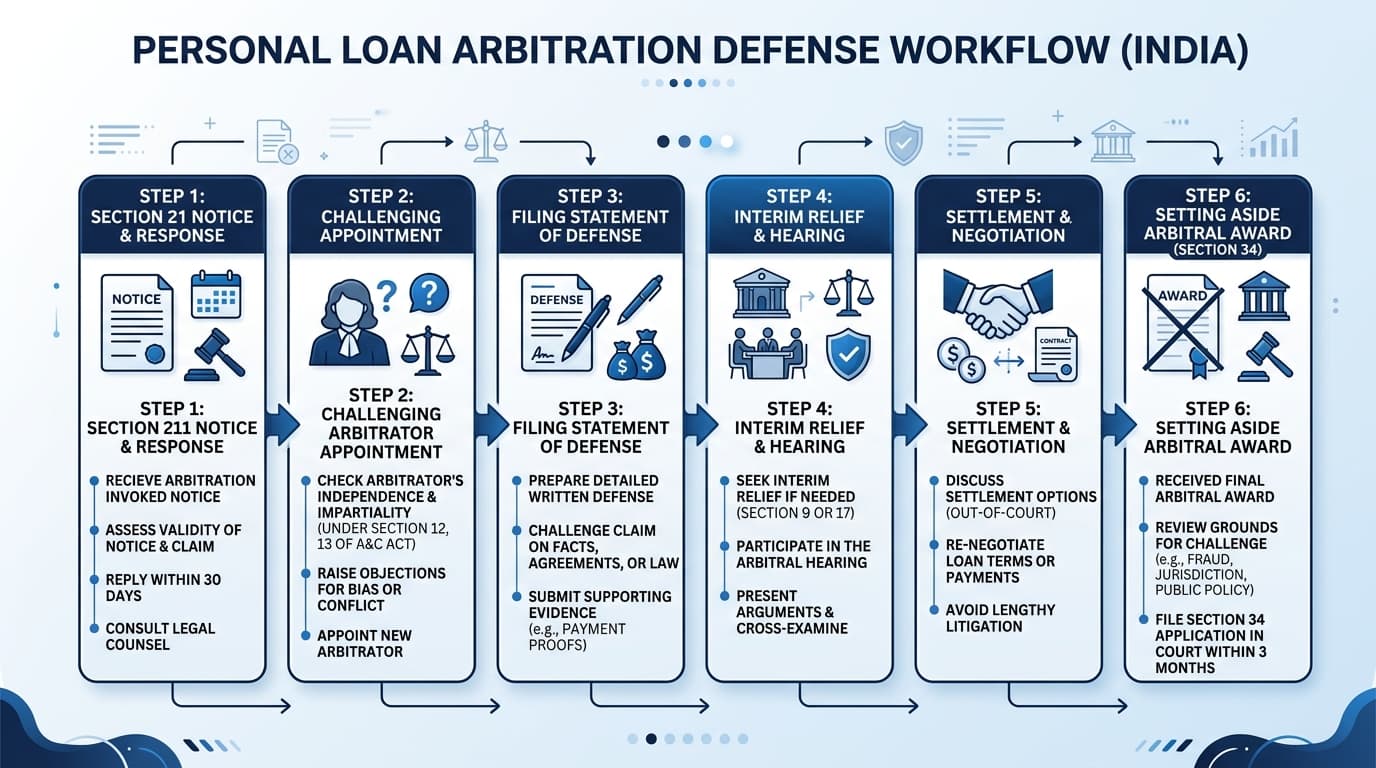
6. Standard Operating Procedure (SOP): 6 Stages of Arbitration Defense
Follow this sequential, battle-tested standard operating procedure to safeguard your rights upon receiving an arbitration notice for an unpaid personal loan:
Comprehensive Receipt, Claim & Agreement Audit
Verify the exact date of receipt of the Section 21 notice. Examine the underlying loan agreement to inspect the specific wording of the arbitration clause. Cross-examine the claimed outstanding balance against your actual bank account bank statements and loan disbursement records to identify predatory penalty charges, insurance mis-selling deductions. Unsubstantiated collection fees.
Section 12(5) Challenge on Unilateral Appointment & Bias
Serve a formal written objection upon both the lending institution and the nominated sole arbitrator citing the Supreme Court precedents in. Perkins Eastman and TRF Ltd. Object that the unilateral appointment violates Section 12(5) read with the Seventh Schedule of the 1996 Act. Demand that the nominated arbitrator immediately recuse themselves from entering upon the reference.
Jurisdictional Objection under Section 16 & Venue Inconvenience
If the arbitrator proceeds to fix a preliminary hearing, file a formal Application under Section 16 of the Act challenging the competence and jurisdiction of the arbitral tribunal. Raise objections regarding improper territorial seat (e.g., proceedings held in Delhi or Mumbai when the loan was sanctioned and released in Bangalore or Hyderabad) under Section 20 of the Act.
Filing Substantive Statement of Defense (SOD) & Financial Evidence
Without waiving your jurisdictional objections, submit a detailed Statement of Defense. Document genuine reasons for default (such as medical records, salary cut letters, or business closure notices). Challenge inflated compounding interest calculations, submit proof of all historical repayments. Pray for the dismissal or large scaling down of the bank's claim.
Leveraging Legal Impasse to Transition into Compromise OTS
Filing strong Section 12(5) and Section 16 objections creates major litigation risk for the bank, as any award obtained would be vulnerable to being set aside. Use this procedural stalemate to initiate bilateral settlement discussions with the bank's Legal Recovery Desk, securing a 40% to 70% waiver on accumulated penal interest and closing the loan under a formal One-Time Settlement.
Section 34 Petition to Set Aside Award (If Award Passed)
If the arbitrator improperly passes an ex-parte or unilateral award despite your objections, file an application under Section 34 of the Act before the Principal District Civil Court or High Court within 90 days. Concurrently file for an unconditional stay of execution under Section 36(2) and 36(3) citing patent illegality and bias.
7. Formal Reply Architecture & Substantive Legal Defense Strategy
Crafting a legally sound and authoritative response to an arbitration notice requires a multi-layered statutory strategy that addresses procedural invalidity, jurisdictional deficiencies. Substantive financial errors. When served with a notice invoking arbitration under Section 21 of the Arbitration and Conciliation Act, 1996, the response must be dispatched via registered speed post with acknowledgment due and registered email within thirty days of receipt, addressing both the institutional claimant and the designated sole arbitrator.
The foremost pillar of the reply must dismantle the legitimacy of the arbitrator nomination itself by invoking Section 12(5) read in conjunction with the Seventh Schedule of the Act. Citing the binding constitutional authority of the Supreme Court in. Perkins Eastman Architects DPC v. HSCC (India) Ltd. and TRF Ltd. v. Energo Engineering Projects Ltd., the reply should formally record that a lender cannot unilaterally select an adjudicator from its private panel without prior mutual written consent executed after the dispute has matured. The communication must place the nominee on notice that proceeding with hearings under a tainted, unilateral appointment renders them de jure disqualified from acting as an arbitral tribunal, exposing any subsequent award to automatic invalidation under Section 34(2)(a)(v) of the statute.
The second layer of the defense must target territorial jurisdiction and forum convenience under Section 20 of the Act. Many digital lending NBFCs and national private banks routinely schedule arbitral sittings in remote metropolitan centers such as New Delhi or Mumbai, even when the borrower resides in a distant state and the loan was sanctioned through a localized branch or digital application. The formal reply must register strong objections against such forum shopping, showing that forcing a financially distressed borrower to defend proceedings at an inconvenient seat violates principles of natural justice under Section 18 of the Act, which guarantees equal treatment and full opportunity to present one's case.
On the financial and accounting merits, the response must rigorously challenge the quantum of the bank's monetary claim by demanding a certified, audited loan account ledger under the Bankers&apos. Books Evidence Act, 1891. Lenders frequently inflate personal loan claims by capitalizing compounding penal interest, levying arbitrary cheque bounce fees. Attaching unapproved legal recovery charges that contravene Reserve Bank of India Master Directions on Fair Practices Code. The reply should formally repudiate these unconscionable penalties, establish the borrower's genuine willingness to clear legitimate principal dues under restructured terms. Invite the institutional claimant to participate in an amicable compromise One-Time Settlement (OTS) before any adversarial steps are taken.
8. The 3-Tier Escalation Matrix & Judicial Remedies
If the lending bank or its recovery agents persist with unlawful recovery harassment or refuse to acknowledge legitimate Section 12(5) objections, escalate through this structured 3-tier regulatory and judicial matrix:
Filing Formal Section 16 & Section 12 Objections
Submit written applications directly to the arbitral tribunal contesting jurisdiction, unilateral nomination, and excessive penal interest. Simultaneously serve a copy upon the Bank Principal Nodal Officer (PNO) requesting formal referral to the bank's OTS compromise committee.
Judicial Termination of Arbitrator Mandate
If the sole arbitrator refuses to recuse themselves despite Section 12(5) ineligibility, file an application under Section 14 and Section 15 of the 1996 Act before the High Court for termination of the arbitrator's mandate. Pray for the appointment of an independent arbitrator under Section 11(6).
Regulatory Complaint for Predatory Recovery & Harassment
If the bank combines arbitration with abusive phone calls, workplace visits. Third-party agent threats, file an immediate complaint on the. RBI CMS portal (cms.rbi.org.in). under the Reserve Bank - Integrated Ombudsman Scheme, 2021 for violation of the Fair Practices Code.
9. Chronological Milestone Resolution Timeline (Day 0 to Month 6)
Understanding institutional and legal milestones allows borrowers to plan defense maneuvers and settlement negotiations strategically:
| Milestone Phase | Key Legal Event | Statutory Limitation. | Borrower Strategic Action. |
|---|---|---|---|
| Day 0 | Receipt of Section 21 Arbitration Notice. | Clock starts for 30-day response. | Audit loan ledger & seek legal debt assessment. |
| Days 15–30 | Service of Formal Defense & Objection Reply. | Within 30 days of notice receipt. | Dispatch Section 12(5) challenge & dispute penal costs. |
| Days 45–75 | Preliminary Arbitral Hearing / Section 16 Hearing. | before filing Statement of Defense. | Appear virtually/in-person through counsel to argue bias. |
| Months 3–4 | Compromise OTS Negotiation Window. | Bilateral negotiation period. | Secure written OTS letter with 40%–70% waiver. |
| Months 5–6 | Full Closure & No Dues Certificate Issuance. | Within 30 days of OTS remittance. | Obtain official NDC and update CIBIL status to Closed. |
10. Special Scenarios: Fintech Apps, Credit Cards & ARCs
Arbitration mechanics vary across different credit products and institutional structures:
Fintech NBFC Loan Apps & Online Dispute Resolution (ODR)
Digital loan apps frequently use automated Online Dispute Resolution (ODR) platforms to send automated WhatsApp and email arbitration notices. Many of these platforms operate with automated algorithms and empaneled arbitrators who pass awards in bulk. You must send a formal written response challenging the digital consent mechanisms and unilateral arbitrator assignment.
Credit Card Dues vs. Personal Loans in Arbitration
Credit card agreements frequently incorporate unilateral arbitration clauses. Because credit card claims often include 40%+ revolving annualized finance charges and GST on penalties, filing an arbitration defense focusing on unconscionable finance charges consistently yields major compromise settlement discounts.
Debt Assigned to Asset Reconstruction Companies (ARCs)
If your personal loan was sold to an ARC (such as Phoenix ARC, CFM ARC. ARCIL), the ARC steps into the shoes of the original lender under Section 5 of the SARFAESI Act. ARCs actively invoke arbitration to secure enforceable awards. However, ARCs acquire bad loan portfolios at deep discounts (often 20% to 30% of face value), making them highly receptive to fast One-Time Settlements.
Co-Borrowers and Legal Heirs in Arbitration
In joint personal loans, arbitration notices are served on all co-signers and guarantors simultaneously. In the unfortunate event of a deceased borrower, legal heirs are liable only to the extent of the value of any inherited estate and cannot be held personally liable for the remaining debt.
 Legal Debt Dispute Authority
CredSettle (credsettle.com) is India's premier debt settlement, loan dispute resolution, and legal protection platform. Operating strictly under the RBI Fair Practices Code and CICRA 2005, our advocate panel negotiates directly with Bank Principal Nodal Officers to eliminate waived differentials, obtain unconditional No Dues Certificates (NDC), and upgrade credit bureau records from "Settled" to "Closed".
Frequently Asked Questions on Personal Loan Arbitration Notices
Click on any question below to view detailed legal answers verified by our debt resolution professionals:
Official Regulatory Citations & Judicial References
- Arbitration and Conciliation Act, 1996: Sections 11, 12(5), 16, 21, 25, 34, and 36, Ministry of Law and Justice, Government of India.
- Supreme Court of India: Perkins Eastman Architects DPC v. HSCC (India) Ltd. (2020) 20 SCC 760. (Disqualification of Unilateral Arbitrator Appointments).
- Supreme Court of India: TRF Ltd. v. Energo Engineering Projects Ltd. (2017) 8 SCC 377. (Ineligibility of Interested Parties to Nominate Sole Arbitrators).
- Reserve Bank of India Master Directions: Master Direction on Fair Practices Code for Lenders and Grievance Redressal Mechanism (Updated 2026).
- Reserve Bank - Integrated Ombudsman Scheme, 2021: Redressal of Unfair Recovery Practices and Arbitrary Interest Capitalization.