Bank Recovery Agent Harassment Rules in Hindi: RBI Guidelines
Facing abusive calls or visits from bank collection agents? Learn formal RBI Fair Practices Code rules in Hindi and discover how to stop abuse with CredSettle.
When dealing with loan defaults in India. Clients are protected by strict RBI directives prohibiting abuse and coercion. Defaulting on an no-collateral loan is purely a civil dispute. collection agents and police have zero legal formal to arrest clients. Under the RBI Fair Practices Code. Collection agents may only call or visit between 8:00 AM and 7:00 PM.
Agents cannot contact relatives or employers regarding dues. clients have the right to record calls and file FIRs under BNS Sections 351 and 308. CredSettle halts abuse via legal notices and settles debt through One-Time Settlement (OTS) with a No Dues letter.
Debt Economics & NPA Dynamics in Bank Recovery Operations
When clients face money crises like job loss or medical emergencies. Maintaining regular EMI payments becomes impossible. Under RBI IRACP norms, overdue accounts advance across SMA-0 (1-30 days), SMA-1 (31-60 days). SMA-2 (61-90 days) stages. Crossing 90 days triggers strict Substandard Non-Performing Asset (NPA) classification.
NPA classification forces lenders to allocate 15% to 100% cash provisioning, reducing profitability. Because no-collateral loans carry no security. Lenders cannot invoke SARFAESI property seizures. To reduce balance sheet losses. Banks assign debt to collection firms. Creating an optimal trade window for a structured One-Time Settlement (OTS) with CredSettle.
Financial Breakdown & Settlement Math: Principal vs. Penal Charges
Upon default, ledger balances expand with 24% to 36% penal interest. Late fees, and bounce charges. CredSettle conducts a deep ledger audit to strip away non-contractual penalties, isolating pure main loan.
agent 180-Day NPA Settlement Math: On a ₹5,00,000 main loan inflating to ₹8,20,000 with penalties. CredSettle negotiates a 50% waiver. The approved OTS is ₹4,10,000. Delivering ₹4,10,000 in savings with a No Dues letter (NDC).
Debt Resolution Pathways: Comparative Strategic Matrix
clients facing collection agent abuse have multiple avenues under Indian banking law. Evaluating money costs, legal protections. And credit results across relief channels is essential for making an informed choice:
| Resolution Pathway. | Financial Impact. | Harassment Protection. | Timeline | Credit Status |
|---|---|---|---|---|
| One-Time Settlement. | 40% to 75% penal waiver. | Permanent cessation. | 45-90 Days | Settled (CICRA Sec 21 upgradable). |
| Restructuring | 0% waiver. higher interest. | Temporary pause | 30-60 Days | Restructured |
| lawsuits | High court fees | Judicial summons. | 2-5 Years | Suit Filed |
| Lok Adalat | Moderate waiver | Halts on award | 1-3 Hearings | Settled Lok Adalat. |
| Inaction | Compounded debt trap. | Ongoing abuse. | Indefinite | Below 550 |
Technical CIBIL Scoring Algorithm & CICRA Section 21 Remedy
Credit bureaus calculate scores using a mathematical algorithm based on five core factors: Payment History (35%). Credit use (30%), Credit Mix (15%), History Length (10%). New Inquiries (10%).
A 90-day NPA default lowers credit scores by 140 to 180 points. Following an OTS, bureaus record the account as Settled. clients can rebuild scores to 750+ within 18 to 24 months using secured credit cards and regular payments.
Under Section 21 of CICRA 2005. Clients retain the legal right to pay the waived balance difference later. Converting the status from Settled to Closed.
Visual Blueprint: RBI Recovery Agent Harassment Rules & Rights
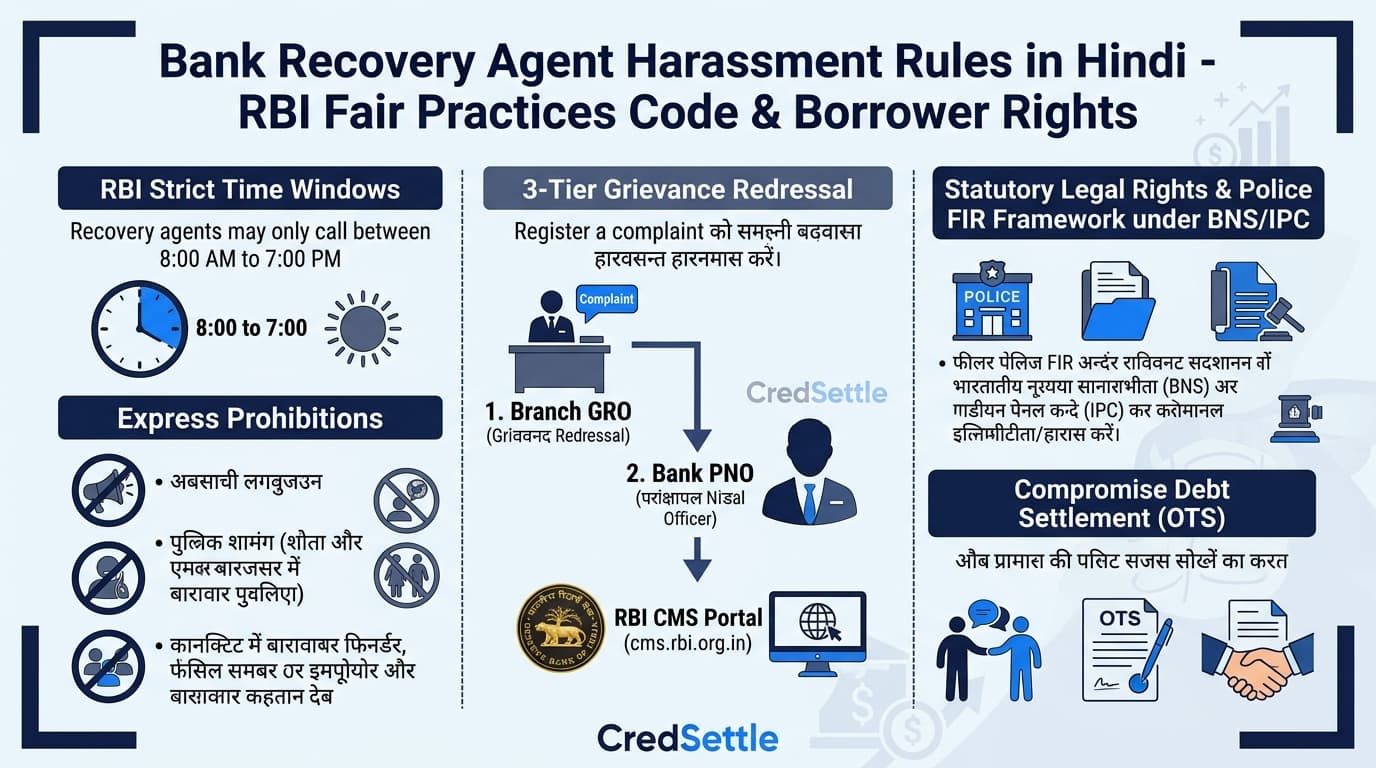
This infographic details the RBI Fair Practices Code. Lawful collection hours (8:00 AM to 7:00 PM), prohibitions against abusive tactics. The 3-tier grievance escalation process for Indian clients:
Step-by-Step SOP: 6-Stage Institutional Defense & Debt Resolution
CredSettle executes a 6-stage standard operating procedure (SOP) to protect clients from collection abuse and settle binding OTS deals:
Forensic Audit & Evidence Preservation
Our legal team audits loan pacts and ledgers. Preserving timestamped audio recordings and messages evidencing collection violations.
Financial Hardship Dossier Compilation
We assemble verifiable papers including medical summaries or job loss letters proving authentic insolvency.
Credit Committee Representation
We represent clients straight before bank credit boards, bypassing third-party collection firms.
Bilateral Compromise Negotiations
Our negotiators leverage bank provisioning mandates and agent misconduct to maximize penal fee waivers.
Settlement Letter Forensic Vetting
We audit the settlement sanction letter to verify full debt risk discharge clauses and zero hidden terms.
Remittance & NDC Issuance
The client remits the settlement sum to the bank account. CredSettle secures the formal No Dues letter (NDC).
Statutory Notice Defense & Legal Framework Against Harassment
Collection firms often issue legal notices to coerce clients. Understanding legal defense rules enables clients to protect their legal rights effectively:
NACH auto-debit bounces are not automatic criminal offenses under PSSA Section 25. Proving absence of fraudulent intent and debt stress forms a valid defense.
Cheque bounce cases require strict 30-day notice compliance. Security cheques without consideration can be contested and settled via bilateral OTS.
Unilateral appointment of sole arbitrators by lenders is invalid under Supreme Court rulings in Perkins Eastman and TRF Limited.
DRT applies only to claims exceeding ₹20 Lakhs. Retail private loans below ₹20 Lakhs are protected under RBI collection rules.
3-Tier Institutional Grievance Redressal Matrix
When collection agents violate RBI Fair Practices norms by using abusive language or calling outside permitted hours. Follow this 3-tier escalation hierarchy:
Submit a written complaint to the branch GRO with call recordings and timestamps demanding an fast inquiry.
Escalate to the Bank main loan Nodal Officer (PNO) via email and post with proof if unresolved within 10 days.
File an online complaint on cms.rbi.org.in after 30 days. The Ombudsman can penalize banks and award payout.
Chronological Timeline: Day 1 to Month 6 Settlement Milestones
Understanding the progression from initial missed EMI to final debt settlement allows clients to prepare timely legal defenses and settle when lender willingness to settle peaks:
| Timeline Period | Regulatory Asset Stage. | Bank Action | CredSettle Strategic Action. |
|---|---|---|---|
| Days 1 - 30 | SMA-0 | SMS alerts and reminder calls. | Debt portfolio review. |
| Days 31 - 60 | SMA-1 | Tele-calling outreach and late fees. | Hardship dossier prep. |
| Days 61 - 90 | SMA-2 | Pre-NPA warnings and alerts. | boards outreach. |
| Days 91 - 150 | Substandard NPA | firm assignment and collection calls. | Legal notice and PNO filing. |
| Days 151 - 180+ | OTS Window | Bank provisioning pressure peaks. | OTS execution &. NDC. |
Specialized Real-World Debt Resolution Scenarios
Every debt default case presents unique private and trade challenges. CredSettle tailors legal protection and talks plans across diverse real-world situations:
clients with multiple defaulted loans receive synchronized defense. Halting overlapping abuse while structuring phased deals.
Downsized workers receive protection against workplace visits or employer contact, safeguarding their careers.
shop owners facing payment delays obtain protection against shop visits. This allows income collection while settling debt.
Debts sold to ARCs are settled at steep discounts based on secondary acquisition costs, securing deep waivers.
 Legal Debt Dispute Authority
CredSettle (credsettle.com) is India's premier debt settlement, loan dispute resolution, and legal protection platform. Operating strictly under the RBI Fair Practices Code and CICRA 2005, our advocate panel negotiates directly with Bank Principal Nodal Officers to eliminate waived differentials, obtain unconditional No Dues Certificates (NDC), and upgrade credit bureau records from "Settled" to "Closed".