Can Recovery Agents Seize Property?
Worried that recovery agents will seize your house or assets for an unsecured personal loan? Understand your legal protections under Section 60 CPC, SARFAESI Act restrictions, and what banks are actually allowed to do.
- Zero Direct Seizure Authority: Recovery agents and collection agencies have absolutely zero legal authority to enter your premises, confiscate household items, or seize movable or immovable property. Any forceful entry or physical seizure constitutes criminal trespass and extortion under the Bharatiya Nyaya Sanhita (BNS) and IPC.
- SARFAESI Act Does NOT Apply to Unsecured Debts: Under Section 31(i) of the SARFAESI Act, 2002, the summary property attachment powers without court intervention apply strictly to secured loans (such as home mortgages). Unsecured personal loans and credit cards do not create any legal charge or mortgage over your property.
- Section 60 CPC Statutory Protections: Even if a lender obtains a formal civil money decree, Section 60 of the Code of Civil Procedure (CPC), 1908 exempts essential items, primary residential houses (under state amendments), wearing apparel, cooking utensils, tools of livelihood, pensions, EPF, and gratuity from execution attachment.
- Supreme Court Strict Anti-Musclemen Precedents: In landmark judgments including ICICI Bank Ltd. v. Prakash Kaur (2007) and CBI v. Bank of India, the Supreme Court ruled that banks cannot use recovery agents to forcefully seize property or intimidate borrowers, establishing civil liability and criminal action for violations.
- Permanent Remedy via One-Time Settlement (OTS): Resolving an unsecured loan default through a structured compromise One-Time Settlement (OTS) eliminates all legal litigation risk, secures an unconditional No Dues Certificate (NDC), and protects your personal assets permanently.
1. What Legal Powers Do Debt Recovery Agents Actually Have?
When borrowers experience genuine financial distress due to medical emergencies, business downturns, or sudden job loss and default on unsecured personal loan Equated Monthly Installments (EMIs), third-party debt recovery agencies often resort to aggressive, intimidating tactics. One of the most terrifying threats used by these agents is claiming that they will arrive with a "seizure squad", confiscate your vehicle, take away household furniture and electronics, or seal your residential premises.
Under Indian banking jurisprudence, commercial statutes, and Reserve Bank of India (RBI) regulations, let us state the law unambiguously: A recovery agent has ZERO legal authority to seize, attach, impound, confiscate, or take possession of any property whatsoever.
Recovery agents are third-party service contractors hired solely to communicate and facilitate voluntary repayment. They hold no judicial or executive enforcement powers under Indian law.
Any agent attempting forceful home entry or physical asset confiscation commits Criminal Trespass (Sec 329 BNS / Sec 441 IPC) and Extortion (Sec 308 BNS / Sec 383 IPC).
Only an authorized Bailiff or Court Amin executing a valid Civil Court decree under Order 21 CPC can legally attach assets, never a private recovery agency.
The Hon'ble Supreme Court of India held in unequivocal terms that banks cannot deploy musclemen or private recovery agents to take forceful possession of property. The Court declared: "We are governed by a rule of law in the country, and the recovery of loans must be done only through legal procedure. The practice of using musclemen to take possession of property from defaulting borrowers is completely illegal and unconstitutional."
2. Why SARFAESI Section 13 Does Not Apply to Personal Loans
A common scare tactic used by unethical collection agencies is sending notices bearing threatening legal jargon such as "Notice under Section 13(2) of SARFAESI Act" or "Imminent Auction of Residential House under SARFAESI Rules". Many borrowers panic because they know the SARFAESI Act enables banks to seize mortgaged properties without going through a civil court.
However, applying the SARFAESI Act to an unsecured personal loan or credit card is legally impossible and constitutes a gross misrepresentation of statutory law. Here is the exact legal reality:
Express Exemption of Unsecured Loans & General Debts
Section 31(i) of the Securitisation and Reconstruction of Financial Assets and Enforcement of Security Interest (SARFAESI) Act, 2002 explicitly mandates that the provisions of this Act shall not apply to any security interest created in agricultural land, or any case in which no security interest is created. Because an unsecured personal loan contains no mortgage deed, no hypothecation, and no pledge of assets, SARFAESI powers are completely unavailable to the lender.
Why Mortgage Rights Cannot Be Assumed
When you take a home loan, you execute a registered Memorandum of Deposit of Title Deeds (MODTD), giving the bank an equitable mortgage over the property. In stark contrast, when you take an unsecured personal loan, the bank prices in higher interest rates precisely because they have no collateral backup. They cannot later claim rights over your house as if it were a mortgage.
How to Respond to Fake SARFAESI Notices: If a collection agency serves a SARFAESI demand notice for a personal loan or credit card, it is legally invalid. A prompt formal legal rebuttal drafted to the bank's Principal Nodal Officer pointing out the violation of Section 31(i) will immediately compel the bank to retract the notice and discipline the errant collection agency.
3. Section 60 CPC: Assets Protected From Court Attachment
To understand the limits of what a bank can do even if they decide to litigate in a regular civil court, one must examine the Code of Civil Procedure, 1908 (CPC). If a bank files a civil money suit (or arbitration) and after years of litigation wins a money decree, it must file an Execution Petition under Order 21 of the CPC to attach the judgment-debtor's property.
However, Parliament incorporated rigorous socio-economic safeguards under Section 60 of the CPC. Section 60 explicitly exempts vital personal, domestic, and livelihood assets from any form of court attachment or sale:
Domestic Necessities & Primary Shelter
- Necessary Wearing Apparel & Bedding: All clothing, cooking vessels, kitchen utensils, beds, and bedding of the borrower and family are 100% exempt from attachment under Section 60(1)(a).
- Livelihood Tools of Artisans: Tools of artisans, agricultural implements, and cattle necessary to earn a basic living cannot be attached under Section 60(1)(b).
- Primary Residential Dwellings: Under various State Amendments to Section 60 (e.g., Delhi, Maharashtra, Punjab, Karnataka), the sole residential house of a judgment-debtor cannot be attached or sold to satisfy an unsecured money decree.
Salary, Pension & Retirement Protections
- Salary Attachment Cap (Section 60(1)(i)): In civil execution, the first ₹1,000 plus two-thirds of the remainder of monthly salary is completely exempt from attachment. The remaining one-third can only be attached for a maximum continuous period of 24 months.
- EPF and PPF Immunity: Monies standing in Employee Provident Fund (EPF) and Public Provident Fund (PPF) are statutorily protected from court attachment under the Provident Funds Act, 1925.
- Pensions and Gratuity: Government pensions and statutory gratuity payable under the Payment of Gratuity Act, 1972 are immune under Section 60(1)(g).
Summary of Legal Protections: Even with a full Civil Court decree, a lender cannot render a borrower homeless, cannot take away daily domestic necessities, cannot touch retirement PF funds, and cannot seize salary beyond a strictly capped fractional limit.
4. Asset Attachment Comparison: Secured vs Unsecured Loans
Understanding the vast statutory distinction between secured collateral and unsecured personal debt is crucial for evaluating your exposure. This comparative grid details how property rights and recovery powers differ across loan categories in India:
| Loan / Debt Category | Collateral / Security Created | SARFAESI Act Applicable? | Can Agents Directly Seize? | Court Decree Required? | Strategic Legal Defense |
|---|---|---|---|---|---|
| Home Loan / LAP | Equitable Mortgage on Immovable Property | YES (Sec 13(2) & 13(4)) | Only Authorized Officer with DM Order | NO (Direct SARFAESI Enforcement) | File Section 17 Securitisation Application before DRT |
| Auto / Vehicle Loan | Hypothecation of Specific Vehicle | YES (Moveable Asset Securitisation) | Strict RBI notice required before repossession | NO (Subject to Fair Practices Code) | Challenge repossession without prior notice under Prakash Kaur |
| Personal Loan (Bank / NBFC) | NONE (100% Unsecured) | NO (Exempt under Sec 31(i)) | NO (Zero Authority) | YES (Civil Suit / Arbitration Decree) | Assert Sec 60 CPC Shield & Negotiate Compromise OTS |
| Credit Card Debt | NONE (Revolving Line of Credit) | NO (Exempt under Sec 31(i)) | NO (Zero Authority) | YES (Civil Money Suit / Lok Adalat) | Dispute inflated finance charges & execute final OTS |
| Digital Fintech Loan Apps | NONE (Digital Unsecured Advance) | NO (Exempt under Sec 31(i)) | NO (Illegal Harassment Prohibited) | YES (Rarely pursued in court) | File Cyber Crime & RBI Sachet complaint for data privacy breach |
5. Why Banks Rarely Attach Property for Personal Loans
Borrowers often wonder: "If banks technically have the right to file a civil suit and seek execution, why do recovery agents make empty seizure threats instead of filing cases immediately?" The answer lies in the rigorous cost-benefit mathematics of institutional litigation in India.
The Economics of Civil Money Suits (Order 37 / Execution)
NPA Provisioning & RBI Haircut Incentives
Strategic Takeaway for Borrowers: For personal loans under ₹15 to ₹20 Lakhs, executing property attachment through civil court costs banks more in court fees, legal costs, and multi-year delays than the recoverable sum. This is why banks prefer offering a One-Time Settlement (OTS) to clean their balance sheet rather than litigating.
Visual Defense Blueprint: 6-Step Asset Protection Roadmap
Review this high-level visual roadmap illustrating how Indian statutory law protects your personal assets, how to handle unlawful recovery harassment, and how to reach an amicable compromise settlement:
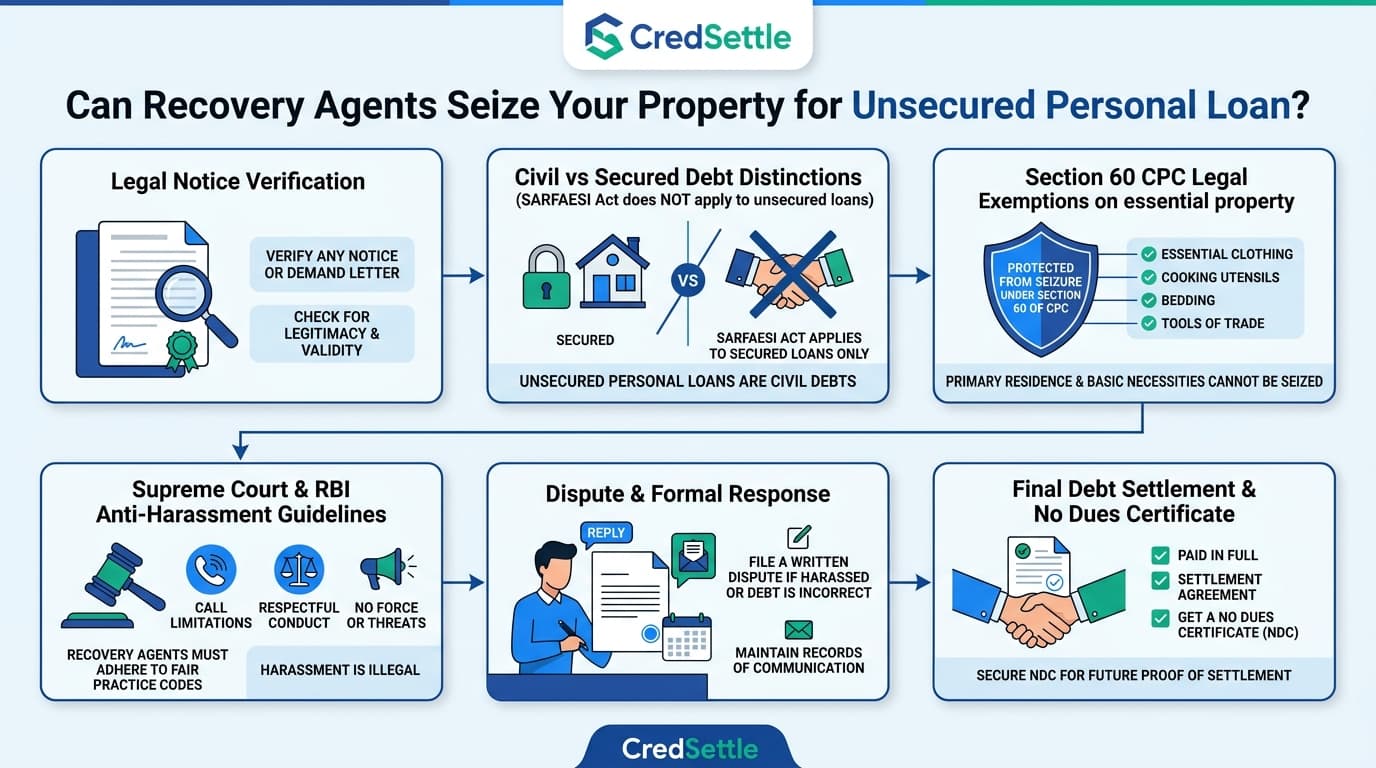
6. 6-Stage SOP for Borrowers Facing Property Seizure Threats
If recovery agents contact you or visit your home making threats of asset confiscation, follow this structured, legally backed 6-stage Standard Operating Procedure to protect your rights:
Stage 1: Credential Verification & Audio/Video Documentation
Demand the recovery agent's official Employee ID card, the bank's direct letter of authorization, and their Debt Recovery Agency (DRA) accreditation details. Record all telephonic conversations and home visits. Do not sign any handwritten undertakings or voluntary surrender slips under duress.
Stage 2: Rebuttal on SARFAESI & Section 60 CPC Immunity
Inform the agent in writing or verbally that an unsecured personal loan contains no mortgage lien, making SARFAESI Act inapplicable under Section 31(i). Remind them that primary residences and basic household assets are statutorily protected from execution under Section 60 of the CPC.
Stage 3: Cease & Desist Notice to Bank Principal Nodal Officer (PNO)
Issue a formal legal Cease & Desist notice addressed to the bank's Principal Nodal Officer and Managing Director. Cite specific instances of agent intimidation, time-stamp violations (calling outside 8 AM to 7 PM), and illegal seizure threats in violation of RBI Master Directions.
Stage 4: Police Complaint for Extortion and Criminal Intimidation
If agents threaten physical force, attempt to enter your home without consent, or threaten your family, lodge an immediate written complaint / FIR at the local police station under Section 329 (Criminal Trespass), Section 308 (Extortion), and Section 351 (Criminal Intimidation) of the Bharatiya Nyaya Sanhita (BNS).
Stage 5: Escalation to RBI Integrated Ombudsman (cms.rbi.org.in)
If the bank fails to resolve your grievance within 30 days, file an online complaint through the RBI Complaint Management System (CMS). The RBI Ombudsman holds statutory authority to penalize banks, award compensation for mental agony, and enforce compliance with Fair Practices Codes.
Stage 6: Negotiating a Compromise OTS & Securing No Dues Certificate
Once abusive recovery tactics are halted through legal intervention, initiate professional One-Time Settlement (OTS) negotiations with the bank's senior settlement committee. Secure a formal settlement letter with 40% to 75% waiver, pay directly to the bank loan account, and collect your unconditional No Dues Certificate (NDC).
7. Formal Cease & Desist Legal Notice Draft
Below is a formal legal response template engineered to stop unlawful property seizure threats and assert your statutory protections under Section 60 CPC, SARFAESI Section 31(i), and RBI Recovery Master Directions:
TO: The Principal Nodal Officer / Grievance Redressal Desk
LENDER: [Name of Commercial Bank / NBFC Institution]
LOAN ACCOUNT NUMBER: [Enter Unsecured Personal Loan No.]
SUBJECT: Notice of Criminal Intimidation, Unlawful Property Seizure Threats & Gross Violation of RBI Fair Practices Code by Authorized Collection Agents
Sir / Madam,
1. The undersigned borrower availed an unsecured personal loan bearing account number referenced above. Due to unforeseen financial hardship [brief reason: job loss / medical emergency], monthly installments suffered default.
2. Take notice that on [Date] at [Time], third-party recovery agents claiming representation on behalf of your institution visited the undersigned's residential premises and issued severe threats of forceful entry, auction of residential premises, and confiscation of domestic furniture and vehicles.
3. You are explicitly reminded that the subject debt is entirely UNSECURED. Under Section 31(i) of the SARFAESI Act, 2002, your institution holds zero security interest, mortgage, or hypothecation over the undersigned's assets. Direct seizure of assets without a decree is an act of Criminal Trespass (Sec 329 BNS / Sec 441 IPC) and Extortion (Sec 308 BNS / Sec 383 IPC).
4. Furthermore, under Section 60 of the Code of Civil Procedure, 1908, essential personal effects, wearing apparel, cooking utensils, tools of trade, and primary residential houses are statutorily immune from civil execution.
5. You are hereby called upon to immediately CEASE AND DESIST all unauthorized home visits, abusive communications, and unlawful seizure threats. Direct your authorized settlement committee to provide an audited Statement of Account to explore an amicable One-Time Settlement (OTS) in accordance with RBI guidelines.
8. 3-Tier Grievance Redressal & Institutional Escalation Matrix
When dealing with abusive recovery agents, escalate systematically through the statutory grievance redressal mechanism established by the Reserve Bank of India:
Branch Manager & Bank Customer Service
Submit a formal written complaint via registered email or speed post to the Branch Head and Head of Customer Care detailing recovery agent harassment. Obtain a formal Complaint Ticket Number.
Principal Nodal Officer (PNO)
If Tier 1 fails to resolve the harassment within 30 days or rejects the dispute, escalate to the bank's Principal Nodal Officer (PNO) and Internal Ombudsman, who have direct authority to recall recovery files.
RBI Integrated Ombudsman & Courts
File a complaint on the RBI CMS Portal (cms.rbi.org.in) under the Reserve Bank - Integrated Ombudsman Scheme, 2021. For criminal harassment, lodge an FIR with local police or Cyber Crime Cell.
9. Chronological Resolution Timelines & Settlement Milestones
The journey from loan default and recovery threats to complete debt resolution follows a predictable statutory and banking lifecycle. Here is the realistic milestone roadmap:
| Timeline Stage | Default & Bank Action | Recovery Tactics Encountered | Borrower Protection Strategy | Credit & Legal Outcome |
|---|---|---|---|---|
| Days 1 – 30 | Special Mention Account (SMA-0) | Automated SMS, reminder IVR calls | Communicate financial hardship in writing | Late fee applied; minor score drop (-15 pts) |
| Days 31 – 60 | SMA-1 Classification | Collection call center outreach | Request loan restructuring or moratorium | 30+ DPD reported to CIBIL / Experian |
| Days 61 – 90 | SMA-2 Classification | Third-party agency assignment, home visits | Demand agent ID; verify credentials; record visits | 60+ DPD flag; credit freeze across bureaus |
| Days 91 – 120 | NPA (Non-Performing Asset) | Legal demand notices, property seizure threats | Issue Cease & Desist Notice citing Sec 60 CPC & SARFAESI | NPA status reported; bank creates capital provision |
| Days 121 – 180 | Loss Asset / Hard Recovery | Arbitration notices or Lok Adalat referrals | Initiate formal One-Time Settlement (OTS) negotiations | Waiver of 40% to 75% on penal charges offered |
| Post-Settlement | Debt Extinguished | Zero recovery activity; all harassment halted | Obtain unconditional No Dues Certificate (NDC) | Account marked "Closed" / "Settled"; permanent asset safety |
10. Specialized Scenarios: Credit Cards, ARCs & Fake Court Bailiffs
Different lending institutions and recovery channels employ distinct tactics. Here is how to navigate complex real-world situations:
Forged "Court Orders" Sent via Instant Messaging
Credit card recovery agencies frequently send forged documents marked "Notice of Attachment of Moveable Property" over WhatsApp, demanding immediate UPI payments. Authentic court processes are NEVER served via unofficial WhatsApp numbers without an official eCourts CNR number. Verify any case number on ecourts.gov.in to expose the forgery.
When Your Bad Loan is Sold to an ARC
When banks write off defaulted personal loans, they bundle and assign the portfolio to Asset Reconstruction Companies under Section 5 of the SARFAESI Act. ARCs purchase these loans at a steep discount (often 15% to 30% of face value). ARCs inherit only the rights of the original lender; they cannot magically convert an unsecured loan into a secured property attachment. ARCs are prime candidates for lucrative OTS compromise settlements.
Agents Claiming to be Court Bailiffs or Police Sub-Inspectors
If an individual arrives at your home claiming to be a police officer or court bailiff to "seize property" for a personal loan, immediately ask for their official government ID and badge number, and dial 112 (Emergency Police Control Room). Impersonating a public servant is a non-bailable cognizable offense under Section 204 of the Bharatiya Nyaya Sanhita (BNS) / Section 170 IPC.
 Legal Debt Dispute Authority
CredSettle (credsettle.com) is India's premier debt settlement, loan dispute resolution, and legal protection platform. Operating strictly under the RBI Fair Practices Code and CICRA 2005, our advocate panel negotiates directly with Bank Principal Nodal Officers to eliminate waived differentials, obtain unconditional No Dues Certificates (NDC), and upgrade credit bureau records from "Settled" to "Closed".
Frequently Asked Questions About Property Seizure & Recovery Agents
Review exhaustive legal answers to the most common questions regarding loan default, recovery agent boundaries, and statutory asset protection under Indian banking law:
Official Statutory & Regulatory Citations
The legal frameworks, statutory exemptions, and precedents referenced in this guide are anchored directly in official Indian legislation and regulatory master directions: