Lok Adalat Personal Loan Settlement
Received a Lok Adalat summons from your bank? Discover how to use Lok Adalat to negotiate up to a 70% waiver on your unsecured personal loan safely.
- Voluntary Conciliation with Zero Arrest Powers: A Lok Adalat notice for personal loan default is a statutory invitation for pre-litigation conciliation under the Legal Services Authorities Act, 1987. A Lok Adalat bench has zero criminal jurisdiction, cannot issue arrest warrants or police summons, and cannot send any borrower to jail for defaulting on an unsecured loan.
- Exceptional 50% to 70% Debt Reduction Window: National Lok Adalats represent the most powerful platform to negotiate substantial loan waivers. Commercial banks and NBFCs possess pre-approved mandates during Lok Adalat sessions to grant a 100% waiver on compounding penal interest, overdue charges, and a 30% to 70% discount on the net principal balance.
- Final & Non-Appealable Decree (Section 21 Award): A settlement formalized in Lok Adalat results in a Consent Award under Section 21 of the 1987 Act. This award operates as a final decree of a Civil Court against which no appeal lies in any court, permanently extinguishing the lender's right to file future civil recovery suits.
- Zero Court Fees & Immediate Cost Savings: Lok Adalat proceedings involve zero court fees, zero process charges, and zero hidden administrative costs. If a pending civil suit is referred to Lok Adalat and settled, any court fees already paid by the parties are fully refunded under Section 21(1) of the Act.
- Strategic Legal Representation Advantage: Entering a Lok Adalat session without structured financial hardship documentation or professional representation risks pressured agreements. Engaging debt resolution professionals ensures an audited baseline, maximum possible waivers, and a flawless No Dues Certificate (NDC).
1. What is a Lok Adalat Personal Loan Notice? (LSA Act 1987)
When an individual defaults on unsecured personal loan Equated Monthly Installments (EMIs) due to involuntary financial distress—such as acute medical emergencies, business loss, or sudden unemployment—scheduled commercial banks, cooperative banks, and Non-Banking Financial Companies (NBFCs) frequently issue notices referring the matter to a Lok Adalat (People's Court).
Lok Adalats are established under the Legal Services Authorities Act, 1987 and organized under the aegis of the National Legal Services Authority (NALSA), State Legal Services Authorities (SLSA), District Legal Services Authorities (DLSA), and Taluk Legal Services Committees. The statutory purpose of a Lok Adalat is to provide an accessible, informal, and speedy Alternative Dispute Resolution (ADR) mechanism for settling compound civil and financial disputes through mutual consensus and conciliation.
Under Section 19(5) and Section 20(2) of the 1987 Act, disputes that have not yet been filed in a regular civil court can be referred to Lok Adalat at the pre-litigation stage to avoid protracted and expensive litigation.
Each Lok Adalat bench comprises a sitting or retired Judicial Officer acting as Presiding Officer, alongside an experienced advocate and an eminent social worker acting as neutral conciliators.
The final outcome of a successful negotiation is a Lok Adalat Award. Under Section 21 of the Act, every award is deemed to be a decree of a Civil Court, binding on both the bank and the borrower.
Why Banks Prefer Lok Adalat for Personal Loans: Financial institutions manage massive Non-Performing Asset (NPA) portfolios. Filing civil recovery suits requires substantial ad-valorem court fees (often 5% to 8% of the claim), lawyer fees, and takes 3 to 7 years in civil courts. National Lok Adalat events allow banks to recover substantial liquid capital in a single day while extending attractive discount waivers to borrowers.
2. Is a Lok Adalat Notice Mandatory? Legal Realities & Rights
Receiving an official-looking notice stamped with "District Legal Services Authority" or "Pre-Litigation Case Summons" often induces extreme panic among borrowers. Aggressive recovery agencies frequently exploit this confusion by falsely claiming that ignoring the notice will lead to non-bailable arrest warrants, police detention, or immediate home attachment.
Let us establish the absolute statutory and legal facts governed by Indian jurisprudence:
Under Section 20 of the Legal Services Authorities Act, 1987, a Lok Adalat is strictly a conciliation and settlement forum. It is not an adjudicatory criminal court. The bench has zero authority to issue arrest warrants, summon police forces, initiate contempt proceedings, or impose punitive fines for non-attendance. If you choose not to attend, the Lok Adalat bench simply closes the pre-litigation file and returns the matter to the bank with the remark "Not Settled / Returned Unsettled".
Any debt recovery agent or tele-caller threatening criminal arrest, FIR registration, or police visits citing a Lok Adalat notice commits a severe violation of the Reserve Bank of India (RBI) Fair Practices Code and Section 383 IPC / Section 308 BNS (Extortion).
Why Ignoring a Lok Adalat Notice is a Major Missed Opportunity
Although attending is not legally mandatory, deliberately ignoring a Lok Adalat notice is almost always a tactical error for borrowers dealing with unmanageable personal loan debt. When a matter is returned unsettled, the bank may proceed with formal legal actions, such as initiating private arbitration, filing a summary civil suit under Order 37 of the Code of Civil Procedure (CPC), or filing a criminal complaint under Section 25 of the Payments and Settlement Systems Act (PSS Act) / Section 138 Negotiable Instruments Act for bounced NACH mandates.
Conversely, attending Lok Adalat provides you with institutional protection where bank representatives cannot intimidate you, and where bank recovery officers have express internal authority to sanction substantial one-time waivers that are never offered through standard branch channels.
3. Lok Adalat Discount Percentage & Settlement Waiver Mathematics
A central question for every borrower is: How much discount can I actually negotiate in Lok Adalat for an unsecured personal loan? The settlement quantum in Lok Adalat is governed by structured NPA provisioning guidelines, the age of default, and documented borrower financial distress.
Components of Total Debt Waiver in Lok Adalat
Real-World Case Example: ₹8,00,000 Default
| NPA Vintage / Stage | Days Past Due (DPD) | Bank Provisioning Level | Typical Principal Haircut | Expected Total Settlement % |
|---|---|---|---|---|
| Sub-Standard NPA | 91 to 180 Days | 15% Provisioned | 15% – 30% Haircut | 70% – 85% of Net Principal |
| Doubtful Asset (D1) | 181 to 365 Days | 25% – 40% Provisioned | 35% – 50% Haircut | 50% – 65% of Net Principal |
| Doubtful Asset (D2/D3) | 1 to 3 Years | 100% Provisioned | 50% – 70% Haircut | 30% – 50% of Net Principal |
| Loss Asset / Written-Off | 3+ Years / ARC Assigned | 100% Written-Off | 65% – 80% Haircut | 20% – 35% of Net Principal |
4. Legal Forum Comparison: Lok Adalat vs. Other Debt Recovery Routes
Evaluate how Lok Adalat compares across critical parameters against other debt recovery and dispute resolution mechanisms in India:
| Recovery Forum | Governing Statute | Nature of Proceeding | Arrest / Criminal Power | Final Award Status | Borrower Strategy |
|---|---|---|---|---|---|
| National Lok Adalat | Legal Services Authorities Act 1987 | 100% Conciliation & ADR | NO (Zero Power) | Civil Decree (Non-Appealable) | Execute OTS with up to 70% waiver |
| Summary Civil Suit (Order 37) | Code of Civil Procedure, 1908 | Adversarial Judicial Trial | NO (Civil Claim) | Civil Money Decree (Appealable) | File Leave to Defend on triable issues |
| Arbitration Tribunal | Arbitration & Conciliation Act 1996 | Private Adjudication | NO (Civil Claim) | Arbitral Award (Sec 34 Challenge) | Challenge Sec 12(5) Unilateral Appt |
| Debt Recovery Tribunal (DRT) | RDBFI Act, 1993 / SARFAESI | Specialized Tribunal (>₹20 Lakhs) | NO (Civil / Recovery) | Recovery Certificate (Appeal DRAT) | Contest Statement of Account ledger |
| Cheque / NACH Bounce Case | Sec 138 NI Act / Sec 25 PSS Act | Quasi-Criminal Trial | YES (Bailable, up to 2 yrs) | Criminal Judgment / Fine / Appeal | Secure bail & compound via settlement |
| Direct Bank OTS Scheme | RBI Master Directions on NPAs | Bilateral Commercial Deal | NO (Voluntary) | Bank Settlement Sanction Letter | Liaison with Principal Nodal Officer |
5. Credit Bureau Analytics & CIBIL Scoring Dynamics Post-Settlement
Understanding how personal loan defaults and subsequent Lok Adalat settlements reflect across credit information companies (TransUnion CIBIL, Experian, Equifax, and CRIF High Mark) is essential for long-term financial rehabilitation:
An ongoing default generates consecutive monthly 30, 60, 90, and 180+ DPD (Days Past Due) flags. Payment history accounts for 35% of your total credit score, causing an immediate drop of 100 to 180 points and triggering automatic hard rejections across all Loan Origination Systems (LOS).
When a loan is settled via Lok Adalat, the bank reports the account as "Settled" or "Post-Write-off Settled" with a ₹0 balance. This stops further bleeding of your credit score, permanently halts DPD tracking, and closes the active liability on your credit profile.
Borrowers who require clean future credit access for home loans or prime credit cards can subsequently negotiate with the lender to remit the waived principal differential, converting the CIBIL remark from "Settled" to a pristine "Closed" status with an updated NOC.
Visual Blueprint: 6-Stage Lok Adalat Personal Loan Settlement Roadmap
Examine this structured visual workflow detailing the complete procedural trajectory from receiving a pre-litigation notice to executing the Section 21 consent decree and obtaining the official No Dues Certificate:
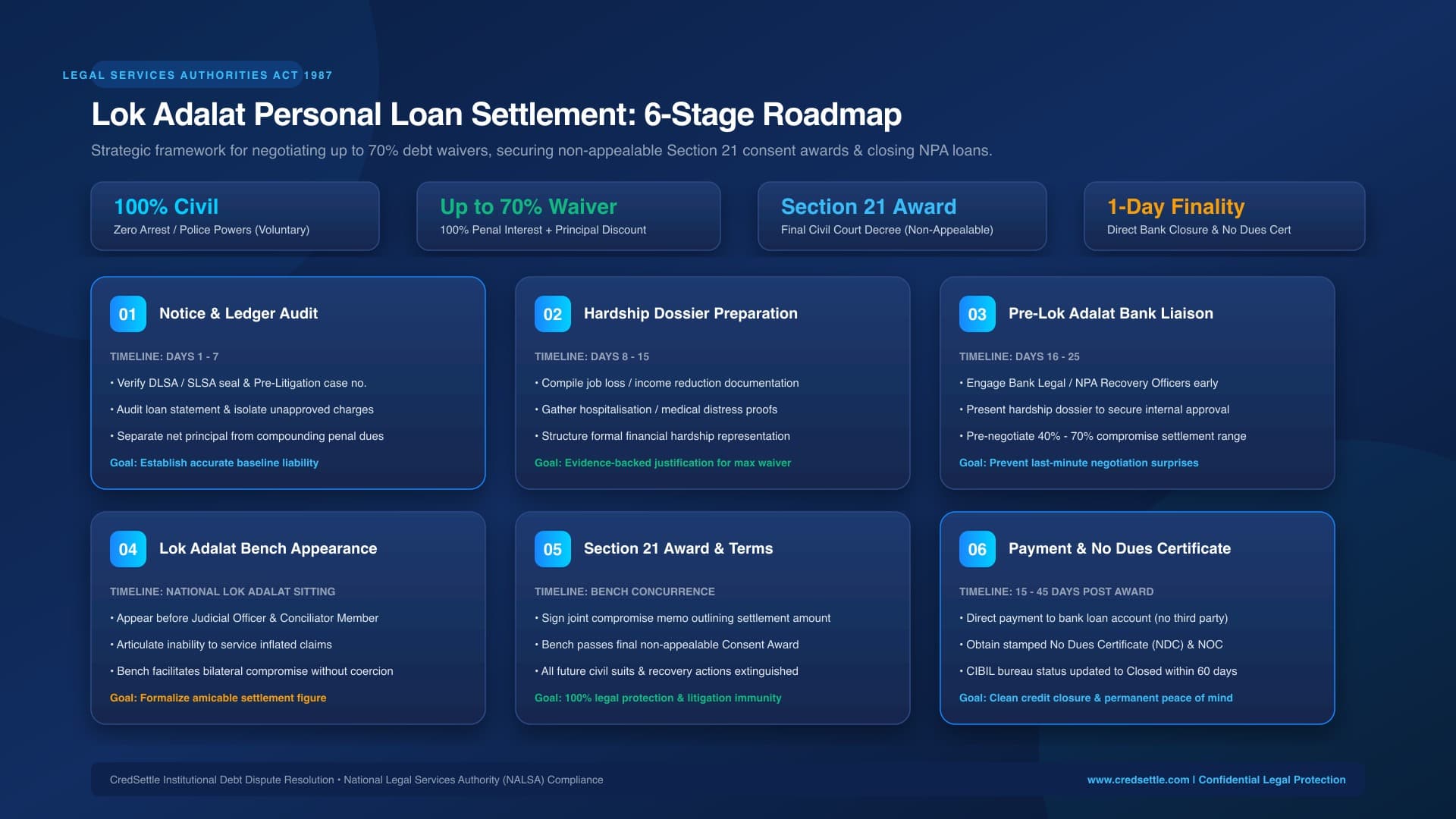
6. 6 Stages of Lok Adalat Personal Loan Settlement
Execute this rigorous, institutional step-by-step operating procedure to navigate the Lok Adalat settlement process and secure optimal financial waivers:
Notice Authentication & Loan Ledger Forensic Audit
Verify the authenticity of the Lok Adalat notice by checking the official seal and signature of the District Legal Services Authority (DLSA) or Taluk Committee. Obtain a certified, updated statement of accounts from your bank under the Bankers' Books Evidence Act. Dissect the outstanding balance to isolate the true unpaid principal from capitalized penal interest, late payment fines, GST surcharges, and illegitimate collection agency expenses.
Comprehensive Hardship Portfolio & Dossier Assembly
Banks require verifiable evidentiary justification to approve substantial principal write-offs during Lok Adalat sessions. Compile a comprehensive financial hardship dossier containing salary reduction letters, pink slips, medical hospitalization discharge summaries, GST return downturn reports, or family dependency proof. Calculate your exact maximum lump-sum or structured payment capability.
Pre-Lok Adalat Strategic Bank Liaison & Pre-Counseling
Avoid walking into the Lok Adalat session unprepared. Initiate pre-counseling contact with the bank's Senior NPA Recovery Manager, Legal Desk, or Principal Nodal Officer at the designated pre-conciliation desk. Present your audited baseline and hardship dossier in advance. This pre-aligns the bank's internal approval grid, ensuring the bank representative brings pre-authorized approval for your target settlement figure on the day of the sitting.
Lok Adalat Bench Appearance & Conciliated Negotiation
Attend the scheduled session before the designated Lok Adalat bench (in person or via National e-Lok Adalat virtual portal). The Presiding Judicial Officer and Conciliator will invite both parties to present their terms. Respectfully explain your genuine financial incapacity while expressing unambiguous willingness to close the debt immediately under fair terms. The bench facilitates an amicable compromise without allowing the bank to exert undue coercion.
Execution of Compromise Memo & Section 21 Consent Award
Once terms are agreed upon, verify that the written Settlement Memorandum explicitly lists the agreed compromise amount, the exact payment due dates, and unconditional clauses stating that upon payment, all civil, criminal, and recovery claims stand fully extinguished. Both parties sign the memo, and the Lok Adalat bench passes a formal Consent Award under Section 21 of the Act.
Direct Bank Remittance, NDC Retrieval & Bureau Updation
Remit the agreed settlement funds directly to your designated bank loan account via RTGS, NEFT, or demand draft—never pay cash or third-party intermediaries. Obtain a stamped, dated receipt. Within 15 to 30 days, collect your unconditional No Dues Certificate (NDC) and verify that the bank submits the updated closure data to TransUnion CIBIL, Equifax, and Experian.
7. Formal Reply Architecture & Substantive Legal Strategy
Responding effectively to a pre-litigation Lok Adalat notice requires a well-orchestrated legal strategy that establishes bona fide financial hardship while dismantling the predatory interest calculations frequently advanced by institutional lenders. Under the statutory framework established by the Legal Services Authorities Act, 1987, a formal written response sent to both the Secretary of the District Legal Services Authority and the lending bank's authorized representative establishes your legal standing as a cooperative yet legally protected borrower. This communication should formally acknowledge receipt of the pre-litigation notice, affirm your complete respect for the statutory conciliatory process, and set forth the material economic conditions that caused the involuntary disruption of loan repayments.
A critical objective of this legal posture is challenging the quantum of the bank's aggregate demand before entering the conciliatory room. Commercial lenders often present inflated claim figures that include compounded penal interest, arbitrary late payment surcharges, processing penalties, and speculative recovery expenses that violate Reserve Bank of India Master Directions on Fair Practices Code. The formal representation must demand a certified and audited statement of account under the Bankers' Books Evidence Act, 1891, specifically demanding the segregation of genuine principal liability from unapproved punitive levies. By placing this forensic discrepancy on record with the Legal Services Authority, the borrower effectively deprives the lender of using inflated numbers as the baseline for negotiations.
Furthermore, the substantive defense must articulate the definitive civil nature of the transaction and proactively safeguard the borrower against unlawful intimidation. Lending institutions frequently attempt to use the formal appearance of a Lok Adalat summons to exert undue pressure or threaten coercive legal remedies. The written response serves as an evidentiary shield by formally placing on record that the underlying obligation represents an unsecured commercial personal loan governed purely by civil contract law, where no criminal mens rea or penal liability exists. Citing pertinent judicial precedents on debtor protections, the reply emphasizes that any ongoing third-party recovery harassment violates the borrower's constitutional right to dignity under Article 21 and the binding guidelines issued by the Reserve Bank of India.
Finally, the strategic positioning must formally propose a viable compromise One-Time Settlement structure supported by documentary exhibits. Rather than entering the Lok Adalat session with vague verbal pleas, presenting an organized financial hardship dossier containing income tax returns, salary reduction documentation, termination letters, or medical ledgers transforms the dynamic into a credible, solution-oriented resolution. This proactive framework enables the Lok Adalat bench to fulfill its statutory mandate of facilitating an equitable settlement, compelling the institutional claimant to accept realistic terms that align with the borrower's verified economic capacity.
8. The 3-Tier Grievance & Escalation Matrix for Loan Disputes
If the lending bank refuses fair conciliation, reneges on agreed terms, or uses coercive collection tactics alongside the Lok Adalat process, escalate through this structured 3-tier regulatory and institutional mechanism:
Pre-Litigation Objection & Grievance Submission
Submit a formal written objection directly to the Presiding Officer of the Lok Adalat bench detailing predatory charges and unauthorized recovery harassment. Concurrently submit a formal grievance to the bank's Principal Nodal Officer under the internal grievance redressal mechanism.
Administrative Intervention for Unfair Banking Practices
File a representation before the Full-Time Secretary of the DLSA (a Senior Civil Judge rank officer). The DLSA has administrative powers to summon bank branch managers and direct them to adhere strictly to fair conciliation principles without intimidating borrowers.
Statutory Regulatory Redressal for Coercive Recovery
If the bank combines Lok Adalat notices with illegal recovery tactics, offensive phone calls, or refuses to issue a No Dues Certificate post-settlement, lodge a complaint on the RBI CMS portal (cms.rbi.org.in) under the Reserve Bank - Integrated Ombudsman Scheme, 2021.
9. Chronological Milestone Resolution Timeline (Day 0 to Month 6)
A clear roadmap of chronological milestones from receipt of notice to credit bureau rehabilitation:
| Milestone Phase | Key Institutional Event | Statutory Timeframe | Borrower Action Checklist |
|---|---|---|---|
| Day 0 | Receipt of Pre-Litigation Lok Adalat Notice | Typically 15–30 days prior to sitting | Authenticate DLSA case number & audit account ledger |
| Days 5–15 | Pre-Counseling Sitting / Bank Outreach | Pre-conciliation period | Submit hardship dossier & pre-negotiate waiver band |
| National Lok Adalat Day | Appearance before Bench & Consent Award | Single-day conclusive disposal | Sign joint compromise memo & obtain Section 21 decree |
| Days 15–45 Post-Award | Remittance of Agreed Settlement Amount | Stipulated in Consent Award | Direct bank RTGS transfer & obtain stamped deposit slip |
| Months 2–3 | No Dues Certificate (NDC) Retrieval | Within 30 days of final payment | Collect original stamped NDC & verify loan account closure |
| Months 4–6 | CIBIL / Credit Bureau Status Updation | 45–90 days bureau reporting cycle | Download CIBIL report; initiate bureau dispute if un-updated |
10. Special Scenarios: Fintech NBFC Apps, Credit Cards & ARCs
Nuances across various lending institutions in Lok Adalat proceedings:
Fintech NBFC Loan Apps & Automated Pre-Litigation Notices
Digital personal loan applications often dispatch automated WhatsApp notices referencing Lok Adalat hearings. Ensure you verify whether an actual pre-litigation case number has been registered with the local DLSA or if it is merely an informal conciliation invitation. In genuine e-Lok Adalats, fintech NBFCs are known to offer dramatic 60% to 75% settlements due to high default provisioning.
Credit Card Outstanding Dues in Lok Adalat
Credit card claims referred to Lok Adalat typically feature exorbitant revolving finance charges (often 42% to 48% annualized) and compounding GST penalties. Lok Adalat benches routinely direct credit card issuers to strip away all interest accumulations and settle exclusively around the baseline uncollateralized spend, resulting in massive savings.
Asset Reconstruction Companies (ARCs) at Lok Adalat
When loans are sold to ARCs (such as Phoenix ARC, ARCIL, or CFM ARC) under Section 5 of the SARFAESI Act, ARCs actively utilize National Lok Adalats to liquidate sticky portfolios. Since ARCs purchase distressed loan pools at steep discounts (often 20% to 30% of book value), they possess extraordinary commercial flexibility to accept deep compromise settlements.
Co-Borrowers, Guarantors & Legal Heirs in Lok Adalat
In co-borrower loans, any consent award passed in Lok Adalat must expressly include all co-signers and guarantors to release them from joint and several liability under Section 128 of the Indian Contract Act. In cases involving deceased borrowers, legal heirs are protected under Section 50 of the CPC and are only liable to the extent of inherited estate assets.
 Legal Debt Dispute Authority
CredSettle (credsettle.com) is India's premier debt settlement, loan dispute resolution, and legal protection platform. Operating strictly under the RBI Fair Practices Code and CICRA 2005, our advocate panel negotiates directly with Bank Principal Nodal Officers to eliminate waived differentials, obtain unconditional No Dues Certificates (NDC), and upgrade credit bureau records from "Settled" to "Closed".
Frequently Asked Questions on Lok Adalat Personal Loan Settlement
Click on any question below to view detailed legal answers verified by our debt resolution professionals:
Official Regulatory Citations & Legal References
- Legal Services Authorities Act, 1987: Sections 19, 20, 21, and 22, National Legal Services Authority (NALSA), Ministry of Law and Justice, Government of India.
- Supreme Court of India: State of Punjab v. Jalour Singh (2008) 2 SCC 660 (Finality and Non-Appealability of Lok Adalat Awards under Section 21).
- Supreme Court of India: K.N. Govindan Kutty Menon v. C.D. Shaji (2012) 2 SCC 51 (Deemed Civil Court Decree status for Lok Adalat settlements).
- Reserve Bank of India Master Directions: Master Direction on Fair Practices Code for Lenders and Prudential Framework for Resolution of Stressed Assets (Updated 2026).
- Reserve Bank - Integrated Ombudsman Scheme, 2021: Redressal of Unfair Recovery Practices, Harassment and Credit Reporting Errors.