Section 138 Cheque Bounce Case for Personal Loans
Is your bank threatening jail time under Section 138 for a bounced security cheque? Learn how to secure same-day bail, rebut statutory presumptions, challenge Section 143A interim compensation, and settle the debt out of court.
- Bailable Offense with Mandatory Bail Right: A cheque bounce case under Section 138 of the Negotiable Instruments Act is a quasi-criminal, bailable offense. You cannot be summarily arrested by police. You are legally entitled to regular bail as a matter of right under Section 436 CrPC (Section 478 BNSS) on the day of appearance before the Magistrate.
- Security Cheques Cannot Exceed Legally Enforceable Debt: Under the Supreme Court landmark ruling in Dashrathbhai Trikambhai Patel (2022), presenting a blank post-dated security cheque for the full original loan amount without endorsing prior EMI part-payments under Section 56 invalidates the criminal complaint entirely.
- Crucial 15-Day Statutory Cure Period: The cause of action for Section 138 only arises after the expiry of 15 days from the date of receiving the bank's demand notice. Replying strategically within this 15-day window can halt premature litigation or lay an unassailable foundation for acquittal.
- Section 143A Interim Compensation is Discretionary: Following the Supreme Court's 2024 verdict in Rakesh Ranjan Shrivastava, courts cannot mechanically order a 20% interim deposit. Disputing the debt ledger and showing financial hardship protects you against coercive interim deposits.
- 100% Compoundable Under Section 147 via Lok Adalat: Cheque bounce offenses are explicitly compoundable at any stage of proceedings. CredSettle legal negotiators routinely leverage procedural defects to settle personal loan cases in National Lok Adalats with 40% to 70% waivers, resulting in complete case withdrawal and formal acquittal.
1. Anatomy of a Section 138 Cheque Bounce Case for Personal Loans
When borrowers avail unsecured personal loans from commercial banks or Non-Banking Financial Companies (NBFCs), lenders routinely collect signed blank post-dated cheques (PDCs) or security cheques under the guise of loan security. If the borrower suffers severe financial distress, medical emergencies, or job loss and misses consecutive Equated Monthly Installments (EMIs), lenders often fill in arbitrary amounts on these cheques and present them for clearing.
When the cheque returns dishonored with bank memo remarks such as "Funds Insufficient", "Account Closed", or "Refer to Drawer", the lender triggers criminal machinery under Section 138 of the Negotiable Instruments Act, 1881.
Mandatory 30-Day Demand Notice
Within 30 days of receiving the bank dishonor memo, the lender must dispatch a formal written statutory demand notice demanding payment of the exact cheque amount.
15-Day Statutory Cure Window
Under Section 138(c), the borrower has exactly 15 calendar days from the date of receipt of the legal notice to pay the demanded amount or propose an OTS.
30-Day Court Filing Limitation
If payment is not made within 15 days, the bank has a strict 30-day limitation period under Section 142(1)(b) to institute a criminal complaint before the Judicial Magistrate.
Why Banks Use Section 138: Lenders prefer Section 138 over traditional civil recovery suits because criminal summons exert tremendous psychological pressure on borrowers, compelling them to settle quickly to avoid appearing in a criminal courtroom.
2. Can You Go to Jail for a Cheque Bounce? Bail Rights & Law
The single most common fear among borrowers facing loan default is that the local police will arrive at their doorstep with handcuffs to arrest them for a bounced personal loan cheque. Aggressive recovery telecallers routinely exploit this anxiety by sending forged arrest notices, fake police station summons, and fabricated warrant threats on WhatsApp.
Let us establish the definitive legal reality under Indian criminal jurisprudence:
Under the Code of Criminal Procedure, 1973 (and the Bharatiya Nagarik Suraksha Sanhita, 2023 - BNSS), an offense under Section 138 of the Negotiable Instruments Act is categorized as non-cognizable, bailable, and compoundable. The police have absolutely zero authority to register an FIR, conduct an arrest without a judicial warrant, or summon you to a police station for a simple cheque bounce.
When you receive a court summons from a Judicial Magistrate First Class (JMFC) or Metropolitan Magistrate (MM), you are entitled to Regular Bail as a matter of statutory right under Section 436 of CrPC (Section 478 BNSS). Bail is granted on the same day upon furnishing a personal bail bond and a local surety.
When Does Jail Actually Become a Risk?
Imprisonment in a Section 138 case occurs exclusively under two distinct procedural circumstances:
1. Wilful Absconding & Ignoring Court Summons: If you ignore repeated court summons, the Magistrate will issue a Bailable Warrant (BW), followed by a Non-Bailable Warrant (NBW). If you remain absent, the court will declare you a Proclaimed Offender under Section 82 CrPC (Section 84 BNSS), empowering police to execute an arrest to secure your court presence.
2. Final Conviction Post Full Trial: If the trial concludes without settlement, the court finds you guilty beyond reasonable doubt, and sentences you under Section 138 (up to 2 years imprisonment), you may face custody if you fail to appeal before the Sessions Court within 30 days and obtain a suspension of sentence under Section 389 CrPC.
3. Supreme Court Rulings on Security Cheques & Section 139
The Supreme Court of India has established authoritative legal principles governing blank security cheques, unendorsed part-payments, and the statutory presumption of debt under Section 139 of the Negotiable Instruments Act. These landmark precedents form the core artillery of your legal defense:
Mandatory Section 56 Endorsement for Part-Payments
The Supreme Court held that where a borrower has paid part of the loan liability through prior EMIs, the lender cannot present a security cheque for the entire original face value without formally endorsing the part-payments on the cheque under Section 56 of the Act. Presenting a cheque for an amount greater than the actual subsisting legally enforceable debt at the date of presentation renders Section 138 inapplicable and mandates acquittal.
Section 139 Presumption Rebuttal on Preponderance of Probabilities
The Supreme Court clarified that the statutory presumption under Section 139 (that the cheque was issued for discharge of a debt) does not require the accused borrower to prove their defense beyond reasonable doubt. The accused only needs to raise a probable defense based on a "preponderance of probabilities" by highlighting inconsistencies in the bank's loan ledger or cross-examining the bank's authorized representative.
Section 143A Interim Compensation is Strictly Discretionary
The Supreme Court held that the power of a Magistrate to award interim compensation up to 20% of the cheque value under Section 143A is directory and discretionary, not mandatory. The court must evaluate the prima facie case, the merits of the defense, the financial capability of the accused, and whether directing an interim deposit would result in grave hardship.
Why These Judgments Matter to You: When lenders deposit pre-signed security cheques after you have already paid 12 or 24 EMIs, they almost never endorse the paid EMIs on the cheque. Under Dashrathbhai Trikambhai Patel, this failure constitutes a fatal legal flaw in the bank's prosecution.
4. Legal Forum Comparison: Personal Loan Default Recovery Mechanisms
When a borrower defaults on a personal loan, banks possess several recovery channels. The comparative matrix below outlines how Section 138 compares to electronic mandate bounces, civil summary suits, arbitration, and Lok Adalat compounding:
| Legal Forum / Statute | Nature of Action | Power to Jail / Arrest | Bail Requirement | Typical Duration | Strategic Resolution Strategy |
|---|---|---|---|---|---|
| Section 138 (NI Act, 1881) | Quasi-Criminal Complaint | Yes (Post-Conviction / NBW Only) | Yes (Sec 436 CrPC Mandatory Bail) | 12 to 36 Months | Rebut Sec 139, Challenge Sec 143A & Settle via Sec 147 Compounding |
| Section 25 (PSS Act, 2007 - NACH) | Quasi-Criminal Complaint | Yes (Same as Sec 138) | Yes (Mandatory Bail) | 12 to 24 Months | Consolidate multiple bounce notices & negotiate structured OTS |
| Summary Civil Suit (Order 37 CPC) | Civil Money Recovery | NO (Pure Civil) | Not Applicable | 18 to 36 Months | File Leave to Defend citing dispute on exorbitant penal interest |
| Arbitration Tribunal (1996 Act) | Private Civil Adjudication | NO (Zero Power) | Not Applicable | 4 to 8 Months | Challenge Sec 12(5) Unilateral Appointment & Perkins Eastman Precedent |
| National Lok Adalat | Judicial Conciliation | NO (Compromise Forum) | Not Applicable | 1 Day (Single Sitting) | Execute Final Compromise Award with full acquittal and 50%+ waiver |
5. Section 143A Interim Compensation & Legal Penalties
A Section 138 prosecution carries both statutory judicial financial exposure and severe credit bureau impairment across TransUnion CIBIL, Experian, CRIF High Mark, and Equifax:
Statutory Court Penalties & Interim Deposits
Credit Score Destruction & Bureau Reporting
6-Step Section 138 Defense & Settlement Roadmap
Refer to this high-resolution visual roadmap outlining the strategic 6-stage workflow to defend against personal loan cheque bounce cases, secure same-day bail, assert statutory objections, and achieve out-of-court compounding:
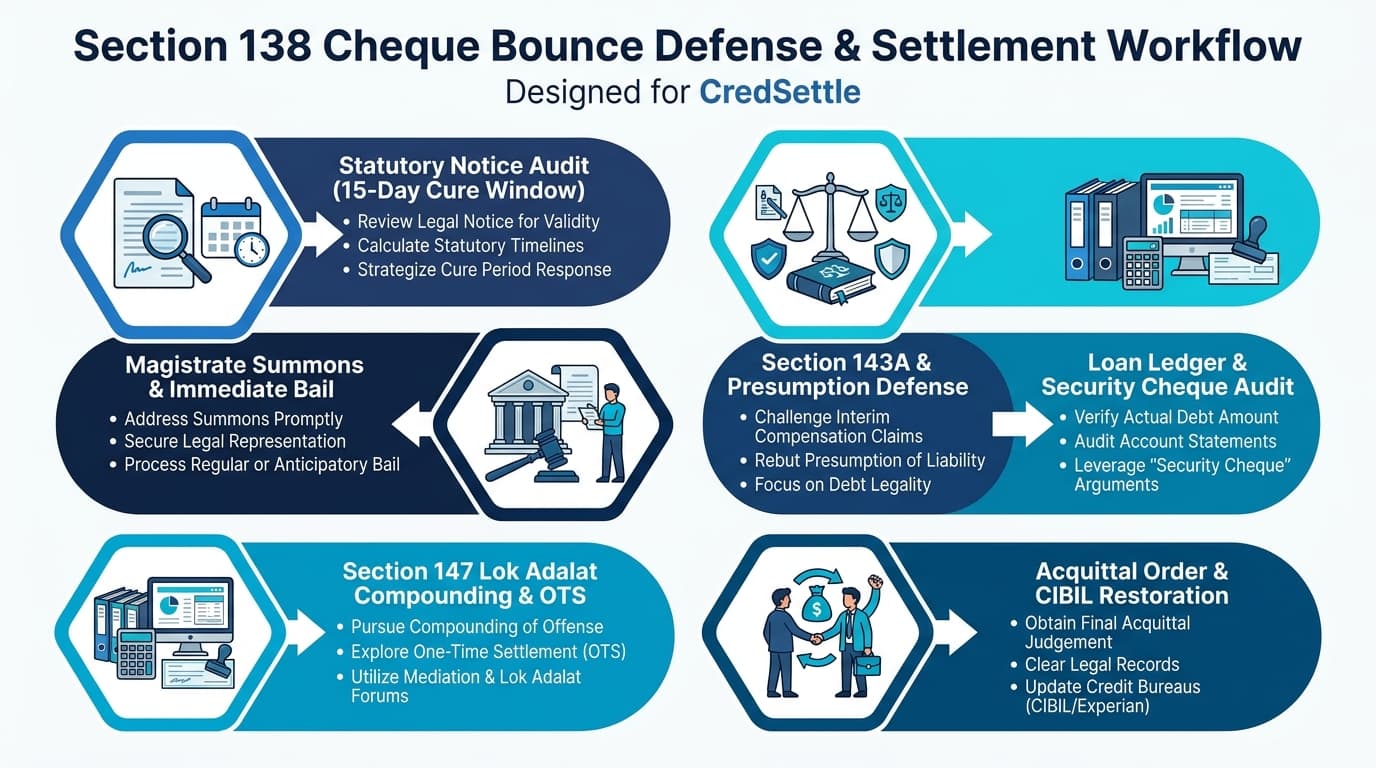
6. 6-Stage SOP for Section 138 Cheque Bounce Defense
Follow this sequential, institutional procedure to navigate a Section 138 cheque bounce case from the receipt of the initial statutory notice to full judicial acquittal and debt closure:
Statutory Notice Audit & 15-Day Cure Window Response
Verify the exact date of receipt of the bank's demand notice. Audit whether the notice was served within 30 days of cheque dishonor. Dispatch a comprehensive reply denying liability for unadjusted penal amounts, stating that the cheque was a blank security instrument, and reserving rights under Dashrathbhai Trikambhai Patel while offering to negotiate an amicable compromise.
Court Appearance & Immediate Regular Bail under Section 436 CrPC
Upon receiving the court summons from the Magistrate, engage an advocate immediately. On the scheduled date, appear before the court and move a Regular Bail Application under Section 436 CrPC (Section 478 BNSS) along with a personal bond and surety. Bail is granted immediately, securing complete protection against arrest warrants.
Section 251 Notice Plea & Section 143A Interim Compensation Challenge
When the court frames notice under Section 251 CrPC (Section 274 BNSS), plead "Not Guilty" and claim trial. If the bank files an application under Section 143A seeking a 20% interim deposit, file a detailed written objection citing Rakesh Ranjan Shrivastava (2024) demonstrating financial insolvency, medical records, and prima facie defects in the bank's ledger.
Bank Witness Cross-Examination & Presumption Rebuttal
Cross-examine the bank's Authorized Representative (AR) under Section 145(2) of the Act. Demand the production of the certified statement of account under the Bankers' Books Evidence Act. Expose uncredited EMI payments, unauthorized interest capitalization, and the absence of Section 56 part-payment endorsements to successfully rebut the Section 139 presumption.
National Lok Adalat Referral & Section 147 Compounding
Because active litigation burdens lenders with legal expenses and recovery delays, leverage your strong defense to refer the matter to the National Lok Adalat or court mediation cell. Negotiate a One-Time Settlement with a 40% to 70% waiver on accumulated penal charges. Execute a compromise deed and compound the offense under Section 147 of the NI Act.
Judicial Acquittal Order & CIBIL Bureau Restoration
Upon payment of the agreed settlement amount, the Magistrate records the compromise and passes a formal order of acquittal under Section 320(8) CrPC. Obtain a certified copy of the acquittal order and the bank's unconditional No Dues Certificate (NDC), ensuring your CIBIL record is updated from "Suit Filed" to "Closed".
7. Legal Defense Strategy & Section 139 Presumption Rebuttal
Establishing an unassailable legal defense in a Section 138 personal loan cheque bounce prosecution demands a rigorous, multi-pronged statutory strategy that systematically dismantles the evidentiary foundations of the complainant institution. The Negotiable Instruments Act, 1881 incorporates strong statutory presumptions under Section 118(a) and Section 139, which assume that every negotiable instrument was drawn for consideration and handed over in discharge of a legally enforceable debt or liability. However, this presumption is not irrebuttable; under the established jurisprudence of the Supreme Court in Basalingappa v. Mudibasappa, the accused borrower is not obligated to mount a defense proven beyond all reasonable doubt, but is merely required to establish a credible doubt based on the standard of preponderance of probabilities.
The foundational pillar of the defense centers on proving the misuse of blank pre-signed security cheques collected prior to loan disbursal. In standard retail lending operations, banks and non-banking financial companies mandate the submission of multiple undated security cheques as an institutional condition precedent for loan sanctioning. When default occurs, recovery departments unilaterally write the aggregate outstanding claim onto the cheque without the borrower's specific consent. Under the doctrine articulated in Dashrathbhai Trikambhai Patel v. Hitesh Mahendrabhai Patel, if the borrower has made interim repayments through prior monthly installments, the subsisting legal debt at the time of presentation is invariably less than the original loan amount. Presenting a cheque for the total undiscounted amount without making a formal statutory endorsement under Section 56 of the Act extinguishes the offense under Section 138, rendering the criminal complaint inherently defective and liable for dismissal.
The second critical line of defense requires a meticulous forensic audit of the statutory demand notice and limitation periods. Under Section 138 clause (b) and (c) read with Section 142(1)(b) of the Act, strict procedural timelines govern the life cycle of a cheque bounce complaint. The demand notice must be dispatched within thirty days of receiving the return memo, and must explicitly demand the exact cheque amount rather than an ambiguous, omnibus claim comprising unverified penal interest, foreclosure charges, and recovery agent fees. Furthermore, the complaint must be filed within thirty days following the expiration of the fifteen-day cure window. Any procedural irregularity, delay in dispatch, absence of postal tracking proof, or failure to establish valid service of notice breaks the chain of causation and deprives the Magistrate of lawful cognizance.
On the accounting and transactional merits, the defense must challenge the complainant bank's statement of account under Section 4 of the Bankers' Books Evidence Act, 1891 and Section 65B of the Indian Evidence Act (Section 63 of Bharatiya Sakshya Adhiniyam, 2023). By demonstrating that the bank improperly capitalized penal interest, levied compound interest during distress moratoriums in contravention of Reserve Bank of India Master Directions, or failed to credit verified digital transfers, the defense demonstrates that the claimed sum does not represent a crystallized, legally enforceable debt. This evidentiary exposure strips the complainant of its statutory leverage, compelling the institutional lender to abandon adversarial prosecution and execute an out-of-court compounding settlement under Section 147 of the Negotiable Instruments Act.
8. The 3-Tier Judicial & Regulatory Escalation Matrix
When facing Section 138 litigation coupled with aggressive recovery harassment, navigate your defense and grievance redressal through this structured 3-tier matrix:
Bail Application, Defense Cross-Examination & Section 147 Compounding
Secure immediate bail under Section 436 CrPC on first appearance. Contest Section 143A interim compensation applications. Move a joint compounding application under Section 147 of the NI Act once OTS terms are agreed upon.
Petition for Quashing Summoning Order & Suspension of Sentence
If the complaint is barred by limitation, lacks a valid cause of action, or involves an unendorsed security cheque, file a Quashing Petition under Section 482 CrPC (Section 528 BNSS) before the High Court. If convicted by a trial court, file a Criminal Appeal before the Sessions Court within 30 days.
Complaint for Coercive Cheque Presentation & Recovery Agent Abuse
If the lender presents security cheques repeatedly without prior notice, dispatches unauthorized recovery agents to your home or workplace, or threatens illegal arrest, lodge an immediate complaint on the RBI CMS portal (cms.rbi.org.in) under the Fair Practices Code.
9. Chronological Milestone Resolution Timeline (Day 0 to Acquittal)
Understanding statutory timelines enables you to coordinate legal defense, prevent non-bailable warrants, and plan settlement negotiations:
| Milestone Phase | Key Procedural Event | Statutory Limitation | Borrower Strategic Action |
|---|---|---|---|
| Day 0 | Cheque Dishonor & Return Memo Issued | Cheque valid for 3 months | Review bank account statement and loan repayment ledger |
| Days 1–30 | Service of Statutory Demand Notice | Within 30 days of dishonor memo | Audit notice validity & reply within 15-day cure period |
| Days 45–75 | Filing of Criminal Complaint & Pre-Summoning | Within 30 days of cure window expiry | Monitor e-Courts portal for complaint filing |
| Months 3–5 | Court Summons Issued & Appearance | Date fixed by Magistrate | Engage counsel, appear in court, and secure same-day bail |
| Months 6–9 | Section 143A Hearing & Lok Adalat Referral | During trial stage | Argue 143A objection and initiate One-Time Settlement talks |
| Months 10–12 | Compounding Order, Acquittal & NDC | Upon final settlement payment | Obtain certified court acquittal order and update CIBIL to Closed |
10. Special Scenarios: NACH Bounces, Fintech Apps & Guarantors
Cheque bounce and digital mandate defaults involve nuanced statutory dynamics across various retail credit products:
Section 25 Payment & Settlement Systems (PSS) Act: NACH / e-Mandates
Modern personal loans primarily use electronic NACH auto-debits rather than physical paper cheques. When an electronic mandate fails due to insufficient balance, lenders file complaints under Section 25 of the PSS Act, 2007. The legal provisions, bailable rights, 15-day cure notice rules, and compounding provisions under Section 25 mirror Section 138 almost identically.
Fintech Loan Apps & Aggressive Automated Cheque Notices
Instant loan apps frequently generate automated WhatsApp notices threatening immediate police action under Section 138. Many of these notices are unsigned, lack proper statutory demand language, or relate to loans where no physical cheque was ever drawn. A formal legal reply calling out their non-compliance with Section 138 rules stops automated harassment instantly.
Cheques Deposited Post-NPA and Post-Settlement
In several instances, bank recovery departments mistakenly deposit archived security cheques even after the loan has been classified as an NPA or while settlement negotiations are actively underway. Depositing a cheque during an ongoing settlement constitutes bad faith, and the court can quash such complaints with heavy costs on the bank.
Co-Borrowers, Guarantors & Signatory Liability
Under Section 138, criminal liability attaches strictly to the drawer of the cheque (the person who signed the instrument on their bank account). Co-borrowers or family members who did not sign the specific bounced cheque cannot be prosecuted under Section 138, even if they are co-signers on the underlying loan agreement.
 Legal Debt Dispute Authority
CredSettle (credsettle.com) is India's premier debt settlement, loan dispute resolution, and legal protection platform. Operating strictly under the RBI Fair Practices Code and CICRA 2005, our advocate panel negotiates directly with Bank Principal Nodal Officers to eliminate waived differentials, obtain unconditional No Dues Certificates (NDC), and upgrade credit bureau records from "Settled" to "Closed".
Frequently Asked Questions on Section 138 Personal Loan Cases
Click on any question below to view detailed legal answers verified by our debt resolution professionals:
Official Regulatory Citations & Judicial References
- Negotiable Instruments Act, 1881: Sections 56, 118, 138, 139, 142, 143A, 145, and 147, Ministry of Law and Justice, Government of India.
- Supreme Court of India: Dashrathbhai Trikambhai Patel v. Hitesh Mahendrabhai Patel (2022) 7 SCC 694 (Mandatory Section 56 Endorsement for Part-Payments on Cheques).
- Supreme Court of India: Rakesh Ranjan Shrivastava v. State of Jharkhand (2024) 4 SCC 714 (Discretionary Nature of Section 143A Interim Compensation).
- Supreme Court of India: Basalingappa v. Mudibasappa (2019) 5 SCC 418 (Standard of Preponderance of Probabilities for Section 139 Presumption Rebuttal).
- Payment and Settlement Systems Act, 2007: Section 25 (Dishonour of Electronic Funds Transfer / NACH Mandates), Reserve Bank of India.