ECS / NACH Bounce Legal Notice (Section 25)
Did your bank or NBFC send a legal notice under Section 25 of the Payment and Settlement Systems Act for an auto-debit bounce? Understand your statutory rights, bailable protections, and strategic legal reply framework.
- Quasi-Criminal Electronic Counterpart to Section 138: Section 25 of the Payment and Settlement Systems Act, 2007 penalizes dishonored electronic fund transfer mandates (NACH, e-NACH, ECS) exactly like Section 138 of the Negotiable Instruments Act governs physical paper cheques.
- 100% Bailable and Compoundable Offense: While Section 25 prescribes a maximum sentence of up to 2 years imprisonment or twice the transfer amount, it is statutorily bailable as a matter of right. Police cannot arrest you without a Magistrate court warrant, and compounding is permissible at any stage under Section 25(5).
- Mandatory 15-Day Statutory Cure Window: The bank must serve a demand notice within 30 days of the bounce return memo. The borrower is granted 15 days from notice receipt to pay. Any criminal complaint filed prior to the 16th day is legally premature and void ab initio.
- Defense of Uncredited Part-Payments: Applying the Supreme Court doctrine in Dashrathbhai Trikambhai Patel, presenting an electronic mandate for the full original amount without endorsing interim EMI payments invalidates the Section 25 cause of action.
- Transition to Lok Adalat & One-Time Settlement (OTS): Serving a robust legal reply exposing procedural flaws creates decisive leverage, allowing borrowers to negotiate a 40% to 70% waiver on penal charges and execute a formal OTS compounding order.
1. What is a Section 25 Notice Under the PSS Act, 2007?
In India's digital banking ecosystem, the vast majority of retail credit facilities—including personal loans, digital credit lines, vehicle loans, and business term loans—rely on automated electronic clearing instructions rather than paper cheques. When a borrower authorizes an Electronic Clearing Service (ECS), National Automated Clearing House (NACH), or e-NACH mandate, the lending institution presents scheduled monthly debits directly to the borrower's savings or current account.
When an electronic debit instruction fails due to insufficient funds, exceeding credit arrangement limits, or payment stopped by drawer, the transaction is formally dishonored by the clearing house operated by the National Payments Corporation of India (NPCI). To enforce financial recovery and initiate coercive proceedings, lenders issue a formal demand notice under Section 25 of the Payment and Settlement Systems Act, 2007 (PSS Act).
Applies strictly to electronic fund transfer mandates initiated through RBI-regulated payment systems under Section 2(1)(i) of the PSS Act, covering NACH, e-NACH, and legacy ECS debits.
Under Section 25(1)(b), the lender must serve a formal written notice within 30 days of receiving the return memo from the clearing bank, demanding payment of the dishonored sum.
Failure to satisfy the notice within the statutory 15-day cure window allows the lender to file a private criminal complaint before a Metropolitan Magistrate (MM) or Judicial Magistrate First Class (JMFC).
Why Lenders Prefer Section 25 over Civil Suits: Commercial banks and digital NBFCs prefer Section 25 proceedings because criminal court summons compel borrower appearances much faster than civil recovery suits, creating immediate psychological and legal urgency to settle the outstanding debt.
2. Is an ECS/NACH Bounce a Criminal Offense? Legal Realities
Borrowers receiving a Section 25 notice are often subjected to aggressive threats by third-party recovery agencies claiming that an auto-debit bounce leads to immediate police arrest, non-bailable warrants, and jail time. It is vital to separate statutory reality from unlawful recovery intimidation.
Under Indian jurisprudence, an electronic mandate bounce under Section 25 of the PSS Act is classified as a quasi-criminal regulatory offense created to enforce commercial credibility. While Section 25(1) stipulates that a convicted drawer may face imprisonment for a term that may extend to two years, or with fine which may extend to twice the amount of the electronic funds transfer, or with both, it is governed by summons-trial procedure under the Code of Criminal Procedure, 1973 (now Bharatiya Nagarik Suraksha Sanhita, 2023).
Key Protection: Section 25 is a bailable offense. The police cannot register an FIR, cannot issue arrest warrants on their own accord, and cannot detain a borrower. Bail is granted as a matter of legal right upon your initial appearance before the Magistrate court under Section 436 CrPC (Section 478 BNSS).
When Does Legal Risk Escalate to Warrants?
Actual legal risk only arises if you completely ignore the legal notice, fail to reply, and subsequently ignore official summons issued by the Judicial Magistrate. If a borrower fails to appear on the scheduled hearing date after being duly served with court summons, the Magistrate may issue a Bailable Warrant (BW), followed by a Non-Bailable Warrant (NBW) to compel appearance.
However, as long as you engage legal representation to file a memo of appearance and a regular bail bond, imprisonment is not awarded during trial. The primary legislative intent behind Section 25 is debt recovery, not incarceration.
3. The Mandatory 30-Day Notice & 15-Day Statutory Cure Window
For a bank or NBFC to establish a legally sustainable criminal complaint under Section 25 of the PSS Act, they must strictly comply with three immutable statutory limitation milestones defined under Section 25(1):
Dispatch of Demand Notice Within 30 Days of Return Memo
The lender must issue a formal demand notice in writing within 30 calendar days from the date on which they receive information from their clearing bank or NPCI that the electronic fund transfer instruction was dishonored. A notice dispatched on the 31st day or later is barred by statutory limitation.
15 Days Granted to the Drawer to Make Payment
The borrower is granted exactly 15 calendar days from the date of receipt of the legal notice to make payment of the demanded sum. The cause of action for a criminal complaint does not arise on the date the NACH bounces, nor on the date the notice is posted. It arises strictly on the 16th day following receipt.
Filing Criminal Complaint in Court Within 1 Month
If the borrower does not pay within the 15-day cure window, the lender has exactly 30 days from the expiry of that 15-day period to file a formal private criminal complaint before the Metropolitan Magistrate or Judicial Magistrate First Class having territorial jurisdiction.
Premature Complaint Defense: If a bank files a court complaint before the completion of your full 15-day cure period, the complaint is defective in law. The Magistrate cannot take cognizance, and the proceedings are liable to be quashed under Section 482 CrPC (Section 528 BNSS).
4. Section 25 PSS Act vs Section 138 NI Act Comparison
Understand how a Section 25 NACH bounce notice compares against physical cheque bounce cases, private arbitration, civil suits, and Lok Adalat settlements:
| Legal Mechanism | Governing Statute | Instruments Covered | Bail / Jail Nature | Adjudication Forum | Strategic Resolution |
|---|---|---|---|---|---|
| Section 25 Notice & Case | PSS Act, 2007 | NACH, e-NACH, ECS auto-debits | 100% Bailable; up to 2 yrs fine/jail | MM / JMFC Court | Challenge Section 56 part-payments & compound via OTS |
| Section 138 Cheque Bounce | NI Act, 1881 | Physical paper cheques | 100% Bailable; up to 2 yrs fine/jail | MM / JMFC Court | Rebut Section 139 presumption & settle under Section 147 |
| Arbitration Tribunal | Arbitration Act, 1996 | Contractual debt disputes | Zero arrest/jail powers (Civil) | Sole Arbitrator | Challenge Section 12(5) unilateral appointment |
| Summary Civil Suit (Order 37) | CPC, 1908 | Liquidated monetary debts | Zero arrest/jail powers (Civil) | Civil Judge / District Court | File Leave to Defend citing accounting disputes |
| National Lok Adalat | LSA Act, 1987 | Compoundable disputes | Pure Conciliation (No Jail) | Lok Adalat Bench | Execute formal OTS with maximum waiver & case dismissal |
5. Technical Financial Risk Analytics & CIBIL Scoring Penalties
When an electronic mandate bounces, the financial damage extends far beyond the unpaid EMI itself. Banks and credit bureaus impose multi-tiered algorithmic penalties that compound monthly:
Compounding Bounce Charges & Penal Surcharges
Credit Score (CIBIL / Experian) Damage
Visual Defense Blueprint: 6-Step Section 25 Defense Workflow
Refer to this visual roadmap outlining the strategic 6-stage procedural sequence to challenge Section 25 notices, prevent illegal recovery harassment, secure bail, and execute a formal compromise settlement:
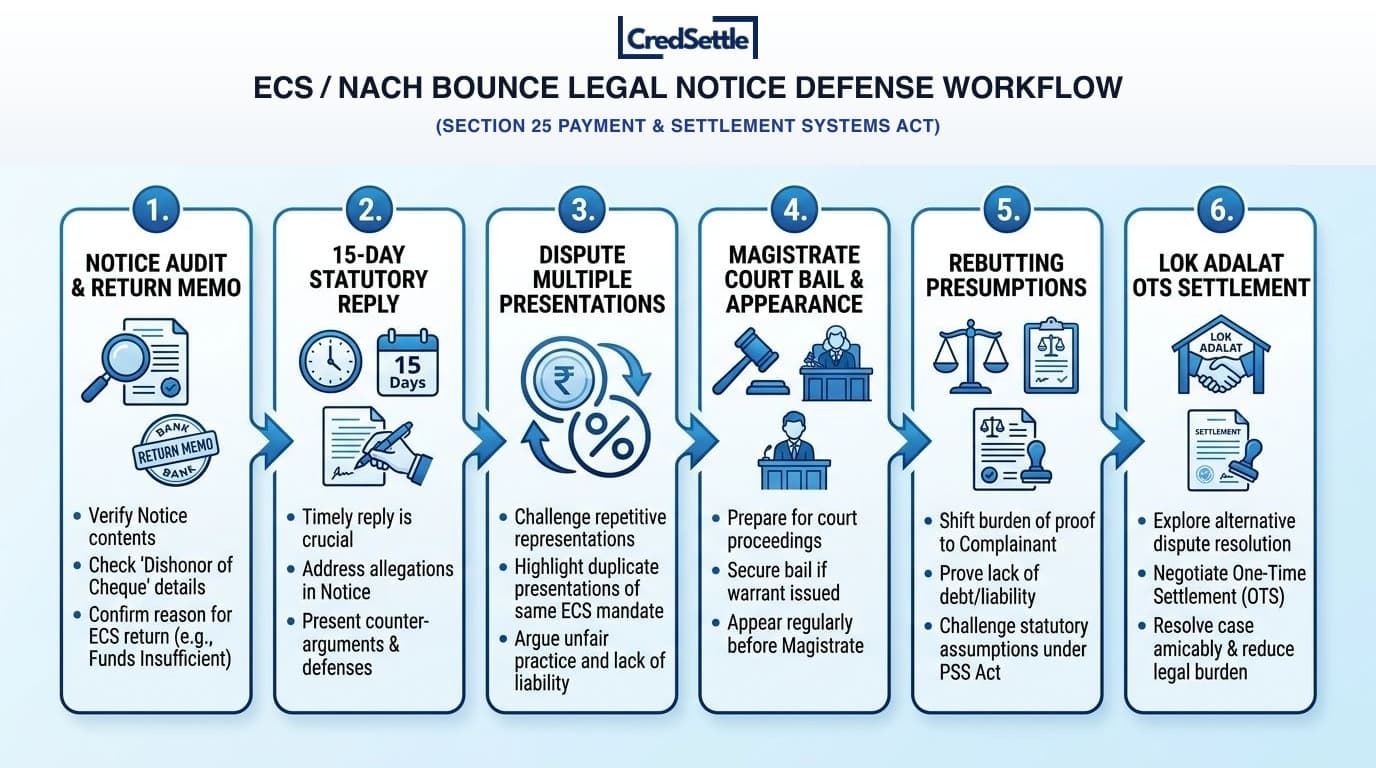
6. 6-Stage Defense Process for Section 25 PSS Act Notices
Follow this battle-tested, sequential protocol to defend your rights upon receiving a Section 25 legal notice:
Notice Receipt, Return Memo & Mandate Audit
Verify the exact date of receipt of the legal notice (preserve the postal speed post envelope with tracking barcode or email header). Review the underlying loan sanction letter and original NACH mandate form. Compare the demanded amount against your bank statement to identify whether the lender debited unauthorized penal surcharges, insurance additions, or unverified collection fees.
Drafting & Dispatching 15-Day Statutory Legal Reply
Within the mandatory 15-day cure window, dispatch a comprehensive legal response to the lender's advocate via Registered Speed Post AD and email. Dispute the inflated liability, demonstrate lack of mens rea (genuine financial hardship rather than fraudulent intent), cite uncredited part-payments, and formally propose a structured One-Time Settlement.
Revoking e-Mandate & Halting Multiple Presentation Loops
If the lender continues to repeatedly hit your bank account with recurring NACH presentations causing multiple bounce charges, submit an official Mandate Cancellation Request through your bank branch and online portal. File an objection under RBI Fair Lending Guidelines against predatory multiple debit attempts.
Magistrate Court Appearance & Same-Day Regular Bail
If the bank proceeds to file a complaint before the Judicial Magistrate or Metropolitan Magistrate, do not panic when summons arrive. Engage an advocate to file a formal appearance and Bail Application under Section 436 CrPC (Section 478 BNSS). Submit a personal bond and local surety to obtain immediate same-day regular bail.
Cross-Examination & Rebutting Statutory Presumptions
Examine the complainant's electronic evidence. Demand compliance with Section 65B of the Indian Evidence Act (Section 63 BSA) and Bankers' Books Evidence Act for digital clearing memos. Rebut the statutory presumption of legally enforceable debt on a preponderance of probabilities by proving uncredited repayments or inflated penal rates.
Compounding Offense in Lok Adalat & Full Loan Closure
Leverage your statutory defense to negotiate an out-of-court One-Time Settlement (OTS) with a 40% to 70% waiver on accumulated penal interest. Execute a formal compounding application before the Magistrate or in a National Lok Adalat under Section 25(5), leading to complete withdrawal of the criminal complaint and issuance of a clean No Dues Certificate.
7. Formal Reply Architecture & Substantive Legal Defense Strategy
Formulating an authoritative and legally impenetrable response to a Section 25 demand notice requires a multi-tiered statutory defense addressing procedural compliance, evidentiary admissibility, and substantive accounting discrepancies. When served with a notice invoking Section 25 of the Payment and Settlement Systems Act, 2007, the drawer must dispatch their reply within the mandatory fifteen-day cure period via Registered Speed Post with Acknowledgment Due and registered email, ensuring service upon both the institutional lender and its issuing legal counsel. This timely communication establishes the borrower's bona fide intent and lays an essential evidentiary foundation that will protect against adverse inferences should the matter proceed to court.
The initial pillar of the defense must rigorously examine the strict limitation parameters established under Section 25(1)(a) of the statute. The reply must demand certified documentary proof demonstrating the exact date on which the complainant bank received the electronic return memo from the clearing house, verifying whether the demand notice was dispatched within the unextendable thirty-day statutory window. If the notice was posted beyond thirty days from the return advice, the entire criminal proceeding is rendered legally invalid and unsustainable before any Judicial Magistrate. Furthermore, the response should verify whether the electronic mandate was registered under valid authorization parameters or whether the lender altered debit caps and dates without the borrower's explicit written consent.
The second layer of the defense must deploy the binding jurisprudence established by the Supreme Court of India in Dashrathbhai Trikambhai Patel v. Hitesh Mahendrabhai Patel (2022), which holds that presenting an instrument for the full face value without endorsing interim part-payments renders the statutory demand notice legally defective. Lending banks and digital NBFCs routinely demand the gross defaulted balance in Section 25 notices while neglecting to credit partial EMI repayments, interest subventions, or insurance premium refunds made by the borrower. The formal response must document every historical remittance with transaction reference numbers, demonstrating that the demanded sum does not represent the exact legally enforceable debt existing on the date of presentation, thereby destroying the foundational premise required for criminal prosecution.
On accounting and regulatory grounds, the reply must challenge the capitalization of exorbitant penal surcharges, multiple bounce presentation fees, and unauthorized collection costs that contravene Reserve Bank of India Master Directions on Fair Practices Code and Guidelines on Penal Charges in Loan Accounts. The communication should formally demand a complete, certified statement of account under the Bankers' Books Evidence Act, 1891, accompanied by mandatory electronic certificates under Section 65B of the Indian Evidence Act, 1872 (Section 63 of the Bharatiya Sakshya Adhiniyam, 2023). By placing the institutional claimant on notice regarding these evidentiary hurdles, the reply effectively shifts the litigation risk back onto the lender, opening a strategic pathway to transition adversarial litigation into an amicable One-Time Settlement (OTS) with substantial interest waivers.
8. The 3-Tier Escalation Matrix & Regulatory Remedies
If the lending bank or its recovery agents combine Section 25 notices with abusive phone calls, family harassment, or repeated unauthorized NACH presentations, escalate through this structured 3-tier regulatory framework:
Formal Dispute of Bounce Penalties & Loan Ledger
Submit a written grievance to the lender's Branch Manager and Grievance Redressal Officer disputing multiple bounce surcharges, requesting mandate suspension, and applying for an internal OTS compromise review.
Escalation of Harassment & Statutory Reply Tracking
If the GRO fails to resolve the dispute, escalate to the bank's Principal Nodal Officer. Attach call recordings or WhatsApp threats from recovery agents violating the RBI Fair Practices Code, demanding an immediate freeze on coercive actions.
Statutory Complaint on cms.rbi.org.in
If 30 days elapse without resolution from the PNO, file a complaint on the RBI CMS portal (cms.rbi.org.in) under the Reserve Bank - Integrated Ombudsman Scheme, 2021 for unfair debt recovery practices, predatory auto-debit loops, and non-compliance with digital lending guidelines.
9. Chronological Milestone Resolution Timeline (Day 0 to Month 6)
Understand the complete lifecycle of a Section 25 legal matter from the moment an auto-debit bounces to final debt compounding:
| Milestone Phase | Key Event & Trigger | Statutory Limitation | Borrower Defense Action |
|---|---|---|---|
| Day 0 | NACH Mandate Auto-Debit Bounces | NPCI return memo generated | Review account balance & check bounce reason |
| Days 1–30 | Bank Dispatches Section 25 Legal Notice | Must be sent within 30 days of memo | Record exact postal delivery date & audit claim |
| Days 30–45 | Mandatory 15-Day Statutory Cure Period | 15 days from notice receipt | Dispatch formal legal reply disputing uncredited payments |
| Days 45–75 | Bank Files Complaint in Magistrate Court | Within 30 days of cure window expiry | Track court e-filing via e-Courts services portal |
| Months 3–4 | Magistrate Summons & First Appearance | As per court calendar date | Appear with advocate & secure same-day regular bail |
| Months 5–6 | Lok Adalat Compounding & Full Settlement | Section 25(5) Compounding | Pay negotiated OTS, dispose case & get NDC |
10. Special Scenarios: Fintech Apps, BNPL & Multiple Debit Loops
Different digital credit products utilize NACH mandates in distinct operational ways:
Fintech NBFC Loan Apps & Instant e-Mandates
Digital lending apps register e-mandates via Netbanking or Debit Card authentication with daily debit limits up to ₹1,00,000. When default occurs, automated algorithms trigger automated Section 25 notices via WhatsApp and email. You must ensure you respond formally via registered post as digital notices require strict proof of delivery under the Information Technology Act, 2000.
Buy Now Pay Later (BNPL) & Micro-Credit Defaults
BNPL providers split small ticket purchases into electronic monthly installments. Issuing Section 25 notices for minor amounts (e.g., ₹2,000 to ₹10,000) is common practice to intimidate young borrowers. Because litigation costs exceed claim value, serving a firm legal reply citing RBI Digital Lending Guidelines consistently leads to swift OTS closure.
Multiple Simultaneous Presentations in a Single Month
Certain lenders present the same NACH mandate 3 to 5 times within a 10-day period, depleting the borrower's account through cumulative bounce fees. NPCI operating circulars restrict excessive recurring presentations. Expose this abusive practice in your legal reply and lodge a grievance with the RBI Ombudsman.
Co-Borrowers, Joint Accounts & Primary Mandate Drawers
Under Section 25, criminal liability attaches strictly to the drawer of the electronic account from which the fund transfer was authorized. If a co-borrower did not sign or digitally authenticate the specific bank account mandate, they cannot be prosecuted under Section 25, although civil contractual liability remains joint.
 Legal Debt Dispute Authority
CredSettle (credsettle.com) is India's premier debt settlement, loan dispute resolution, and legal protection platform. Operating strictly under the RBI Fair Practices Code and CICRA 2005, our advocate panel negotiates directly with Bank Principal Nodal Officers to eliminate waived differentials, obtain unconditional No Dues Certificates (NDC), and upgrade credit bureau records from "Settled" to "Closed".
Frequently Asked Questions on ECS & NACH Bounce Legal Notices
Click on any question below to view detailed legal answers verified by our debt resolution professionals:
Official Regulatory Citations & Judicial References
- Payment and Settlement Systems Act, 2007: Section 25 (Dishonour of electronic funds transfer for insufficiency, etc., of funds in the account), Ministry of Law and Justice, Government of India.
- Supreme Court of India: Dashrathbhai Trikambhai Patel v. Hitesh Mahendrabhai Patel (2022) 10 SCC 594 (Mandatory endorsement of part-payments and invalidity of inflated demand notices).
- Supreme Court of India: Kaushalya Devi Massand v. Roopkishore Khore (2011) 4 SCC 593 (Quasi-criminal nature of dishonor offenses aimed primarily at debt recovery rather than incarceration).
- Reserve Bank of India Master Directions: Master Direction on Fair Practices Code for Lenders and Guidelines on Reset of Floating Interest Rates / Penal Charges (Updated 2024–2026).
- National Payments Corporation of India (NPCI): Procedural Guidelines on NACH Debit Mandate Management & e-Mandate Revocation Architecture.