Overdraft and Cash Credit Default Settlement: Rules and Relief
A definitive legal guide for MSMEs, proprietorships, and corporate borrowers facing OD/CC delinquency. Understand RBI 90-day NPA rules, stop SARFAESI auctions, resolve stock audit discrepancies, and negotiate up to 75% compromise settlements.
- The 90-Day Out of Order Trigger: An OD/CC facility defaults into NPA status when it remains continuously in excess of the limit or drawing power for 90 days, or credits fail to service debited interest.
- Stock Deficit is Not Fraud: Stock discrepancies arising from business slowdowns or bad debtors are civil issues. The Supreme Court shields honest entrepreneurs from bogus criminal breach of trust allegations.
- SARFAESI Defense Window: Borrowers have a 60-day statutory window under Section 13(3A) to challenge bank demand notices, halt auctions, and mandate formal reconsideration.
- Unsecured Shortfall Haircuts: Unsecured working capital gaps resulting from drawing power erosion regularly settle at 40% to 75% discounts on ledger balances under RBI OTS norms.
- Complete Security Release: A formal compromise settlement legally binds the bank to release original property deeds, cancel personal guarantees, and file Form CHG-4 on MCA.
1. Understanding OD and CC Facilities: Structure and Defaults
Overdraft (OD) and Cash Credit (CC) facilities are the financial lifeblood of Indian commerce. Unlike regular term loans where fixed monthly installments amortize principal over time, OD and CC are revolving credit arrangements designed to fund day-to-day operating cycles, raw material procurement, and debtor payment gaps.
A Cash Credit facility is sanctioned primarily against the hypothecation of current assets, such as inventory, semi-finished goods, and receivables. An Overdraft facility allows current account holders to draw funds beyond their credit balance up to an agreed sanction limit, secured against book debts, fixed deposits, or commercial and residential real estate.
Default in an OD/CC facility does not happen through a single missed EMI. Instead, delinquency develops through operational failure: inability to service monthly interest debits, failure to achieve adequate account turnover, or a gradual deterioration of eligible inventory and book debts that shrinks the permissible Drawing Power (DP).
When cash flow contracts, borrowers frequently find themselves trapped in compounding interest debits. Banks levy penal interest, inspection charges, and stock audit fees directly onto the principal balance, accelerating the depletion of available credit limits and precipitating sudden NPA classification.
2. RBI NPA Classification Norms: 90-Day Overdue Rules
The Reserve Bank of India (RBI) regulates working capital loan delinquency through its Master Circular on Prudential Norms on Income Recognition, Asset Classification and Provisioning pertaining to Advances (IRACP). Unlike term loans that focus purely on overdue dates, working capital accounts are governed by the strict regulatory concept of Out of Order status.
Under paragraph 2.2 of the RBI Master Circular, an Overdraft or Cash Credit facility is categorized as Out of Order if any of the following statutory conditions occur:
The outstanding balance remains continuously in excess of the sanctioned limit or calculated Drawing Power for a period of 90 consecutive days.
Although the balance is below the limit, there are no credits continuously for 90 days, or credits are insufficient to cover interest debited during the same 90-day cycle.
In addition, non-renewal or non-review of the OD/CC facility within 180 days from the due date, or non-submission of stock statements for more than three months (90 days), automatically disqualifies the Drawing Power, requiring the lending bank to tag the entire credit line as a Non-Performing Asset (NPA).
| Claim Breakdown Component | Bank Ledger Entry | Audit Finding & RBI Rule | Settlement Figure |
|---|---|---|---|
| Original Sanctioned Principal Limit | ₹30,00,000 | Actual capital disbursed and drawn for operations. | ₹18,00,000 (Base Target) |
| Accumulated Normal & Unapplied Interest | ₹8,40,000 | Eligible for 50% to 100% waiver under bank OTS rules. | ₹2,00,000 (Reduced) |
| Compound Penal Charges & Audit Fees | ₹6,60,000 | Unlawful under RBI Jan 2024 Fair Lending Rules. | ₹0 (100% Waived) |
| Total Payable Settlement Amount | ₹45,00,000 Claimed | 55.5% Total Haircut Secured through OTS | ₹20,00,000 (Full & Final) |
3. Collateral & Security Matrix: Primary vs Collateral Assets
Negotiating an Overdraft or Cash Credit default requires distinguishing between primary security and collateral security. The nature, liquidity, and physical existence of these assets dictate the bank bargaining position during settlement talks.
| Security Category | Asset Description | Bank Enforcement Power | Vulnerability Level | OTS Haircut Potential |
|---|---|---|---|---|
| Primary Current Assets | Raw materials, finished goods, and work-in-progress stock. | Hypothecation charge; physical seizure via court commissioner. | Moderate to High | 50% to 75% Waiver |
| Book Debts & Receivables | Uncollected customer invoices and trade receivables. | Garnishee notices under Section 60 CPC to debtor firms. | Moderate | 50% to 70% Waiver |
| Collateral Real Estate | Commercial factories, industrial sheds, and residential flats. | Direct auction under Section 13(4) of SARFAESI Act. | Severe Risk | 25% to 40% Waiver |
| Plant & Fixed Machinery | Industrial machinery, generators, and specialized equipment. | Hypothecation attachment and commercial salvage auction. | Moderate (Low Resale Value) | 45% to 60% Waiver |
| Personal Promoter Guarantees | Personal net worth of directors, partners, or guarantors. | IBC Section 95 insolvency or DRT recovery applications. | High Personal Risk | Total Release via OTS |
4. Drawing Power and Stock Audit: Preventing Criminal Action
When a Cash Credit account turns delinquent, lending banks routinely appoint empanelled chartered accountants to conduct forensic stock audits. If the physical audit reveals that the value of existing warehouse inventory is lower than the figures submitted in earlier monthly stock statements, lenders often threaten police complaints under Bharatiya Nyaya Sanhita (BNS) Section 316 (Criminal Breach of Trust) and Section 318 (Cheating).
Borrowers must understand the legal boundary between commercial business failure and criminal fraud. In manufacturing and wholesale trade, inventory levels fluctuate constantly due to market price corrections, perishable obsolescence, cancelled buyer contracts, or uncollectible trade receivables.
The Supreme Court of India has held in multiple landmark judgments, including Dalip Kaur v. Jagnar Singh and Vesa Holdings v. State of Kerala, that an honest failure to repay a commercial loan or a shortfall in hypothecated stock does not constitute a criminal offence. For an act to be categorized as cheating or criminal breach of trust, fraudulent intention must be proven to have existed at the inception of the loan contract.
Unless a bank can document deliberate siphoning of capital into unrelated third-party entities, stock discrepancies represent civil recovery disputes. CredSettle legal specialists issue robust legal rejoinders against threatening bank letters, demonstrating genuine market hardship and halting unlawful police intimidation.
5. Visual Blueprint: OD/CC Settlement Workflow Architecture
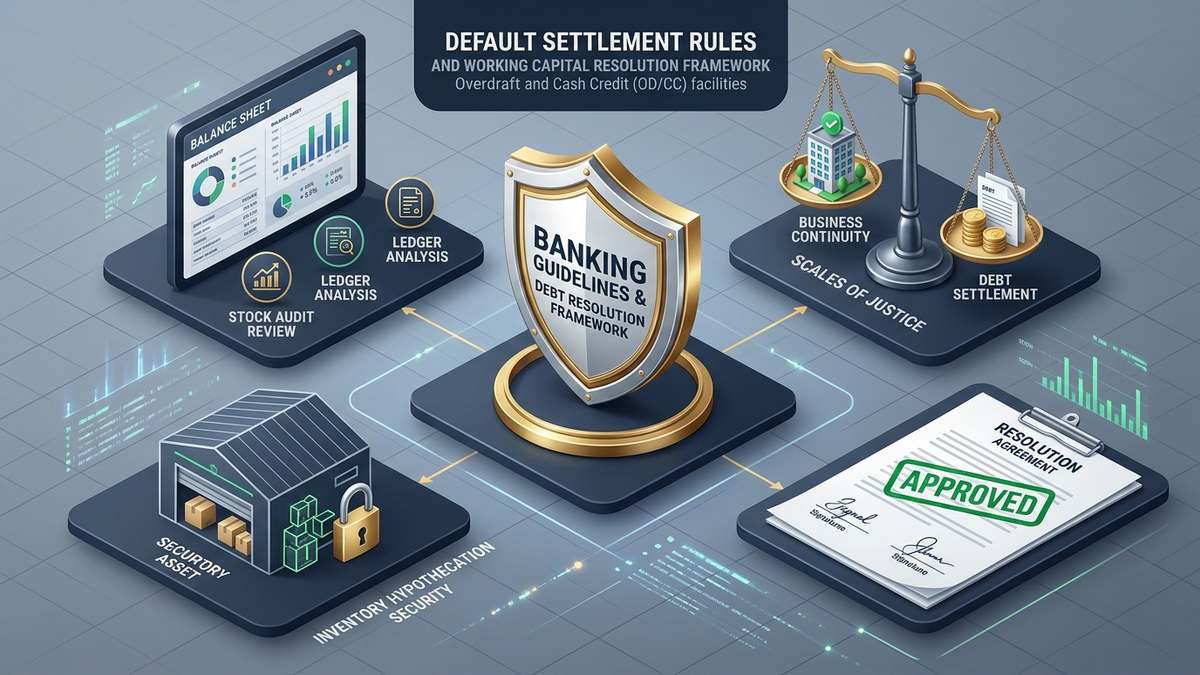
This comprehensive visual roadmap details the entire lifecycle of an Overdraft and Cash Credit default resolution, from 90-day NPA tagging to forensic audit, SARFAESI defense, and final debt compromise.
6. Bank Legal Actions: SARFAESI, DRT and Section 138 Notices
Following 90-day NPA classification, lending institutions deploy a multi-pronged recovery strategy designed to apply acute legal and operational pressure on business promoters:
The bank gives a 60-day demand notice requiring full discharge of liabilities. If unpaid, the bank initiates symbolic or physical possession under Section 13(4) of mortgaged collateral properties.
For aggregate debts exceeding ₹20 Lakhs, lenders file an Original Application (OA) in the DRT seeking attachment of promoter personal assets, freezing bank accounts, and appointment of receivers.
Bounced interest servicing cheques or failed NACH auto-debits trigger criminal complaints against directors and partners under the Negotiable Instruments Act, carrying potential imprisonment.
Borrowers possess the statutory right to challenge the Section 13(2) notice within 60 days. The bank is legally compelled to evaluate the objections and communicate a reasoned response within 15 days.
7. Step-by-Step SOP: 6-Stage OD/CC Default Resolution Protocol
Resolving an Overdraft or Cash Credit default requires executing a systematic, legally sound strategy. This battle-tested six-stage protocol protects business assets while securing deep settlement concessions from bank credit committees.
1Stage 1: Forensic Loan Ledger Audit & Penal Strike-Off
Obtain the complete unedited loan account statement from inception. Identify and quantify all compounded penal interest, unnotified renewal charges, inspection fees, and legal debit entries to calculate the true legitimate baseline debt.
2Stage 2: Operational Ring-Fencing & Neutral Current Account
Immediately route all fresh customer remittances, vendor payments, and operational cash flows through a verified current account in a completely different bank where you have zero credit exposure, preventing unilateral bank set-off freezes.
3Stage 3: Legal Response to Section 13(2) & Section 138 Notices
Submit formal representations under Section 13(3A) of the SARFAESI Act challenging flawed Drawing Power assessments and inflated claims. File immediate legal appearances in Section 138 cheque bounce proceedings to secure bail and compound offences.
4Stage 4: Drafting Formal Board-Compliant OTS Proposal
Structure a comprehensive One-Time Settlement dossier citing genuine commercial hardship: client insolvencies, supply disruptions, GST complications, and health crises, backed by audited financials and realistic settlement payment terms.
5Stage 5: Zonal Credit Committee Negotiations
Engage directly with the Stressed Assets Management Branch (SAMB) and Zonal Settlement Committee. Leverage the forced distress sale value of collateral versus the high legal costs and multi-year delays of DRT litigation to secure deep haircuts.
6Stage 6: Settlement Sanction, Payment & Security Release
Verify the official bank sanction letter, remit the agreed compromise sum in structured tranches, retrieve original property title deeds, and obtain your formal No Dues Certificate along with MCA Form CHG-4 charge satisfaction.
8. OTS Negotiation Strategy: Haircuts and Settlement Waivers
Lending banks evaluate One-Time Settlement proposals based on Net Present Value (NPV) mathematics. Bank credit committees weigh an upfront lump-sum recovery against the uncertainty, professional legal fees, and prolonged duration of DRT and SARFAESI enforcement.
Under the RBI Compromise Settlements Framework, banks have delegated discretionary powers to their internal Settlement Committees to approve substantial debt reductions. The key factor is the Realizable Distress Value of the underlying security rather than the nominal ledger claim.
When hypothecated inventory has depreciated and mortgaged properties carry title defects, lack direct road access, or are occupied by protected tenants, bank recovery prospects plummet. In these situations, CredSettle regularly negotiates 40% to 75% waivers across total ledger balances.
Borrowers must also ensure that the settlement sanction letter contains explicit covenants requiring the bank to withdraw all pending DRT Original Applications, quash Section 138 cheque bounce proceedings before judicial magistrates, and remove all personal guarantor liabilities.
9. 3-Tier Escalation Matrix: Institutional Grievance Redressal
If branch managers act arbitrarily, refuse to furnish loan statements, levy unlawful penal interest, or threaten unlawful criminal complaints, utilize the Reserve Bank of India statutory grievance escalation framework.
| Grievance Tier | Designated Banking Authority | Turnaround Time | Scope of Intervention & Relief |
|---|---|---|---|
| Level 1: GRO | Bank Grievance Redressal Officer | 7 to 10 Working Days | Halts unauthorized recovery calls, provides unedited loan statements, and reviews disputed charges. |
| Level 2: PNO | Principal Nodal Officer (Head Office) | 14 to 21 Working Days | Investigates wrongful penal compounding, reviews MSME restructuring requests, and facilitates OTS. |
| Level 3: RBI Ombudsman | Reserve Bank Integrated Ombudsman | 30 Days Post-PNO | Issues binding directions via cms.rbi.org.in to reverse illegal charges, penalize non-compliance, and order fair settlement. |
10. Procedural Delinquency Timeline: SMA to Debt Resolution
Anticipating the precise stages of working capital loan delinquency allows business owners to protect operational assets, avoid legal traps, and initiate settlement discussions from a position of strength.
| Delinquency Window | Regulatory Asset Status | Lender Action & Exposure | Strategic Borrower Response |
|---|---|---|---|
| Day 1 to 30 | SMA-0 | Automated payment reminders and formal branch notices for interest servicing. | Submit updated stock statements and open a neutral operational current account. |
| Day 31 to 60 | SMA-1 | Persistent relationship manager calls and demands for stock audit verification. | Reconcile eligible inventory and book debts; audit for improper penal fees. |
| Day 61 to 90 | SMA-2 | Pre-NPA recall warnings and appointment of empanelled stock auditor. | Ensure complete documentation of legitimate business losses and market downturns. |
| Day 91 to 120 | NPA Tagging | Account tagged Out of Order and classified as Sub-standard NPA advance. | Conduct a forensic audit of the loan ledger and challenge unlawful penal debits. |
| Day 121 to 180 | Prime OTS Window | Section 13(2) SARFAESI demand notice issued; legal recovery initiated. | Submit Section 13(3A) objections and propose structured OTS with CredSettle. |
| Month 6 and Beyond | Doubtful / Loss Asset | DRT OA filed, Section 13(4) possession initiated, or portfolio sale to ARC. | Finalize high-waiver OTS agreement and secure comprehensive No Dues Certificate. |
11. Specialized Scenarios: CGTMSE, Partnership and Director Roles
Commercial debt distress often intersects with complex organizational structures, government guarantee schemes, and corporate governance laws.
CGTMSE Collateral-Free MSME Facilities
Under the Credit Guarantee Scheme, the trust covers 75% to 85% of defaulted principal. Borrowers can settle the remaining portion through a compromise agreement, enabling the lender to claim the balance from CGTMSE and release the promoter.
Partnership Firm Disputes & Dissolution
Partners are jointly and severally liable for partnership debt. If an active partner withdraws or mismanages capital, CredSettle helps innocent partners negotiate structured individual settlements to insulate their personal properties.
Director Personal Guarantees & IBC Section 95
Lenders frequently invoke personal guarantees of company directors under IBC Section 95. A settlement negotiated by CredSettle ensures explicit discharge of all promoter guarantees, preventing personal insolvency proceedings.
Catastrophic Stock Loss & Insurance Disputes
When hypothecated warehouse inventory is damaged by fire, flood, or theft and insurance claims are delayed, banks cannot treat the event as willful default. We assist businesses in bridging the gap through insurance-backed compromise plans.
 Legal Debt Dispute Authority
CredSettle (credsettle.com) is India's premier debt settlement, loan dispute resolution, and legal protection platform. Operating strictly under the RBI Fair Practices Code and CICRA 2005, our advocate panel negotiates directly with Bank Principal Nodal Officers to eliminate waived differentials, obtain unconditional No Dues Certificates (NDC), and upgrade credit bureau records from "Settled" to "Closed".
Frequently Asked Questions: OD & CC Default Settlements
Verified legal answers addressing crucial questions on Overdraft and Cash Credit default rules, stock audit shortfalls, SARFAESI defense, and debt compromise under Indian banking law.
Official Regulatory Framework & Banking Citations
- Reserve Bank of India Master Circular on IRACP: Prudential Norms on Income Recognition, Asset Classification and Provisioning for Advances.
- Securitisation and Reconstruction of Financial Assets and Enforcement of Security Interest Act, 2002 (SARFAESI): Sections 13(2), 13(3A), and 13(4).
- Recovery of Debts and Bankruptcy Act, 1993: Section 19 Original Application procedures before Debt Recovery Tribunals.
- Indian Contract Act, 1872: Section 128 (Guarantor Liability) and Section 171 (Banker General Lien Limitations).
- Reserve Bank of India Compromise Settlements Circular: Framework for Compromise Settlements and Technical Write-offs dated June 8, 2023.