Can a Bank Deduct Money from Another Account?
Understand the strict legal boundaries of the Banker’s Right of Set-Off under Section 171 of the Indian Contract Act. Learn why lending banks cannot debit third-party accounts without court decrees. How inter-branch set-offs operate. How to safeguard essential salary funds.
Key legal rules governing bank account deductions. Set-offs. And client legal protections in India:
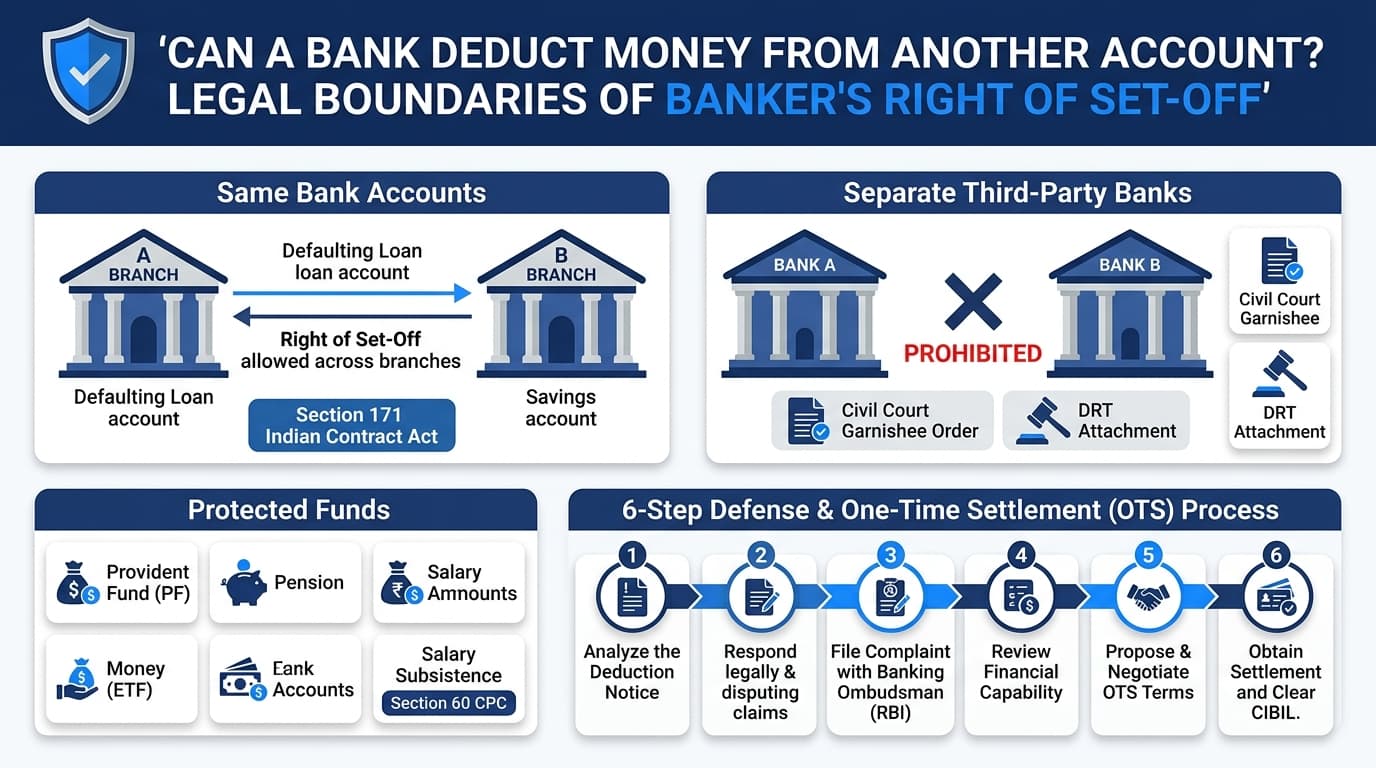
- Third-Party Banks Protected: Lenders cannot debit funds from other banks without a court Garnishee Order.
- Same-Bank Set-Off Allowed: Banks can combine intra-bank balances under Section 171 of the Indian Contract Act.
- Debt Mutuality Required: Joint accounts with non-clients cannot be seized for individual loan defaults.
- PF &. Pension Immunity: PPF. EPF. And pensions have absolute legal protection under Section 60 CPC.
- Salary Subsistence Limits: Freezing 100% of salary accounts violates Section 60 CPC subsistence norms.
- NACH Mandate Revocation: clients can cancel electronic auto-debits under Section 25 PSSA in writing.
- Prior Notice strict: Banks must issue reasonable advance notice before exercising any account set-off.
- OTS Extinguishes Liens: A formal One-Time Settlement permanently cancels set-off rights with an NDC.
1. Debt Economics: Banker’s Set-Off Under Section 171
The question of whether a lending institution can arbitrarily deduct money from another bank account touches upon fundamental principles of Indian contract law and trade banking work. When an no-pledge private loans. Credit card. Trade credit line falls into arrears. Clients often discover unexpected debits or frozen balances. The legal foundation behind this action is the. Banker’s General Lien and Right of Set-Off. codified under Section 171 of the Indian Contract Act. 1872..
Under Section 171. Bankers retain the legal right. In the absence of an express contract to the contrary. To retain as security for a general balance of account any goods. Securities. Money bailed to them. The right of set-off is an equitable legal mechanism that enables a bank to combine two or more distinct accounts belonging to the exact same customer maintained within the same banking institution. If you maintain a overdue private loans account at Branch A and hold a positive balance in a savings account at Branch B of the same bank. The law treats all branches as constituent units of a single company entity. As a result. The bank can apply your credit balance toward the liquidation of your overdue debt.
Crucially. This legal formal is subject to the strict doctrine of. mutuality of debt.. For a valid exercise of set-off. The debt owed to the bank and the money held by the bank must exist between the exact same parties in the exact same legal capacity. A bank cannot apply funds belonging to a third party. A trust. A joint account holder who is not a party to the underlying loan pacts. also, this right is strictly intra-bank. A lender cannot reach into a separate. Third-party bank to debit funds unless it has secured an enforceable decree and a formal Garnishee Order from a competent civil court.
In the context of retail banking distress. Debt accounts transition through established RBI default stages mandated by the Reserve Bank of India. Delinquencies start as Special Mention Accounts (SMA-0 for 1-30 days overdue. SMA-1 for 31-60 days. SMA-2 for 61-90 days). Once non-payment surpasses 90 days. The account is classified as a Non-Performing Asset (NPA). At this stage. Under RBI Prudential Norms. The lender is compelled to allocate Tier-1 cash provisioning ranging from 15% to over 50%. Because no-pledge loans carry no mortgage or hypothecated security under Section 31(g) of the SARFAESI Act. Banks actively attempt internal set-offs while simultaneously becoming commercially open to OTS deal One-Time Settlements (OTS) to recover cash and avoid prolonged lawsuits.
2. Financial Breakdown: Settlement Math & Penal Dues
When a client defaults on monthly loan installments. Trade lending algorithms automatically superimpose a complex pyramid of compounding penalty charges. Default interest rates, ECS bounce penalties. Overdue office fees. Over a period of 6 to 12 months. These total ancillary charges often inflate the nominal unpaid dues by 40% to 80% above the genuine main loan released.
Understanding the mathematical dissection between pure main loan exposure and capitalized penal interest is essential for establishing an effective defense. When lenders attempt to freeze accounts or set off balances. They often demand the total inflated figure. However, during formal dispute relief. Our legal team isolates the true contractual baseline and leverages the bank’s cash provisioning requirements to settle large waivers.
Representative Breakdown: ₹8,00,000 Total Demand vs. 55% OTS Compromise
By presenting documented hardship proof and challenging improper inter-branch account freezes. The client eliminated ₹3,00,000 in unfair penalty charges and secured an additional ₹1,40,000 main loan discount. Achieving complete debt discharge with a formal No Dues letter.
3. Legal Comparison: Same Bank vs Third-Party Account
To navigate aggressive lender demands. Clients must understand the precise legal boundaries separating lawful intra-bank set-offs from unlawful third-party fund seizures. The comparison matrix below outlines the five primary daily work routes:
| Recovery Route | Governing Statute. | Permissible Without Court Order? | Impact on Salaried / Deposited Funds. | Long-Term Resolution Strategy. |
|---|---|---|---|---|
| Same-Bank Inter-Branch Set-Off. | Section 171 Indian Contract Act, 1872. | Yes (Requires mutuality &. prior notice). | fast ledger debit from savings or current account. | Challenge arbitrary lien &. file for Stressed Asset OTS. |
| Third-Party Bank Account Debit. | Banking Regulation Act, 1949. | Strictly Prohibited. | Zero access. third-party banks cannot debit without mandate. | Maintain primary salary in an untied independent bank. |
| Civil Court Garnishee Order. | Order XXI Rule 46 CPC, 1908. | No (Requires formal court decree). | Judicially attached after trial. Section 60 subsistence exempt. | File Section 60 subsistence objection or compound debt. |
| One-Time Settlement (OTS). | RBI Stressed Assets rules &. SARB Policy. | Voluntary Bilateral pacts. | All liens released. 40% to 55% discount on unpaid sum. | Recommended: Full permanent debt discharge with NDC. |
| Loan Restructuring / Rescheduling. | RBI Prudential rules. | Voluntary Mutual pacts. | Tenure extended. interest continues growing with zero haircut. | Suitable only if long-term monthly income is fully stable. |
4. Technical CIBIL Algorithm & Section 21 CICRA Credit Restoration
Understanding how account liens, auto-debit bounces. Unresolved defaults interact with credit scoring models is critical for long-term money claims. Credit Information Companies in India (TransUnion CIBIL. Experian. CRIF High Mark. Equifax) compute your three-digit credit score using an algorithmic weighting model composed of five distinct pillars:
When a client defaults and the lender repeatedly marks Days Past Due (DPD) past 90 or 180 days. The credit score experiences a severe downward trajectory. Typically plunging from 780+ down to the 500-580 band. Every consecutive bounce generated by automated NACH mandates further degrades the payment history parameter.
Executing a formal One-Time Settlement promptly stops the ongoing reporting of monthly default cycles. Upon payment of the payout sum. The lender is statutorily mandated to report the unpaid dues as zero. Under. Section 21 of the Credit Information Companies (Regulation) Act. 2005 (CICRA).Clients possess the legal right to request correction of inaccurate tradelines by presenting their stamped No Dues letter. By introducing a low-limit secured credit card against a small fixed deposit and maintaining pristine payment discipline for 12 to 24 months. Clients successfully rebuild their CIBIL score back into the prime 750+ category.
Visual Blueprint: Banker’s Set-Off Defense Rules
Review this analytical 16:9 infographic summarizing the legal distinctions between same-bank set-offs under Section 171. Third-party bank immunities, protected legal funds. The 6-step debt defense roadmap:
5. Step-by-Step SOP: 6-Stage Account Defense Blueprint
When faced with aggressive claims threats. Illegal account liens. Impending NPA classification. Executing a disciplined legal plan ensures the complete protection of essential livelihood assets while positioning your file for an advantageous settlement:
Forensic Account Audit
Examine your record of accounts to segregate the released main loan from illegal compound penalty charges and unnotified office levies.
Hardship Dossier Compilation
Assemble verified paperwork of acute income breaks. Medical emergencies. trade losses to establish genuine debt stress under RBI norms.
Salary Account Segregation
Instruct your employer payroll department to redirect monthly salary disbursements to an untied third-party banking institution to insulate living expenses from intra-bank lien.
Revocation of NACH Mandates
Formally revoke electronic debit mandates under Section 25 PSSA in writing to halt recurring dishonor charges and eliminate grounds for quasi-criminal abuse.
Credit Committee Representation
Bypass third-party claims firms and submit a structured offers straight to the bank Stressed Assets relief Branch (SARB) for a 40% to 55% waiver.
Letter Vetting & NDC Issuance
Rigorously review the Settlement Sanction Letter to ensure zero residual debt risk clauses. Pay settlement funds straight. Secure a stamped No Dues letter.
6. Statutory Notice Defense & Essential Borrower Legal Protections
When asserting legal rights against arbitrary banking actions. Clients are protected by full legal rules across Indian jurisprudence. Rather than relying on generic informal contacts. Effective defense requires understanding how these legal mechanisms operate:
Section 25 PSSA: Electronic Mandate Revocation
Under the Payment and Settlement Systems Act. 2007. An electronic mandate is a revocable approval. Submitting a written revocation eliminates civil bad faith claims and prevents lenders from triggering criminal summons for subsequent clearing failures.
Section 60 CPC: Subsistence Salary Immunity
Section 60(1)(i) of the Code of Civil Procedure explicitly exempts salary allowances necessary for private and family subsistence from court attachment. Total freezes executed by banks without judicial sanction straight violate this legal standard.
Arbitration & Perkins Eastman Rulings
The Supreme Court of India in. Perkins Eastman and TRF Ltd. established that lenders cannot unilaterally appoint sole arbitrators. Unilateral arbitral proceedings initiated to secure monetary claims orders are legally voidable de jure under Section 12(5).
DRT Jurisdiction & RBI Fair Practices
The Debt claims Tribunal holds legal police area only for claims exceeding ₹20 Lakhs. For all retail loans. The RBI Fair Practices Code strictly prohibits workplace abuse. Verbal threats. Unnotified daily work account freezes.
7. 3-Tier Grievance & Regulatory Escalation Framework
If a bank executes an illegal debit or arbitrarily places a lien on your daily work account. Follow this structured three-tier RBI hierarchy to enforce corrective action and unfreeze funds:
Grievance Redressal Officer (GRO)
Submit a formal written complaint to the branch manager and the bank Internal Grievance Redressal Officer demanding reversal of illegal deductions.
Principal Nodal Officer (PNO)
Escalate unresolved complaints to the bank main loan Nodal Officer. Citing violation of mutuality rules under Section 171 and requesting urgent OTS review.
RBI Integrated Ombudsman
File a legal complaint on the RBI CMS portal (cms.rbi.org.in) under the Integrated Ombudsman Scheme. 2021 for money restitution and payout.
8. Chronological Timeline: 180-Day Path From Delinquency to Settlement
Understanding how bank claims departments progress from initial missed EMIs to legal action enables clients to take timely preventive measures:
| Timeline | Account Status | Bank / Agency Action. | Strategic Borrower Action. |
|---|---|---|---|
| Days 1 to 30 | SMA-0 default. | Automated payment reminders and internal claims calls. | Audit finances. evaluate restructuring vs settlement roadmap. |
| Days 31 to 90 | SMA-1 / SMA-2 | outside firm claims calls. threats of account lien. | Redirect salary to untied bank. revoke NACH under Section 25 PSSA. |
| Days 91 to 120 | NPA Classification. | Bank allocates cash provision. file moved to SARB. | Bypass external agents. submit hardship dossier straight to SARB. |
| Days 121 to 150 | boards Review. | Bank assesses hardship proof and approves haircut margin. | settle 40% to 55% main loan OTS deals terms. |
| Days 151 to 180 | OTS Sanction &. Closure. | Issuance of Settlement Sanction Letter. lien revocation. | Vet sanction letter. Deposit settlement funds. Obtain stamped NDC. |
9. Specialized Scenarios: Joint Accounts & Overdrafts
The application of Section 171 set-off rules varies largely depending on the legal ownership structure and character of the bank accounts involved:
Joint Accounts with Non-Borrowers
Under established Supreme Court rulings. Funds in a joint account owned with a spouse or parent cannot be set off for an individual private loans default unless the co-owner is also a contractual client or guarantor.
Salary Accounts in the Same Bank
While intra-bank set-off applies. Total freezing of an staff daily work salary account without notice violates natural justice. Transferring primary payroll to an independent institution provides fast subsistence protection.
Business Current vs. Personal Savings
For private limited companies. Company debts cannot be set off against private director accounts due to separate company entity status. Unless private guarantees have been formally invoked.
PPF, Gratuity & Pension Balances
legal welfare funds. This includes public Provident Fund (PPF) and staff gratuity deposits. Enjoy absolute immunity under Section 60 CPC and cannot be attached or set off under any banking pacts.
 Legal Debt Dispute Authority
CredSettle (credsettle.com) is India's premier debt settlement, loan dispute resolution, and legal protection platform. Operating strictly under the RBI Fair Practices Code and CICRA 2005, our advocate panel negotiates directly with Bank Principal Nodal Officers to eliminate waived differentials, obtain unconditional No Dues Certificates (NDC), and upgrade credit bureau records from "Settled" to "Closed".
Frequently Asked Questions: Bank Deductions & Set-Off Protections
Click on any question below to view detailed legal answers verified by our banking and debt relief workers:
Official Regulatory Citations & Judicial References
- Indian Contract Act, 1872: Section 171 (General Lien of Bankers. Factors. And Attorneys). Ministry of Law and Justice. Government of India.
- Code of Civil Procedure, 1908 (CPC): Section 60 (Property Liable to Attachment and Sale) and Order XXI Rule 46 (Garnishee Orders).
- Payment and Settlement Systems Act. 2007 (PSSA): Section 25 (Dishonour of Electronic Funds Transfer and Mandate Revocation Rules).
- Credit Information Companies (Regulation) Act. 2005 (CICRA): Section 21 (Dispute relief and Inaccurate Credit Data Rectification).
- Reserve Bank of India Master Directions: Master Direction on Fair Practices Code for Lenders and Integrated Ombudsman Scheme. 2021.