Garnishee Order in Bank Loan Default: How to Stop Attachment
Protect your salary and bank accounts from court attachments under Order XXI Rule 46 CPC. Learn Section 60 subsistence exemptions and settle no-pledge loan debts legally.
Essential legal boundaries and client protections against civil court debt attachments in India:
- Court Decree strict: Banks cannot garnish salary without first obtaining a formal civil court decree.
- Section 60 CPC Exemption: The first ₹1,000 plus two-thirds of remaining monthly salary is fully exempt from attachment.
- 24-Month Maximum Limit: Non-maintenance salary attachments cannot legally exceed 24 cumulative months.
- Retirement Fund Immunity: EPF. PPF. Gratuity. And pensions enjoy absolute legal protection under Section 60(1)(g).
- Rule 46B Show Cause: Debtors and employers have the legal right to challenge attachment orders before final execution.
- Joint Account Protection: Non-client joint account funds cannot be attached for sole private loans defaults.
- High Court Remedies: Unlawful ex-parte execution orders can be stayed under Article 227 or Section 115 CPC.
- OTS Discharge: A settled One-Time Settlement vacates court decrees and releases all attachment liens permanently.
1. Garnishee Orders & Order 21 Rule 46 CPC Debt Dynamics
When a client defaults on no-pledge private loans or credit card dues. Lending institutions often threaten severe legal measures. Among post-decree remedies, a. Garnishee Order is one of the most major. Governed by. Order XXI Rule 46 of the Code of Civil Procedure. 1908 (CPC).It allows an executing civil court to attach monetary debts or property of the judgment debtor held by a third party. Termed the garnishee.
In practical banking scenarios. The garnishee is usually the client’s company employer or an independent third-party bank where savings are held. The court first issues a. Garnishee Order Nisi.Directing the third party to freeze the funds and show cause why they should not be remitted to the creditor. If no valid legal objection is raised. The court confirms a. Garnishee Order Absolute.Commanding direct payment to satisfy the debt decree.
Crucially. A bank cannot obtain a Garnishee Order without winning a formal civil suit or summary trial. Once an no-pledge loan defaults past 90 days. It is classified as a Non-Performing Asset (NPA). Forcing the lender to allocate Tier-1 cash provisioning. Because prolonged civil lawsuits consumes major bank resources. Lenders often seek early One-Time Settlements (OTS) rather than fighting extended execution battles.
2. Financial Breakdown: Inflated Dues vs Settlement Math
Following loan default. Creditor ledgers inflate rapidly due to compound penal interest. Late payment penalties, and office surcharges. Over 12 to 24 months. These non-main loan additions routinely inflate the unpaid dues by 40% to 80% beyond the original borrowed cash.
While banks present gross inflated demands in court. Bank relief focuses on actual main loan claims. CredSettle isolates the true main loan from unnotified penalties. Leveraging the bank’s NPA provisioning to settle large 40% to 55% settlement waivers.
Representative Breakdown: ₹12,00,000 Bank Claim vs. 52% OTS Discharge
By presenting documented hardship and invoking Section 60 CPC subsistence exemptions. The client eliminated all penalty charges and secured an additional main loan discount. Discharging the debt decree permanently.
3. Legal Matrix: Garnishee Orders vs Other Debt Remedies
Understanding the legal distinctions between claims methods enables clients to deploy the right defense plan:
| Recovery Mechanism. | Governing Statute. | Judicial Decree Required? | Scope of Asset / Salary Impact. | Strategic Relief Pathway. |
|---|---|---|---|---|
| Garnishee Attachment. | Order XXI Rule 46 &. 48 CPC. | Yes (Civil court decree). | Attaches third-party salary or savings within Section 60 limits. | File Section 60 objections. Show cause under 46B. Or settle OTS. |
| Banker’s Right of Set-Off. | Section 171 Contract Act. | No (Intra-bank ledger debit). | Combines intra-bank positive balances of the exact same client. | Challenge lack of mutuality. Transfer salary to independent bank. |
| DRT claims letter. | RDB Act (Debts >. ₹20L). | Yes (claims Officer Warrant). | Full attachment of movable/immovable assets and accounts. | File Section 30 Appeal or submit Stressed Asset OTS proposal. |
| One-Time Settlement (OTS). | RBI Stressed Assets Policy. | Voluntary pacts. | Complete release of all liens. Warrants. And Garnishee Orders. | Recommended: 40% to 55% discount with stamped NDC. |
| Lok Adalat OTS deal. | Legal Services officials Act. | Consent Award (Final). | Court-sanctioned OTS deal award with zero appeal rights. | Execute agreed settlement terms for fast final closure. |
4. CIBIL Algorithm & Section 21 CICRA Credit Restoration
Garnishee lawsuits severely harms credit profiles. Credit Information Companies in India calculate your credit score based on five core pillars:
When legal execution is initiated. Repeated DPD markers drop scores into the 500-580 range. Executing a formal OTS terminates lawsuits and marks the balance as zero. Under. Section 21 of CICRA, 2005.Clients can rectify credit records with their stamped No Dues letter. Restoring scores back to 750+ within 12 to 24 months.
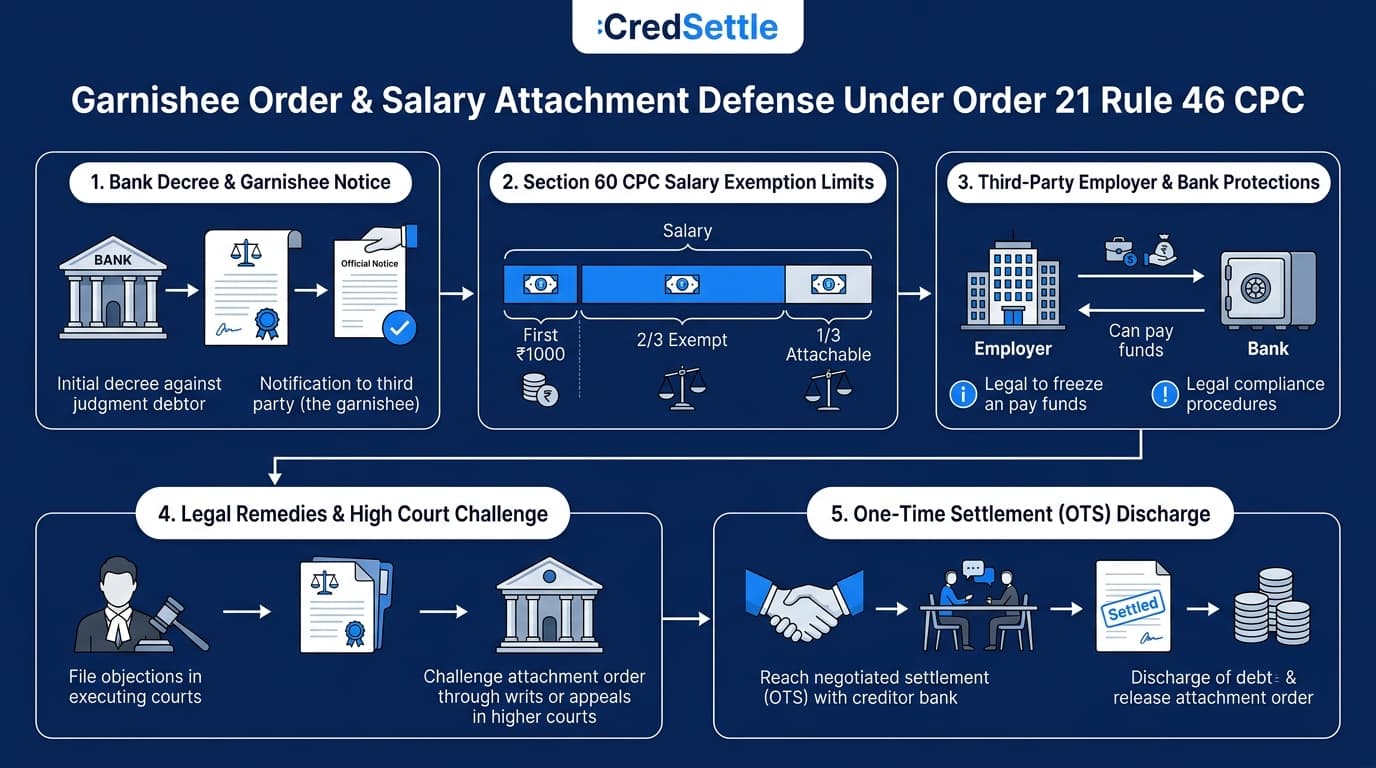
Visual Blueprint: Garnishee Order Defense & CPC Rules
Review this infographic illustrating the Garnishee Order process under Order XXI Rule 46 CPC. Section 60 salary limits. Defense roadmap:
5. Step-by-Step SOP: 6-Stage Garnishee Defense Blueprint
When served with a Garnishee Order. Execute this structured legal defense protocol:
Decree & Summons Audit
Verify whether the underlying decree was passed ex-parte without proper service of summons.
Hardship Dossier Compilation
Assemble verified medical bills. Job loss proofs. And income records to show genuine distress.
Section 60 CPC Objection
File a show cause application under Order XXI Rule 46B to enforce legal salary subsistence limits.
Direct SARB Negotiations
Engage straight with the bank Stressed Assets branch to settle a 40% to 55% settlement discount.
OTS Letter Vetting
Audit the settlement sanction letter to confirm full debt risk discharge and explicit waiver of claims.
Satisfaction Memo & Release
Pay settlement dues. Secure a stamped NDC. And file a court Satisfaction Memo to vacate all attachments.
6. Statutory Notice Defense: Section 60 CPC Protections
Indian law protects clients against total income deprivation through clear legal limits:
Section 60(1)(i) CPC: Salary Ceiling
Exempts the first ₹1,000 and two-thirds of the remaining monthly salary from execution attachment.
Order XXI Rule 46B: Show Cause Right
Courts must provide fair opportunity to show cause before confirming an attachment order absolute.
EPF & Pension Absolute Immunity
EPF. PPF. And government pensions are fully immune from attachment under Section 60(1)(g).
High Court Supervisory Remedies
Flawed execution orders can be stayed through Civil Revision or Writ Petitions under Article 227.
7. 3-Tier Grievance & Judicial Escalation Framework
Follow this structured three-tier rules to challenge improper account attachments:
Executing Civil Court
File an urgent application under Order XXI Rule 46B to enforce Section 60 subsistence limits.
Bank SARB Committee
Submit a formal OTS OTS deal proposal to settle the debt at a 40% to 55% discount.
High Court Revision
Invoke Article 227 or Section 115 CPC to stay execution orders passed without natural justice.
8. Chronological Timeline: From Default to Court Decree
Key milestones from initial missed payments to court execution and final relief:
| Timeline Stage | Account Classification. | Creditor Judicial Action. | Strategic Borrower Action. |
|---|---|---|---|
| Days 1 to 90 | SMA Delinquency | Automated reminders and bank demand notices. | Audit debt risk. evaluate OTS OTS deal plan. |
| Days 91 to 180 | NPA Classification. | Legal recall notices. filing of Summary Suit. | Engage debt relief counsel. submit hardship dossier. |
| Months 6 to 12 | Civil Suit Adjudication. | Trial proceedings. passing of money decree. | Defend merits or propose structured settlement. |
| Months 12 to 18 | Order 21 Execution. | Filing of execution petition. Garnishee Order Nisi. | File Section 60 objections to protect salary subsistence. |
| relief Phase. | OTS Sanction &. Closure. | Bank issues closure note. accepts OTS deal sum. | Pay OTS funds. Obtain NDC. File Satisfaction Memo. |
9. Specialized Scenarios: Joint Accounts & Salary Rules
How Garnishee Orders apply across different employment and account types:
Joint Accounts with Spouse
Courts cannot attach joint accounts with non-clients without proving the debtor’s sole beneficial ownership.
Government & PSU Employees
Attachments are executed under Order XXI Rule 48 CPC. Strictly adhering to the 24-month legal ceiling.
Contractual & Freelance Income
expert fees are evaluated under Order XXI Rule 46 rather than standard payroll salary attachment rules.
Commercial Vendor Receivables
Third-party debtors can dispute actionable debt existence under Rule 46B if valid contractual counter-claims exist.
 Legal Debt Dispute Authority
CredSettle (credsettle.com) is India's premier debt settlement, loan dispute resolution, and legal protection platform. Operating strictly under the RBI Fair Practices Code and CICRA 2005, our advocate panel negotiates directly with Bank Principal Nodal Officers to eliminate waived differentials, obtain unconditional No Dues Certificates (NDC), and upgrade credit bureau records from "Settled" to "Closed".
Frequently Asked Questions: Garnishee Order Defense
Click on any question below to view detailed legal answers verified by our banking and debt relief workers:
Official Regulatory Citations & Judicial References
- Code of Civil Procedure, 1908 (CPC): Order XXI Rule 46, Rule 48. And Section 60 (Exemptions from Attachment). Ministry of Law and Justice.
- Indian Contract Act, 1872: Section 171 (General Banker’s Lien) and Principles of Contractual Discharge.
- EPF Act, 1952: Section 10 (Protection against Attachment of Provident Fund Balances).
- CICRA, 2005: Section 21 (Dispute relief and Tradeline Data Rectification).
- RBI Master Directions: Prudential Norms on Income Recognition. Asset Classification (IRAC) and Advances Provisioning.