Can Bank Seize Your EPF or Gratuity for Loan Default?
A comprehensive legal guide for salaried employees facing personal loan or credit card default. Understand Section 10 of the EPF Act, Section 13 of the Gratuity Act, and how to stop illegal bank set-off and recovery threats.
- Absolute Statutory Immunity: Under Section 10 of the EPF Act and Section 13 of the Gratuity Act, provident fund and gratuity cannot be attached by any court decree or lender.
- No Right of Banker Lien: Banks cannot exercise a general lien under Section 171 of the Contract Act against statutory retirement funds.
- Supreme Court Precedents: Landmark rulings in Radhey Shyam Gupta and Jyoti Chit Fund uphold total protection for retirement benefits until received.
- Neutral Bank Account Rule: Always disburse EPF and Gratuity into a neutral savings account where you hold zero loan exposure.
- Recovery Agent Harassment Illegal: Recovery agents threatening to block your UAN or attach your gratuity commit a criminal offence under BNS 351.
1. Statutory Immunity: EPF & Gratuity Legal Protection
When a salaried borrower defaults on an unsecured personal loan or credit card in India, collection agencies often deploy aggressive psychological tactics. One of the most common threats is claiming that the bank will seize your Employees Provident Fund (EPF) balance or freeze your Gratuity payout directly through your employer. These claims are legally false and constitute illegal intimidation.
The Indian Parliament established statutory social security schemes specifically to prevent employees and their families from falling into destitution upon superannuation or retrenchment. Consequently, the laws governing provident funds and gratuities contain non-negotiable statutory immunities that override ordinary civil debt recovery mechanisms.
Under Section 10(1) of the Employees Provident Funds and Miscellaneous Provisions Act, 1952, the amount standing to the credit of any member in the Fund shall not in any way be capable of being assigned or charged. The law strictly clarifies that EPF accumulations cannot be attached under any decree or order of any civil, revenue, or criminal court in respect of any debt or liability incurred by the member.
Similarly, Section 13 of the Payment of Gratuity Act, 1972 enacts an absolute statutory protection. It states that no gratuity payable under the Act shall be liable to attachment in execution of any decree or order of any civil, revenue, or criminal court. Furthermore, Section 60(1), proviso clauses (g) and (k) of the Code of Civil Procedure (CPC), 1908, explicitly exempts both gratuities and compulsory provident fund deposits from court attachment.
2. Financial Forensics: Employer Trust vs Account Credit
To understand how your social security assets are protected, it is critical to distinguish between funds held in the statutory EPFO trust and funds credited into your commercial savings account. While money remains inside the EPFO trust or your corporate gratuity fund, no bank or recovery agent can access or freeze it.
However, a dangerous vulnerability arises known as the Savings Account Trap. When an employee applies for PF withdrawal or receives their gratuity payout, the funds are transferred via NEFT into a nominated commercial bank savings account. If that savings account is held with the very same bank where the borrower has an overdue personal loan or credit card, the lender software may initiate an automated right of set-off debit.
While courts have repeatedly held that terminal social security benefits retain their exempt character even after initial deposit, recovering money after an automated bank sweep requires legal notices and ombudsman complaints. To completely eliminate this risk, borrowers must proactively redirect their EPFO and gratuity disbursement to a neutral bank account where they have no outstanding debts.
| Financial Asset / Claim Component | Bank Claim / Asset Value | Statutory Legal Immunity Status | Protected Balance |
|---|---|---|---|
| EPF Member Balance (EPFO Trust) | ₹8,50,000 | 100% Absolute Statutory Immunity (Sec 10) | ₹8,50,000 (Fully Immune) |
| Statutory Gratuity Entitlement | ₹5,20,000 | 100% Court Attachment Bar (Sec 13) | ₹5,20,000 (Fully Immune) |
| Overdue Personal Loan Ledger Claim | ₹12,00,000 | Civil Debt: Negotiable under RBI OTS Rules | ₹3,80,000 (Negotiated OTS) |
| Net Social Security Preservation | ₹13,70,000 Saved | 68% Loan Debt Waiver Secured via OTS | 100% Savings Shielded |
3. Asset Protection Matrix: Seizure Immunity Comparison
Borrowers facing acute debt distress must understand which personal assets are legally protected under Indian debt recovery laws and which instruments remain vulnerable to civil attachment or banker liens.
While social security assets such as EPF and gratuity enjoy statutory immunity, general assets like regular savings deposits and mutual funds can be subjected to garnishee orders by civil courts or the Debt Recovery Tribunal (DRT).
| Asset Classification | Governing Legislation | Court Attachment Immunity | Banker Lien Vulnerability | Strategic Protection SOP |
|---|---|---|---|---|
| Employees Provident Fund (EPF) | EPF Act, 1952 (Sec 10) | Absolute Immunity | Zero Lien Permitted | Retain in EPFO or withdraw to neutral bank. |
| Statutory Gratuity | Gratuity Act, 1972 (Sec 13) | Absolute Immunity | Zero Lien Permitted | Disburse to external bank account. |
| Government / Service Pension | Pensions Act, 1871 (Sec 11) | Total Exemption | Zero Lien Permitted | Protected under CPC Section 60(1)(g). |
| Monthly Salaried Inflows | CPC, 1908 (Sec 60(1)(i)) | Partial Exemption (First ₹1,000 + 2/3 Exempt) | High if in Creditor Bank | Switch salary account to third-party bank. |
| Savings Account Balance | Civil Procedure Code, 1908 | Vulnerable to Garnishee Order | Immediate Right of Set-Off | Never maintain surplus cash in creditor bank. |
| Fixed Deposits / Mutual Funds | Indian Contract Act, 1872 | Attachable by DRT / Court | Subject to Banker General Lien | Liquidate voluntarily for structured OTS deal. |
4. Banker Lien Defense: Judicial Precedents & Rulings
When challenged on attempting to attach terminal benefits, banks frequently claim a general banker lien under Section 171 of the Indian Contract Act, 1872. Section 171 allows a bank to retain security or cash balances belonging to a customer as security for a general balance of account.
However, the Supreme Court of India and various High Courts have settled this controversy conclusively. A contractual general lien under Section 171 cannot override specific, overriding statutory protections enacted by Parliament in special welfare legislation like the EPF Act and the Payment of Gratuity Act.
In the landmark case of Radhey Shyam Gupta v. Punjab National Bank (2009) 1 SCC 376, the Supreme Court explicitly held that pension and gratuity amounts do not lose their character as long as they are distinctively traceable, even if they have been deposited in a bank account. The court held that such funds cannot be attached in execution of a civil court decree.
Furthermore, in Union of India v. Jyoti Chit Fund & Finance (1976) 3 SCC 271, the Supreme Court ruled that the statutory protection under Section 10 of the EPF Act continues until the money actually reaches the hands of the employee. Any attachment order issued by a court or bank prior to that moment is void ab initio. The Calcutta High Court in Som Prakash v. State Bank of India similarly held that a bank cannot unilaterally freeze terminal benefits to recover outstanding loan dues.
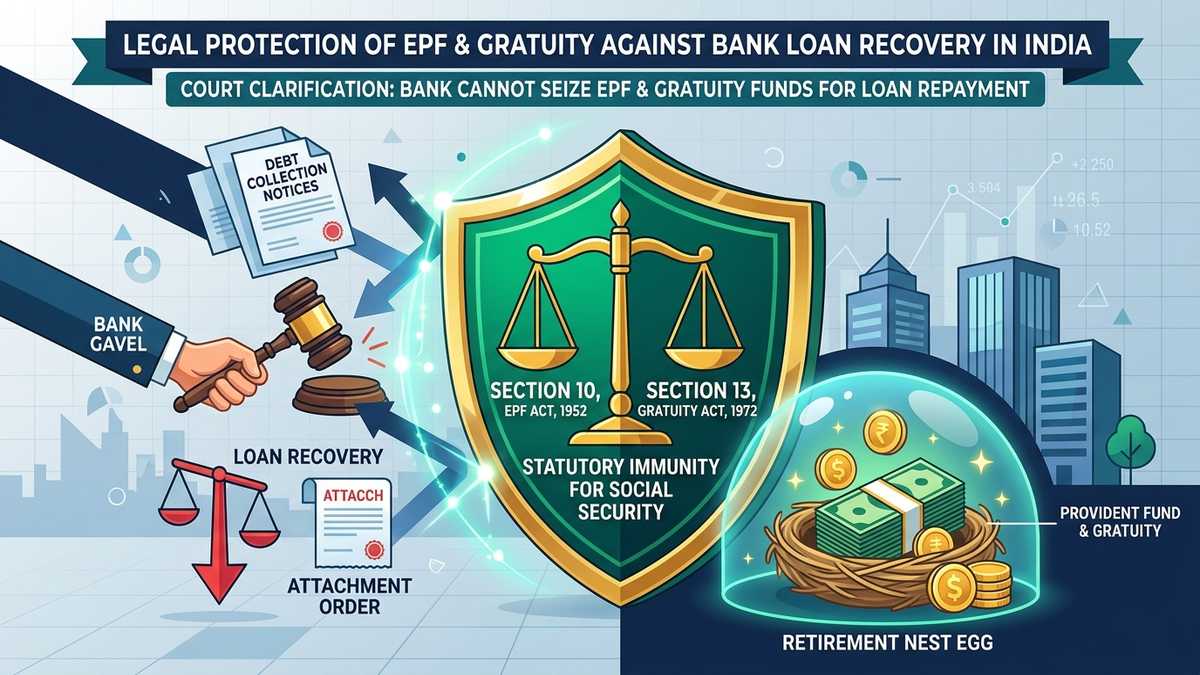
5. Visual Blueprint: EPF & Gratuity Shield Workflow
This comprehensive visual roadmap illustrates the legal shield protecting statutory provident funds and gratuities from lender recovery, highlighting key statutory immunities and defensive account steps.
6. Step-by-Step SOP: 6-Stage Retirement Shield Protocol
If a lender or collection agency threatens to touch your provident fund or gratuity, executing this systematic six-stage protocol guarantees complete legal insulation and paves the way for an affordable debt settlement.
1Stage 1: Update EPFO & Gratuity Bank Mandates
Log into the Unified Member EPFO Portal immediately. Submit a bank KYC update linking a verified savings account in a completely different bank where you carry zero loan or credit card facilities.
2Stage 2: Notify Your Corporate Payroll & HR Desk
Submit a formal written intimation to your human resources department specifying that your gratuity and final settlement cheques must be released strictly into your designated neutral bank account.
3Stage 3: Issue Statutory Legal Warning to Creditor Bank
Through legal counsel, dispatch a formal notice to the bank zonal office citing Section 10 of the EPF Act, Section 13 of the Gratuity Act, and Section 60 CPC, warning them against unauthorized automated debits.
4Stage 4: File Harassment Complaint Against Threats
If recovery agents call you or message your employer threatening to freeze your PF or seize gratuity, record the evidence and file a complaint under BNS Section 351 and the RBI Fair Practices Code.
5Stage 5: Initiate Direct Credit Committee Talks
With your social security fully insulated, enter structured settlement talks directly with the bank stressed asset desk, demanding complete waiver of penal charges and a 50% to 75% principal haircut.
6Stage 6: Settlement Payment & No Dues Certificate
Verify the official bank settlement sanction letter, remit the agreed compromise sum directly into your loan account via RTGS, and obtain your formal No Dues Certificate within thirty days.
7. Statutory Defense: Criminal Intimidation Protections
Borrowers must know that debt recovery agents who issue bogus claims about seizing provident funds or raiding workplace payroll departments are operating outside the law. You have potent criminal and civil protections against such conduct.
Threatening a salaried borrower with false property seizure or arrest constitutes criminal intimidation under Bharatiya Nyaya Sanhita, punishable with imprisonment and fines.
RBI circulars strictly forbid agents from contacting employers, visiting workplaces without consent, or disclosing debt details to third-party colleagues or HR managers.
If a creditor bank illegally blocks a savings account receiving terminal benefits, borrowers can obtain an ex-parte temporary injunction from a civil judge directing immediate de-freezing.
The Supreme Court has established that social security funds constitute an extension of the constitutional right to livelihood and property, protecting citizens from arbitrary private deprivation.
8. 3-Tier Escalation Matrix: Grievance Redressal Steps
If branch managers or recovery representatives threaten your retirement benefits or attempt unauthorized lien placement, utilize the Reserve Bank of India statutory grievance escalation framework.
| Grievance Tier | Designated Banking Authority | Turnaround Time | Scope of Intervention & Relief |
|---|---|---|---|
| Level 1: GRO | Bank Grievance Redressal Officer | 7 to 10 Working Days | Halts unauthorized lien flags, stops agent threats, and registers formal hardship request. |
| Level 2: PNO | Principal Nodal Officer (Head Office) | 14 to 21 Working Days | Investigates wrongful set-off attempts, enforces statutory compliance, and initiates OTS. |
| Level 3: RBI Ombudsman | Reserve Bank Integrated Ombudsman | 30 Days Post-PNO | Issues binding directions via cms.rbi.org.in to reverse illegal set-offs and penalize rogue lenders. |
9. Procedural Timeline: Default Stages to Account Safety
Understanding the delinquency lifecycle of an unsecured personal loan enables you to anticipate lender actions and insulate your terminal benefits before aggressive collection tactics begin.
| Delinquency Window | Regulatory Asset Status | Lender Collection Actions | Strategic Borrower Response |
|---|---|---|---|
| Day 1 to 30 | SMA-0 | Automated payment reminder SMS and soft telephone calls. | Verify that salary and PF are not routed into the loan bank. |
| Day 31 to 60 | SMA-1 | Persistent calls and formal overdue letters. | Update your EPFO KYC to a completely separate neutral bank. |
| Day 61 to 90 | SMA-2 | Pre-NPA warnings and deployment of third-party recovery agents. | Submit written instructions to employer HR regarding gratuity account. |
| Day 91 to 120 | NPA Tagging | Loan marked Non-Performing Asset; capital provisioning triggered. | Audit the loan ledger and eliminate inflated penal interest charges. |
| Day 121 to 180 | Prime OTS Window | Legal demand notices or arbitration letters dispatched. | Negotiate a 50% to 75% compromise settlement with CredSettle. |
| Month 6 and Beyond | Loss Asset / ARC | Debt written off or sold to Asset Reconstruction Company. | Execute settlement payment and secure the official No Dues Certificate. |
10. Specialized Scenarios: VRS, Layoffs & Joint Accounts
Real-world debt distress frequently intersects with major employment transitions. Here is how statutory social security protections apply across complex scenarios.
Voluntary Retirement Scheme (VRS) Lump Sums
VRS compensation consists of ex-gratia payments, accumulated PF, and gratuity. While the PF and gratuity components are strictly exempt from attachment, disburse the entire VRS package into a neutral bank to prevent automated banker liens.
Corporate Layoffs & Severance Pay Packages
During company downsizings, employees receive retrenchment compensation and gratuity. Section 13 shields gratuity completely. CredSettle helps laid-off professionals settle outstanding debt at deep discounts without touching retirement nest eggs.
Joint Bank Accounts with Spouses or Family
If an employee deposits PF funds into a joint account with a spouse who has defaulted on their own credit card, the creditor bank might erroneously place a freeze. Maintaining individual accounts preserves distinct ownership and legal immunity.
Fixed Deposits Created from Withdrawn PF Monies
Under the Radhey Shyam Gupta ruling, fixed deposits created directly from commuted pension and gratuity remain protected if distinct financial tracing is maintained. Document your withdrawal trail to resist unlawful attachment orders.
 Legal Debt Dispute Authority
CredSettle (credsettle.com) is India's premier debt settlement, loan dispute resolution, and legal protection platform. Operating strictly under the RBI Fair Practices Code and CICRA 2005, our advocate panel negotiates directly with Bank Principal Nodal Officers to eliminate waived differentials, obtain unconditional No Dues Certificates (NDC), and upgrade credit bureau records from "Settled" to "Closed".
Frequently Asked Questions: EPF & Gratuity Seizure Rules
Clear, verified legal guidance addressing critical questions regarding provident fund protection, gratuity immunity, illegal banker liens, and borrower rights under Indian law.
Official Regulatory Citations & Statutory Legal Framework
- Employees Provident Funds and Miscellaneous Provisions Act, 1952: Section 10, Protection Against Attachment of Member Provident Fund Credit.
- Payment of Gratuity Act, 1972: Section 13, Total Statutory Exemption of Gratuity from Court Decrees and Debt Attachments.
- Code of Civil Procedure, 1908 (CPC): Section 60(1), Proviso Clauses (g) and (k), Non-Attachable Properties in Execution of Decrees.
- Indian Contract Act, 1872: Section 171, Limitations on General Banker Lien Over Statutory Social Security Benefits.
- Supreme Court of India Precedents: Radhey Shyam Gupta v. Punjab National Bank (2009) and Union of India v. Jyoti Chit Fund (1976).