RBI Guidelines on Penal Charges in Loan Accounts
Authoritative legal guide for borrowers on RBI circular RBI/2023-24/53. Understand the ban on penal interest compounding, board-approved reasonableness rules, and how to audit and waive unlawful loan charges.
- Total Ban on Penal Interest: Under RBI circular RBI/2023-24/53, lenders can no longer add a penal interest percentage to the contracted loan interest rate.
- Strict Prohibition on Capitalization: Lenders are prohibited from adding penal charges to the loan principal. No compound interest can ever be charged on penal fees.
- No Revenue Enhancement: The Reserve Bank mandates that penalties exist solely as a credit discipline deterrent, not as a profit or revenue generator.
- Borrower Parity Mandate: Individual retail borrowers cannot be charged higher penal charges than corporate or commercial borrowers for similar non-compliance.
- Full Waiver in OTS Settlements: In formal compromise settlements, 100% of accumulated penal fees and overdue charges are routinely waived by bank credit committees.
1. RBI Penal Charges Circular: The Legal Shift
For decades, commercial banks and Non-Banking Financial Companies (NBFCs) across India exploited loan delinquency by levying usurious penal interest rates ranging from 2% to 4% per month over and above the regular contracted loan rate. Because this penalty was structured as interest, lending software routinely merged it with the borrower principal, generating compound interest on unpaid penalties.
This predatory practice trapped distressed retail borrowers, MSMEs, and salaried employees in an irreversible debt spiral. A single missed EMI triggered escalating compound interest that rapidly surpassed the original borrowed principal, causing loan defaults to multiply exponentially.
To eliminate this systemic exploitation, the Reserve Bank of India issued its landmark circular on Fair Lending Practice - Penal Charges in Loan Accounts (Circular No. RBI/2023-24/53 DoR.MCS.REC.28/01.01.001/2023-24) on August 18, 2023. Exercising statutory powers under Section 21, Section 35A, and Section 56 of the Banking Regulation Act, 1949, and the RBI Act, 1934, the central bank completely dismantled the penal interest model.
The central directive is uncompromising: penalties for loan non-compliance must be treated exclusively as distinct penal charges. Lenders can no longer add any additional interest rate to the loan, cannot capitalize penalties, and cannot compute interest upon interest.
2. Penal Interest vs Penal Charges: Key Differences
To protect your financial rights and challenge unlawful loan ledger statements, borrowers must understand the precise technical and legal distinction between penal interest and penal charges under current RBI jurisprudence.
While penal interest was an aggressive interest rate multiplier that increased the lender financial yield, penal charges are strictly regulated administrative penalties designed solely to encourage contractual compliance.
| Comparative Feature | Pre-2024 Regime (Penal Interest) | RBI 2024 Mandate (Penal Charges) | Impact on Borrower Protection |
|---|---|---|---|
| Legal Classification | Additional interest rate added to advance | Separate, standalone non-interest charge | Eliminates disguised interest rate inflation. |
| Capitalization on Principal | Added to principal balance every billing cycle | Absolute statutory bar on capitalization | Prevents snowballing compounding debt traps. |
| Interest on Penalty | Full compounding interest charged on penalty | Zero interest permitted on penal charges | Borrowers only pay the exact base penalty fee. |
| Regulatory Purpose | Used as revenue and profit enhancement | Restricted strictly to credit discipline | Prohibits predatory lender fee structures. |
| Board Policy Oversight | Arbitrary officer discretion at branch level | Mandatory published Board-Approved Policy | Enforces uniform, transparent standards. |
| Individual vs Corporate | Retail borrowers charged 2x to 3x higher rates | Strict parity: individual charges ≤ corporate | Guarantees equal rights for retail consumers. |
3. Ban on Capitalization: Compounding Restrictions
The most impactful clause of the RBI guidelines is paragraph 3(b): Lenders shall not capitalize penal charges, meaning no further interest shall be computed on such charges. This instruction does not affect the normal procedures for compounding interest on the principal loan amount itself, but completely isolates the penalty.
Under the old system, if a borrower missed an EMI of ₹40,000 on a ₹10,00,000 personal loan, the bank added ₹1,500 penal interest to the principal ledger balance. In the next billing cycle, the bank charged its 16% regular interest PLUS 24% penal interest on ₹10,01,500. Within 12 months of default, the borrower owed hundreds of thousands in phantom interest.
Under the 2024 RBI directive, penal charges must sit in a separate non-interest-bearing column. Even if penal charges remain unpaid for twelve consecutive months, they remain fixed at their nominal figure without ever attracting interest.
| Ledger Component | Old Compounding Practice | RBI Compliant Balance | Borrower Relief via Audit |
|---|---|---|---|
| Contracted Principal Balance | ₹10,00,000 | ₹10,00,000 | ₹0 (Base Principal) |
| Regular Contracted Interest (15% p.a.) | ₹1,50,000 | ₹1,50,000 | Standard Contractual |
| Penal Interest Levied | ₹2,40,000 (Capitalized) | ₹0 (Strictly Banned) | ₹2,40,000 Saved |
| Compound Interest on Penal Dues | ₹78,400 (Interest on Interest) | ₹0 (Prohibited) | ₹78,400 Saved |
| Approved Standalone Penal Charges | ₹0 (Disguised in interest) | ₹18,000 (Fixed Fee) | Waved in OTS |
| Total Claim vs Final OTS Settlement | ₹14,68,400 Gross Claim | ₹11,68,000 Real Dues | Settled at ₹3,85,000 |
4. Board-Approved Policy & Parity for Borrowers
Prior to the 2024 directive, branch managers and credit recovery desks applied arbitrary penalties based on internal recovery quotas. A borrower who was 30 days late on a personal loan might see a 36% penal charge, while a commercial borrower defaulting on a ₹10 Crore cash credit line was offered a waiver.
The RBI has instituted two ironclad governance safeguards that every Regulated Entity (RE) must implement:
The quantum and schedule of penal charges must be explicitly approved by the Board of Directors of the bank or NBFC. Penalties must be reasonable, proportionate to default duration, non-discriminatory within loan categories, and published prominently on the institution website.
Under paragraph 3(e) of the circular, penal charges levied on individual borrowers for non-business loans (home loans, personal loans, vehicle loans, education loans) can never be higher than those applicable to corporate borrowers for identical non-compliance.
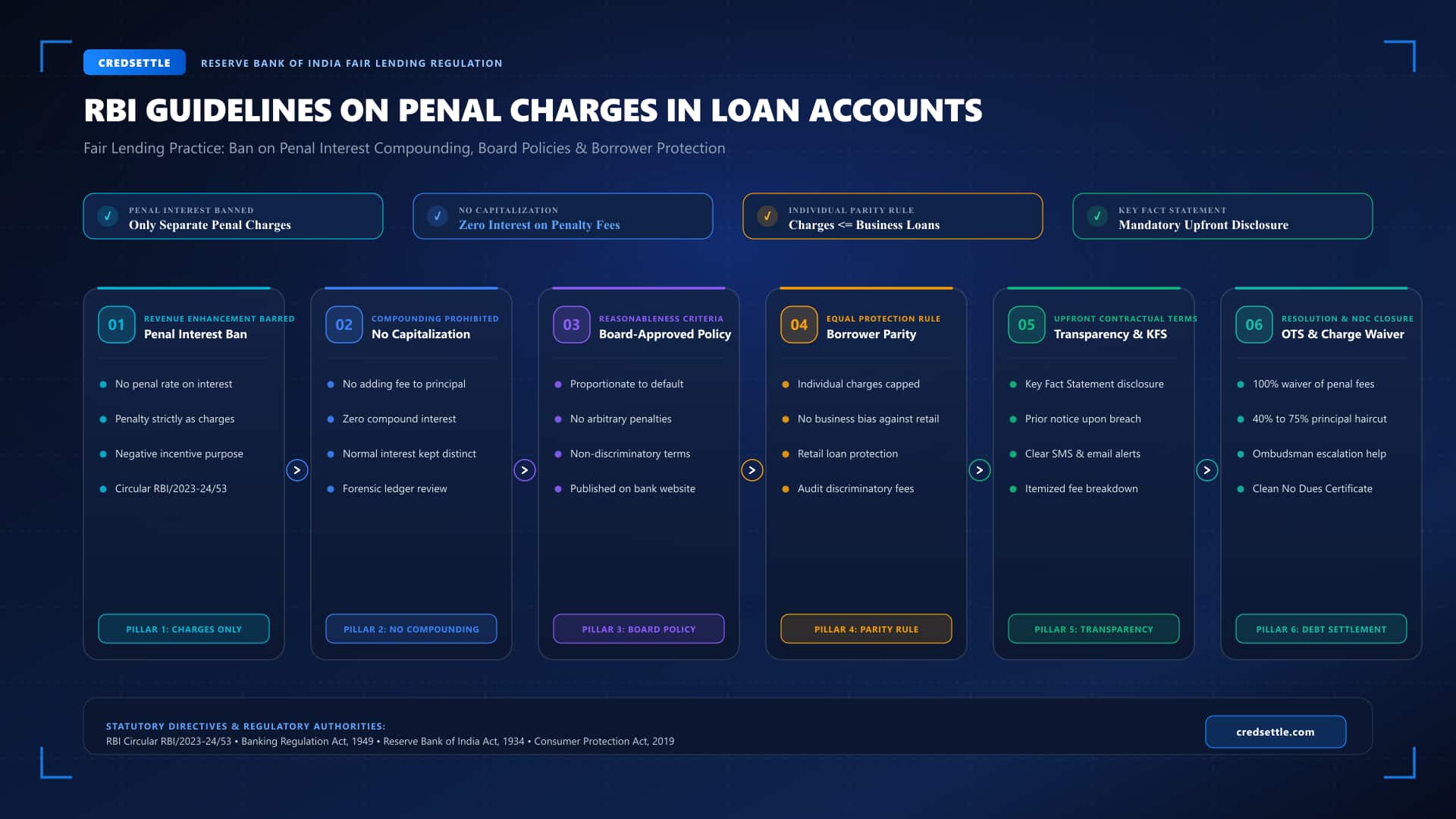
5. Visual Blueprint: RBI Fair Lending Framework
This comprehensive infographic visualizes the six regulatory pillars enacted by the Reserve Bank of India, detailing the operational shifts from predatory penal interest to transparent, board-governed penal charges.
6. Step-by-Step SOP: Audit & Waive Penal Charges
If your bank or NBFC has levied inflated interest, compound charges, or arbitrary default penalties on your loan account, execute this six-stage legal resolution protocol to reclaim your rights and achieve a debt-free resolution.
1Stage 1: Procure Certified Statement of Account (SOA)
Request a complete, certified loan statement from the date of loan disbursement to the present. Ensure the statement itemizes all debits, specifically separating principal repayments, regular contracted interest, penal interest, and incidental fees.
2Stage 2: Conduct Forensic Accounting Ledger Audit
Audit the ledger against RBI Circular RBI/2023-24/53. Identify whether penal interest was capitalized into the principal balance post-April 2024, whether interest was charged on penalties, and whether individual borrower parity rules were breached.
3Stage 3: Issue Formal Regulatory Dispute Notice
Through legal counsel, dispatch a formal demand notice to the bank Grievance Redressal Officer (GRO) and Nodal Desk. Demand immediate de-capitalization of unlawful charges and a re-calculation of the true outstanding principal.
4Stage 4: Escalate to the RBI Integrated Ombudsman
If the lender fails to resolve the unauthorized ledger entries within 30 days, file an official grievance through the RBI Complaint Management System (CMS) at cms.rbi.org.in, invoking regulatory penalties against the bank.
5Stage 5: Propose One-Time Settlement (OTS) with Full Waiver
With regulatory leverage established, initiate structured compromise negotiations directly with the bank Stressed Asset Resolution Branch (SARB). Demand 100% waiver of all penal fees and a 40% to 75% haircut on the core principal balance.
6Stage 6: Settlement Sanction & No Dues Certificate
Vet the formal settlement sanction letter to confirm that all penal claims are irrevocably extinguished. Remit the agreed settlement funds directly into your loan account and secure your clean No Dues Certificate within 30 days.
7. Key Fact Statement & Transparency Directives
The Reserve Bank of India has mandated complete contractual transparency so that borrowers are never surprised by hidden charges or ambiguous penalty clauses upon loan default.
Lenders must disclose the exact quantum and specific calculation formula of penal charges in the standard Key Fact Statement provided to borrowers before signing the loan contract.
Whenever an EMI payment reminder is issued via SMS, WhatsApp, or formal letter, the lender must clearly communicate the exact applicable penal charge and the factual basis of the levy.
Every commercial bank, cooperative bank, and NBFC must display its comprehensive penal charges schedule under the Interest Rates and Service Charges portal on its official website.
The Most Important Terms and Conditions (MITC) must include clear examples showing how penal charges are computed, explicitly confirming that no interest will be applied to penal fees.
8. 3-Tier Escalation Matrix: RBI Redressal Steps
If your lender continues to levy unauthorized compound penal interest, fails to transition an existing loan by June 2024, or refuses to provide an itemized fee statement, utilize the Reserve Bank institutional grievance redressal mechanism.
| Grievance Tier | Designated Banking Authority | Turnaround Time | Scope of Intervention & Relief |
|---|---|---|---|
| Level 1: GRO | Bank Grievance Redressal Officer | 7 to 10 Working Days | Reviews statement of account, identifies unauthorized compounding, and freezes disputed penal debits. |
| Level 2: PNO | Principal Nodal Officer (Head Office) | 14 to 21 Working Days | Enforces institutional compliance with circular RBI/2023-24/53, reverses illegal charges, and evaluates OTS. |
| Level 3: RBI Ombudsman | Reserve Bank Integrated Ombudsman | 30 Days Post-PNO | Issues binding statutory award via cms.rbi.org.in, mandates ledger rectification, and awards compensation. |
9. Procedural Timeline: Default to Charge Waiver
Understanding the delinquency lifecycle of your loan enables you to monitor when penal charges are recorded and leverage regulatory non-compliance during compromise negotiations.
| Delinquency Window | Asset Classification | Penal Charge Behavior | Strategic Action Required |
|---|---|---|---|
| Day 1 to 30 | SMA-0 | Fixed penal charge recorded; zero interest compounded. | Review reminder notice to ensure fee matches KFS schedule. |
| Day 31 to 60 | SMA-1 | Second default fee recorded in separate non-interest ledger. | Ensure bank has not added unpaid fees to loan principal. |
| Day 61 to 90 | SMA-2 | Pre-NPA notice dispatched with itemized overdue breakdown. | Demand audit if cumulative penalty exceeds approved policy. |
| Day 91 to 120 | NPA Tagging | Account marked NPA; income recognition suspended. | Regular interest stops accruing; conduct forensic ledger audit. |
| Day 121 to 180 | Prime OTS Window | Lender open to full waiver of uncollected penal charges. | Execute structured 50% to 75% OTS with CredSettle. |
| Month 6 and Beyond | Recovery / ARC | Debt assigned or referred to legal recovery committee. | Enforce NDC closure and obtain CIBIL record update. |
10. Product Exceptions: Credit Cards & Business
While the RBI guidelines apply broadly to commercial banks, NBFCs, and cooperative banks, borrowers must be aware of specific product exemptions and specialized loan categories.
Credit Card Accounts Excluded
Paragraph 2 of the circular explicitly states that instructions on penal charges do not apply to credit cards. Credit cards remain governed by the Master Direction on Credit Card and Debit Card Issuance and Conduct Directions, 2022. However, credit card dues can still be settled via OTS.
Business Loans & Overdraft Facilities
Commercial loans, MSME credit, and working capital overdrafts fall strictly within the penal charges circular. Lenders cannot charge penal interest on stock statement delays or technical covenant defaults.
Housing & Vehicle Loan Parity
Home loans and auto loans availed by individuals enjoy full parity protection. NBFC housing finance companies (HFCs) cannot charge higher penal rates on retail mortgage defaults than corporate project finance loans.
Pre-April 2024 Transition Rules
For loan accounts running prior to April 1, 2024, lenders were given until June 30, 2024, to switch over. Any capitalization of penal charges continuing after June 30 constitutes a direct regulatory breach.
 Legal Debt Dispute Authority
CredSettle (credsettle.com) is India's premier debt settlement, loan dispute resolution, and legal protection platform. Operating strictly under the RBI Fair Practices Code and CICRA 2005, our advocate panel negotiates directly with Bank Principal Nodal Officers to eliminate waived differentials, obtain unconditional No Dues Certificates (NDC), and upgrade credit bureau records from "Settled" to "Closed".
Frequently Asked Questions: RBI Penal Charges Rules
Clear, verified legal guidance addressing critical questions regarding penal charges, compounding prohibitions, borrower parity rights, and loan settlement procedures under Indian banking law.
Official Regulatory Citations & Statutory Directives
- RBI Circular RBI/2023-24/53 (DoR.MCS.REC.28/01.01.001/2023-24): Fair Lending Practice - Penal Charges in Loan Accounts, issued August 18, 2023.
- RBI Circular RBI/2023-24/102 (DoR.MCS.REC.61/01.01.001/2023-24): Fair Lending Practice - Penal Charges in Loan Accounts Extension of Timeline, issued December 29, 2023.
- Banking Regulation Act, 1949: Section 21 and Section 35A, Statutory Powers of the Reserve Bank to Control Advances and Issue Public Interest Directions.
- Reserve Bank of India Act, 1934: Section 45JA, 45L, and 45M, Regulatory Powers Over Non-Banking Financial Companies.
- Consumer Protection Act, 2019: Section 2(47), Unfair Trade Practices Arising from Compounding Penal Interest and Concealed Charges.