Settling International & Forex Credit Card Bills in India
Understand how FEMA, LRS limits, and 20% TCS rules apply to foreign credit card swipes. Stop false airport arrest threats, check 3.5% forex fees, and settle INR card dues legally under RBI rules.
- Civil INR Debt, Not a FEMA Crime: Missing an Indian credit card bill for lawful travel, study, or online buys is a civil rupee default. It does not bring ED raids or criminal FEMA arrest.
- 0% TCS on Credit Cards vs 20% on Forex Cards: Under the June 2023 Ministry of Finance update, overseas credit card spends stay outside LRS and carry 0% TCS. Prepaid forex cards face 20% TCS above ₹10 Lakh per year.
- Frozen in Indian Rupees: Your bank pays the foreign store right away and bills you in INR. Later jumps in the US Dollar or Euro do not raise your billed principal.
- Zero Passport or Airport Block: Card banks cannot cancel your passport or stop you at airport checks for routine unsecured credit card dues.
- Eligible for RBI One-Time Settlement: Once your INR card bill hits 90 days past due (NPA), you can settle the full debt with deep waivers on 3.5% markup fees and 42% card interest.
1. How International Credit Card Bills Settle in INR
Many card users panic when they miss a credit card bill with USD, EUR, AED, or GBP charges. Recovery agents often scare borrowers by claiming a foreign government or bank will sue them. That claim is completely false.
When you swipe an Indian credit card abroad or on a foreign site, the overseas shop gets paid within days. Visa, Mastercard, or Amex clears the payment using your Indian bank's Authorised Dealer (AD) desk.
Your Indian bank then converts that foreign sum into Indian Rupees (INR) on the posting date. It adds its forex markup fee plus 18% GST and puts the final rupee figure on your monthly statement.
From that day forward, no foreign store is waiting for your money. Your unpaid bill is a regular, unsecured rupee debt owed only to your Indian bank. Even better, later dollar rate hikes do not change your billed rupee amount. You can read more in our credit card settlement process guide.
2. FEMA Rules, LRS Limits & 20% TCS on Overseas Spends
Foreign spending by Indian residents falls under the Foreign Exchange Management Act, 1999 (FEMA). Under the RBI Liberalised Remittance Scheme (LRS), you can spend up to USD 2,50,000 per year abroad for allowed uses.
For years, Rule 7 of the FEMA Current Account Rules kept foreign credit card swipes outside LRS limits. On May 16, 2023, the government removed Rule 7. That move aimed to bring credit cards under LRS and charge 20% Tax Collected at Source (TCS).
Soon after, on June 28, 2023, the Ministry of Finance and CBDT paused this change until further orders. Thanks to this pause, overseas credit card spends still carry 0% TCS under Section 206C(1G) of the Income Tax Act.
Prepaid forex cards, debit cards, and wire transfers follow stricter rules. They count toward your annual LRS cap. They also face 20% TCS once total LRS spends cross ₹10 Lakh in a year. Even if TCS is deducted, you can claim 100% of it back via Form 26AS in your tax return.
| Rule Feature | International Credit Card | Prepaid Travel Forex Card | International Debit Card |
|---|---|---|---|
| LRS $250,000 Tracking | Paused until further orders | Counted under annual LRS cap | Counted under annual LRS cap |
| Section 206C(1G) TCS | 0% TCS on foreign swipes | 20% TCS above ₹10 Lakh/year | 20% TCS above ₹10 Lakh/year |
| Default Risk Type | Unsecured INR revolving bill | Offline negative balance only | Direct savings account debit |
| RBI OTS Eligibility | Full INR OTS after 90 DPD | Shortfall settlement if negative | Not a credit product |
3. Civil Card Default vs Prohibited FEMA Violations
Every borrower must separate two very different issues: what you bought with the card, and whether you could pay the bill on time. Indian law treats these two matters in totally separate ways.
Suppose you used your card for flights, hotels, hospital bills, college fees, cloud tools, or legal shopping. If job loss or illness later stops you from paying the INR bill, there is zero FEMA breach. Under Indian law, non-payment of a lawful card bill is a pure civil breach of contract. Learn why you cannot go to jail for credit card debt.
FEMA trouble starts only when a resident swipes an Indian card for banned uses listed in Schedule I of the Current Account Rules or RBI alerts. Even if you pay your credit card bill on time, these banned foreign spends still break FEMA:
- Unapproved Forex Margin Apps: Funding foreign CFD or forex trading apps not listed on Indian stock exchanges (NSE, BSE, MSEI).
- Online Casinos & Betting: Using Indian cards on offshore gambling sites, sportsbooks, poker rooms, or sweepstakes.
- Foreign Lottery Tickets: Buying overseas lottery tickets or banned publications in foreign currency.
- Offshore Margin Crypto Trades: Sending leveraged margin funds to unapproved foreign portals outside LRS rules.
Under Section 13(1) of FEMA, 1999, banned foreign spends can bring a civil fine of up to three times (3x) the sum spent. Banks also watch Merchant Category Codes (MCCs) and block cards used on betting or forex sites right away.
4. Forex Markup, DCC Trap & 42% APR Inflation Math
Foreign credit card bills grow much faster than local rupee spends. Three stacked cost layers push borrowers into a deep debt trap within months.
First, most Indian cards add a 3.5% forex markup fee on every foreign charge, plus 18% GST on that fee. That adds 4.13% upfront to your bill.
Second, watch out if a foreign card machine asks to bill you in INR instead of USD or EUR. Picking INR starts Dynamic Currency Conversion (DCC). Foreign stores bake in a bad 4% to 7% rate spread. Indian banks then add an extra 1% DCC fee plus GST.
Third, missing full payment ends your interest-free grace window. Banks charge 36% to 45% annual interest (3% to 3.75% per month) plus 18% GST. Still, under the RBI Credit Card Master Direction 2022 (updated March 2024), banks cannot add over-limit fees without prior consent. They also cannot charge interest on unpaid late fees and taxes.
| Billing Component | Rate / Rule Applied | Dispute or OTS Status | Amount in INR |
|---|---|---|---|
| Base Overseas Spend ($3,000) | Network Rate @ ₹85 | Core Principal Spend | ₹2,55,000 |
| 3.5% Forex Markup + 18% GST | 4.13% Effective Fee | Negotiable in OTS | + ₹10,532 |
| 6 Months Revolving APR (42%) | 3.5% Monthly Rate | Targeted for 100% Waiver | + ₹60,650 |
| Late Fees & 18% GST on Interest | 6 Billing Cycles | Targeted for 100% Waiver | + ₹18,120 |
| Total Inflated Bank Demand | Post-NPA Bill | 35% Above Base Swipe | ₹3,44,302 |
| Typical RBI OTS Resolution | Hardship Compromise | Full Closure + Written NOC | ₹1,35,000 to ₹1,70,000 |
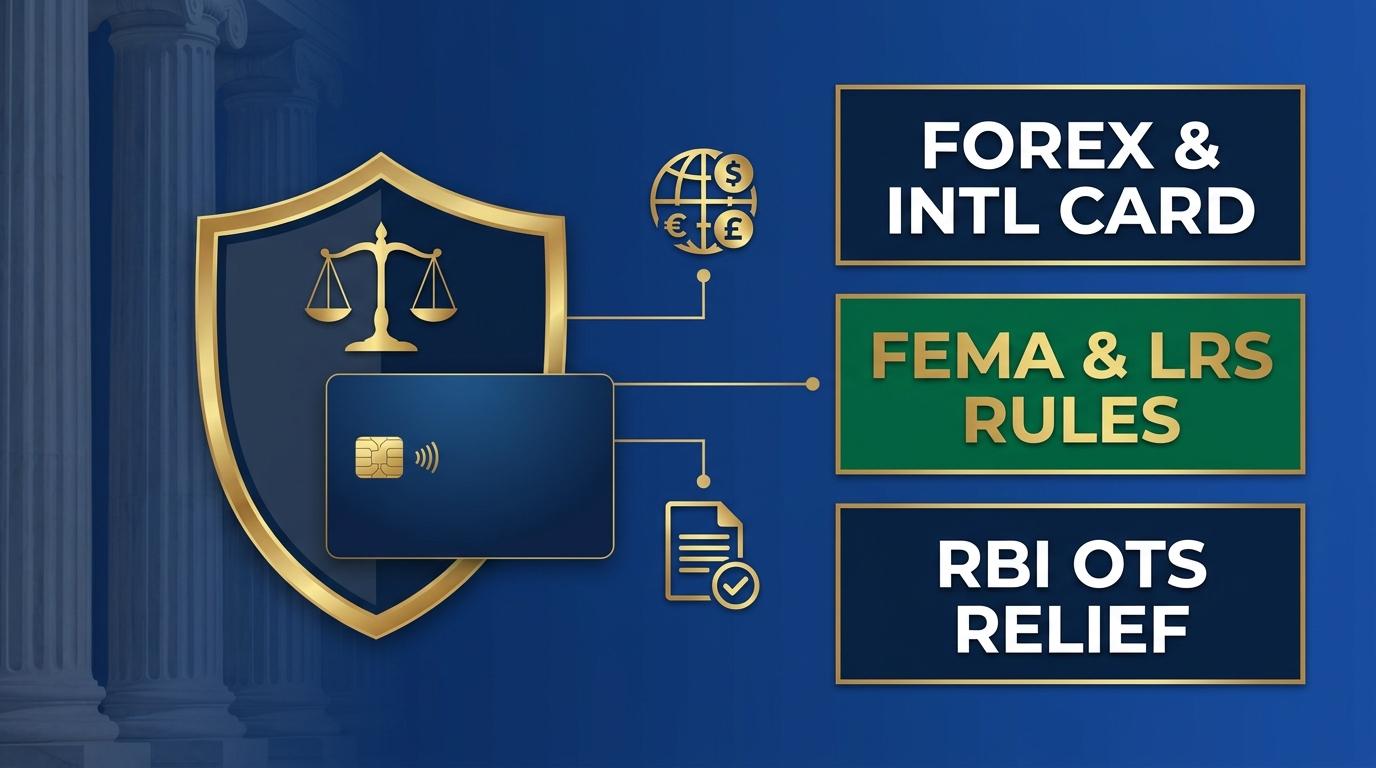
5. Visual Blueprint: Forex Card Debt & FEMA Shield
This visual chart shows how foreign card swipes turn into domestic INR bills, how FEMA and LRS rules work, and how RBI One-Time Settlement clears overdue debt.
6. Step-by-Step SOP: Settling Foreign Swipe Card Debt
If foreign travel, overseas medical care, or business ad spends left you with an unpaid credit card bill, follow these six steps to resolve the debt safely.
1Stage 1: Turn Off International & Recurring Card Controls
Open your bank app and switch off international online and POS controls under RBI card rules. Cancel foreign auto-debits and SaaS trials so new dollar charges stop hitting your bill.
2Stage 2: Audit Foreign Charges, DCC & Unlawful Fees
Check every foreign line item on your INR statement. Flag unknown swipes for chargeback right away, and challenge any unconsented over-limit fees or interest charged on late fees.
3Stage 3: Confirm Lawful Purpose & Stop Minimum Due Traps
Keep travel tickets, medical bills, or software invoices as proof of lawful FEMA current account use. Stop paying the 5% Minimum Amount Due, which only feeds 42% interest without cutting principal.
4Stage 4: Shut Down False FEMA & Airport Threats
If recovery callers threaten ED raids, Interpol notices, or passport blocks, save the call recordings or texts. Report these illegal threats to the bank Grievance Officer under RBI Fair Practices rules.
5Stage 5: Negotiate INR One-Time Settlement Post-NPA
Once the card crosses 90 days past due, submit a formal hardship file under RBI Circular RBI/2023-24/40. Push for a 100% waiver of 42% APR, late fees, and markup charges.
6Stage 6: Verify Written OTS Letter & Collect Final NOC
Pay only after verifying an official bank OTS sanction letter from a real bank email domain. After paying, collect your No Dues Certificate (NOC) and verify CIBIL updates within 30 days.
7. Court Rulings: Airport LOC, Passport & Card APR Law
Frequent flyers and NRI workers often fear that an unpaid credit card bill will get them stopped at airport immigration. Indian courts have drawn firm legal shields protecting borrowers' right to travel. See our full guide on passport renewal and LOC rules for loan default.
The Bombay High Court held that letting bank heads issue Look Out Circulars (LOCs) for civil defaults violates Article 21 liberty. Even during Supreme Court review, routine credit card dues never qualify for airport LOCs.
Delhi High Court benches have repeatedly held that LOCs exist only for serious cognizable crimes where an accused flees arrest. An LOC cannot be used as a debt recovery tool for unpaid bank bills.
The Supreme Court ruled that consumer courts cannot cap 36% to 49% credit card APR disclosed in card terms. Thus, negotiating a bank OTS is far more effective than fighting card APR in consumer court.
Only a Passport Authority acting on a criminal court warrant or security order can impound a passport. Private and public banks have zero power to block passport renewal or visa stamping.
8. 3-Tier Escalation Matrix: Bank GRO to RBI Ombudsman
If your bank adds unconsented over-limit fees, ignores a valid foreign chargeback, or lets agents make fake FEMA threats, escalate through this three-tier RBI channel.
| Escalation Tier | Designated Authority | Turnaround Time | Relief & Action Scope |
|---|---|---|---|
| Level 1: GRO | Card Grievance Redressal Officer | 7 to 10 Working Days | Logs foreign chargeback, reverses unconsented over-limit fees, and halts agent threats. |
| Level 2: PNO | Principal Nodal Officer (Head Office) | 14 to 21 Working Days | Reviews RBI Master Direction breaches and approves hardship INR OTS waivers. |
| Level 3: RBI Ombudsman | RBI Integrated Ombudsman (CMS) | 30 Days Post-GRO | Orders fee refunds and compensation via cms.rbi.org.in for unfair recovery or billing defects. |
9. Default Timeline: Foreign Swipe to OTS Closure
Tracking each stage from your foreign card swipe to final settlement helps you protect your rights and avoid panic payments.
| Timeline Stage | Account Status | Bank System Action | Smart Borrower Step |
|---|---|---|---|
| Swipe + 2 Days | INR Settlement | Converts foreign spend to INR and adds 3.5% markup + 18% GST. | Check exchange rate and raise chargeback fast if unauthorized. |
| 1 to 30 DPD | SMA-0 Stage | Ends interest-free period; adds late fee and 42% annual APR. | Disable international card toggle and stop recurring USD subscriptions. |
| 31 to 89 DPD | SMA-1 / SMA-2 | Blocks card; sends 7-day prior notice before bureau default report. | Keep salary in a separate non-lender bank to avoid auto set-off. |
| Day 90+ DPD | NPA Classification | Marks card as Non-Performing Asset and moves file to recovery desk. | Submit formal hardship OTS offer in INR under RBI rules. |
| 120 to 180+ DPD | OTS Closure Window | Issues written OTS sanction waiving penal APR and fee layers. | Pay settled INR sum, collect NOC, and track CIBIL update. |
10. Prepaid Forex Cards, NRI Dues & Chargeback Rules
Cross-border card troubles often involve prepaid travel cards, returning NRIs, or overseas fraud. Here is how Indian banking law handles each case.
Prepaid Travel Card Negative Balance
In-flight POS terminals, highway tolls, or delayed hotel bills can push a prepaid forex card below zero. Banks convert this negative balance to INR and can exercise lien rights on linked savings accounts if ignored.
Returning NRIs With Foreign Bank Cards
Cards issued by US, UK, or UAE banks do not report directly to Indian CIBIL files. Foreign lenders must follow strict Section 13 and Section 44A CPC court steps in India to enforce any foreign decree. Read our NRI unpaid debt guide.
Overseas Skimming & Zero Liability Rule
Foreign magnetic-stripe or card-not-present swipes often skip OTP checks. Under the July 2017 RBI Zero Liability circular, reporting unauthorized foreign fraud within 3 working days protects you from loss.
Foreign Ad Spends on Personal Cards
Freelancers and founders often run Meta, Google, or AWS dollar ads on personal cards. Banks may block the card for commercial use and recall the full INR balance, which can then be settled via OTS.
 Legal Debt Dispute Authority
CredSettle (credsettle.com) is India's premier debt settlement, loan dispute resolution, and legal protection platform. Operating strictly under the RBI Fair Practices Code and CICRA 2005, our advocate panel negotiates directly with Bank Principal Nodal Officers to eliminate waived differentials, obtain unconditional No Dues Certificates (NDC), and upgrade credit bureau records from "Settled" to "Closed".
Frequently Asked Questions: Forex Card Debt & FEMA
Clear, verified answers on international credit card defaults, FEMA rules, 20% TCS exemptions, airport travel rights, and INR debt settlement in India.
Official RBI, FEMA & Income Tax Statutory Citations
- Foreign Exchange Management Act, 1999 (FEMA): Section 5 (Current Account Transactions), Section 13 (Penalties for Contravention), and Foreign Exchange Management (Current Account Transactions) Rules, 2000 (Schedule I & Rule 7 Omission Notification G.S.R. 369(E), May 16, 2023).
- Ministry of Finance & CBDT Clarification (June 28, 2023) & Section 206C(1G), Income Tax Act, 1961: Postponement of LRS classification and TCS on overseas International Credit Card spends; ₹10 Lakh annual TCS exemption threshold on LRS remittances.
- RBI Master Direction - Credit Card and Debit Card - Issuance and Conduct Directions, 2022 (Updated March 7, 2024): Default opt-out for international usage, explicit consent for over-limit fees, ban on capitalizing penal charges, and 7-day default reporting notice.
- RBI Circular on Compromise Settlements and Technical Write-offs: RBI/2023-24/40, DoR.STR.REC.20/21.04.048/2023-24 (dated June 8, 2023).
- Supreme Court & High Court Precedents: Hongkong and Shanghai Banking Corp. Ltd. v. Awaz & Ors. (Supreme Court, Dec 20, 2024); Viraj Chetan Shah v. Union of India (Bombay High Court, April 23, 2024); Sumer Singh Salkan v. Asstt. Director (Delhi High Court, 2010).