Claim Refund for Unauthorized Credit Card Overlimit Fees
Reserve Bank of India rules ban banks from letting your card cross its credit limit or charging overlimit fees without your clear prior consent. Learn how to claim a 100% fee and GST refund, fix your CIBIL score, and exit unfair card debt.
- No Consent Means Zero Fee: Under RBI Master Directions, banks cannot let your card cross its approved limit or charge an overlimit fee unless you gave clear prior consent.
- Interest & Late Fees Excluded: Banks cannot count monthly finance charges, late fees, or GST to push your balance past your limit and slap an overlimit fine.
- Mandatory ON/OFF Toggle: Since March 2024, every card issuer must give you a live toggle inside its mobile app and net banking to turn overlimit use off anytime.
- 100% Fee, GST & Interest Reversal: If charged without valid opt-in proof, the bank must refund the full overlimit fee, 18% GST, and any interest added on top of it.
- Ombudsman & OTS Protection: If the bank refuses a refund within 30 days, escalate to the RBI Ombudsman for free, or settle maxed-out NPA dues via official OTS.
1. RBI Master Direction: Prior Explicit Consent Mandate
For years, credit card users in India faced an unfair bill shock. You would swipe your card near its spending cap, expecting any extra amount to fail. Instead, the bank let the swipe go through and added a ₹600 fine to your next bill.
To stop this trap, the Reserve Bank of India issued the Credit Card and Debit Card Directions, 2022 (Circular DoR.AUT.REC.No.27/24.01.041/2022-23). These strict rules cover every bank and card issuer in India, such as SBI Card, HDFC, ICICI, Axis, and Kotak.
Under Paragraph 6(b)(v) of the RBI Master Direction, a bank cannot let your card cross its set limit without your prior clear consent. Simply put, overlimit use must stay OFF by default when you get a new card.
If you never opted in, the bank must decline any swipe that goes past your limit. If the bank still lets the charge pass without your clear nod, it cannot bill you one rupee as an overlimit fee.
2. Interest & Fee Exclusion: Illegal Overlimit Triggers
The worst abuse happens when you stop swiping your card, yet overlimit fines keep showing up each month. This hits people stuck in the credit card minimum due trap or facing a cash crunch.
Take a real example. Say your card limit is ₹1,00,000 and you spent ₹97,000 on care bills. You stayed ₹3,000 under your limit. On the due date, you miss full payment, so the bank adds ₹3,600 in interest and a ₹1,100 late fee.
Your total bill now sits at ₹1,01,700. Many banks used to call that an overlimit breach and slap a ₹600 fine plus 18% GST each month. RBI Master Direction FAQs now ban this trick across India.
RBI rules say interest, late fees, GST, and bank charges must never count toward an overlimit breach. Only your own approved spending past the limit can bring an overlimit fee. Every fine caused by bank interest or late fees must be paid back in full.
3. March 2024 RBI Rules: App & Net-Banking Toggle Rights
On March 7, 2024, the RBI made card rules even stronger via Circular DoR.RAUG.AUT.REC.No.81/24.01.041/2023-24. Earlier, sales callers pushed users to say yes once on a phone call. Banks then gave no easy way to turn the feature back off.
Under the March 2024 rule, every card issuer must give you a live ON or OFF switch inside its mobile app and net banking site. It sits right next to the switches for online or foreign swipes.
You can turn overlimit use off in seconds without calling care desks or visiting a branch. Once that switch is OFF, any fee billed for crossing your limit breaks RBI law.
The 2024 update also shields part-payers. Banks can charge interest only on the unpaid balance left after taking out your part-payments, refunds, and fee reversals.
4. Bank Overlimit Fee Math, 18% GST & Minimum Due Trap
An unauthorized overlimit fee hurts your wallet in three ways at once. First, banks charge 2.5% of the overlimit sum with a minimum floor of ₹500 to ₹600. Even crossing your limit by ₹50 triggers the full ₹500 or ₹600 fine plus 18% GST.
Second, banks add the entire overlimit sum plus the fee straight into your Minimum Amount Due (MAD). If you cannot pay that sudden jump in MAD, the bank slaps a late payment fine and reports Days Past Due (DPD) to CIBIL. Check typical bank charges below.
| Card Issuer | Standard MITC Fee | Min Bill Hit (With GST) | Fee Owed Without Explicit Consent |
|---|---|---|---|
| SBI Card | 2.5% of overlimit (Min ₹600) | ₹708 per cycle | ₹0 (100% Refundable) |
| HDFC Bank | 2.5% of overlimit (Min ₹550) | ₹649 per cycle | ₹0 (100% Refundable) |
| ICICI Bank | 2.5% of overlimit (Min ₹500) | ₹590 per cycle | ₹0 (100% Refundable) |
| Axis & Kotak Bank | 2.5% of overlimit (Min ₹500) | ₹590 per cycle | ₹0 (100% Refundable) |
| Interest / Late Fee Breach | Balance crossed limit via bank fees | Illegal across all banks | Full Fee + GST + Interest Reversal |
5. Visual Blueprint: Overlimit Consent & Refund Rules
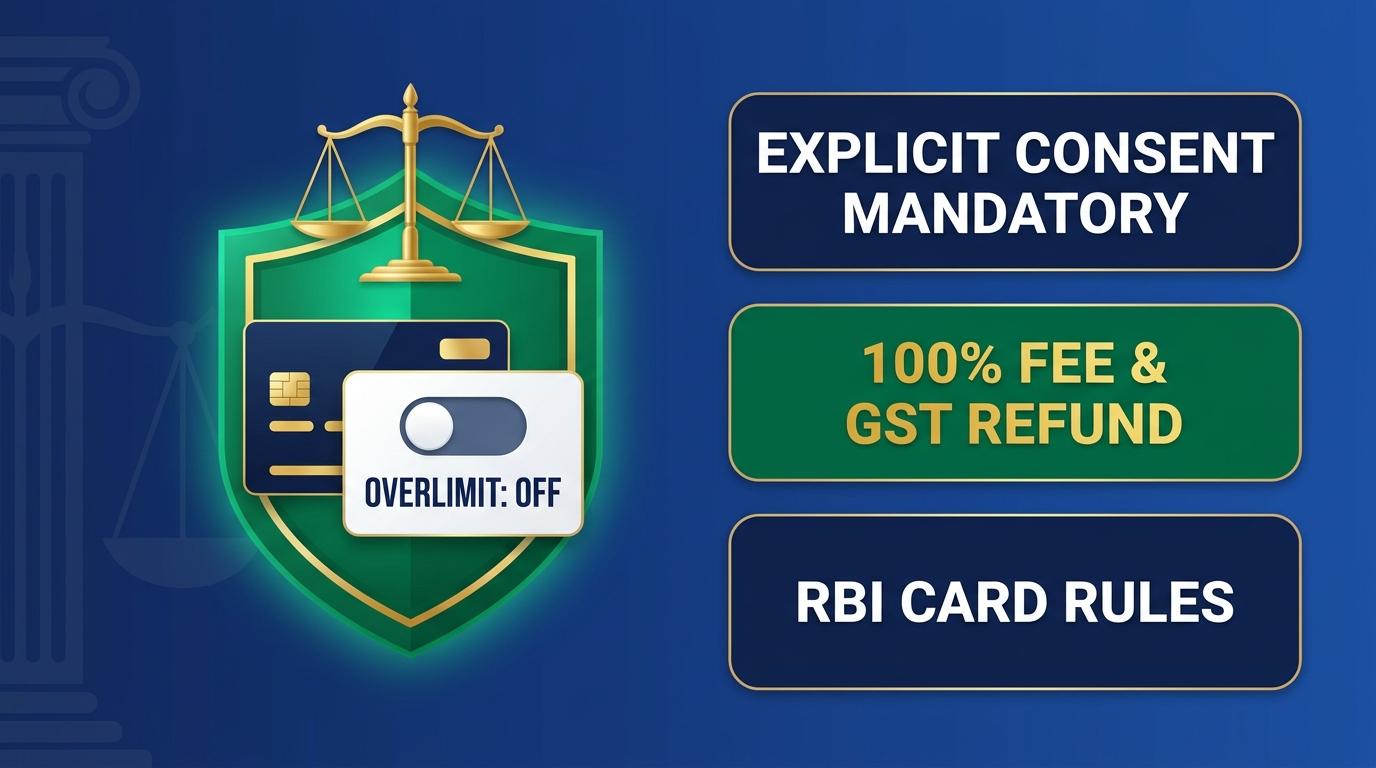
This visual guide summarizes how the RBI explicit consent shield works. Use it to verify whether an overlimit charge on your monthly statement is legal or eligible for a full reversal.
6. Valid Opt-In vs Illegal Overlimit Charges Compared
Customer care teams often claim that you agreed to overlimit charges when you first applied for the card. That excuse fails under RBI audits. Check this table to see if your bank has valid proof of consent.
| Billing Scenario | Does It Count as RBI Consent? | Your Legal Refund Right |
|---|---|---|
| Fine print in initial card form | No (Bundled boilerplate is invalid) | Demand 100% refund of fee and 18% GST |
| Pre-ticked checkbox on portal | No (Dark pattern, not active opt-in) | Demand full reversal and consent audit log |
| Interest or late fee crossed limit | No (Banned even if toggle was ON) | Mandatory refund of every monthly fine |
| Bank slashed limit below balance | No (User did not swipe over limit) | Zero overlimit fee allowed after limit cut |
| User turned toggle ON via OTP/App | Yes (Valid for retail swipes only) | Valid once per cycle; switch OFF in app now |
7. Supreme Court & Consumer Rulings on Card Charges
Indian courts and regulatory forums draw a sharp line between disclosed interest rates and unauthorized penalty fees. When a bank breaks an explicit RBI rule, strong legal remedies back the cardholder.
The Supreme Court held that RBI has exclusive power under the Banking Regulation Act, 1949 to regulate credit cards. While courts do not cap MITC interest rates, every RBI Master Direction rule on consent is binding law under Section 35A.
Charging unconsented card fees is a Deficiency in Service under Section 2(11) and an Unfair Trade Practice under Section 2(47). District Commissions order full refunds plus harassment damages via E-Jagriti.
Under RBI Circular DoR.FIN.REC.49, if a wrong overlimit fee harmed your CIBIL report and the bank fails to fix it within 30 days of complaint, you earn ₹100 per day.
The RBI Ombudsman orders banks and NBFC card issuers to reverse unauthorized overlimit fees, GST, and compounding interest for free, and can award up to ₹1 Lakh for mental agony.
8. Step-by-Step SOP: Claim Full Overlimit Fee Refund
Do not rely on a phone call alone. Care agents often reverse just one month while keeping older fines. Follow these six steps to get every rupee back.
1Stage 1: Check and Screenshot Your Card App Toggle
Open your card app or net banking page and save a screenshot of the Overlimit switch. If it is ON without your nod, turn it OFF right now and save the alert.
2Stage 2: Audit Past Statements for Fee & Interest Triggers
Download your past 12 to 24 monthly bills. List each Overlimit Fee and its 18% GST. Mark every month where bank interest or late fees pushed your balance past the limit.
3Stage 3: Demand Digital Consent Proof From Bank GRO
Email the Bank Grievance Officer citing RBI Master Direction DoR.AUT.REC.No.27/24.01.041/2022-23. Ask the bank to show dated OTP or call proof, or refund all fees, GST, and extra interest.
4Stage 4: Pay Undisputed Dues to Prevent Fresh Interest
If your card is still active, pay your real spending amount while you dispute the wrong fee in writing. Check your interest math with our credit card interest calculator.
5Stage 5: Escalate to Principal Nodal Officer & RBI CMS
If the bank says no or fails to reply within 30 days, file a free case on cms.rbi.org.in. Upload your card bills, email trail, and app screenshots.
6Stage 6: Verify CIBIL Rectification or Close via OTS
Make sure the bank clears any late mark caused by the wrong fee across all four bureaus. If your debt is too big to pay, start a legal credit card settlement after cutting out unfair fines.
9. 3-Tier Escalation Matrix: Bank GRO to RBI Ombudsman
Follow this exact institutional chain so your complaint is never rejected on technical grounds for skipping internal bank grievance desks.
| Escalation Tier | Designated Authority | Response Window | Relief & Enforcement Power |
|---|---|---|---|
| Level 1: GRO | Card Grievance Redressal Officer | 7 to 10 Working Days | Logs service ticket, checks opt-in trail, and reverses recent cycle fees. |
| Level 2: PNO | Principal Nodal Officer (Head Office) | Up to Day 30 Total | Audits historical ledger, refunds multi-month fees + 18% GST, fixes CIBIL. |
| Level 3: RBI CMS | RBI Integrated Ombudsman (cms.rbi.org.in) | After Day 30 or Rejection | Orders binding fee, GST, and interest refund plus up to ₹1 Lakh harassment award. |
10. Deadlines & Timelines: Fee Reversal to CIBIL Fix
Every RBI remedy runs on strict statutory clocks. Track these dates carefully from the day you spot an unauthorized overlimit charge on your bill.
| Timeline Window | Regulatory Stage | Bank Legal Duty | Cardholder Action |
|---|---|---|---|
| Within 30 Days of Bill | Billing Dispute | Must explain charge with documentary proof within 30 days under Master Direction. | Turn off app toggle and email written dispute to bank GRO. |
| Day 15 (Fortnightly) | Bureau Sync | Must push updated card balance and status to credit bureaus every 15 days. | Monitor CIBIL utilization drop once overlimit fees are credited back. |
| Day 31 Post-Complaint | Statutory Breach | Unresolved CIBIL dispute triggers ₹100/day fine; Ombudsman window opens. | Lodge online case on cms.rbi.org.in within 1 year of bank reply/30-day lapse. |
| Day 90+ Overdue | NPA & OTS Stage | Classifies unpaid card as NPA; stops unapplied interest accrual in suspense ledger. | Strip out illegal fees and negotiate lump-sum OTS with NOC. |
11. Common Mistakes & OTS Relief for Overlimit Debt
Watch out for subtle bank app prompts and settlement traps when clearing an over-utilized credit card account.
Clicking Pop-Up OTPs During Checkout
Some bank apps flash a quick prompt asking to "Enable Overlimit to Complete Payment." Clicking that OTP turns the switch ON permanently for future cycles until you manually turn it off again.
Accepting Partial Fee Waivers Without GST
Phone agents often reverse ₹600 as a courtesy while keeping the ₹108 GST and 42% annual interest charged on that fee. Always insist on a complete reversal of fee, tax, and cascading finance charges.
Stopping Recovery Harassment on Maxed Cards
Overlimit accounts get flagged to aggressive call desks first. Remember that RBI recovery rules strictly bar calls before 8 AM, after 7 PM, or to your family and workplace.
Using Fee Audits to Maximize OTS Waivers
When a ₹1 Lakh card balloons to ₹2.4 Lakh from 42% APR, late fines, and illegal overlimit fees, CredSettle challenges the unlawful charges first and negotiates a 50% to 75% OTS waiver under RBI rules.
 Legal Debt Dispute Authority
CredSettle (credsettle.com) is India's premier debt settlement, loan dispute resolution, and legal protection platform. Operating strictly under the RBI Fair Practices Code and CICRA 2005, our advocate panel negotiates directly with Bank Principal Nodal Officers to eliminate waived differentials, obtain unconditional No Dues Certificates (NDC), and upgrade credit bureau records from "Settled" to "Closed".
Frequently Asked Questions: Credit Card Overlimit Refunds
Clear, verified answers on RBI explicit consent rules, interest-triggered overlimit breaches, GST refunds, CIBIL repairs, and credit card settlement options.
Official RBI Circulars & Statutory Legal References
- RBI Master Direction (Credit Card and Debit Card - Issuance and Conduct Directions, 2022): RBI/2022-23/92, DoR.AUT.REC.No.27/24.01.041/2022-23, Paragraph 6(b)(v) on Prior Explicit Consent for Credit Limit Breach.
- RBI 2024 Amendment & Official FAQs (March 7, 2024): RBI/2023-24/132, DoR.RAUG.AUT.REC.No.81/24.01.041/2023-24 on Overlimit Digital Toggle Controls and Exclusion of Interest/Charges from Overlimit Calculation.
- Reserve Bank - Integrated Ombudsman Scheme, 2021: Clause 14 & 15 on Deficiency in Service Reversals and Compensation Awards.
- RBI Credit Information Compensation Circular: RBI/2023-24/72, DoR.FIN.REC.49/20.16.003/2023-24 (₹100 per calendar day compensation for delayed CIBIL rectification beyond 30 days).
- RBI Compromise Settlement Framework: RBI/2023-24/40, DOR.STR.REC.20/21.04.048/2023-24 on Board-Approved One-Time Settlement (OTS) of Stressed Credit Card Accounts.
- Supreme Court of India Precedent: The Hongkong and Shanghai Banking Corporation Ltd. (HSBC) v. Awaz Foundation & Ors., Civil Appeal No. 5273 of 2008 (Decided December 20, 2024) & Consumer Protection Act, 2019 (Sections 2(11) & 2(47)).