How to Recover Refunds Sent to a Closed Credit Card
Did a store send a refund to a credit card that is now blocked, closed, or settled? Your money is not lost. Learn how RBI NEFT rules, 23-digit ARN codes, and OTS laws get your cash back.
- Money Never Vanishes: Refunds sent to a blocked or closed card still reach your card bank. They land in your card ledger or the bank internal sundry pool.
- RBI Direct NEFT Rule: Under the RBI Credit Card Master Direction, banks must transfer any credit balance in a closed card directly to your savings account.
- 23-Digit ARN Proof: Ask the merchant for the 23-digit ARN (Visa or Mastercard) or 12-digit RRN (RuPay). Banks must trace this reference number.
- Overdue vs Settled Cards: On unpaid overdue cards, refunds cut your bill balance. On settled OTS cards, payout rights depend on whether you paid that bill earlier.
- Ombudsman Relief: If a bank holds your refund past 30 days, you can file a free claim on the RBI CMS portal at cms.rbi.org.in.
1. Why Merchants Send Refunds to Blocked or Closed Cards
Cardholders often panic when an airline, hotel, or shopping app sends a refund to a dead credit card. You may ask the store to pay your UPI ID or bank account instead. Almost every merchant will say no.
Merchants follow strict closed-loop rules set by Visa, Mastercard, RuPay, and payment gateways. Under anti-money laundering norms, a card purchase refund must go back to the exact original payment source.
If stores sent credit card refunds to savings accounts, users could turn credit limits into free cash. It would also let dishonest buyers take a bank transfer and still file a card chargeback later.
Here is the good news. Your 16-digit plastic card is only a key, not the whole bank ledger. Even when a card is hotlisted, expired, blocked, or closed, the payment network still delivers the money to your card bank.
2. RBI Master Direction: Closed Card NEFT Refund Mandate
The Reserve Bank of India sets strict rules in its Credit Card Master Direction, 2022 (Circular RBI/2022-23/92). This law binds every bank and card NBFC in India.
The RBI rule on closed cards is direct and clear. Once a credit card is closed, the bank must send any credit balance to your savings bank account.
What if the bank does not have your bank account number? Under RBI rules, the bank must reach out to you, get your bank details, and pay via NEFT or RTGS.
A bank cannot keep your excess cash in a hidden suspense account. Nor can it deduct fake service fees to wipe out a positive refund balance on a zero-dues closed card.
3. Four Card Scenarios: Blocked, Closed, Overdue & Settled
Not every blocked card follows the same payout rule. What happens to your merchant refund depends on why the card was stopped and whether any unpaid debt remains.
| Credit Card Status | Where the Refund Lands | Your Legal Outcome |
|---|---|---|
| 1. Lost, Hotlisted or Upgraded Card | Maps automatically to your new 16-digit replacement card ledger. | Lowers next bill or transfers to bank on request. |
| 2. Closed Card With Zero Dues | Creates a positive credit balance or sits in bank sundry pool. | 100% NEFT payout to your savings account under RBI law. |
| 3. Blocked Overdue or NPA Card | Posts directly to your delinquent credit card account ledger. | Bank sets off refund against unpaid card dues (no cash out). |
| 4. Settled Card After OTS & NOC | Hits closed write-off ledger or bank internal suspense pool. | NEFT payout if purchase was already paid; adjusted if waived. |
Look closely at Scenario 3. Suppose your card is blocked for missed bills while you plan a credit card settlement. Any refund posted before OTS cuts your unpaid debt first. Under the March 7, 2024 RBI rule (Circular DoR.AUT.REC.86), banks can charge interest and late fees only on the net sum left after refunds post.
4. Refunds on Settled (OTS) Cards: Section 63 & Bank Lien
Big disputes often start after a One-Time Settlement (OTS). Suppose you owed Rs 1,50,000, paid Rs 65,000 to settle, and got a No Dues Certificate (NOC). Two months later, an airline sends a Rs 25,000 ticket refund to that settled card.
Many banks quietly keep that Rs 25,000 and blame the Rs 85,000 waiver they gave earlier. Whether the bank can keep it depends on two clear legal tests.
Case A: You Already Paid for That Item Before Default. Suppose you bought a ticket a year ago and paid that monthly card bill in full. Later, you defaulted on newer bills and settled the card with a clear No Dues Certificate. Under Section 63 of the Indian Contract Act, 1872, that OTS wiped out the old debt. Keeping your paid ticket refund violates Section 72.
Case B: The Refunded Swipe Was Part of the Waived Debt. Suppose you swiped Rs 50,000 for a phone, never paid that bill, settled for 40%, and then cancelled the order. You cannot take both a debt waiver and cash back on an unpaid swipe. Also check your OTS letter terms and check for other unpaid loans under Section 171 banker's lien rules.
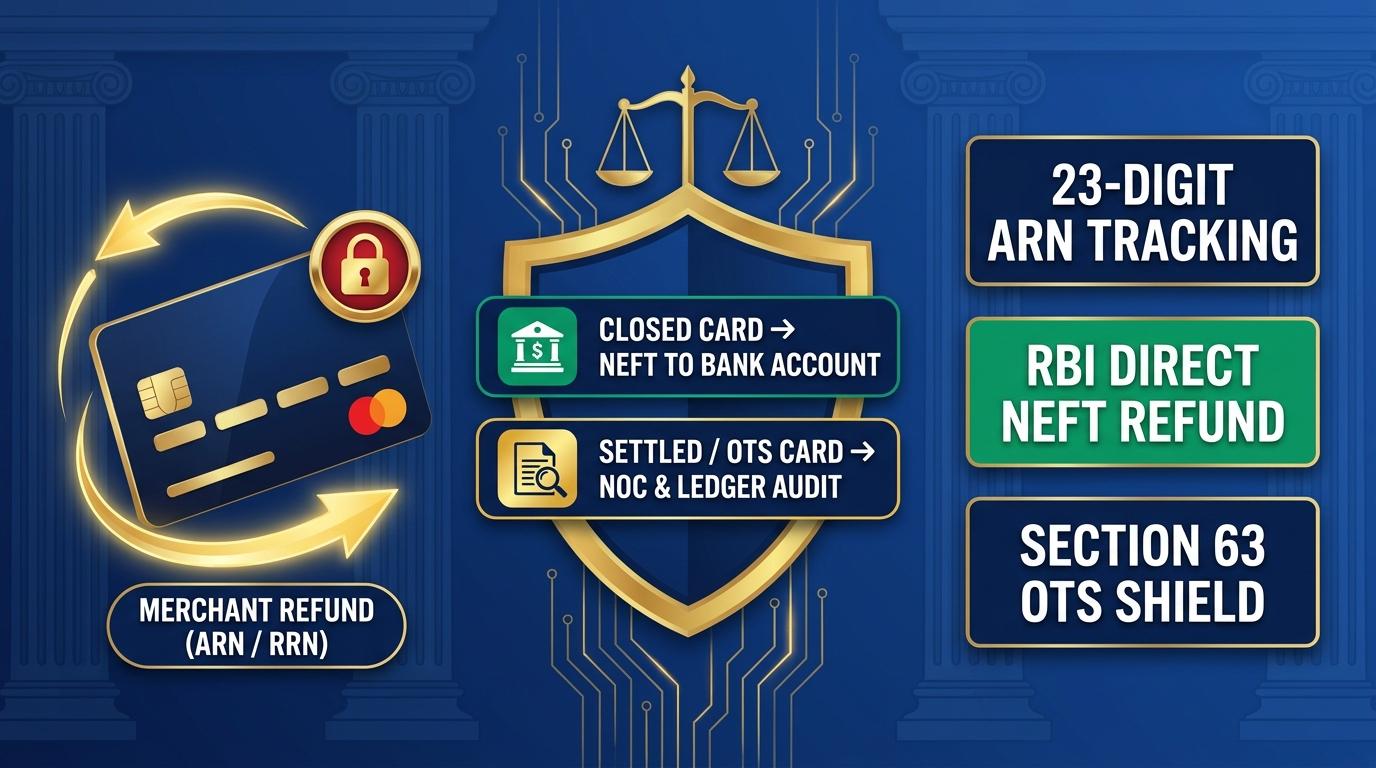
5. Visual Blueprint: ARN Refund Tracking & NEFT Recovery
This chart shows how store refunds move via ARN or RRN codes into closed card ledgers. It also shows how RBI rules send clean credit balances to your bank account.
6. ARN vs RRN Tracking & Sample Refund Adjustment Math
Phone banking agents often say they see no refund on your closed card. That happens because frontline staff only check your statement screen, not the bank back-end clearing suspense pool.
To force a back-end trace, ask the merchant for the official network reference number. Visa and Mastercard refunds carry a unique 23-digit Acquirer Reference Number (ARN). RuPay credit card and domestic refunds carry a 12-digit Retrieval Reference Number (RRN).
| Account Situation | Balance Before Refund | Rs 30,000 Refund Action | Net Cash or Debt Result |
|---|---|---|---|
| Closed Card (Zero Dues) | Rs 0 | Credited to Closed Ledger | Rs 30,000 NEFT to You |
| Closed With Small Credit | Rs 1,200 Credit | Added to Credit Balance | Rs 31,200 NEFT to You |
| Blocked Overdue (Pre-OTS) | Rs 90,000 Due | Set Off Under RBI Rule | Net Due Drops to Rs 60,000 |
| Settled OTS (Prior Paid Bill) | Rs 0 (NOC Issued) | Section 63 & 72 Claim | Rs 30,000 NEFT Claimable |
7. Step-by-Step SOP: Claiming Refunds via NEFT Transfer
Follow these six practical steps to move a stuck refund from a closed or settled card into your active savings account.
1Step 1: Collect Written ARN or RRN Proof From the Merchant
Wait 3 to 5 business days after the merchant confirms refund dispatch. Ask merchant support for an email showing the exact refund amount, date, last 4 card digits, and the 23-digit ARN or 12-digit RRN.
2Step 2: Check Closure Letter or OTS No Dues Certificate
Keep your zero-dues closure email or verified OTS closure letter ready. If your card was settled, pull the old bill statement proving you paid for that item before default.
3Step 3: Email the Card Grievance Desk for a Sundry Trace
Do not rely on phone calls. Email the bank credit card grievance cell asking them to trace the ARN in their Visa, Mastercard, or RuPay inward clearing and sundry suspense account.
4Step 4: Submit NEFT Mandate and Cancelled Cheque Leaf
Attach a clear scan of a cancelled cheque with your printed name, IFSC code, and active savings account number, along with self-attested PAN or Aadhaar KYC.
5Step 5: Cite RBI Credit Balance Transfer Mandate in Writing
Mention RBI Master Direction RBI/2022-23/92 in your email. Demand direct NEFT release of your post-closure credit balance within 7 to 10 working days.
6Step 6: Escalate to Principal Nodal Officer and RBI CMS
If the bank delays past 30 days or wrongly retains cash after an unconditional NOC, file a formal complaint on cms.rbi.org.in for refund payout plus compensation.
8. Court Rulings: Accord, Unjust Enrichment & Deficiency
Indian courts and consumer commissions take a strict view when banks hold back customer funds without legal authority. Four established legal pillars protect your claim.
Interpreting Section 63 of the Indian Contract Act, the Supreme Court held that once a creditor accepts a reduced sum in full and final settlement, the whole debt stands discharged.
As affirmed by the Supreme Court in Kanhaiya Lal Saraf and Mafatlal Industries, Section 72 bars any institution from keeping money received by mistake that belongs to another party.
Consumer commissions consistently hold that parking a closed card refund in a suspense account and making customers run pillar to post is a deficiency in banking service.
For failed online or POS swipes where the merchant got no value, RBI Circular DPSS.CO.PD No.629 mandates reversal in T+5 days, with a Rs 100 daily penalty for bank delay.
9. 3-Tier Escalation Matrix & RBI Turnaround Deadlines
Never let a ticket drag on for months on phone support. Use this three-tier banking escalation path to recover stuck refunds fast.
| Escalation Tier | Authority to Contact | Response Window | Action & Relief Granted |
|---|---|---|---|
| Tier 1: Card Grievance | Credit Card Grievance Redressal Cell | 7 to 10 Working Days | Traces 23-digit ARN in clearing files and triggers NEFT credit balance payout. |
| Tier 2: Bank PNO | Principal Nodal Officer (Head Office) | 10 to 15 Working Days | Audits OTS NOC terms, overrides wrong write-off holds, and clears suspense funds. |
| Tier 3: RBI Ombudsman | RBI Integrated Ombudsman (cms.rbi.org.in) | After 30 Days Total | Orders full NEFT refund, applicable TAT compensation, and CIBIL correction if needed. |
10. Common Mistakes, Chargebacks & DEA Fund Rules
Small procedural errors can delay your refund or create unexpected CIBIL remarks. Watch out for these four special cases.
Accepting Store Wallet Vouchers Blindly
If your card is blocked for unpaid bills, taking a non-transferable store voucher instead of a source refund leaves your high-interest card bill unchanged. Weigh interest cost first.
Post-Closure Chargeback Credits
Won a fraud or non-delivery chargeback after closing your card? That reversal follows the exact same RBI Master Direction rule and must be sent to your bank account via NEFT.
10-Year RBI DEA Fund Transfer Rule
Under Section 26A of the Banking Regulation Act, unclaimed credit balances in closed cards move to the RBI DEA Fund after 10 years. You can still claim them via KYC at the issuing bank.
Checking CIBIL After Post-OTS Credits
Sometimes a late refund re-opens an internal closed card ledger and triggers a wrong reporting feed. Always audit your credit report and file a CIBIL dispute if status shifts.
 Legal Debt Dispute Authority
CredSettle (credsettle.com) is India's premier debt settlement, loan dispute resolution, and legal protection platform. Operating strictly under the RBI Fair Practices Code and CICRA 2005, our advocate panel negotiates directly with Bank Principal Nodal Officers to eliminate waived differentials, obtain unconditional No Dues Certificates (NDC), and upgrade credit bureau records from "Settled" to "Closed".
Frequently Asked Questions: Closed & Settled Card Refunds
Clear, verified answers on ARN tracking, RBI closed card NEFT rules, overdue card set-off, and post-settlement refund recovery in India.
Official RBI Circulars & Statutory Legal Citations
- RBI Master Direction (Credit Card & Debit Card Issuance and Conduct Directions, 2022): RBI/2022-23/92, DoR.AUT.REC.No.27/24.01.041/2022-23 (dated April 21, 2022) and Amendment Circular RBI/2023-24/132, DoR.AUT.REC.86/24.01.041/2023-24 (dated March 7, 2024).
- RBI Harmonisation of Turn Around Time (TAT) Circular: RBI/2019-20/67, DPSS.CO.PD No.629/02.01.014/2019-20 (dated September 20, 2019) on T+5 Auto-Reversal and Rs 100/Day Compensation.
- Indian Contract Act, 1872: Section 63 (Remission of Performance & Full Satisfaction), Section 72 (Restitution of Money Paid by Mistake), and Section 171 (General Lien of Bankers).
- Banking Regulation Act, 1949: Section 26A (Depositor Education and Awareness Fund Rules for 10-Year Unclaimed Credit Balances).
- Supreme Court Precedents & Consumer Law: Lala Kapurchand Godha v. Mir Nawab Himayatalikhan Azamjah, AIR 1963 SC 250; Sales Tax Officer v. Kanhaiya Lal Mukund Lal Saraf, AIR 1959 SC 135; Consumer Protection Act, 2019, Section 2(11).