What Happens If You Default on Credit Card Balance EMI?
Missing a balance transfer bill cancels your low promo rate and shifts your debt to 42% card APR. Learn what retroactive interest RBI rules allow, spot unlawful bank fees, and settle card debt safely.
- Instant Loss of Promo Rate: Missing your Minimum Amount Due or monthly EMI cancels 0% or low-APR balance transfer deals and shifts debt to 36% to 45% yearly APR.
- Retroactive Interest Limit: Banks can charge backdated interest from the transfer date on 0% promo deals only if that rule was clearly printed in your MITC.
- Ban on Fee Compounding: Under RBI Credit Card Directions, banks cannot add unpaid late fees or 18% GST to principal to charge compound interest on fees.
- NPA Plan Auto-Closure: At 90 days past due, active Balance Transfer on EMI plans auto-close and merge all remaining principal into one lump-sum card bill.
- RBI One-Time Settlement Exit: Unsecured balance transfer defaults qualify for compromise OTS under June 2023 RBI rules, waiving post-default 42% APR spikes.
1. How Credit Card Balance Transfer Default Triggers APR Jumps
A credit card balance transfer lets you move unpaid debt from one bank card to another bank card at a low rate. Big banks like SBI Card, HDFC Bank, ICICI Bank, and Axis Bank offer two main plans.
The first plan gives a short promo window with 0% or under 1% monthly interest for 60 to 90 days. The second plan is a Balance Transfer on EMI spread over 6 to 24 fixed monthly bills at 12% to 20% yearly interest.
Both plans work as strict offers bound by the card Most Important Terms and Conditions (MITC). Your low rate stays live only if you pay each monthly bill on or before the due date.
If you miss the Minimum Due or skip a monthly EMI, the bank cancels the promo deal right away. Your grace period on new swipes stops, and the unpaid balance jumps to 3.4% to 3.75% per month (40.8% to 45% per year) plus 18% GST.
2. RBI Master Direction Rules on Retroactive Card Interest
Many card users see huge shock bills when banks add backdated interest from Day 1 of the transfer. The RBI Credit Card Master Direction 2022 (updated on March 7, 2024) draws a sharp line between valid rules and unfair billing.
First, on a 60-day or 90-day 0% promo window, a bank can charge interest from Day 1 on default only if that rule was printed clearly in your MITC. On fixed EMI plans, past paid EMIs stay closed, while left-over principal shifts to standard card APR.
Second, the March 7, 2024 RBI update states that banks can charge interest and late fees only on the unpaid amount left after credits. If you paid half your bill on time, the bank cannot charge interest on the paid half.
Third, note that RBI Circular DoR.MCS.REC.28 on loan penal charges excludes credit cards. Instead, Paragraph 9 of the RBI Card Master Direction bars banks from adding unpaid late fees, charges, or GST to principal to charge compound interest.
3. Cost Breakdown: Promo EMI vs Post-Default 42% Card APR
Looking at real numbers shows why a missed balance transfer bill grows so fast. Suppose you move ₹1,50,000 onto a 12-month Balance Transfer on EMI plan at 15% yearly interest, pay two EMIs, and then lose your job.
Once bills stay unpaid for three months (90 days past due), the bank closes the EMI plan, adds a closure fee, and moves the ₹1,27,500 base debt to 42% yearly card APR plus 18% GST on interest.
| Repayment Stage | Applied Interest Rate | Billing & Penalty Action | Total Payable Balance |
|---|---|---|---|
| Month 1 to 2 (On Time) | 15% p.a. (Promo EMI) | Fixed ₹13,539 EMI Paid Cleanly | ₹1,27,500 (Unbilled Base) |
| Day 30 Past Due (1 Missed EMI) | 42% p.a. on Overdue EMI | Late Fee ₹950 + Grace Period Lost | ₹1,29,180 |
| Day 91 NPA (Plan Cancelled) | 42% p.a. on Full Principal | Unbilled EMI Merged + 3% Fee + GST | ₹1,46,850 (Lump Sum Due) |
| Day 180 Past Due (6 Months) | 3.5%/Month + 18% GST | Monthly Revolving Interest Snowball | ₹1,68,900 |
| RBI Compromise OTS Exit | Frozen & Settled | Waiver of Post-Default APR & Fees | ₹58,000 to ₹75,000 (OTS Range) |
4. Unlawful Charges You Can Dispute After Balance Default
Banks can switch to standard card rates on default, yet billing systems often add extra fees that break RBI rules. Checking your monthly bills gives you strong ground for fee refunds or lower settlement payouts.
Check first for unapproved credit card over-limit fees. When an unbilled EMI closes on default and joins past interest, your bill often crosses your card limit. Under RBI rules, banks cannot charge over-limit fees without clear opt-in consent, or when interest pushes debt past your limit.
Check second for interest added on unpaid late fees and 18% GST. Your card bill must keep base debt apart from fee and tax lines. Charging 3.5% monthly interest on old late fees breaks RBI Master Direction Paragraph 9(b).
Check third for double fees when the bank cancels your EMI plan. Many card MITC sheets list a 3% closure fee only when a user asks to close early. If the bank ends your plan on its own and charges 42% APR right away, you can dispute that 3% fee.
5. Visual Blueprint: Balance Transfer Default & OTS Relief
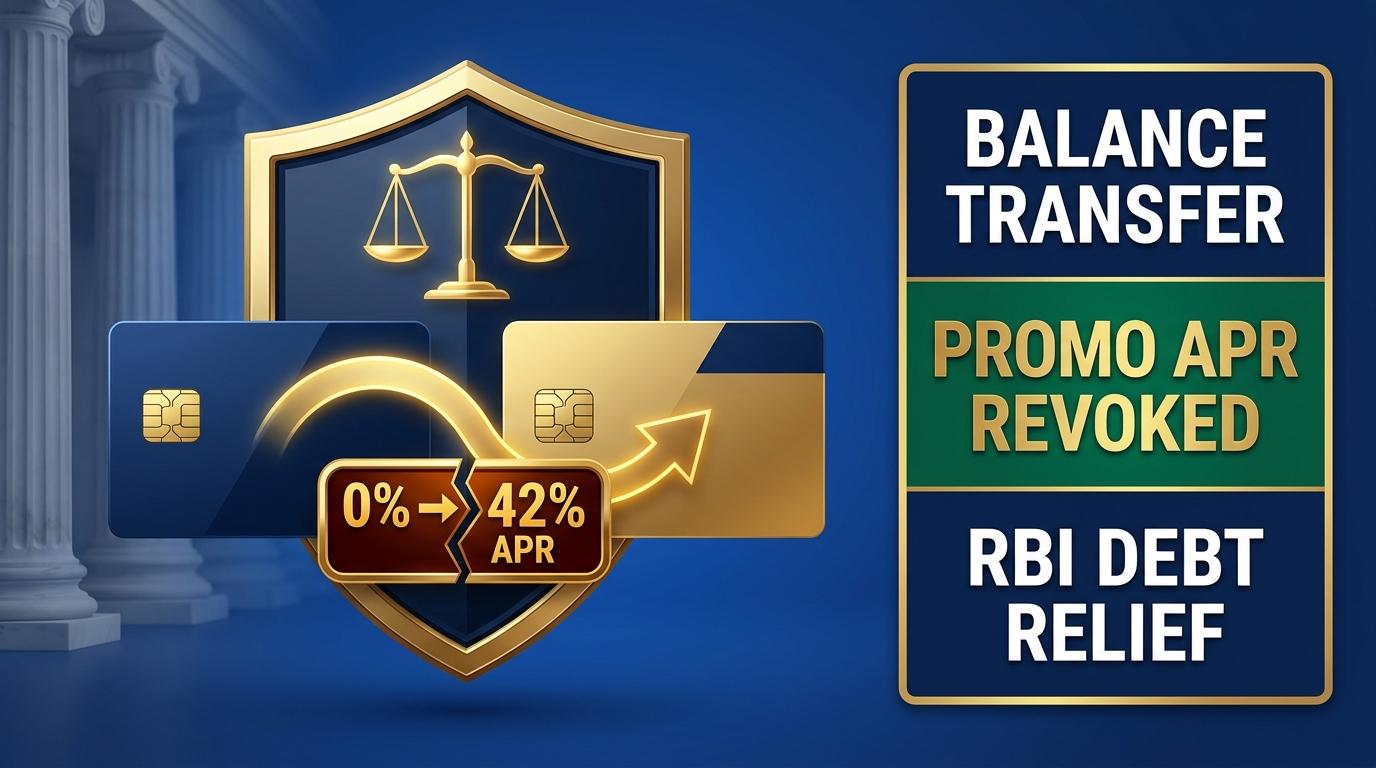
This visual overview shows how missed payments revoke low balance transfer rates, trigger 42% card APR, and open legal debt relief pathways under RBI guidelines.
6. Step-by-Step Guide: Exiting Defaulted Balance Transfers
If your low balance transfer rate is gone and monthly charges are growing fast, follow these six steps to stop the debt trap and close your card safely.
1Stage 1: Stop New Swipes on Both Cards Right Away
Once a balance transfer bill is late, your grace period stops. Every new swipe draws 42% APR from Day 1. Move daily spends to a debit card or savings UPI.
2Stage 2: Save Your Booking Mail & MITC Sheet
Download your first balance transfer mail, EMI chart, and card MITC. Note down the real transferred sum apart from processing fees, late charges, APR, and GST.
3Stage 3: Ask for Goodwill Waiver After a 1-Time Slip
If you missed one bill by 2 or 3 days due to an auto-pay glitch and can pay it now, email support asking for a one-time late fee refund and rate reset.
4Stage 4: Escape the Minimum Amount Due Trap
Do not keep paying just the 5% Minimum Amount Due once your low rate ends. At 42% APR plus GST, small minimum bills only feed monthly interest while your base debt stays flat.
5Stage 5: Flag Illegal Fee Compounding in Writing
Email the bank Grievance Officer to flag any unapproved over-limit fees, interest billed on paid sums, or interest charged on late fees under the March 2024 RBI rules.
6Stage 6: Seek a Formal One-Time Settlement (OTS)
In real hardship after Day 90 NPA, share job loss or health proof to seek a lump-sum credit card OTS. Pay only after checking an official bank OTS letter and collect your No Dues Certificate.
7. Supreme Court Law & Legal Rights for Card Defaulters
Many old web blogs still claim that courts cap credit card interest at 30% per year. Knowing the real Supreme Court law saves you time and guides you to relief steps that work.
While courts do not cap stated card APR, Indian law gives card users strong shields against hidden backdated charges, rude agents, and illegal fee compounding.
The Supreme Court ended the old 2008 NCDRC 30% cap under Section 21A of the Banking Regulation Act. Banks can charge 36% to 45% APR if stated clearly in the MITC, making OTS talks far smarter than rate-cap suits.
Under RBI Card Rules, banks cannot change balance transfer terms or raise fees mid-plan without giving 30 days clear notice and a right to close the card under old terms.
In civil or arbitration claims, banks cannot enforce random penalty slabs that cross fair breach loss or clash with their own signed MITC sheet.
Balance transfer default is a civil unsecured case, not a crime unless a cheque or mandate bounces with fraud. Agents cannot call outside 8 AM to 7 PM or shame your family.
8. 3-Tier Escalation Matrix: Bank GRO to RBI Ombudsman
If a card issuer charges undisclosed retroactive interest, compounds late fees, or ignores unlawful recovery complaints, escalate through this three-tier RBI redressal path.
| Escalation Tier | Designated Banking Authority | Turnaround Time | Scope of Billing & Legal Relief |
|---|---|---|---|
| Level 1: Card GRO | Card Grievance Redressal Officer | 7 to 10 Working Days | Reviews BT booking logs, reverses glitch-based late fees, and checks MITC rules. |
| Level 2: Bank PNO | Principal Nodal Officer (Head Office) | 14 to 21 Working Days | Removes unlawful over-limit or compounded fee interest and reviews hardship OTS files. |
| Level 3: RBI Ombudsman | Reserve Bank Integrated Ombudsman | 30 Days Post-GRO | Adjudicates RBI Master Direction breaches on cms.rbi.org.in and orders fee refunds. |
9. Default Timeline: Missed BT Due Date to NPA Settlement
Tracking each delinquency stage on your balance transfer card helps you act before interest snowballs or legal notices arrive.
| Days Past Due | Account Stage | Bank Billing & Bureau Impact | Recommended Borrower Action |
|---|---|---|---|
| Day 1 to 3 | RBI Grace Window | No late fee or CIBIL past-due report if cleared within 3 days after due date. | Pay overdue EMI or Minimum Due right away to save your promo rate. |
| Day 4 to 30 | SMA-0 / Promo Revoked | Promo APR revoked; late fee added; standard 3.5% monthly interest begins. | Stop card spends and seek a goodwill fee reversal if delay was a one-off error. |
| Day 31 to 89 | SMA-1 & SMA-2 | Card blocked for swipes; CIBIL score drops 60 to 100 points; reminder calls rise. | Explore fixed term restructuring if salary is stable; audit statements for unlawful fees. |
| Day 90+ | NPA & EMI Auto-Closure | Unbilled BT-on-EMI cancels and merges into main bill at 42% APR. | Avoid small token payments; prepare hardship file for formal OTS talks. |
| Day 120 to 180+ | OTS Resolution Window | Bank recovery & Lok Adalat teams open compromise waivers on inflated dues. | Close debt via verified bank OTS letter, collect NDC, and check 15-day bureau update. |
10. Common Traps: Origin Card Delays & Dual-Card Defaults
Many credit card balance transfer crises begin with hidden operational traps across the old card and the new card. Watch out for these four common scenarios.
NEFT Transfer Delay on the Origin Card
Balance transfer NEFT or draft payouts take 3 to 5 working days. If your old card due date passes before the payout settles, the old bank charges late fees and 42% APR too. Always pay Minimum Due on the old card first.
Re-Swiping the Freed-Up Old Credit Card
Moving ₹2 Lakh to a new card frees up the ₹2 Lakh limit on your old card. Swiping the old card again quickly doubles your total debt. If both cards go overdue, you can settle multiple credit cards together.
Balance Transfer vs Personal Loan Consolidation
Card balance transfers carry a 42% default APR cliff. If your CIBIL is still healthy, a standard debt consolidation loan at 12% to 15% avoids revolving card interest jumps.
Salary Account Set-Off Risk in Same Bank
Never transfer huge card debt onto a credit card issued by the same bank that holds your salary account. On default, that bank may invoke banker lien under Section 171 of the Contract Act to hold savings funds.
 Legal Debt Dispute Authority
CredSettle (credsettle.com) is India's premier debt settlement, loan dispute resolution, and legal protection platform. Operating strictly under the RBI Fair Practices Code and CICRA 2005, our advocate panel negotiates directly with Bank Principal Nodal Officers to eliminate waived differentials, obtain unconditional No Dues Certificates (NDC), and upgrade credit bureau records from "Settled" to "Closed".
Frequently Asked Questions: Card Balance Transfer Default
Clear, verified answers on promotional interest revocation, backdated APR rules, Supreme Court judgments, RBI fee caps, and credit card settlement options in India.
Official Regulatory Citations & Statutory References
- RBI Credit Card Master Direction: RBI/2022-23/92, DoR.AUT.REC.No.27/24.01.041/2022-23, Master Direction - Credit Card and Debit Card - Issuance and Conduct Directions, 2022 (as amended via RBI/2023-24/132 dated March 7, 2024).
- Supreme Court of India Precedent: Hongkong and Shanghai Banking Corp. Ltd. v. Awaz Foundation & Ors., 2024 INSC 1019 (Decided December 20, 2024) on Section 21A of the Banking Regulation Act, 1949 and RBI rate jurisdiction.
- RBI Compromise Settlement Framework: RBI/2023-24/40, DOR.STR.REC.20/21.04.048/2023-24 (June 8, 2023), Framework for Compromise Settlements and Technical Write-offs.
- RBI Recovery Conduct Circular: RBI/2022-23/108, DOR.ORG.REC.65/21.04.158/2022-23 (August 12, 2022), Outsourcing of Financial Services - Responsibilities of Regulated Entities Employing Recovery Agents.
- Statutory Enactments: Section 74 & Section 171 of the Indian Contract Act, 1872, and Reserve Bank - Integrated Ombudsman Scheme, 2021.