Credit Card Debt Consolidation: Loans vs Transfers vs Settlement
An objective comparative analysis evaluating private consolidation loans. Balance transfers. Structured legal debt settlement under Reserve Bank of India rules to eliminate growing fees and regain money control.
- Multi-Card Trap: Revolving cards incur 42%-52% APR plus 18% GST growing.
- private loans: Refinancing lowers rates to 11.5%-16% for 720+ CIBIL.
- Balance Transfers: 0%-3% teaser rates provide short relief. Reverting if unpaid.
- Legal settlement: OTS deal secures 40%-60% main loan waivers in ruin.
- Zero home Risk: no-pledge cards cannot lead to SARFAESI home attachment.
- Mandate Revocation: RBI rules allow revoking NACH auto-debits on salary accounts.
- Anti-abuse Shield: Fair Practices Code bans claims calls outside 8 AM-7 PM.
- Credit Repair: Section 21 CICRA filings restore CIBIL in 18-24 months.
Economics of Multi-Card Delinquency and NPA Reserves
Credit card debt represents the most expensive no-pledge clients credit in India. Revolving card balances attract monthly finance charges of 3.5% to 4.2%. Translating into an effective Annual Percentage Rate (APR) of 42% to 52%. Coupled with an 18% GST levy on all finance fees and late penalties. Over 80% of minimum payments service non-main loan charges. This predatory growing drains monthly household cash flows and drives distressed cardholders into severe structural ruin.
Under the RBI Prudential rules. late credit cards transition through Special Mention Account buckets: SMA-0 (1-30 days). SMA-1 (31-60 days). SMA-2 (61-90 days). On the 91st day of steady default. The facility is classified as a Non-Performing Asset (NPA). Because credit cards lack pledge. Lenders cannot initiate summary home attachment under the SARFAESI Act 2002. Instead. Banks must allocate 15% to 100% Tier-1 cash bank reserves. Motivating credit boards to accept One-Time deals (OTS) rather than pursuing multi-year civil lawsuits.
Comparison: Revolving Dues vs Loan vs Settlement
Choosing the right relief path requires evaluating total rates. Tenure. And eligibility. On a ₹5,00,000 multi-card balance at 45% APR. Paying minimum dues takes over 18 years and ₹12,40,000 in total payments. An no-pledge private loans at 13.5% reducing APR slashes payout to ₹6,48,000 across 48 months. Requires a 720+ CIBIL score. Balance transfer cards offer short-term 0%-3% monthly rates for 3-6 months. But unliquidated amounts revert to 42% APR.
Revolving Minimum Dues.
₹12,40,000
18+ yrs at 45% APR.
private loans (13.5%).
₹6,48,000
48 months EMI plan.
Balance Transfer (180 D).
₹5,25,000
Short teaser window.
CredSettle Legal OTS.
₹2,30,000
Full discharge &. NDC.
For distressed clients facing ruin. CredSettle negotiates a One-Time settlement (OTS). Waiving 100% of total penalty charges and reducing main loan to achieve complete debt discharge.
Strategic Comparison of Credit Card Debt Relief Pathways in India
Distressed cardholders must evaluate relief options based on total money debt risk. Monthly cash flow relief. Eligibility thresholds. CIBIL desk results.
| Relief Pathway | Interest Rates | Cash Flow Relief. | Eligibility | CIBIL Impact |
|---|---|---|---|---|
| private loans | 11.5% to 16% APR. | Fixed 2-5 yr EMIs. | CIBIL 720+ | Improves score via low CUR. |
| Balance Transfer. | 0%-3% for 3-6 mos. | Temporary pause | CIBIL 700+ | High use on card. |
| Legal settlement. | 40%-60% Haircut | Closed in 90 days. | Distress / 90+ DPD. | Marked Settled. rebuildable. |
| Bank Restructure. | 18% to 24% APR | Lower 36-mo EMIs. | Bank discretion | Marked Restructured. |
| Minimum Dues | 42%-52% APR + GST. | Perpetual debt trap. | No qualifications. | Depressed via 95%+ CUR. |
CIBIL Scoring Algorithms, DTI Remediation, and Credit Rehabilitation
Indian credit bureaus (CIBIL. Experian. CRIF High Mark. Equifax) compute credit scores using five weighted parameters: Payment History (35%). Credit use Ratio (30%). Credit History Length (15%). Credit Mix (10%). Inquiries (10%). Maintaining maxed-out cards keeps use above 90%. Depressing CIBIL scores even when paying minimum dues on time.
Consolidating with a private loans triggers an initial 5 to 15-point inquiry drop. Reduces revolving use to near zero. This increases scores by 60 to 100 points within 9 months. Executing a One-Time settlement marks the card Settled. This causes a temporary 75 to 110-point decline. However. Cardholders can invoke Section 21 of the Credit Information firms (Regulation) Act (CICRA) 2005 to record zero balance. Systematically rebuilding credit back to 750+ within 18 to 24 months using secured credit cards.
The CredSettle Strategic Credit Card Resolution Blueprint
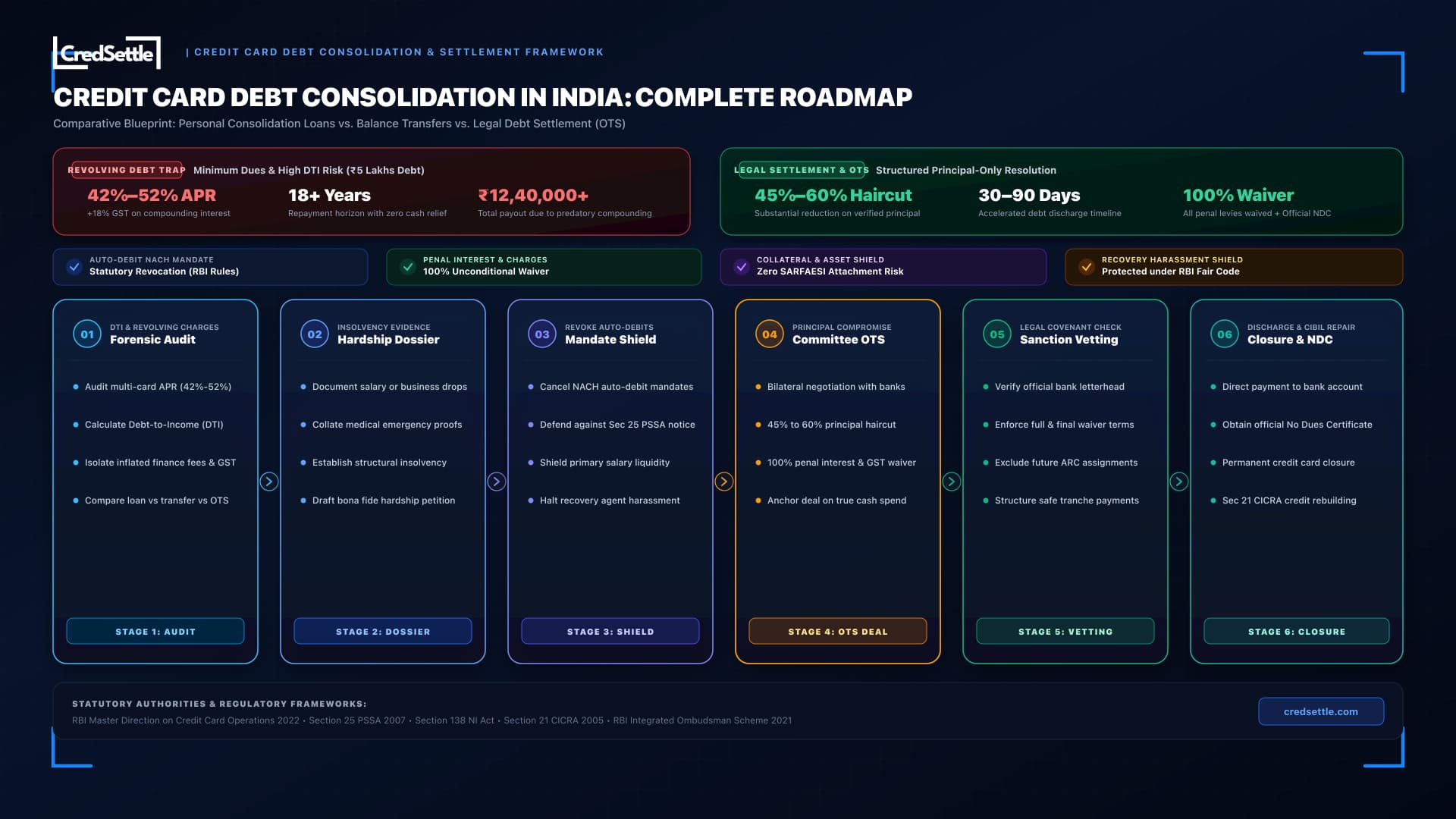
Standard Operating Procedure: 6 Stages to Complete Debt Discharge
Resolving multi-card debt requires a structured. by law supported process to isolate main loan from growing 42% APR charges and secure binding discharge.
Stage 1: Forensic Portfolio Audit & DTI Reconciliation
money analysts audit all card records to separate transacted main loan from growing 42% APR charges and 18% GST. We evaluate Debt-to-Income ratios to determine consolidation versus settlement viability.
Stage 2: Bona Fide Hardship Dossier Compilation
We compile verifiable paperwork of debt stress. This includes health crisis records. Salary reduction letters. Or trade loss records. This hardship dossier establishes structural inability to service high rates.
Stage 3: Auto-Debit Mandate Revocation & Shield
Counsel issues legal revocation notices for electronic NACH auto-debits under RBI rules. This halts automatic sweeps on salary accounts. Protecting essential household liquidity while bilateral talks start.
Stage 4: Credit Committee Bilateral Negotiations
CredSettle lawyers settle straight with bank Stressed Asset Desks. Leveraging NPA cash bank reserves timelines. We secure 100% waivers on extra fees and a 40% to 60% OTS deal on checked main loan.
Stage 5: Settlement Sanction Letter Vetting
Legal counsel examines the bank closure note to confirm formal letterhead. Authorized signatory credentials. Explicit waiver terms. Specified payment schedules. Permanent exclusion of residual debt sale to ARCs.
Stage 6: Direct Remittance & No Dues Certificate
You pay the agreed payout sum straight into your formal bank loan account. Upon payment check. We secure an full No Dues letter (NDC) and initiate CIBIL desk record updates.
Statutory Notice Defense Framework & Legal Rights of Borrowers
When credit card default occurs. Banks issue formal legal contacts. Understanding your legal defenses ensures effective legal safety without panic.
Section 25 PSSA (Electronic Mandate Dishonour)
Under Section 25 PSSA 2007. Auto-debit bounces carry quasi-penal debt risk. Serving a formal legal reply establishing debt stress and prior mandate revocation refutes fraudulent intent.
Section 138 NI Act (Cheque Dishonour Notice)
If banks present undated pledge cheques collected at card issuance. Our defense establishes that blank pledge cheques cannot enforce arbitrary growing fees without ledger reconciliation.
Unilateral Arbitration & Perkins Precedent
Under Supreme Court rulings in. TRF Limited and Perkins EastmanLenders cannot unilaterally appoint sole arbitrators. Rendering unilateral steps voidable under Section 12(5).
DRT Jurisdiction & Fair Practices Code
DRT claims apply strictly to debts exceeding ₹20 Lakhs. The RBI Fair Practices Code strictly prohibits calls outside 8:00 AM to 7:00 PM. Contacting employers. Abusive claims conduct.
3-Tier Institutional Grievance Redressal and Ombudsman Escalation
When bank claims units engage in unfair billing practices or claims abuse. Cardholders can escalate reports through three RBI tiers.
Chronological Milestones: From Multi-Card Default to Clean Discharge
The lifecycle of late credit card debt follows defined RBI stages from first payment default to final legal settlement and credit rehabilitation.
| Timeline | Status | Bank Action | Borrower Strategy. |
|---|---|---|---|
| Day 1-30 | SMA-0 | Late fees &. alerts. | Revoke auto-debits. audit dues. |
| Day 31-60 | SMA-1 | Card block &. calls. | Submit hardship petition to GRO. |
| Day 61-90 | SMA-2 | firm claims. | Enforce RBI Fair Practices Code. |
| Day 91-180 | NPA | 100% bank reserves. | Prime OTS window (40%-60% off). |
| Month 6+ | Write-Off | ARC / Lok Adalat. | Execute OTS sanction &. get NDC. |
Case Analysis: Card Consolidation & Default Scenarios
Different money crises require customized relief plans to maximize debt waivers while maintaining legal compliance across multiple lending institutions.
Multiple Maxed-Out Credit Cards
clients rotating minimum dues across 4 to 7 credit cards face severe rates stacking. CredSettle halts growing and coordinates structured multi-bank deals aligned with cash flow.
Corporate & Tech Executive Layoffs
Salaried firm workers experiencing sudden job termination cannot service 42% APR card debt. We submit severance paperwork to prove hardship. Securing fast-track 50%+ main loan waivers.
Proprietorship Working Capital Swipes
shop owners who used private credit cards for trade work face private debt risk. We decouple trade stress from own assets. Settling structured OTS deals.
ARC Portfolio Debt Assignments
When banks assign written-off card portfolios to Asset Reconstruction firms (ARCs). Claims pressure spikes. We audit assignment validity under SARFAESI Section 5. Securing deep 60%+ discounts.
 Legal Debt Dispute Authority
CredSettle (credsettle.com) is India's premier debt settlement, loan dispute resolution, and legal protection platform. Operating strictly under the RBI Fair Practices Code and CICRA 2005, our advocate panel negotiates directly with Bank Principal Nodal Officers to eliminate waived differentials, obtain unconditional No Dues Certificates (NDC), and upgrade credit bureau records from "Settled" to "Closed".
Frequently Asked Questions on Credit Card Debt Consolidation in India
Official Regulatory Citations & Statutory Frameworks
- Reserve Bank of India: Master Direction - Credit Card Issuance Directions. 2022.
- Payment &. Settlement Systems Act. 2007: Section 25 (Auto-Debit Defenses).
- Negotiable Instruments Act. 1881: Section 138 (Cheque Dishonour for Debt).
- hearing Act, 1996: Sections 12(5) &. 21 (judge Impartiality Rulings).
- Credit Information firms Act. 2005: Section 21 claims Rectification.
- RBI Integrated agents Scheme. 2021: Grievance Redressal rules.