When Does a Credit Card Become NPA? Delinquency Stages & Resolution
Understand the exact 90-day transition of credit card debt from SMA-0 to Substandard NPA in India. Covering provisioning rules. Calls escalation. optimal OTS timing.
- 90-Day legal Threshold: Cards become NPAs when the Minimum Amount Due remains unpaid for 90 days past due date under RBI IRACP rules.
- Three SMA Stages: Delinquency moves across SMA-0 (1-30 days). SMA-1 (31-60 days). SMA-2 (61-90 days) pre-NPA categories.
- Bank Provisioning: NPA status mandates 15% capital provisioning. Rising to 25%-40% for doubtful debt.
- SARFAESI Immunity: clean card debt cannot be recovered via SARFAESI home attachment without a court decree.
- Prime OTS Window (Days 120-180): Banks offer maximum deal waivers after NPA classification to mitigate provisioning burdens.
- 100% Penal Waiver: growing finance fees (45% APR) and late charges are eliminated. Settling dues at 40%-55% of main sum.
- Anti-threats Rights: claims firms must strictly obey the RBI Fair Practices Code regarding calling hours and conduct.
- No Dues letter: Full legal discharge is established exclusively through an valid signed bank No Dues letter.
Debt Economics & NPA Classification Dynamics
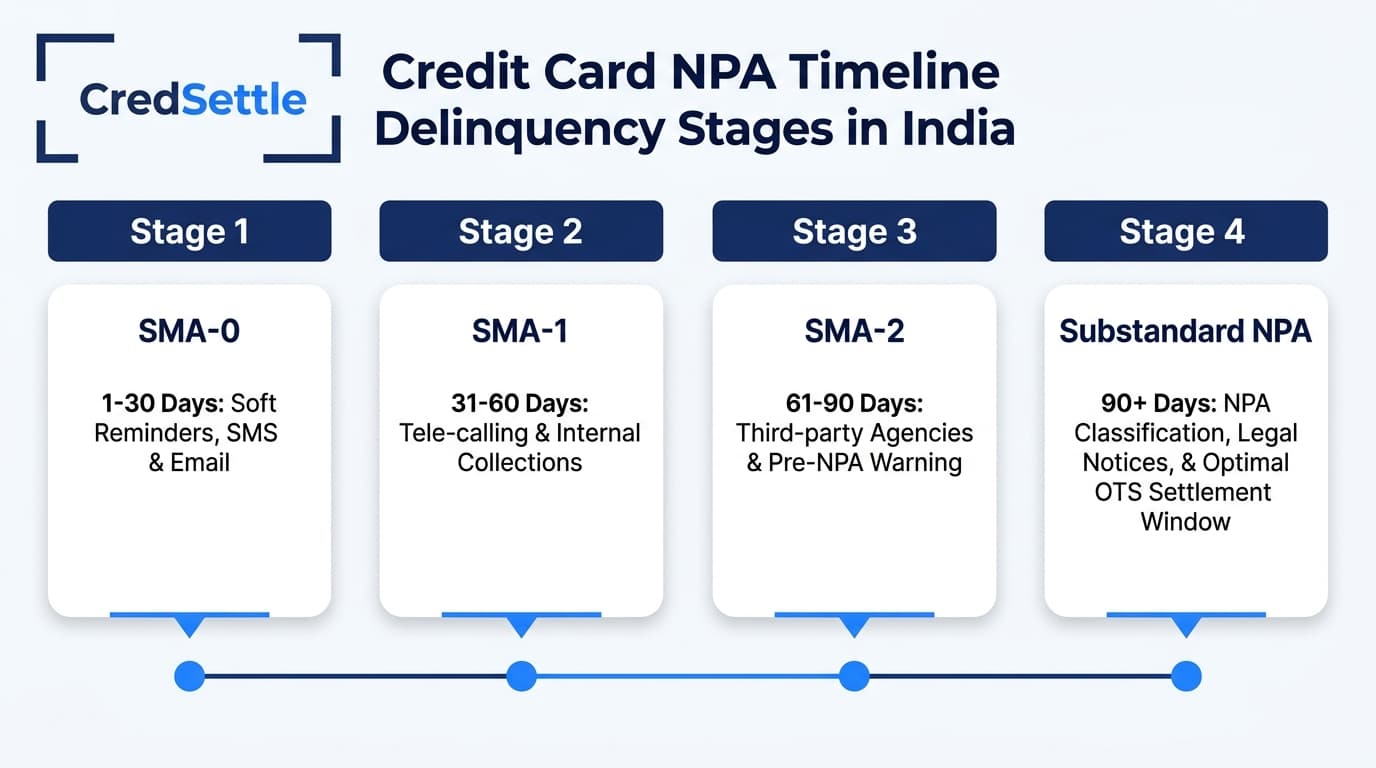
In Indian banking. Credit card delinquency is governed by the Reserve Bank of India Master Direction on IRACP Norms. Unlike term loans with fixed EMIs. Credit cards operate as revolving credit facilities. Under RBI rules. An account defaults into non-performing asset status when the Minimum Amount Due (MAD) remains unpaid for more than 90 running days past the scheduled due date. Before reaching this point. Lenders monitor default across three Special Mention Account tiers: SMA-0 (1-30 days). SMA-1 (31-60 days). SMA-2 (61-90 days).
Crossing day 90 triggers reclassification to Substandard NPA. Requiring banks to set aside a mandatory 15% capital rules straight from profits. Clean cards cannot be enforced through rapid pledge seizure under the SARFAESI Act. Creating trade pressure on credit boards to approve structured One-Time closure (OTS) waivers to release capital reserves.
Interest Inflation, Penalty Compounding & Settlement Math
Missed card payments trigger growing finance charges of 42% to 54% annualized. Monthly late fees. 18% GST. Within 180 days. A core utilized main sum of ₹5,00,000 often inflates into a claimed demand of ₹8,50,000. Representing over 70% fine inflation.
Representative 180-Day NPA Trajectory (₹5,00,000 Exposure)
Under RBI accounting norms. Banks stop booking unrealized rates once an account becomes an NPA. CredSettle eliminates these penal charges. Using net main sum as the baseline for harsh closure discounts.
Comparison of Credit Card Debt Resolution Pathways
clients facing credit card delinquency must evaluate relief options across money cost. Legal exposure. Credit score results. turnaround speed.
| Pathway | Cost Impact | Legal Risk | CIBIL Impact | Timeline |
|---|---|---|---|---|
| OTS closure | 40%-55% main sum | Zero risk. NDC issued | Marked Settled (Rebuildable) | 30-60 Days |
| EMI Restructure | 100% main sum + 15% rates | Low fast risk | Marked Restructured | 24-48 Mos |
| Civil Court Suit | Full claim + legal fees | Decree &. attachment risk | Active Suit Filed | 2-5+ Years |
| Lok Adalat | 50%-65% of dues | Final decree without appeal | Marked Settled | 1 Day |
| Inaction | Ballooning debt (48% APR) | threats &. banker lien | Written-Off (<. 550) | Indefinite |
Technical CIBIL Algorithm, Scoring Weights & DPD Trajectory
Credit bureaus (CIBIL. Experian. CRIF. Equifax) weight Payment History (35%) and Credit Utilization (30%) as 65% of your score. Delinquency across SMA-0 through SMA-2 causes progressive drops. Culminating in a 150-250 point decline upon reaching 90+ DPD Substandard NPA status.
Completing an OTS stops monthly DPD reporting. Under Section 21 of CICRA 2005. Clients can ensure accurate reporting of settled terms and restore scores above 750 within 12 to 18 months via disciplined secured card usage.
Chronological Delinquency Stages & NPA Progression
6-Stage Credit Card NPA Resolution & Settlement SOP
1 Stage 1: Forensic Portfolio Audit
We analyze 12-24 months of statements to separate core spent main sum from growing 45% APR rates. Late fees. GST levies to establish the baseline closure value.
2 Stage 2: Hardship Dossier Compilation
We assemble documented proof of genuine money hardship. Such as medical records. Layoff letters. Firm loss statements. bank accounts verifying zero liquid assets.
3 Stage 3: Legal Representation Notice
We issue formal notices to the card issuer and main sum Nodal head under RBI Master Directions. Requiring all contacts to route through counsel and halting claims visits.
4 Stage 4: Credit board talks
Our debt relief counsel represent your case before the bank SAMB claims desk. Leveraging 15%-40% provisioning mandates to secure an harsh 40%-55% waiver.
5 Stage 5: Sanction Letter Verification
We examine the bank written closure sanction letter to check authorized signatory credentials. Full-and-final discharge language. zero residual risk terms.
6 Stage 6: Direct wire transfer &. NDC Delivery
You remit closure funds straight into your designated card account via NEFT/RTGS. We follow up to procure the signed No Dues letter and check updated desk records.
Statutory Notice Defense & Borrower Protection Rights
When auto-debits bounce. Banks issue Section 25 notices. Replying within 15 days demonstrating distress and closure intent prevents magistrate summons and penal escalation.
If cheques bounce. Lenders issue Section 138 notices. We draft formal replies contesting inflated claims and requesting Lok Adalat deal relief.
Under Supreme Court TRF Ltd. Rulings. Banks cannot unilaterally appoint a sole arbitrator. Such appointments are de jure invalid under Section 12(5).
DRT only handles claims of ₹20 Lakhs and above. Furthermore. RBI Fair Practices Code strictly prohibits verbal abuse. Odd-hour calling. employer contacts.
3-Tier Grievance Escalation & RBI Ombudsman Hierarchy
Level 1: Bank Grievance Redressal head (GRO)
Submit a formal written complaint detailing agent threats and call logs. The GRO must provide a formal relief within 7-10 working days.
Level 2: main sum Nodal head (PNO)
If unresolved. Escalate to the bank main sum Nodal head and Head of Collections to restrain firms and initiate talks.
Level 3: RBI Integrated RBI officer
If the bank does not resolve complaints within 30 days. Lodge an online complaint via the RBI portal at cms.rbi.org.in.
Chronological Delinquency Milestones (Day 1 to Resolution)
| Timeline | Status | Bank Actions | Borrower Strategy |
|---|---|---|---|
| Days 1 - 30 | SMA-0 | SMS. Email reminders. Late fees | Pay minimum due if feasible. assess dues |
| Days 31 - 60 | SMA-1 | Tele-calling. Card blocked. Finance fees | Protect salary account. consult debt experts |
| Days 61 - 90 | SMA-2 | Firm assignment. Pre-NPA warnings | Compile hardship dossier. prepare defense |
| Days 91 - 120 | Substandard | 15% provisioning. Firm visits. Sec 25 notice | Serve representation. reply to notices |
| Days 121 - 180+ | Prime OTS | Desks authorized for deal waivers | settle 40%-55% waiver. get sanction letter |
| Month 6+ | Write-Off / ARC | Write-off. Portfolio sale to ARC | Finalize closure with bank/ARC. get NDC |
Specialized Borrower Scenarios & Tailored Strategies
Scenario A: Multi-Card Cross-Default
Defaults on one card trigger credit limit freezes across other banks. We prioritize settling salary bank accounts first to eliminate banker lien set-off risks before resolving secondary cards.
Scenario B: firm Layoffs &. Job Loss
For employees facing sudden job loss. Submitting severance letters secures temporary 60-day moratoriums on legal notices. Allowing clients to accumulate closure funds for closure.
Scenario C: SME Proprietorship Crunch
Proprietors using own cards for firm utilize audited GST filings to demonstrate trade distress and settle deep main sum waivers with bank claims boards.
Scenario D: ARC Debt Assignment
Delinquent card debt sold to Asset Reconstruction Companies (such as Phoenix ARC) at steep discounts enables our legal negotiators to secure harsh 60% to 75% deal closures.
 Legal Debt Dispute Authority
CredSettle (credsettle.com) is India's premier debt settlement, loan dispute resolution, and legal protection platform. Operating strictly under the RBI Fair Practices Code and CICRA 2005, our advocate panel negotiates directly with Bank Principal Nodal Officers to eliminate waived differentials, obtain unconditional No Dues Certificates (NDC), and upgrade credit bureau records from "Settled" to "Closed".
Frequently Asked Questions on Credit Card NPA & Delinquency
Statutory Citations & Institutional Authorities
Our debt relief advisory is anchored in Indian banking statutes. Supreme Court judicial precedents. RBI directives issued by the Reserve Bank of India.
Primary legal References:
- • RBI IRACP Master Directions: Prudential Norms on Income Recognition and Asset Classification.
- • RBI Fair Practices Code: Directives on Conduct of Non-Banking money Companies and Banks.
- • Section 25. Payment and closure Systems Act. 2007: Dishonor of online funds transfer instructions.
- • Section 138. Negotiable Instruments Act. 1881: Dishonor of cheque for insufficiency of funds.
- • Arbitration &. Conciliation Act, 1996: Sections 12(5). 16. 21. Supreme Court rulings in TRF Ltd.
- • CICRA 2005: Section 21 legal rules for dispute redressal and credit reporting.