Section 60 CPC: Assets & Property Exempt from Bank Attachment
A simple legal guide for Indian borrowers facing loan default. Learn how Section 60 of the CPC protects your salary, LIC policy, EPF, PPF, home items, and work tools from bank seizure.
- Strong Legal Shield: The Proviso to Section 60(1) of the CPC lists assets that no civil court or DRT can seize for a loan default.
- Salary Safety Rule: Under Clause (i), the first ₹1,000 plus two-thirds (2/3rd) of your remaining monthly pay is fully exempt from attachment.
- LIC, EPF, PPF & Gratuity Safety: Clauses (g), (k), and (kb) give 100% protection to life insurance policies, EPF, PPF, and gratuity money.
- Home & Work Tools: Clauses (a), (b), and (c) protect clothes, cooking pots, beds, mangalsutra, artisan tools, and farmer homes.
- Waiver Clauses Are Void: Under Section 60(1A) CPC, any loan agreement clause that asks you to give up these rights is void by law.
1. Section 60 CPC: Attachable vs Exempt Property Law
When you miss payments on a personal loan or credit card, recovery agents often make scary threats. They claim they will bring court staff to empty your home. They say the bank will take your TV, fridge, kitchen pots, work laptop, LIC policy, and full salary. These claims are false and break Indian law.
In India, no bank or agent can walk into your house and take your things for an unpaid loan. Even if a bank wins a civil case or an arbitration award, it cannot seize assets on its own. The bank must file an execution petition in a civil court. The judge then follows Section 60 of the Code of Civil Procedure (CPC), 1908.
Section 60(1) of the CPC splits a borrower’s property into two simple lists. The first list covers extra assets that a court can attach and sell. This includes a second house, stocks, extra land, or surplus bank cash. The second list, found in the Proviso to Section 60(1), covers items that are 100% exempt from seizure.
Lawmakers wrote this rule so that debt recovery never takes away a family’s basic shelter, food, or way to earn a living. Under Section 29 of the Recovery of Debts and Bankruptcy Act, 1993, even Debt Recovery Tribunals (DRTs) must obey these asset protections.
2. Salary Attachment Calculation: 1/3rd Garnishee Math
Many salaried workers fear that a bank or court will block 100% of their monthly pay. Section 60(1), Clause (i) of the CPC strictly bans full salary attachment in loan recovery cases.
Under Clause (i), the first ₹1,000 of your monthly pay and two-thirds (2/3rd) of the rest are fully safe from court orders. A court garnishee order can cut at most one-third (1/3rd) of your salary above ₹1,000. You always keep over two-thirds of your income to run your home.
The law also sets a strict time cap on salary cuts. Once the one-third share is cut for a total of 24 months, your salary becomes free from any more cuts for that same loan decree.
| Pay or Asset Item. | Total Value. | Section 60(1) CPC Rule. | Safe Amount. |
|---|---|---|---|
| Monthly Take-Home Pay. | ₹76,000. | First ₹1,000 + 2/3rd of ₹75,000 Safe. | ₹51,000 / Month Safe. |
| Max Court Cut Allowed. | ₹25,000 Max. | Capped at 1/3rd for Max 24 Months. | Stop via OTS Deal. |
| EPF, PPF & LIC Value. | ₹14,50,000. | 100% Safe Under Clauses (k) & (kb). | ₹14,50,000 (100% Safe). |
| ₹10 Lakh Loan OTS Closure. | ₹10,00,000 Claim. | Settled at ₹3,20,000 Before Decree. | ₹6,80,000 Waived. |
3. Exempt vs Attachable Assets: Section 60(1) Matrix
Knowing which assets are safe and which are at risk gives you huge power during loan settlement talks. Agents use fear because most people do not know the clauses of Section 60(1).
The table below shows how the Code of Civil Procedure, 1908 treats different personal and family assets during debt recovery.
| Asset Type. | Section 60(1) Clause. | Safety Status. | What the Law Says. | Action Step. |
|---|---|---|---|---|
| Clothes, Beds, Pots & Mangalsutra. | Clause (a). | 100% Exempt. | Daily home items and sacred jewelry are safe. | Refuse agent home entry. |
| Artisan Tools & Farm Gear. | Clause (b). | 100% Exempt. | Work tools, cattle, and seeds cannot be seized. | Keep bills for work tools. |
| Farmer House & Sheds. | Clause (c). | 100% Exempt. | Homes lived in by farmers and farm workers. | Keep land papers ready. |
| Books of Accounts. | Clause (d). | 100% Exempt. | Shop ledgers and tax books cannot be taken. | Cite Clause (d) in reply. |
| Pension & Gratuity. | Clause (g). | 100% Exempt. | Retiree pension and gratuity are fully safe. | Receive in a clean bank. |
| Labourer Wages. | Clause (h). | 100% Exempt. | Wages of manual workers and house staff. | Zero salary cut allowed. |
| Monthly Salary. | Clause (i). | Mostly Exempt. | First ₹1,000 + 2/3rd of remaining pay is safe. | Use a separate salary bank. |
| EPF & PPF Balances. | Clause (k). | 100% Exempt. | All PF and PPF savings are safe from courts. | Keep in PF or neutral bank. |
| LIC & Life Insurance. | Clause (kb). | 100% Exempt. | All payouts from life insurance policies are safe. | Link neutral bank for payout. |
| Extra Plots, Stocks & FDs. | Main Section 60(1). | Attachable. | Can be attached only after a final court decree. | Settle loan via OTS early. |
4. Key Proviso Exemptions: EPF, PPF, LIC & Tools
Several rules in the Proviso to Section 60(1) CPC act as a strong shield for families, workers, and small shop owners. Knowing how courts read these rules helps you stop fake threats right away.
Life Insurance Policies under Clause (kb): Every rupee payable under a life policy (whether LIC or private) is 100% safe from court attachment. In Federal Bank Ltd v. Indiradevi Kunjamma, the High Court ruled that life insurance money protects the family and cannot be taken for a bank loan.
EPF, PPF, and Gratuity under Clauses (g) and (k): Money in an EPF or PPF account, along with gratuity and pension, cannot be seized. In Radhey Shyam Gupta v. Punjab National Bank (2009), the Supreme Court held that retiree funds stay safe even after they enter a bank account or fixed deposit.
No Waiver Allowed under Section 60(1A): Some banks put fine print in loan forms saying you give up your legal exemptions. However, Section 60(1A) of the CPC says that any deal waiving Section 60 rights is completely void. A bank contract can never cancel this protection.
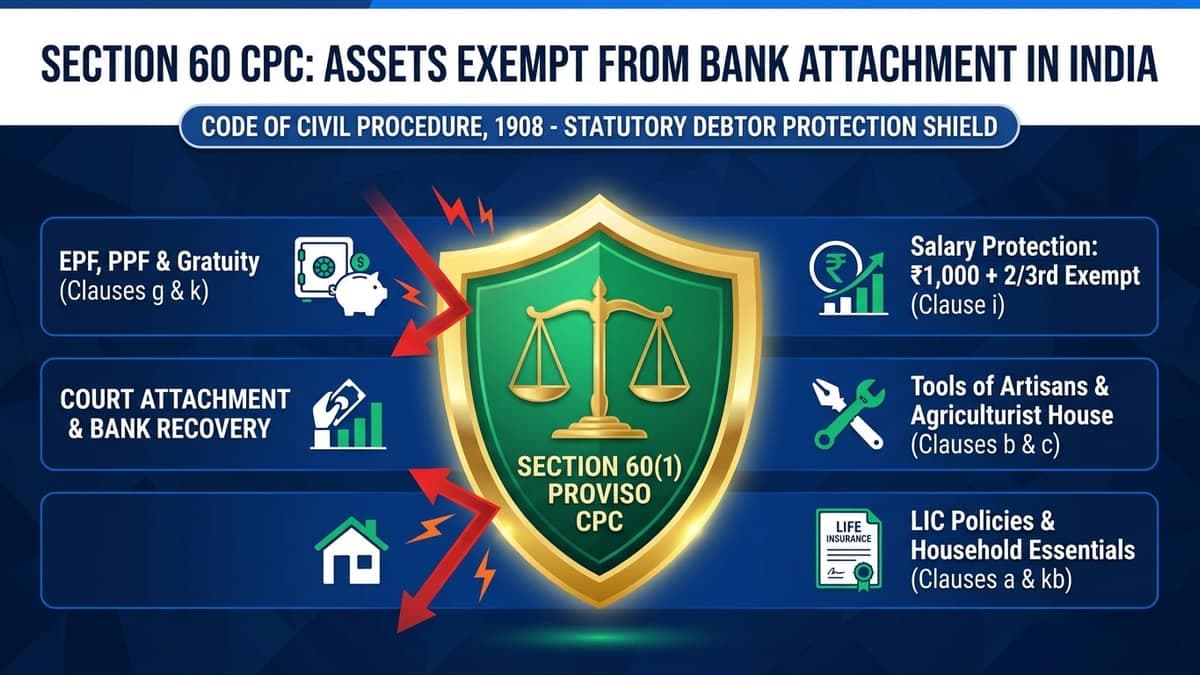
5. Visual Blueprint: Section 60 CPC Asset Shield
This chart shows the debtor protection shield under Section 60(1) of the Code of Civil Procedure, 1908. It highlights the main asset groups that are safe from bank attachment.
6. Step-by-Step SOP: 6-Stage Attachment Defense Plan
If a bank or agent threatens to seize your pay, home items, or LIC policy, follow these six simple steps to keep your assets safe and close the debt.
1Stage 1: Move Your Salary & Benefit Accounts.
Shift your monthly salary, LIC payouts, and EPF bank links to a clean bank where you have no loans or credit cards. This stops automatic bank set-off cuts.
2Stage 2: Spot Fake WhatsApp Notices vs Real Court Orders.
Recovery agents often send fake WhatsApp texts saying a bailiff will take your sofa and TV tomorrow. Check the official e-Courts site with your name or CNR number to see if any real court case exists.
3Stage 3: Send a Section 60 CPC Legal Reply.
Reply to bank legal notices through a lawyer. Cite the matching clauses of Section 60(1) CPC and warn the bank against making illegal seizure threats.
4Stage 4: File an Order 21 Rule 58 CPC Objection.
If a court order wrongly lists exempt tools, home items, or extra salary, file an objection under Order 21 Rule 58 of the CPC. The judge will release the protected items.
5Stage 5: Negotiate a One-Time Settlement (OTS).
Once the bank sees that your core income and savings are safe by law, start OTS talks. You can often close the unsecured loan with a 50% to 75% waiver.
6Stage 6: Get Your No Dues Certificate (NDC).
Verify the bank OTS letter and pay the agreed sum directly to your loan account. Collect your No Dues Certificate and make sure the bank closes any court case under Order 21 Rule 2 CPC.
7. Order 21 Rule 58 CPC: Objecting to Wrongful Seizure
Even when a bank holds a valid court decree, it must obey strict court rules. If a lender or agent crosses the line, Indian law gives you strong legal remedies.
You can file a claim in the executing court showing that the attached item is safe under Section 60(1) CPC. The judge must stop the sale and free your property.
Banks sometimes ask to attach assets before a case ends under Order 38 Rule 5. In Raman Tech v. Solanki Traders, the Supreme Court ruled that courts cannot allow this for normal unpaid loans.
Recovery agents have zero right to enter your house or touch your furniture. Forced entry or threats to take home goods are crimes under Sections 329 and 351 of the Bharatiya Nyaya Sanhita.
Under Section 56 of the CPC, a court can never arrest a woman for a money debt. Under Section 51 Proviso, an honest borrower who lacks cash due to job loss or illness cannot be jailed.
8. 3-Tier Escalation Matrix: Stopping Illegal Liens
If a bank freezes your full salary account or if agents threaten to take exempt home items without a court order, file a complaint through these three steps.
| Tier Level. | Authority. | Time Limit. | How They Help You. |
|---|---|---|---|
| Level 1: GRO. | Bank Grievance Officer. | 7 to 10 Days. | Stops agent home visits, lifts wrong holds, and notes your OTS request. |
| Level 2: PNO. | Principal Nodal Officer. | 14 to 21 Days. | Checks illegal salary cuts that break Section 60 CPC and approves waivers. |
| Level 3: RBI Ombudsman. | RBI Integrated Ombudsman. | 30 Days Post-PNO. | Orders the bank via cms.rbi.org.in to unfreeze exempt pay and pay damages. |
9. Procedural Timeline: Civil Suit to Execution Decree
Court attachment never happens in a day. This timeline from missed EMI to Order 21 execution shows why you have plenty of time to protect your property and settle the loan.
| Time Window. | Loan Stage. | Bank Action. | Your Best Step. |
|---|---|---|---|
| Day 1 to 90. | SMA-0 to SMA-2. | Reminder calls, SMS alerts, and emails. | Shift salary and LIC payouts to a clean bank. |
| Day 91 to 180. | NPA Stage. | Loan marked NPA and recall notice sent. | Reply to notice and start OTS talks. |
| Month 6 to 12. | Best OTS Window. | Lok Adalat invite or arbitration letter sent. | Settle debt with a 50% to 75% waiver. |
| Year 1 to 2. | Civil Suit. | Money suit or DRT case (if ₹20 Lakh+). | Appear via lawyer and ask for mediation. |
| Year 2 to 3+. | Order 21 Stage. | Execution petition filed after final decree. | Claim all exemptions under Section 60(1) CPC. |
10. Specialized Scenarios: Farmers, Artisans & Gold
Section 60 CPC protects people from all walks of life. Here is how these rules work in common family and work situations.
Freelancers, Doctors & Artisans.
Under Clause (b), tools of artisans are fully safe from seizure. For self-employed workers, basic trade tools, medical kits, sewing machines, or a primary work laptop used to earn daily bread are protected.
Farmer House, Tractor & Seeds.
Under Clauses (b) and (c), a farmer’s tools, cattle, seed-grain, and the farm house lived in by the farmer are 100% exempt from attachment in civil money decrees.
Mangalsutra & Wife’s Streedhan.
Clause (a) protects sacred ornaments that a woman wears by custom, such as a mangalsutra. Also, a wife’s personal Streedhan gold cannot be seized for her husband’s loan default.
Ancestral Family House.
A bank cannot seize a whole joint family home for one member’s personal loan. Other family members can file an Order 21 Rule 58 claim to protect their shares right away.
 Legal Debt Dispute Authority
CredSettle (credsettle.com) is India's premier debt settlement, loan dispute resolution, and legal protection platform. Operating strictly under the RBI Fair Practices Code and CICRA 2005, our advocate panel negotiates directly with Bank Principal Nodal Officers to eliminate waived differentials, obtain unconditional No Dues Certificates (NDC), and upgrade credit bureau records from "Settled" to "Closed".
Frequently Asked Questions: Section 60 CPC Exemptions
Simple, verified answers on property exemptions, salary attachment limits, LIC and EPF safety, and court rights under Section 60 of the CPC.
Official Regulatory Citations & Statutory Legal Framework
- Code of Civil Procedure, 1908 (CPC): Section 60(1) Proviso Clauses (a) to (p) and Section 60(1A) on Exempt Assets.
- Code of Civil Procedure, 1908 (CPC): Order 21 Rule 48 (Salary Cuts) and Order 21 Rule 58 (Objections to Attachment).
- EPF Act, 1952 & Payment of Gratuity Act, 1972: Section 10 and Section 13 Bars Against Court Attachment.
- Recovery of Debts and Bankruptcy Act, 1993: Section 29 and Income Tax Act Schedule II Rule 10 (Property Exempt Under CPC).
- Supreme Court Rulings: Radhey Shyam Gupta v. Punjab National Bank (2009) 1 SCC 376 and Union of India v. Jyoti Chit Fund (1976) 3 SCC 271.