Can Banks Auction Agricultural Land Under the SARFAESI Act?
Defaulted on your Kisan Credit Card (KCC). Tractor loan, or farm term credit? Learn how Section 31(i) of the SARFAESI Act strictly prohibits banks from auctioning farm land. Discover your legal legal remedies. settle an affordable OTS deals.
- Absolute Exemption Under Section 31(i): Section 31(i) of the SARFAESI Act. 2002 explicitly mandates that the Act shall not apply to any security interest created in farm land. Rendering any bank takeover or auction notice legally void.
- Zero Arrest or Jail formal: Default on a Kisan Credit Card (KCC) or farm development loan is purely a civil contractual dispute. Meaning banks and claims agents have zero power to arrest or imprison farmers.
- Supreme Court rulings Favor Farmers: Landmark apex court rulings establish that income records (7/12 extracts. Khasra. Khatauni) and actual farm cultivation govern land character. Preventing banks from re-classifying farm land as trade real estate.
- Critical 60-Day Section 13(3A) Objection Window: Upon receiving a Section 13(2) demand notice. Farmers have a legal right to submit written objections within 60 days to formally place the Section 31(i) bar on the bank record.
- DRT Section 17 &. High Court Writs: If a lender ignores objections and issues a Section 13(4) seizure notice. Clients can secure an fast judicial stay before the Debt claims Tribunal or High Court under Article 226.
- Tractor &. Machinery Hypothecation Distinction: While farm land cannot be auctioned under SARFAESI. Movable farm tools like tractors and harvesters remain hypothecated assets governed by strict RBI repossession rules.
- trade Rationale for 40% to 55% OTS Waivers: Because lenders cannot take summary takeover of land under SARFAESI. They face multi-year civil court lawsuits. Making bank credit boards eager to accept OTS deal One-Time Settlements.
- Restoring Credit Bureau Health: Executing a formal OTS pacts eliminates mounting penal interest surcharges and allows clients to obtain an formal No Dues letter (NDC) to update CIBIL records.
1. Agricultural Loan Defaults & Section 31(i) SARFAESI Shield
farm credit in India constitutes the backbone of rural economic stability. Yet it operates under severe structural vulnerabilities ranging from monsoon failure and erratic commodity prices to pest infestations and supply chain breaks. When an farm client defaults on a Kisan Credit Card (KCC) limit. Crop cultivation loan. Farm development term facility. Banks and local rural banks (RRBs) often attempt to initiate aggressive claims measures. However. Parliament on purpose built an impregnable legal shield into the Securitisation and Reconstruction of money Assets and Enforcement of Security Interest (SARFAESI) Act. 2002 to prevent rural dispossession.
Under normal non-farm trade lending. When a loan account crosses ninety days past due (90 DPD). It undergoes Special Mention Account (SMA) progression from SMA-0 to SMA-2 and is formally classified as a Non-Performing Asset (NPA). Lenders promptly invoke Section 13(2) and Section 13(4) of the SARFAESI Act. This lets them to seize trade or residential properties without filing a civil court lawsuit. However,. Section 31(i) of the SARFAESI Act categorically establishes that the provisions of the Act shall not apply to any security interest created in farm land.
This legal exclusion means that banks. Local banks. NBFCs. Asset Reconstruction Companies (ARCs) possess zero legal formal to issue takeover notices. Assume symbolic custody. Appoint receiver officers through areas Magistrates. Conduct public e-auctions against farm land under the SARFAESI rules. When banks classify farm loans as NPAs. They must maintain standard provisioning of fifteen to twenty-five percent Tier-1 cash against sub-standard assets. Because Section 31(i) deprives lenders of summary seizure powers. Banks face the grim prospect of protracted. Multi-year claims steps before civil courts or Debt claims Tribunals. This provides clients with immense leverage to settle a mutually beneficial One-Time Settlement (OTS).
2. Financial Breakdown: Kisan Credit Card Dues vs True Debt
A primary source of severe distress for farming families is the rapid. Artificial escalation of their dues once an farm credit facility turns overdue. Under normal operating conditions. Kisan Credit Cards and crop loans enjoy interest subvention benefits from the Central Government. Offering effective borrowing rates between four and seven percent per annum. However. The moment an account slips past its annual renewal date or experiences non-payment following harvest losses. Banks revoke all subvention subsidies retroactively.
Lenders then apply trade interest rates ranging from eleven to fourteen percent per annum. Coupled with compounding penal interest surcharges of two to three percent per month. Ledger foliation charges, checks penalties. Unapproved claims fees. Within eighteen to thirty-six months of default. A manageable farm loan of ₹8,00,000 often balloons into an unpayable claimed debt risk exceeding ₹15,50,000. Understanding the deep distinction between legitimate main loan disbursements and unearned compound penalties is the cornerstone of executing a successful debt OTS deal.
Result: Full debt closure with formal No Dues letter and permanent release of farm land income charge.
3. Legal Forum Matrix: Agricultural Debt Resolution Options
When farm credit defaults. Lenders evaluate various legal forums. Understanding how each forum operates and the local defense plans available allows clients to protect their assets:
| Recovery Mechanism. | Governing Statute. | Power to Seize Farm Land. | Average Timeline. | Borrower Defense Strategy. |
|---|---|---|---|---|
| SARFAESI Act Action. | SARFAESI Act, 2002. | NO (Strictly Barred by Sec 31(i)). | 60 to 90 Days | File Section 13(3A) objection &. DRT stay under Section 17. |
| Civil claims Suit. | Code of Civil Procedure, 1908. | Only after final decree. | 3 to 7 Years | Submit Written record citing crop damage &. seek OTS. |
| Debt claims Tribunal (DRT). | RDB Act, 1993 (Only >. ₹20 Lakhs). | Through claims Officer. | 2 to 4 Years | Challenge record of Account &. settle OTS deal OTS. |
| National Lok Adalat. | Legal Services officials Act, 1987. | NO (Consent Award Only). | Single Day Sitting. | Execute binding OTS consent decree with maximum interest waiver. |
| Bank farm OTS Scheme. | RBI Master Directions &. Bank Policy. | NO (Voluntary Settlement). | 30 to 60 Days | Submit hardship dossier to secure 40% to 55% waiver with NDC. |
4. Credit Bureau Impact: Rebuilding CIBIL After Farm Default
farm loan default triggers major repercussions across credit bureaus. This includes transUnion CIBIL, Experian. CRIF High Mark, and Equifax. Under the Credit Information Companies (Regulation) Act. 2005 (CICRA). Banks and rural credit institutions upload monthly payment records to bureau databases. The standard credit scoring algorithm distributes a 900-point score across five critical components: payment history (35 percent weight). Credit exposure and use (30 percent weight). Credit history duration (15 percent weight). Credit portfolio mix (10 percent weight). Recent credit inquiries (10 percent weight).
When a Kisan Credit Card or farm term loan crosses 90 days of non-payment. The bureau flag shifts from standard status to Sub-Standard NPA. Promptly deducting 80 to 140 points from the client&apos. s score. If the bank initiates court lawsuits or files an Original Application before the DRT. A severe ". Suit Filed". Or ". Willful Default". Tag is stamped onto the report. This resulting in systemic loan rejections across all formal banking channels.
Executing a structured One-Time Settlement provides the definitive legal pathway to halt this score erosion. Upon full payment of the agreed OTS deal sum. The bank must issue an full No Dues letter and report the account as ". Settled". Or ". Closed". under Section 21 of CICRA within thirty days. Clients can then initiate credit rebuilding by servicing secured credit cards or gold loans. Steadily restoring their credit score above 750 within twelve to eighteen months.
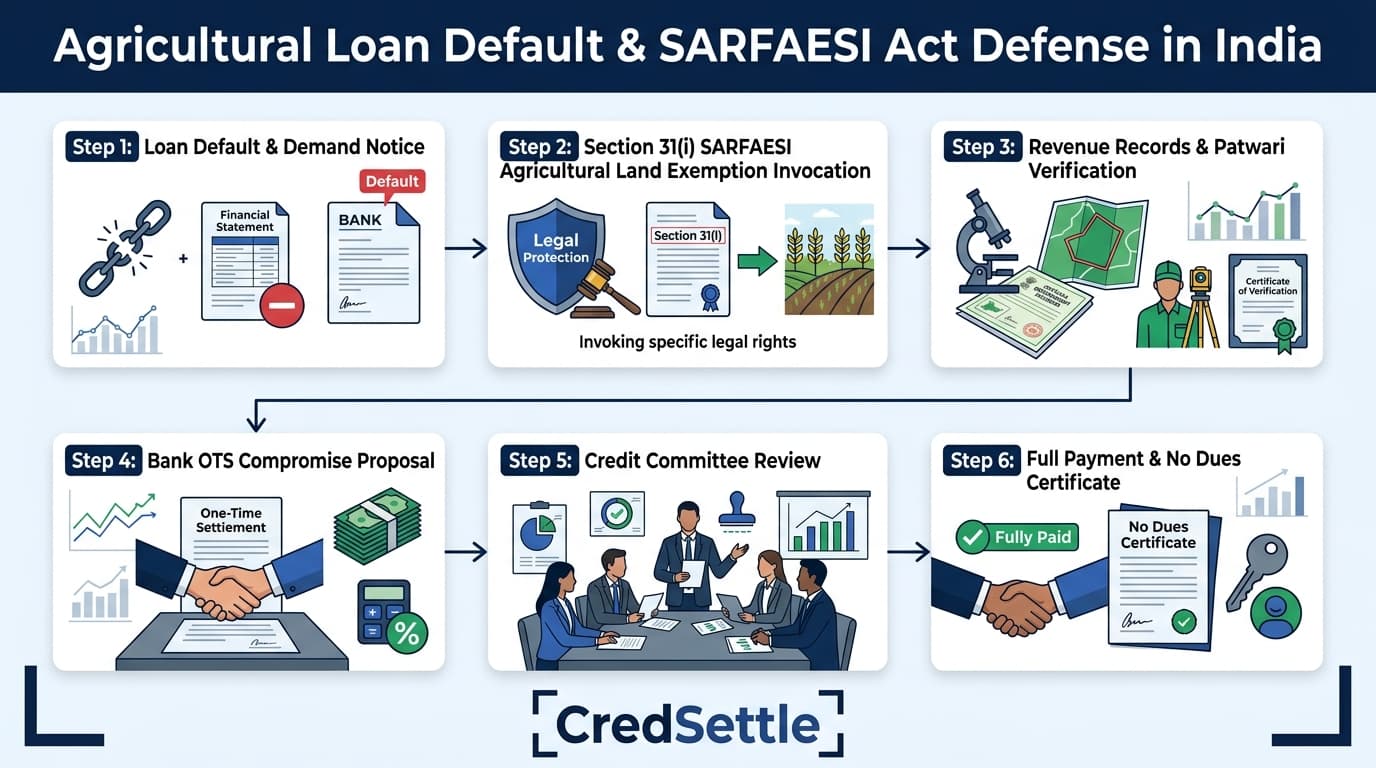
Visual Defense Roadmap: 6-Stage Farm Loan Defense Protocol
This full visual roadmap outlines the sequential. Battle-tested legal and procedural blueprint to challenge unlawful SARFAESI notices. Enforce Section 31(i) farm exemptions. settle a full OTS deals:
5. Step-by-Step SOP: Agricultural Loan Settlement Protocol
Follow this proven six-stage standard operating procedure to defend your farm property against unlawful bank claims and secure a formal OTS deals:
Loan Agreement, Sanction Terms & Title Document Forensic Audit
Examine all original sanction letters. Mortgage deeds, and KCC limit renewals. Cross-examine claimed bank interest rates against RBI farm master directions. Isolating unapproved penal compounding, cover deductions. Un-subvented charges.
Revenue Records Verification & Section 31(i) Evidence Compilation
Procure certified land income records. Including 7/12 extracts, Khasra, Khatauni. And Patwari crop verification letters. Establish documented proof of ongoing farm activity to construct an unassailable legal defense under Section 31(i).
Section 13(3A) Statutory Objection Representation
Serve a formal legal legal help upon the bank Authorised Officer within 60 days of receiving a Section 13(2) notice. Cite Section 31(i) and Supreme Court rulings. Demanding the fast withdrawal of SARFAESI proceedings against the farm land.
DRT Section 17 Securitisation Application & Stay Petition
If the lender attempts physical or symbolic takeover under Section 13(4). File an fast Securitisation Application before the jurisdictional Debt claims Tribunal under Section 17. Secure an interim stay against takeover and auction actions.
Bilateral Agricultural OTS Proposal & Credit Committee Review
Leverage the legal roadblock to submit a structured One-Time Settlement dossier to the bank Settlement alert boards. Present genuine crop loss records to settle a 40% to 55% waiver on total dues.
Compromise Remittance & No Dues Certificate (NDC) Issuance
pay the approved payout sum straight into the bank loan account against a verified sanction letter. Secure the formal No Dues letter. Retrieve original title deeds. And release income charges at the Sub-Registrar office.
6. Statutory Notice Defense: Legal Protections for Farmers
Defending against bank legal notices in farm loan defaults requires a full understanding of Indian legal banking jurisprudence. Lenders often deploy a combination of demand notices under the SARFAESI Act. Dishonored cheque complaints under Section 138 of the Negotiable Instruments Act. 1881. Electronic mandate failure notices under Section 25 of the Payment and Settlement Systems Act. 2007. Each of these legal mechanisms possesses distinct legal thresholds and procedural safeguards.
Under Section 31(i) of the SARFAESI Act. 2002. The bar against proceeding against farm land is absolute and non-derogable. The Supreme Court of India has reaffirmed in landmark judgments including. ITC Ltd. v. Blue Coast Hotels Ltd. (2018). and Indian Bank v. K. Pappireddiyar (2018). that the character of land must be determined based on formal income records. Farm entries in income extracts. Actual farm activity rather than the mere nomenclature in a bank loan mortgage paper. If a bank issues a notice under Section 13(2) demanding takeover of farmland. The client must submit a formal response under Section 13(3A) within sixty days. Placing these certified income extracts on record.
When lenders initiate quasi-criminal proceedings under Section 138 of the NI Act or Section 25 of the PSSA for security cheques or NACH auto-debit bounces. Clients must understand that these are bailable summons cases. Securing bail through counsel on the first appearance is a straightforward procedural step. Clients can then establish that the cheques were issued strictly as undated loan security rather than in discharge of a crystallized debt. Opening the gateway for bilateral talks and compounding under Section 147 of the NI Act.
also. The Reserve Bank of India Fair Practices Code strictly prohibits lenders and their claims agents from engaging in physical threats. Verbal abuse. Visiting clients outside the designated hours of 8:00 AM to 7:00 PM. Banks are also mandated to align farm claims with local crop cycles and harvest seasons. This provides moratoria during documented droughts or natural disasters.
7. 3-Tier Escalation Matrix: Institutional Grievance Redress
If branch managers or claims agents disregard Section 31(i) legal protections or engage in unlawful claims abuse. Escalate through this structured 3-tier RBI hierarchy:
Formal Written Objection & Revenue Record Submission
Submit a registered written complaint to the branch manager and bank internal Grievance Redressal Officer. Enclose certified income extracts proving the farm nature of the property and request the formal stoppage of unlawful SARFAESI claims notices.
Escalation for Compromise Settlement & Harassment Redressal
If the branch fails to withdraw improper notices or settle in good faith. Escalate to the main loan Nodal Officer at the bank head office. Request the referral of the loan account to the farm One-Time Settlement boards for a structured OTS deal.
Regulatory Complaint via CMS Portal & Article 226 Petitions
File a RBI complaint on the RBI CMS portal (cms.rbi.org.in) under the Reserve Bank - Integrated Ombudsman Scheme. 2021 for violation of farm lending norms. Concurrently. File a Writ Petition under Article 226 before the High Court if physical takeover is threatened.
8. Procedural Timeline: Default to No Dues Certificate
Navigating an farm loan relief requires understanding key procedural milestones from initial default to final debt closure:
| Timeline Phase | Institutional Event. | Statutory Limitation. | Strategic Borrower Action. |
|---|---|---|---|
| Days 1. 90 | SMA-0 to SMA-2 default. | before NPA declaration. | Audit loan ledger &. seek crop restructuring if applicable. |
| Day 90+ | NPA Classification &. Demand Notice. | Section 13(2) issuance. | File Section 13(3A) legal help invoking Section 31(i). |
| Months 3. 4 | Legal Roadblock &. OTS Window. | Bilateral talks stage. | Submit hardship dossier to bank OTS Settlement boards. |
| Months 5. 6 | OTS Approval &. Remittance. | Within 30 days of sanction. | pay OTS deal amount and obtain formal No Dues letter. |
9. Specialized Scenarios: Crop Loss, Tractors & ARCs
farm lending encompasses diverse credit structures with distinct legal implications:
Crop Failure, Drought & State Calamity Relief
When areas administrations declare a drought. Flood. Natural calamity. RBI Master Directions require banks to convert short-term crop loans into medium-term loans with a moratorium of one to two years. Farmers can present calamity notifications to restructure dues and halt all adverse claims actions.
Tractor & Farm Equipment Hypothecation vs Land Exemption
While farm land cannot be auctioned under SARFAESI. Movable farm tools like tractors and harvesters are hypothecated chattels. Lenders can repossess tools under contract terms. They must strictly adhere to RBI Fair Practices Code. Provide advance notice. And avoid physical force.
Agricultural Loans Sold to Asset Reconstruction Companies (ARCs)
When banks assign overdue farm loan portfolios to ARCs under Section 5 of the SARFAESI Act. ARCs inherit the same legal restrictions. They cannot enforce SARFAESI on farmland. Because ARCs acquire bad loan portfolios at deep discounts. They are highly motivated to settle fast OTS deals.
Joint Ancestral Mortgages and Co-Borrower Liability
In joint family farm holdings where multiple co-owners execute mortgage deeds. Banks cannot partition or auction undivided farm shares under SARFAESI. The Section 31(i) exemption protects all undivided ancestral land parcels against summary disposal.
 Legal Debt Dispute Authority
CredSettle (credsettle.com) is India's premier debt settlement, loan dispute resolution, and legal protection platform. Operating strictly under the RBI Fair Practices Code and CICRA 2005, our advocate panel negotiates directly with Bank Principal Nodal Officers to eliminate waived differentials, obtain unconditional No Dues Certificates (NDC), and upgrade credit bureau records from "Settled" to "Closed".
Frequently Asked Questions: Farm Loan Defaults & SARFAESI
Click on any question below to view detailed legal answers verified by our debt relief workers:
Statutory References & Official Regulatory Citations
- SARFAESI Act, 2002: Section 31(i) (legal Exemption for farm Land) and Sections 13(2). 13(3A). 13(4). And 17.
- Supreme Court of India: ITC Ltd. v. Blue Coast Hotels Ltd. (2018) 15 SCC 99. and Indian Bank v. K. Pappireddiyar (2018) 18 SCC 252. (income Records Determine farm Character).
- Claims of Debts and Bankruptcy Act. 1993: Section 19 (Tribunal police area for Claims Exceeding ₹20 Lakhs).
- Reserve Bank of India: Master Direction on Priority Sector Lending - farming and Master Direction on Fair Practices Code for Lenders (Updated 2026).
- Credit Information Companies (Regulation) Act. 2005 (CICRA): Section 21 (strict Credit Bureau Dispute Rectification).