Civil Suit for Recovery of Money by Bank: Order 37 CPC Defense
Has your bank instituted a summary civil collection suit under Order 37 CPC for an unpaid loan or credit card? Learn your 10-day timeline to file an appearance and Leave to Defend. Contest inflated penal claims, protect own assets. Secure a 40% to 60% OTS deals.
1. Debt Economics: Bank Civil Suits & Delinquency Cycle
When money hardships like company layoffs, trade losses. Medical crises disrupt cash flows. No-collateral credit facilities like private loans and credit cards enter default. Under RBI prudential rules, unpaid loans transition across Special Mention Accounts: SMA-0 (1. 30 days overdue), SMA-1 (31. 60 days). SMA-2 (61. 90 days). Beyond 90 days, the lender statutorily classifies the loan as a Non-Performing Asset (NPA). Triggering heavy Tier-1 cash provisioning requirements.
For no-collateral loan balances under ₹20 Lakhs. Lenders cannot approach the Debt collection Tribunal (DRT). Since no physical asset is hypothecated or mortgaged. The drastic property seizure powers under Section 13(4) of the SARFAESI Act are also unavailable. To recover dues, banks file summary civil suits under Order 37 CPC rather than ordinary suits under Order 7. Seeking to obtain quick money decrees by curtailing the client&apos. s right to defend unless leave is granted.
For the client, this summary rules requires swift procedural action. Entering a timely appearance and raising large legal defenses blocks fast summary judgments, forcing the bank&apos. s stressed asset cell to settle a realistic OTS deal One-Time Settlement (OTS).
2. Financial Breakdown: Principal vs Inflated Bank Claims
A frequent issue in bank collection suits is the massive inflation of demand amounts. Once an account defaults, banking software automatically layers compounded penal interest. Late payment penalties, bounce charges. lawsuits fees on top of regular interest. Over 12 to 24 months. These unapproved charges often inflate the claimed amount by 45% to 75% above the true base loan.
Indian contract jurisprudence strictly prohibits capitalizing penal interest into main loan balances. The audit below breaks down a agent ₹15 Lakhs no-collateral private loans default. Showing how arbitrary compounding inflates bank claims and illustrating the achievable OTS deals range:
Representative Financial Breakdown & Compromise Target
Note: OTS deals are structured upon verified hardship and legal challenges against penal compounding. Settlement amounts are payable straight to the bank against a formal sanction letter.
3. Legal Forum Matrix: Civil Suits vs Other Debt Forums
banks choose collection avenues based on loan size, security, and contractual terms. Understanding how Order 37 summary suits compare to ordinary suits, DRT proceedings, arbitration. Lok Adalats helps clients select the right legal plan:
| Recovery Forum | Pecuniary Range | Governing Law | Arrest Powers | Appeal Mechanism. | Key Defense Strategy. |
|---|---|---|---|---|---|
| Summary Civil Suit (Order 37 CPC). | Below ₹20 Lakhs | CPC, 1908 | NO (Money collection). | Regular First Appeal (RFA) to areas / High Court. | File 10-day Appearance &. Leave to Defend establishing triable issues. |
| Regular Money Suit (Order 7 CPC). | Any police area. | CPC, 1908 | NO (Civil Remedy). | First Appeal (Sec 96 CPC). | File 30-day Written record, dispute ledgers &. examine bank witnesses. |
| Debt collection Tribunal (DRT). | ₹20 Lakhs &. Above. | RDB Act, 1993 | NO (Special Tribunal). | DRAT (Sec 20) with 25%-50% Pre-deposit. | File Section 19(5) WS, contest penal interest &. settle OTS deal OTS. |
| Arbitration Tribunal. | Contractual Value. | Arbitration Act, 1996. | NO (Private Forum). | Section 34 Petition in Civil Court. | Challenge unilateral arbitrator appointment under Perkins Eastman ruling. |
| National Lok Adalat. | Consensual Settlement. | Legal Services Act, 1987. | NO (Pure talks). | Non-Appealable (Final Consent Award). | Execute mutually agreed OTS with full waiver of penal interest. |
| Inaction / Missing 10-Day Window. | N/A | Ex-Parte Decree | Account Garnishee Risk. | Order 37 Rule 4 Set-Aside Petition. | Results in fast money decree and execution against bank accounts. |
4. CIBIL Algorithm: Credit Score Trajectory & Repair
When a bank files a civil suit. It reports the lawsuits to all four licensed credit bureaus: TransUnion CIBIL, Equifax, Experian. CRIF High Mark. Credit scores are computed across five core parameters: payment history (35%). Credit use (30%), credit history length (15%), credit mix (10%). New inquiries (10%).
Defaulting past 90 DPD drops scores by 100 to 180 points. Crucially, a ". Suit Filed". Remark creates an fast bank block across Indian lenders. Preventing approvals for fresh private, home, or trade credit.
Resolving the suit through a OTS deal OTS resolves this freeze. Under Section 21 of CICRA 2005. The lender must update credit bureaus to ". Settled". Or ". Closed". within 30 days of receiving settlement funds and issuing an NOC. This stops negative DPD reporting and allows clients to rebuild credit scores back to 750+ over 18 to 24 months.
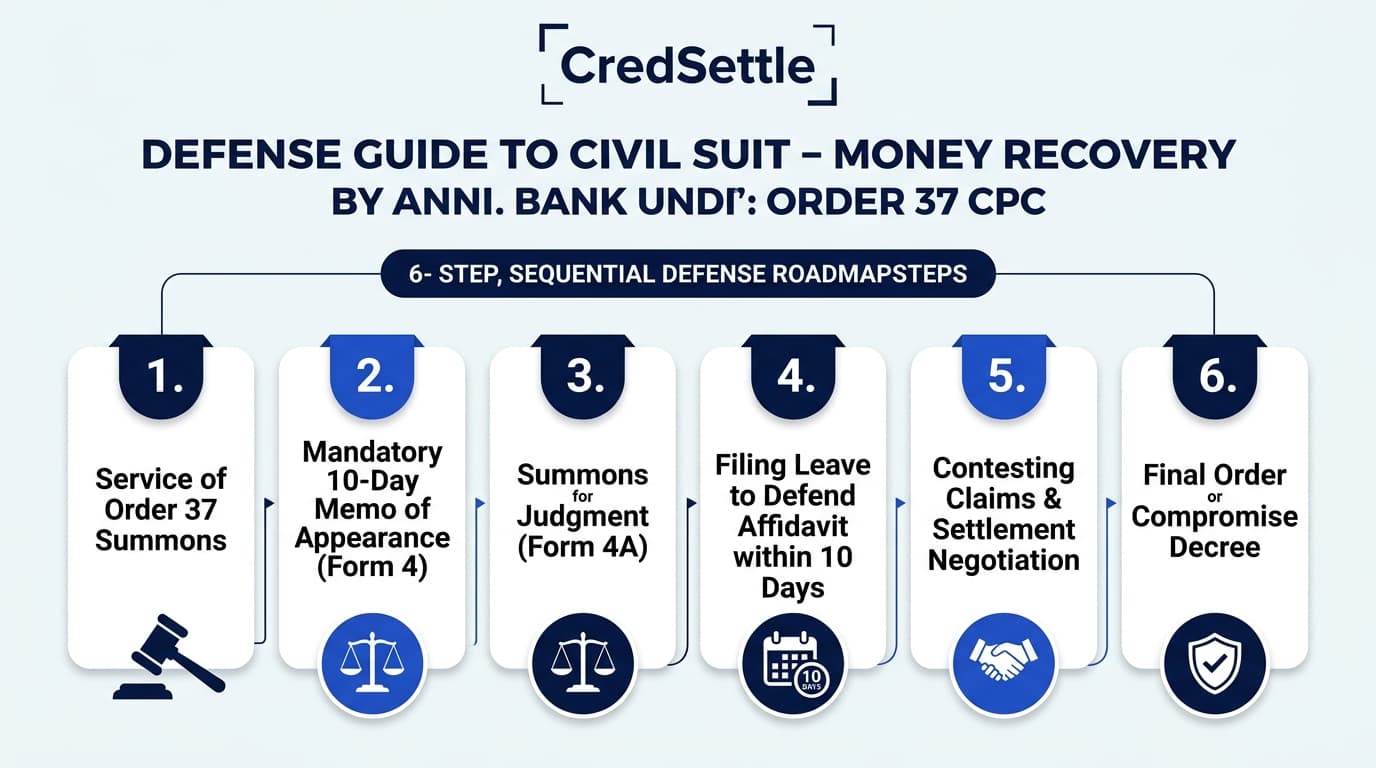
Visual Blueprint: 6-Step Order 37 CPC Defense Workflow
Review the procedural roadmap below detailing the step-by-step defense sequence under Order 37 CPC. From initial summons receipt to decree disposal and credit restoration:
5. Step-by-Step SOP: 6-Stage Civil Suit Defense Protocol
Handling an Order 37 summary suit requires strict adherence to legal deadlines and procedural precision. Follow this 6-stage daily work protocol:
Summons Audit & Service Verification
Verify the Order 37 Form 4 summons and delivery date to start the 10-day appearance clock. Audit the plaint annexures and account records under the Bankers Books proof Act for interest compounding errors.
Filing Mandatory Memo of Appearance (Form 4)
File a formal Memo of Appearance under Order 37 Rule 3(1) CPC within 10 days of service. Serve a copy on bank counsel to formally notify the court and prevent an ex-parte money decree.
Examination of Summons for Judgment (Form 4A)
Upon receiving the bank&apos. S Form 4A Summons for Judgment and affidavit. Evaluate whether procedural mandates are met. Identify flaws like unliquidated damages. Time-barred claims, or missing loan pacts.
Filing Leave to Defend Application & Affidavit
File an Application for Leave to Defend with supporting affidavit under Order 37 Rule 3(5) CPC within 10 days of Form 4A. Raise triable issues under the Hubtown ruling to secure full leave.
Bilateral Compromise Settlement Negotiations
Use legal defenses and accounting disputes to engage the bank&apos. s Stressed Asset relief boards. settle an affordable OTS deal OTS with a 40% to 60% waiver formalized in an formal sanction letter.
Joint Compromise Decree, Case Withdrawal & NDC
File a joint OTS deal petition under Order 23 Rule 3 CPC upon paying settlement funds. The court disposes of the suit as satisfied. Followed by issuance of a No Dues letter and credit bureau closure.
6. Statutory Notice Defense: Order 37 & Limitation Rights
A robust defense against a summary collection suit is grounded in legal procedural safeguards under the CPC, Limitation Act. Supreme Court rulings across four key pillars:
In IDBI Trusteeship Services Ltd. v. Hubtown Ltd. (2017), the Supreme Court established that when a defendant raises plausible. Triable issues regarding debt calculations. The court must grant full leave to defend.
Banks must file collection suits within strictly 3 years from the date of default. Without a written acknowledgment under Section 18 within this 3-year window. The claim is legally time-barred and must be dismissed.
Under Section 34 CPC and Central Bank of India v. Ravindra (2002), courts hold broad discretion over interest rates and cannot permit compounding of penalty charges. This lets clients to dispute inflated demands.
Section 60 CPC protects primary residential dwellings. Essential household items, trade tools, strict salary portions. Provident Fund balances from judicial attachment during execution.
7. 3-Tier Escalation Matrix: Institutional Redressal
clients facing unreasonable collection lawsuits or agent misconduct can escalate through a structured 3-tier grievance rules:
Internal Representation & Stressed Asset Committee
Submit a formal legal legal help to the bank&apos. S main loan Nodal Officer highlighting ledger errors and hardship. Seeking reference to the Stressed Asset relief boards for an OTS.
Section 89 CPC Alternative Dispute Resolution
Apply under Section 89 CPC to refer the collection suit to court-annexed mediation or National Lok Adalat for neutral talks and major compound interest waivers.
Complaint on CMS Portal (cms.rbi.org.in)
Lodge a formal complaint on the RBI CMS portal if the lender employs abusive collection tactics, contacts third-party references. Denies certified account records.
8. Chronological Milestones: Summons to Final Decree
Tracking the chronological timeline of an Order 37 summary collection suit ensures timely defense filings and effective settlement positioning:
| Procedural Phase. | Judicial Milestone. | Statutory Limitation. | Strategic Borrower Action. |
|---|---|---|---|
| Day 1 | Service of Order 37 Form 4 Summons. | Date of registered post delivery. | Preserve postal envelope, audit loan ledger &. consult legal experts. |
| Days 1. 10 | Filing Memo of Appearance in Form 4. | Strictly 10 days from service. | Enter court appearance and serve formal notice on bank counsel. |
| Days 15. 25 | Service of Summons for Judgment (Form 4A). | Bank procedural trigger. | Audit bank affidavit, detect accounting errors &. time-bar flaws. |
| Days 25. 35 | Filing Leave to Defend Affidavit. | Strictly 10 days from Form 4A. | Submit full defense affidavit establishing triable issues. |
| Months 2. 3 | OTS deals &. Mediation Window. | Pre-decree discussion phase. | settle 40% to 60% OTS waiver with Bank Zonal relief Cell. |
| Months 3. 4 | Joint OTS deal Decree &. Suit Disposal. | Order 23 Rule 3 disposal. | pay settlement funds, obtain NDC &. verify credit bureau update. |
9. Specialized Scenarios: High-Exposure Recovery Suits
Bank collection suits often intersect with complex employment. Card debt, and assignment scenarios. Understanding these variations helps clients formulate precise defenses:
Unsecured Personal Loans Under ₹20 Lakhs
Salaried workers facing income loss who defaulted on no-collateral loans (₹5L to ₹19L) receive Order 37 summons. With DRT and SARFAESI unavailable. Showing hardship and interest errors incentivizes banks to approve structured OTS deals.
Credit Card Civil Recovery Suits
Card balances subject to 42% to 48% annual charges can be contested in the Leave to Defend affidavit under Section 34 CPC and the Usurious Loans Act. Forcing issuers to reduce claims to actual main loan spent.
Guarantor Liability in Civil Suits
private guarantors impleaded in collection suits possess distinct legal protections under Sections 133 to 141 of the Indian Contract Act regarding contract variances or creditor negligence.
Debt Assigned to ARCs
When bad loans are assigned to ARCs under Section 5 SARFAESI. ARCs substitute themselves under Order 22 Rule 10 CPC. Because ARCs acquire portfolios at 70% to 80% discounts. They readily accept discounted settlements.
 Legal Debt Dispute Authority
CredSettle (credsettle.com) is India's premier debt settlement, loan dispute resolution, and legal protection platform. Operating strictly under the RBI Fair Practices Code and CICRA 2005, our advocate panel negotiates directly with Bank Principal Nodal Officers to eliminate waived differentials, obtain unconditional No Dues Certificates (NDC), and upgrade credit bureau records from "Settled" to "Closed".
Frequently Asked Questions: Bank Civil Recovery Suits
Click on any question below to explore authoritative legal answers verified by our banking compliance and debt relief workers:
Statutory References & Official Regulatory Citations
- Code of Civil Procedure, 1908: Order 37 Rules 1. 7 (Summary Procedure), Section 34 (Interest). Section 60 (Exemptions), Order 23 Rule 3 (OTS deal).
- Limitation Act, 1963: Articles 19 &. 21 (3-Year Limitation Period), Section 18 (Acknowledgment of Debt).
- Supreme Court rulings: IDBI Trusteeship Services Ltd. v. Hubtown Ltd. (2017) 1 SCC 568. (Leave to Defend) &. Central Bank of India v. Ravindra (2002) 1 SCC 367. (Compound Penal Interest).
- RBI Master Directions: Fair Practices Code for Lenders. Grievance Redressal, and NPA Prudential Norms (Updated 2026).
- CICRA, 2005: Section 21 (strict Accuracy, Dispute relief, and Bureau Reporting Post-Settlement).