Can Banks Legally Attach Pension Funds for Loan Recovery?
Understand your absolute legal immunity under Section 60 CPC and Section 11 of the Pensions Act. Learn how to stop illegal bank liens. Halt claims agent abuse. And settle a lawful debt settlement.
Senior citizens in India enjoy robust. Non-negotiable legal safeguards against bank attachments. Court garnishments, and coercive debt claims:
- Absolute legal Immunity: Under Section 60(1)(g) CPC and Section 11 of the Pensions Act. Pension stipends. Gratuity. EPF balances are strictly exempt from court attachment.
- Illegal Banker Set-Off: Banks cannot unilaterally exercise Section 171 banker lien to debit or freeze dedicated retirement pension accounts for unpaid loans.
- Zero Arrest or Family debt risk: Loan default is purely a civil dispute. Civil courts never issue arrest warrants for bankruptcy. Nor are non-borrowing family heirs liable.
- Anti-abuse Shield: RBI Fair Practices Code strictly prohibits threatening phone calls. Unannounced home visits. And debt abuse against senior citizens.
- OTS deal OTS Relief: Retired clients can settle unmanageable loan debts at a 40% to 55% discount through formal bank One-Time Settlement.
1. Pension Protection: Section 60 CPC & Debt Economics
Many senior citizens in India find themselves trapped in unmanageable debt due to escalating post-retirement healthcare costs. Sudden family emergencies. Co-signing private loans for relatives. When regular EMI payments become unsustainable on fixed pension incomes. Aggressive claims departments often issue alarming threats. Claiming that the bank will seize monthly pension disbursements. Freeze savings accounts. Initiate court warrants to confiscate retirement gratuities.
These claims threats straight contradict Indian legal law. Under. Section 60(1)(g) of the Code of Civil Procedure. 1908 (CPC).Stipends and pensions allowed to pensioners of the government or payable out of any service family pension fund are expressly exempted from civil attachment and court execution. also,. Section 11 of the Pensions Act. 1871. establishes that no pension granted by the government on account of past services can be seized or attached by any process of law at the instance of a creditor.
From a banking balance sheet perspective. Once an no-pledge credit card or private loans defaults past 90 days. It is classified as a Non-Performing Asset (NPA) under Reserve Bank of India prudential norms. Because no-pledge loans carry no underlying physical security for SARFAESI actions. Legal pension immunity renders post-decree salary garnishment legally impossible. Lending institutions recognize that protracted lawsuits offers negligible trade yield. As a result. Banks actively prefer settling a structured One-Time Settlement (OTS) to recover core main loan cash.
2. Financial Breakdown: True Dues vs Settlement Math
When a senior citizen misses consecutive loan installments. The lender ledger balloons rapidly. Banks automatically apply compound penal interest. Late payment surcharges, cheque bounce charges. office claims costs on top of the original main loan. Within 12 to 18 months of default. These illegal additions often inflate the claimed unpaid dues by 35% to 70% above the genuine borrowed main loan.
During legal debt relief talks. CredSettle performs a full audits of the loan account to strip away all capitalized penalty charges and unnotified fees. Because the bank has already made 100% provisioning against the bad asset on its books. Our workers leverage the client’s senior citizen status. Medical hardship records. Fixed pension constraints to secure a large 40% to 55% waiver against the total claimed debt risk.
Representative Breakdown: ₹8,50,000 Total Bank Demand vs. 52% OTS Discharge
By presenting documented medical expenses and invoking legal pension protections under Section 60 CPC. The retired client eliminated all penal interest and closed the entire debt risk in two manageable installments with a stamped No Dues letter.
3. Legal Matrix: Pension Attachment vs Debt Remedies
Understanding the critical legal distinctions between various debt claims actions and client defense mechanisms ensures that senior citizens can protect their hard-earned retirement savings effectively:
| Recovery Mechanism. | Governing Legal Statute. | Pension Impact | Legal Vulnerability & Limits. | Recommended Borrower Action. |
|---|---|---|---|---|
| Court Garnishee Order. | Order XXI Rule 46 CPC. | Zero (Fully Exempt). | Section 60(1)(g) CPC expressly prohibits execution warrants against pension stipends. | File an objection memo citing Section 60(1)(g) CPC before the executing civil judge. |
| Banker&apos. s Right of Set-Off. | Section 171 Contract Act. | High (If in same bank). | Banks attempt internal debit. overridden by Supreme Court rulings protecting pension character. | Issue a formal legal notices to unfreeze funds and shift pension to a separate nationalized bank. |
| Summary Suit / DRT Claim. | Order XXXVII CPC / RDB Act. | Zero on Pension | Judicial decrees cannot attach retirement gratuity. EPF, or family pension funds. | File a leave to defend showing genuine debt stress and propose an OTS. |
| Lok Adalat Settlement. | Legal Services officials Act. | Voluntary Mutual Term. | Consent award passed by judicial bench. final and non-appealable in any court. | Ensure settlement terms are fully vetted and affordable before signing the OTS deal award. |
| One-Time Settlement (OTS). | RBI Stressed Assets rules. | 100% Debt Relief. | Bilateral OTS deal pacts providing 40% to 55% discount and full debt risk release. | Recommended: Secure a written bank sanction letter and obtain a stamped NDC. |
4. CIBIL Impact: Senior Citizen Score Restoration
When a loan or credit card goes into default. Credit information bureaus in India compute the credit score degradation across five weighted algorithmic variables. Understanding this distribution helps senior citizens plan effective post-settlement credit rehabilitation:
During unresolved default. Credit scores typically plunge from prime tiers (750+) down to 500-580. Once a One-Time Settlement is completed and the bank issues a stamped No Dues letter. The reported unpaid dues drops to zero. Under. Section 21 of the Credit Information Companies (Regulation) Act. 2005 (CICRA).Clients have the legal right to mandate that bureaus update inaccurate or overdue records. By managing a fixed-deposit-backed credit card with timely payments. Senior citizens can successfully rebuild their CIBIL score back to 750+ within 12 to 18 months.
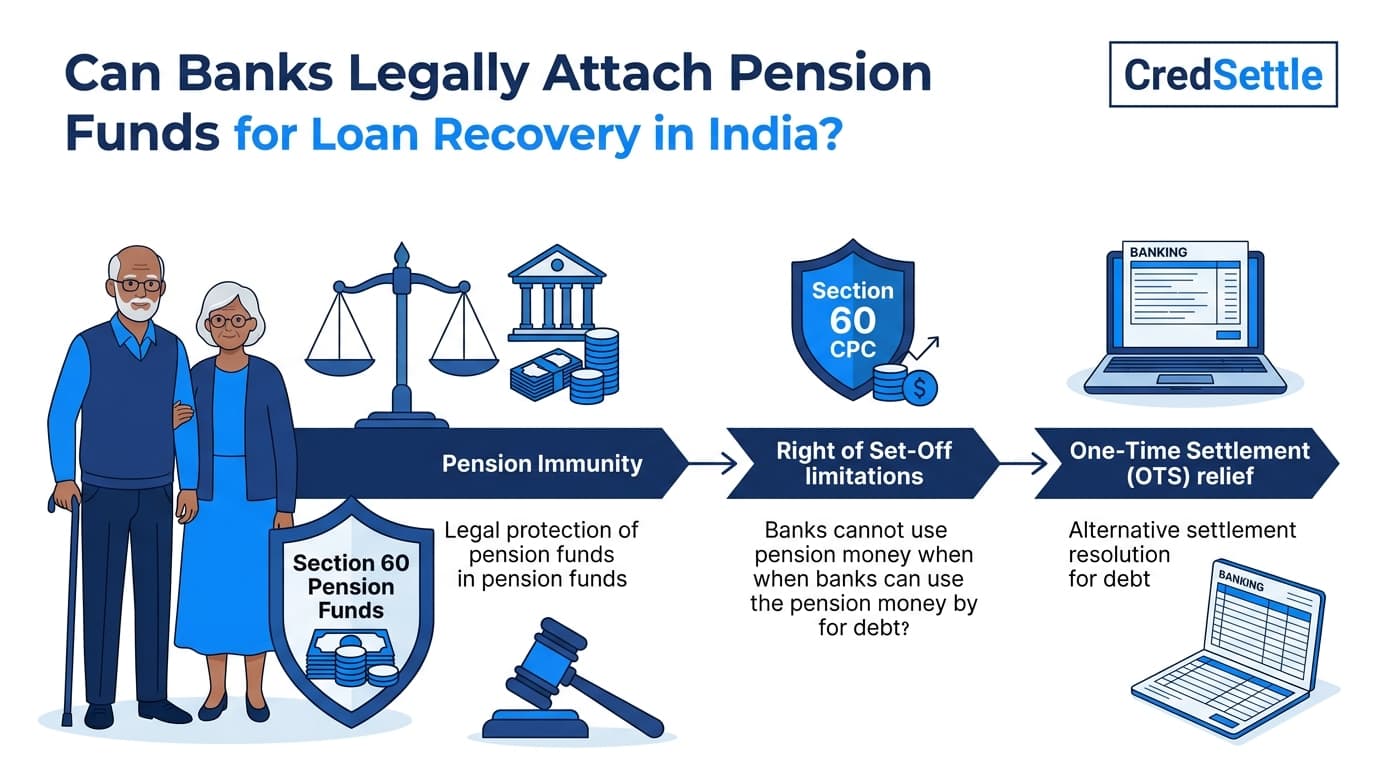
Visual Blueprint: Pension Protection & Legal Defense
Review this visual blueprint detailing the legal immunity of pension funds under Section 60 CPC. Restrictions on banker lien set-offs. The structured CredSettle debt relief protocol:
5. Step-by-Step SOP: 6-Stage Pension Defense Protocol
If you are a retired senior citizen facing loan default or aggressive claims action. Executing this structured legal standard operating procedure ensures complete asset protection and debt closure:
Account Audit & Segregation
Perform a audits of bank records to isolate pension disbursements from other funds and ensure the pension account is held in an unlinked nationalized institution.
Hardship Dossier Compilation
Compile medical bills. Age letters. Fixed pension slips. Dependent care costs into an authoritative hardship portfolio showing genuine inability to pay full dues.
Section 60(1)(g) Legal Notice
Serve a formal legal legal help to the lender citing legal pension exemptions under CPC and RBI Fair Practices Code. Barring claims agents from visiting your residence.
Direct SARB Negotiations
Initiate bilateral talks straight with the bank Stressed Assets claims Branch (SARB) to eliminate all penalty charges and establish a 40% to 55% settlement baseline.
Sanction Letter Legal Audit
Verify the formal bank OTS sanction letter to confirm exact payment dates. Total waiver terms. Explicit clauses promising complete debt discharge and tradeline closure.
Remittance & NDC Issuance
pay the agreed payout sum straight to the bank loan account. Collect a stamped No Dues letter. Ensure the bank updates all credit bureaus with zero balance.
6. Statutory Notice Defense: Senior Citizen Legal Rights
Senior citizen clients are safeguarded by robust constitutional. Legal. And judicial doctrines against coercive bank claims practices:
Section 60(1)(g) CPC & Pensions Act
Pensions, gratuities. Family allowances enjoy complete legal immunity from civil execution decrees. Attachment orders. Creditor seizures under Indian civil law.
Section 25 PSSA & NI Act Defenses
Senior citizens facing NACH or cheque bounce notices can defend on grounds of genuine money incapacity. Lack of fraudulent mens rea. Willingness to settle main loan dues.
Supreme Court Judicial Precedents
Landmark rulings (Radhey Shyam Gupta v. Punjab National Bank) affirm that retirement funds do not lose their exempt character even after being deposited in the pensioner&apos. s bank account.
RBI Fair Practices & Senior Dignity
Lenders must respect the dignity of elderly citizens. claims visits outside prescribed hours. Threats. Shouting. Or contacting family members violate RBI directives and invite penal action.
7. 3-Tier Escalation Matrix: Institutional Redressal
If a lender unlawfully freezes your pension account. Attempts illegal debits. Unleashes abusive claims agents. Escalate systematically through this bank grievance hierarchy:
Branch Manager & GRO
Submit a formal written protest citing Section 60(1)(g) CPC and demand fast reversal of illegal holds or illegal auto-debits on your pension account.
Principal Nodal Officer
Escalate unresolved grievances to the bank main loan Nodal Officer (PNO) highlighting violations of RBI Fair Practices Code and senior citizen protection rules.
RBI Integrated Ombudsman
File an formal digital complaint on cms.rbi.org.in for payout against unlawful account restrictions. Mental distress, and agent abuse.
8. Procedural Timeline: Default to Lien Revocation
The chronological progression of senior citizen loan default. Bank claims stages. The optimal window for securing a OTS deals:
| Timeline Stage | Account Classification. | Creditor Recovery Action. | Senior Citizen Protection Action. |
|---|---|---|---|
| Days 1 to 90 | SMA-0, 1 &. 2 default. | Automated payment reminders. Telephonic notices. And overdue interest levies. | Audit debts. cancel NACH mandates in same bank. isolate pension account. |
| Days 91 to 180 | NPA Classification. | Legal recall notice issued. third-party claims firm assignment. | Issue anti-abuse notice. submit medical and senior citizen hardship dossier. |
| Months 6 to 12 | Legal Notice Stage. | Section 138 NI Act or Section 25 PSSA summons. civil suit notices. | Respond through legal counsel. assert Section 60 CPC pension immunity. |
| Months 12 to 18 | Stressed Assets Review. | 100% provisioning completed. bank writes off bad debt on internal ledger. | Engage bank Stressed Assets boards for an aggressive 40% to 55% OTS. |
| relief Phase. | OTS Sanction &. Closure. | Formal sanction letter issued. complete withdrawal of all legal notices. | Pay settlement sum, obtain stamped NDC. And verify zero CIBIL balance. |
9. Specialized Scenarios: Commuted Pension & EPF Funds
Different categories of retirement assets and account holding structures require local legal handling under Indian banking regulations:
Commuted Pension vs Monthly Pension
Both monthly pension stipends and commuted lump-sum pension payments retain absolute immunity from attachment under Section 60(1)(g) CPC. Provided the funds are clearly traceable to retirement benefits.
Joint Pension Accounts with Spouse
A bank cannot freeze or debit a joint pension savings account held with a non-borrowing spouse or family member. Lack of debt mutuality bars creditors from attaching co-holder funds.
Gratuity & EPF Retirement Corpus
Under Section 10 of the EPF Act and the Payment of Gratuity Act. Terminal retirement benefits cannot be attached by civil courts or appropriated by banks for no-pledge loan defaults.
Unlawful Auto-Debits & NACH Mandates
If a lending bank repeatedly executes automated ECS/NACH debits against your dedicated pension account. You have the legal right to revoke the standing mandate in writing under NPCI rules.
 Legal Debt Dispute Authority
CredSettle (credsettle.com) is India's premier debt settlement, loan dispute resolution, and legal protection platform. Operating strictly under the RBI Fair Practices Code and CICRA 2005, our advocate panel negotiates directly with Bank Principal Nodal Officers to eliminate waived differentials, obtain unconditional No Dues Certificates (NDC), and upgrade credit bureau records from "Settled" to "Closed".
Frequently Asked Questions: Pension Loan Settlement
Click on any question below to view detailed legal answers verified by our banking and debt relief workers:
Official Regulatory Citations & Statutory References
- Code of Civil Procedure, 1908 (CPC): Section 60(1)(g) (Exemption of Stipends and Pensions from Attachment). Ministry of Law and Justice.
- Pensions Act, 1871: Section 11 (Exemption of Pension from Attachment by Process of Court).
- Indian Contract Act, 1872: Section 171 (General Lien of Bankers) and Limits of Debt Mutuality.
- Payment of Gratuity Act, 1972: Section 13 (Protection of Gratuity against Court Attachment).
- Reserve Bank of India Master Directions: Fair Practices Code for Lenders and rules on claims Agent Conduct.