Can Bank Attach Ancestral Property for Personal Loan Default?
A clear legal guide for borrowers and families facing personal loan default in India. Learn Section 60 CPC rules, coparcenary share limits, why SARFAESI does not apply, and how to stop agent threats.
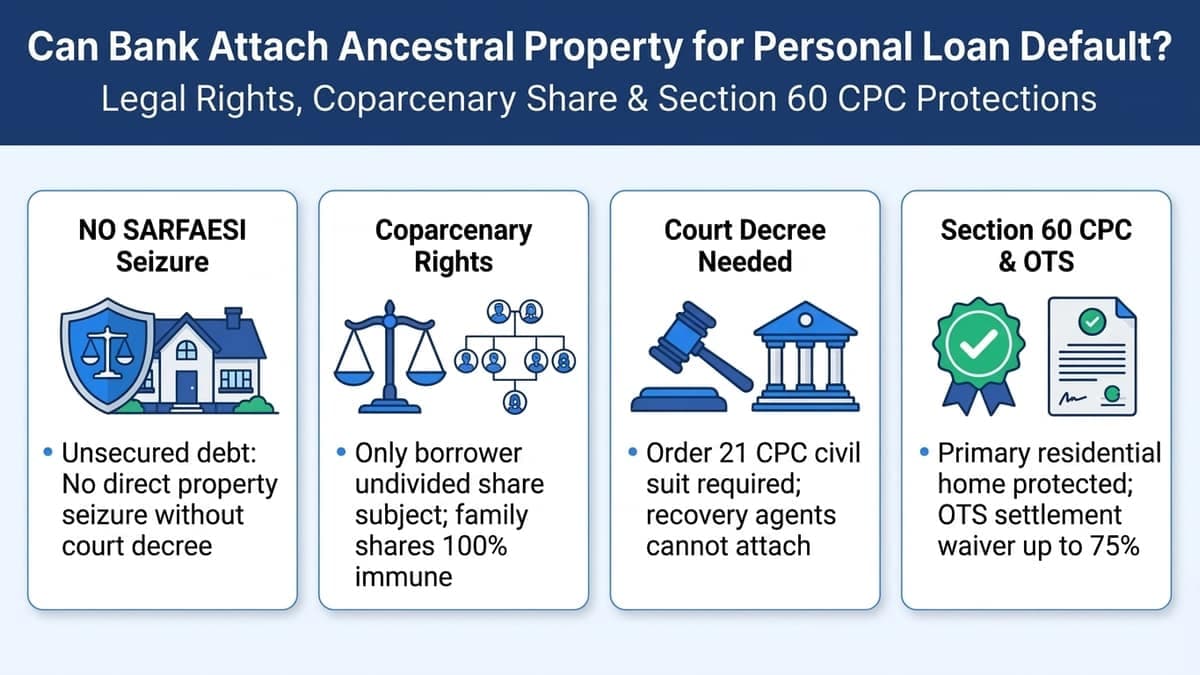
- No Direct Seizure Under SARFAESI: Personal loans have no collateral. Banks cannot use the SARFAESI Act to lock or sell your ancestral home.
- Family Shares Stay 100% Safe: A bank can never take the whole family house. Only the borrower’s own small share can ever face a court claim.
- Civil Court Order Needed: To touch even your small share, a bank must file a civil suit, win a decree, and apply under Section 60 of the CPC.
- Order 21 Rule 58 CPC Shield: Parents, brothers, sisters, and kids can file a claim in court to stop any wrong attachment of the family home.
- No Pious Duty for Family: Under Section 6(4) of the Hindu Succession Act, parents and kids do not have to pay another member’s personal loan.
1. Legal Rules: Can Banks Seize Ancestral Property?
When you miss EMIs on a personal loan or credit card, agents often visit your home. They may threaten to seal your ancestral house or sell your family land in a few days. These threats are fake and break Indian law.
A personal loan is an unsecured loan. You did not pledge any house, gold, or land to get the money. Because you gave no property papers to the bank, the lender has no direct right over your family home.
Many agents try to scare families by naming the SARFAESI Act, 2002. Under Section 13 of the SARFAESI Act, a bank can only seize property that was mortgaged for a secured loan, like a home loan. A bank can never use SARFAESI for a personal loan default.
What can a bank actually do? It must go to a civil court or the Debt Recovery Tribunal (DRT) if the debt is above ₹20 Lakhs. The bank must fight a full trial and win a money decree from the judge. Only then can it ask the court to attach your personal share under Section 60 of the Code of Civil Procedure (CPC), 1908.
3. Property Vulnerability: Attachment Comparison Matrix
Can a court attach a house or land? It depends on who owns the title deed and whether Section 60 of the CPC protects that asset.
Check the table below to see how Indian courts treat ancestral property, parents’ self-bought houses, farm land, and main family homes during loan recovery.
| Property Type | Law | SARFAESI Action | Civil Court Attachment | Best Legal Step |
|---|---|---|---|---|
| Parents’ Self-Bought House | Transfer of Property Act | Not Allowed. | 100% Safe (Zero Borrower Right). | Send legal warning to stop visits. |
| Family Members’ Ancestral Shares | Hindu Succession Act, 1956 | Not Allowed. | 100% Safe from Borrower Debt. | File claim under Order 21 Rule 58 CPC. |
| Farmer’s House & Farm Tools | CPC Sec 60(1)(b) & (c) | Not Allowed. | Fully Exempt by Law. | Show land records in civil court. |
| Main Family Home (Delhi/PB/HR) | CPC Section 60(1)(ccc) | Not Allowed. | Exempt for Unsecured Loans. | Claim main home shield in court. |
| Borrower’s Unsplit Ancestral Share | CPC Section 60(1) | Not Allowed. | Only After Decree & Partition. | Settle loan via OTS before decree. |
| Borrower’s Own Commercial Plot | Order 21 Rule 54 CPC | No (If Unpledged). | Can Be Attached After Decree. | Close debt early through OTS deal. |
4. Section 60 CPC & Supreme Court Rulings on Attachment
Indian law gives strong shields so that an unpaid personal loan does not put a family on the street. These rules are set in the Code of Civil Procedure, 1908, and the Hindu Succession Act, 1956.
First, Section 6(4) of the Hindu Succession (Amendment) Act, 2005 ended the old rule of pious obligation. For any debt taken after December 20, 2004, no court can force a son, daughter, or grandson to pay a father’s unsecured loan out of religious duty.
Second, banks sometimes ask a court to freeze property before the trial ends under Order 38 Rule 5 of the CPC (Attachment Before Judgment). In Raman Tech & Process Engg. Co. v. Solanki Traders (2008) 2 SCC 302, the Supreme Court ruled that a judge cannot attach property just because a loan is unpaid. The bank must prove that the borrower is secretly selling the house to cheat creditors.
Third, Section 60(1)(c) of the CPC protects houses occupied by farmers and workers. Also, under Section 60(1)(ccc) in Delhi, Punjab, Haryana, and Chandigarh, one main residential house of a borrower is fully exempt from attachment for unsecured loans, as held in Sikandar Singh v. Harjit Pal Singh.
5. Visual Blueprint: Ancestral Property Defense Flow
This visual chart shows the four legal walls that guard your ancestral home and family shares against personal loan recovery in India.
6. Step-by-Step SOP: 6-Stage Family Property Shield
If recovery agents or bank letters threaten to seize your ancestral house or your parents’ home, follow these six simple steps to protect your family and settle your loan.
1Stage 1: Check Your Title Deeds & Loan Papers
Make sure your personal loan is unsecured and that no parent signed as a guarantor. Keep your land records or parents’ sale deed ready to show that you do not own the house alone.
2Stage 2: Ignore Fake SARFAESI & Sealing Threats
If agents send fake house auction messages on WhatsApp or threaten to lock your gate, save the proof. No agent or bank officer can enter or seal an unpledged home without a civil court order.
3Stage 3: Send a Legal Reply to the Bank
Send a formal lawyer reply citing Section 60 of the CPC, Section 6(4) of the Hindu Succession Act, and RBI rules. Warn the bank that harassing your parents or co-owners will lead to an RBI complaint.
4Stage 4: File Order 21 Rule 58 Claim (If Suit Filed)
If a bank wins a civil decree and lists the family home for attachment, your parents or siblings can file an objection under Order 21 Rule 58 CPC. The court will protect their shares right away.
5Stage 5: Negotiate a One-Time Settlement (OTS)
Banks know that splitting an ancestral share in civil court takes 5 to 10 years. You can use this leverage to negotiate a One-Time Settlement (OTS) and cut 50% to 75% off your loan dues.
6Stage 6: Get Your No Dues Certificate
Check the official bank OTS letter before paying the settlement amount. Once paid, collect your No Dues Certificate (NDC) to close the loan forever and keep your family home safe.
7. Statutory Defense: Stop Recovery Agent Harassment
Agents who shout outside your family home, paste notices on your gate, or threaten your parents commit serious crimes in India. You and your family can use four strong laws to stop them at once.
Stepping into your home compound without consent or threatening parents with fake house seizure is criminal trespass (Section 329) and intimidation (Section 351) under the Bharatiya Nyaya Sanhita, 2023.
RBI rules strictly ban agents from calling or visiting family members, calling before 8:00 AM or after 7:00 PM, or shaming borrowers in front of neighbours.
If a bank wrongly lists a joint family house in a court execution case, any family member can file a claim under Order 21 Rule 58 CPC. This stops the sale right away.
Under Article 300A of the Constitution of India, no one can take your home without a valid court order. Private recovery agents have zero power to lock any house.
8. 3-Tier Escalation Matrix: Banking Grievance Steps
If agents bother your parents at your ancestral home or send fake court notices, file a complaint through this three-step RBI banking channel.
| Grievance Tier | Banking Authority | Time Limit | Action & Relief |
|---|---|---|---|
| Level 1: GRO | Bank Grievance Officer | 7 to 10 Working Days. | Stops agent visits to your parents’ home and notes your hardship. |
| Level 2: PNO | Principal Nodal Officer | 14 to 21 Working Days. | Removes rogue agencies, stops fake notices, and starts OTS talks. |
| Level 3: RBI Ombudsman | RBI Integrated Ombudsman | 30 Days Post-PNO. | Fines the bank via cms.rbi.org.in for harassing your family. |
9. Procedural Timeline: Default Stages to Court Action
Knowing the exact timeline from the first missed EMI to a civil suit helps you tell fake agent threats apart from real court steps.
| Time Window | Loan Status | Real Bank Power Over Property | Smart Borrower Step |
|---|---|---|---|
| Day 1 to 90 | SMA-0 to SMA-2. | Calls and visits; zero legal power over your home. | Tell family that agents cannot inspect or photo the house. |
| Day 91 to 180 | NPA Stage. | Loan marked NPA; bank sends demand or arbitration letter. | Send lawyer reply and challenge high penal interest. |
| Month 6 to 12 | Best OTS Window. | Lok Adalat invite sent; still zero house attachment. | Settle the loan with a 50% to 75% waiver via CredSettle. |
| Year 1 to 3 | Civil Suit. | Bank may file a civil money suit if the loan amount is large. | Defend the suit or sign a court settlement deal. |
| Year 3 and Beyond | Order 21 Stage. | Only after a final decree can bank target your small share. | Family files Order 21 Rule 58 claim; you settle the decree. |
10. Specialized Scenarios: Guarantors, HUF & Legal Heirs
Special legal rules apply when a parent signed as a guarantor, when a borrower passes away, or when the house is in your father’s own name.
Parents’ Own House vs Ancestral Home
If your father or mother bought the house with their own money, it is their self-acquired home. While they are alive, you have zero legal share in it. No court or bank can ever touch it for your loan.
When a Family Member Signed as Guarantor
Under Section 128 of the Indian Contract Act, 1872, a guarantor is just as liable as the borrower. If your parent signed as a guarantor, their share can also face a civil claim unless you settle via OTS.
Death of Borrower & Legal Heir Rules
If a borrower dies, banks cannot force the spouse or kids to pay from their own salary. Under Section 50 CPC, heirs are liable only up to the value of property they actually inherit from the deceased.
Gifting Your Share After Default (Sec 53 TPA)
Some borrowers try to gift their ancestral share to a sibling after missing EMIs. Under Section 53 of the Transfer of Property Act, 1882, a court can cancel transfers made to block creditors. An OTS is much safer.
 Legal Debt Dispute Authority
CredSettle (credsettle.com) is India's premier debt settlement, loan dispute resolution, and legal protection platform. Operating strictly under the RBI Fair Practices Code and CICRA 2005, our advocate panel negotiates directly with Bank Principal Nodal Officers to eliminate waived differentials, obtain unconditional No Dues Certificates (NDC), and upgrade credit bureau records from "Settled" to "Closed".
Frequently Asked Questions: Ancestral Property Attachment
Clear, verified legal answers to common questions on ancestral property protection, coparcenary shares, Section 60 CPC rules, and personal loan settlement in India.
Official Regulatory Citations & Statutory Legal Framework
- Code of Civil Procedure, 1908 (CPC): Section 60(1), Proviso Clauses (c) and (ccc), and Order 21 Rule 58 on family objections to attachment.
- Hindu Succession Act, 1956 (Amended 2005): Section 6 on coparcenary birth rights and Section 6(4) ending pious obligation for post-2005 debts.
- SARFAESI Act, 2002: Section 13 and Section 31, barring direct seizure for unsecured personal loans and farm lands.
- Transfer of Property Act, 1882 & Contract Act, 1872: Section 53 TPA on property transfers and Section 128 Contract Act on guarantor liability.
- Supreme Court of India Precedents: Raman Tech & Process Engg. Co. v. Solanki Traders (2008) 2 SCC 302 on Order 38 Rule 5 CPC attachment rules.