Documents Needed for Loan Settlement:
Hardship Proof & Checklist
Prepare for your settlement negotiation. Learn exactly which documents you need to prove financial hardship and secure the highest possible waiver.
- Burden of Evidentiary Proof on the Borrower: Under Reserve Bank of India (RBI) compromise settlement norms, banks cannot grant discretionary principal write-offs without an audited hardship dossier proving involuntary inability to pay.
- 4 Verified Hardship Categories: Lenders sanction maximum waivers (50% to 75%+) only when backed by objective documentation: medical summaries for chronic illness, official termination letters for job loss, audited P&L/GST returns for business collapse, or death certificates.
- Forensic Bank Statement Scrutiny: 6 to 12 months of certified account statements across all active accounts are audited by credit committees to verify zero hidden liquidity, low average monthly balances, and absence of fund diversion.
- Crucial Pre-Remittance CBS Sanction Letter: Never transfer funds on WhatsApp drafts or collection agency emails. Demand an official Core Banking System (CBS) One-Time Settlement (OTS) sanction letter on bank letterhead signed by an authorized Scale-IV officer.
- Mandatory Post-Settlement Documents: Immediately upon payment, secure timestamped RTGS/NEFT UTR receipts, an unconditional No Dues Certificate (NDC), court case withdrawal memos, and credit bureau update confirmations within 30 to 45 days.
1. Statutory Framework & The Legal Burden of Proof for Loan Settlement
When a borrower defaults on an unsecured personal loan, credit card, or business credit line in India, entering into a compromise settlement is not an automatic right; it is a legally governed novation process under Section 63 of the Indian Contract Act, 1872 and the Reserve Bank of India (Prudential Framework for Resolution of Stressed Assets) Master Directions. Under these statutory guidelines, Indian scheduled commercial banks, public sector lenders, and non-banking financial companies (NBFCs) operate under stringent regulatory audits. Bank managers and credit sanctioning committees cannot arbitrarily waive public funds or write off loan balances without compiling an incontrovertible evidentiary audit trail.
The legal concept of the "Burden of Proof" rests squarely on the borrower. Under the regulatory definitions established by the RBI and the Central Vigilance Commission (CVC), lending institutions must categorize every defaulting account into one of two fundamental classifications: Genuine Financial Distress or Willful Default / Strategic Non-Payment. If a borrower approaches a lender seeking a substantial waiver without submitting verifiable documentary proof of economic distress, internal credit risk algorithms automatically classify the account as a strategic default. This triggers aggressive legal escalations under Section 138 of the Negotiable Instruments Act (cheque bounce), Section 25 of the Payment and Settlement Systems Act (NACH mandate bounce), civil recovery suits before the Civil Courts or Debts Recovery Tribunal (DRT), and attachment proceedings.
Conversely, when a borrower presents a meticulously documented Hardship Representation Dossier—substantiating unforeseen macroeconomic disruptions, catastrophic medical emergencies, business insolvencies, or involuntary employment termination—the institution's Stressed Assets Management Branch (SAMB) is empowered under board-approved compromise policies to sanction significant principal and interest waivers, sometimes exceeding 50% to 75% of the total outstanding ledger.
All compromise settlements require board-approved policies ensuring that write-offs are backed by verifiable borrower distress documentation, preventing internal vigilance red flags.
Documented proof of hardship refutes allegations of willful default, compelling the bank to prioritize amicable debt resolution over protracted civil and criminal litigation.
2. Comprehensive Hardship Classification & Documentation Matrix
Indian lenders evaluate settlement applications based on distinct hardship categories. Each category requires specific corroborating documentation to substantiate the borrower's financial inability to repay the contractual debt:
| Hardship Category | Mandatory Documentation Dossier | Lender Audit & Scrutiny Level | Target Waiver Potential | Approval Probability |
|---|---|---|---|---|
| Critical Illness / Medical Crisis | Hospital discharge summary, surgery bills, ICU invoices, ongoing prescription protocols, health insurance rejection/exhaustion letters. | High (Cross-verified with hospital billing ledgers and out-of-pocket medical cash debits). | 60% to 80% Waiver on Principal + 100% Interest Write-off | Very High (>90%) |
| Involuntary Job Loss / Retrenchment | Official termination/layoff letter, severance settlement slip, salary account statement showing zero credits for 6+ months, resignation acceptance on medical grounds. | Medium-High (Verification of EPFO passbook exits and active LinkedIn / employment portals). | 50% to 70% Waiver on Principal + 100% Penal Waiver | High (80%–88%) |
| Business Failure / Revenue Collapse | ITR filings (past 2–3 yrs), GSTR-3B/1 returns showing turnover drop, CA Net Worth & Loss Certificate, shop establishment closure deed, vendor default notices. | Extremely High (Forensic analysis of current account cash flows, GST turnover reconciliation). | 45% to 65% Waiver on Principal + 100% Unapplied Interest | Moderate-High (75%–82%) |
| Demise of Primary Earner / Family Crisis | Official Municipal Death Certificate, Legal Heir Certificate / Surviving Member Certificate, family dependency affidavit, no-income declarations. | Standard Legal Audit (Verification of municipal registration and co-borrower / guarantor liability). | 70% to 90% Waiver or Complete Sympathetic Closure | Very High (>95%) |
Key Negotiation Insight: Lenders calculate the settlement haircut strictly on the objective quality of documentation. Presenting disorganized or partial proofs allows recovery desks to downplay your hardship and demand full outstanding payments.
3. Financial Hardship Calculation Math, Debt Service Burdens & Haircut Analytics
Stressed Asset Management Committees and Credit Risk Officers utilize mathematical solvency models to evaluate whether a compromise settlement represents the maximum recoverable value compared to the cost of legal recovery.
Institutional Solvency & Capacity Formulas
Demonstrating Zero Unencumbered Assets
Lenders verify that the borrower does not own unencumbered real estate, mutual fund portfolios, fixed deposits, or demat shares that could be attached via civil execution petitions. A CA-certified Net Worth statement showing zero attachable assets is critical.
Present Value of Future Recovery (PVFR)
Banks compare an immediate cash settlement against the present value of dragged-out litigation over 3 to 7 years in civil court. Proving lack of attachable assets maximizes the bank's willingness to grant a high principal discount today.
Essential Documents Needed for Loan Settlement & Hardship Proof
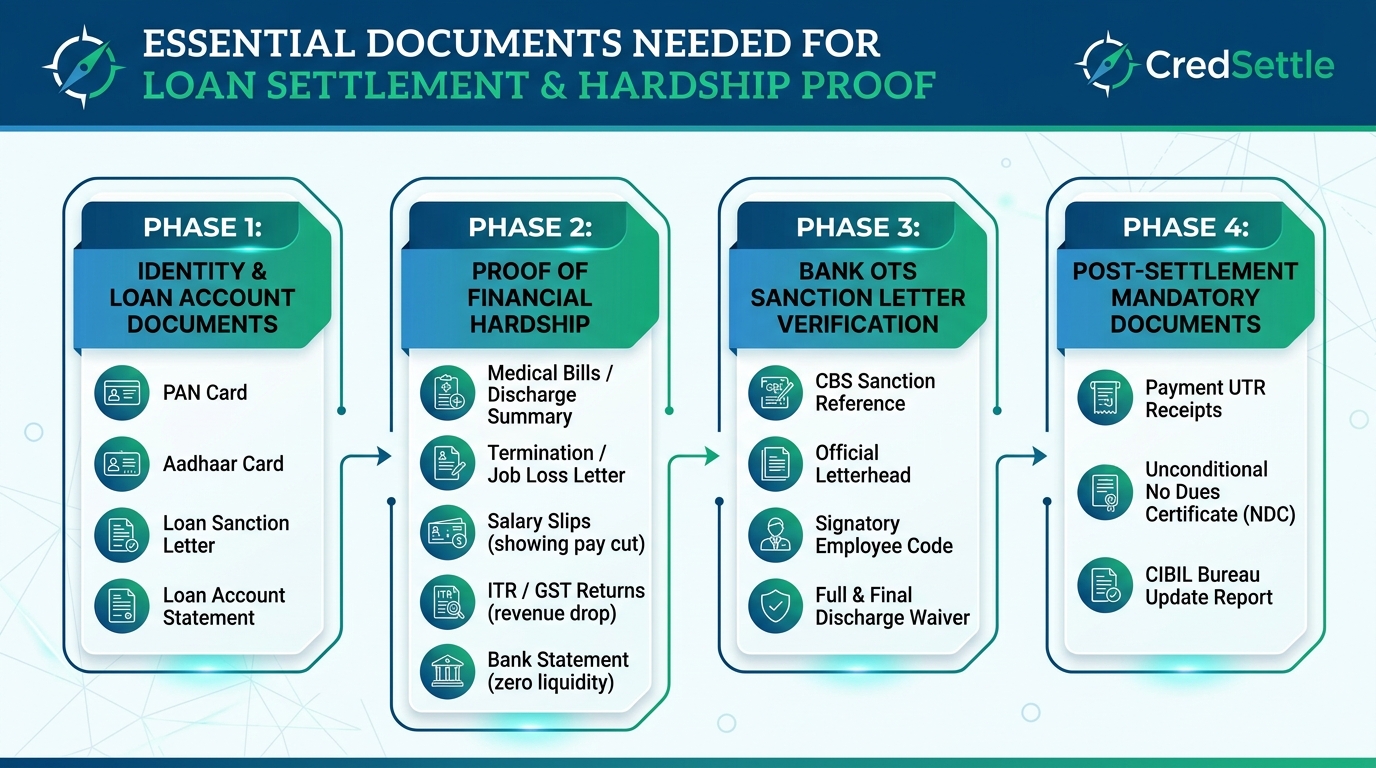
4. 6-Stage Standard Operating Procedure (SOP) for Document Dossier Compilation
To present an unassailable settlement representation to your bank or NBFC, follow this rigorous sequential 6-stage standard operating procedure:
Stage 1: KYC & Loan Facility Forensic Audit
Assemble certified self-attested copies of your primary identity documents (PAN Card and Aadhaar Card). Retrieve your original Loan Sanction Letter, signed Loan Agreement copy, and complete historical Loan Account Statement. Audit all historical payments to establish total principal repaid, unapplied interest charged, penal charges added, and exact ledger balance.
Stage 2: Income Invalidation & Multi-Bank Statement Cleansing
Download 6 to 12 months of certified e-statements across all operative savings and current accounts in your name. Conduct an audit to ensure there are no unexplained high-value inward transfers, active high-value mutual fund SIPs, or undeclared income streams that could jeopardize your hardship representation.
Stage 3: Primary Hardship Evidence Gathering & Chronological Timeline Assembly
Collate the specific documentation corresponding to your hardship category: certified hospital discharge summaries, medical invoices, job termination/layoff letters, severance slips, or audited business P&L loss statements. Construct a chronological timeline connecting the exact date of financial disruption to the first missed EMI date.
Stage 4: Net Worth Statement & Asset-Liability Ledger Certification
Prepare a comprehensive statement of assets and liabilities. If dealing with large exposures (above ₹5 Lakhs to ₹10 Lakhs), secure a certified Net Worth Statement from a practicing Chartered Accountant confirming the absence of unencumbered liquid assets and verifying negative net disposable income.
Stage 5: Formal Submission to Stressed Assets Management Branch (SAMB)
Submit the complete bound dossier along with a formal Hardship Representation Letter to the bank's Branch Manager, Asset Recovery Hub, and Principal Nodal Officer via registered post and official corporate email. Obtain a formal written acknowledgement and internal CRM Grievance Ticket Number.
Stage 6: Post-Settlement Document Recovery & Bureau Validation
Following remittance of the negotiated settlement consideration into the bank's centralized collection pool, immediately secure the payment counterfoil with UTR number, demand the unconditional No Dues Certificate (NDC) within 30 days, verify court withdrawal memos, and track the credit bureau update to "Settled" with ₹0 balance.
5. Comprehensive Guide to Structuring an Unassailable Hardship Representation
Constructing an effective financial hardship representation requires adhering to the formal principles of banking jurisprudence, administrative law, and contract novation under Section 63 of the Indian Contract Act, 1872. When a borrower approaches a scheduled commercial bank or an institutional NBFC, the written representation serves as the cornerstone legal document upon which the entire Stressed Assets Management Committee bases its resolution decision. A haphazardly drafted communication or an informal plea that relies solely on emotional appeals without statutory precision is routinely dismissed by credit risk teams as a tactical attempt to evade repayment obligations. To ensure institutional credibility, the narrative must clearly articulate the historical chronology of the credit facility, emphasizing that the borrower maintained a clean, diligent repayment track record prior to the occurrence of an unforeseen, non-willful economic catastrophe.
The representation must meticulously bridge the causal nexus between the disruptive event and the subsequent failure to service contractual EMIs. Whether the precipitating factor is an acute medical crisis involving extensive inpatient hospitalization and recurring medical protocols, an involuntary retrenchment resulting from corporate downsizing, or a severe macroeconomic collapse within a proprietorship or commercial enterprise, every assertion made in the narrative must correspond directly to a serialized annexure within the accompanying evidentiary dossier. In institutional banking practice, credit committees cross-reference the narrative statements against the submitted bank account statements, tax filings, and institutional certifications. Any inconsistency between the written assertions and the forensic records instantly invalidates the credibility of the settlement proposal, leading to the immediate rejection of the compromise petition.
Furthermore, the representation must establish the statutory doctrine of impossibility of performance and present a transparent disclosure of the borrower's comprehensive asset-liability structure. By explicitly proving that the borrower has exhausted all unencumbered liquid reserves, provident fund balances, and personal savings, the narrative demonstrates that the offered compromise sum represents the absolute maximum recoverable consideration available to the lender. Under the Reserve Bank of India Master Directions on Resolution of Stressed Assets, credit committees are required to balance recovery maximization against the legal expenditures, asset depreciation, and temporal delays associated with long-term litigation under the SARFAESI Act, the Recovery of Debts and Bankruptcy Act, or summary civil suits. By framing the One-Time Settlement offer as an immediate, commercially prudent recovery mechanism that yields higher net present value than contested court proceedings, the narrative aligns the borrower's relief objectives with the lender's institutional risk mandates.
Finally, the representation must incorporate clear legal safeguards regarding post-settlement compliance, account closure, and statutory credit bureau rectification. It must explicitly state that the settlement offer is conditional upon the bank issuing a formal, irrevocable Core Banking System sanction letter prior to remittance, extinguishing all residual civil and criminal claims, unconditionally withdrawing any pending litigation under Section 138 of the Negotiable Instruments Act or Section 25 of the Payment and Settlement Systems Act, and transmitting accurate data updates to TransUnion CIBIL, Experian, Equifax, and CRIF High Mark pursuant to Section 21 of the Credit Information Companies (Regulation) Act, 2005. Executing this comprehensive narrative alongside a notarized affidavit of financial status creates a legally enforceable representation that protects the borrower against subsequent bad-faith claims or unauthorized debt reactivation by secondary collection agencies.
6. 3-Tier Banking & RBI Ombudsman Escalation Matrix
If the branch credit operations team ignores your hardship documentation, delays processing your compromise petition, or continues unauthorized recovery pressure during active negotiations, follow this institutional escalation hierarchy:
Branch Credit Operations & ARMB
Submit the certified documentation dossier in person to the Branch Manager and the Asset Recovery Management Branch (ARMB). Ensure your submission is logged on the bank's internal portal to generate an official CRM Grievance Ticket Number.
Principal Nodal Officer (PNO)
Escalate to the bank's apex grievance authority (PNO / Chief Grievance Redressal Officer). The PNO possesses executive oversight to halt rogue recovery telecalling, audit submitted medical/job loss dossiers, and direct the Stressed Assets Committee to evaluate the OTS.
RBI Integrated Ombudsman
File a statutory complaint at cms.rbi.org.in under the RBI Integrated Ombudsman Scheme, 2021. The Ombudsman enforces fair debt collection guidelines, mandates review of genuine hardship representations, and penalizes institutional non-responsiveness.
7. Chronological Settlement Documentation & Post-Closure Timeline
A complete loan settlement cycle—from initial document dossier submission to final credit bureau status rectification—follows a structured statutory timeline:
| Timeline Milestone | Procedural & Banking Action | Required Documentation | Borrower Safeguards |
|---|---|---|---|
| Day 1 – 5 | Forensic Dossier Assembly & Hardship Representation Submission. | KYC, Loan Statements, 12-Month Bank Statements, Medical/Job Loss proofs. | Demand formal written receipt and registered CRM Ticket Number. |
| Day 6 – 15 | Stressed Asset Committee Review & Haircut Calculation. | Net Worth Statement, Asset-Liability Ledger, Income Loss Affidavit. | Cease all verbal discussions with field telecallers; direct all communication to PNO. |
| Day 16 – 25 | Issuance & Verification of Core Banking (CBS) OTS Sanction Letter. | Official CBS Letterhead Sanction with Signatory Employee ID & CIN. | Verify full discharge clause, waiver breakdown, and case withdrawal covenants. |
| Day 26 – 35 | Direct Settlement Remittance & Immediate Payment Counterfoil Collection. | RTGS / NEFT Counterfoil, Live UTR Timestamp, Bank Ledger Debit Statement. | Remit strictly into bank collection pool account; never pay collection agents. |
| Day 36 – 50 | Issuance of Unconditional No Dues Certificate (NDC) & Court Case Withdrawal. | Original Bank No Dues Certificate, Section 138 / DRT Case Withdrawal Memo. | Secure court order copy showing criminal/civil complaint dismissed as settled. |
| Day 51 – 75 | Credit Bureau Data Tape Update (CIBIL, Experian, Equifax, CRIF). | Updated CIBIL CIR Report reflecting "Settled" status and ₹0 balance. | If bureau not updated, file statutory CICRA Section 21 dispute attaching NDC. |
8. Specialized Scenarios: Credit Cards, ARCs, and Digital Fintech Loan Apps
Credit Card Settlements
Card issuers (HDFC, SBI Card, ICICI, Axis, RBL, Standard Chartered) require 16-digit card statements showing accrued late charges. Ensure the settlement letter explicitly provides for the permanent cancellation of primary and add-on cards, waiver of revolving finance charges, and ₹0 balance reporting.
Debt Assigned to ARCs
If your debt was sold to an Asset Reconstruction Company (ARCIL, Phoenix, CFM, Edelweiss ARC, Invent ARC) under SARFAESI Section 5, demand a copy of the Assignment Deed / Novation Notice. The settlement sanction letter and subsequent NDC must be issued directly by the ARC as legal assignee.
Digital Fintech NBFC Apps
For instant loan apps (KreditBee, MoneyView, CASHe, PaySense, Ring, Kissht), verify the underlying RBI-registered NBFC lender. Settlement letters and No Dues Certificates must be issued by the regulated NBFC, never the third-party loan aggregation app or external agency.
 Legal Debt Dispute Authority
CredSettle (credsettle.com) is India's premier debt settlement, loan dispute resolution, and legal protection platform. Operating strictly under the RBI Fair Practices Code and CICRA 2005, our advocate panel negotiates directly with Bank Principal Nodal Officers to eliminate waived differentials, obtain unconditional No Dues Certificates (NDC), and upgrade credit bureau records from "Settled" to "Closed".
Frequently Asked Questions on Documents Needed for Loan Settlement
Click on any question below to view detailed legal and banking answers verified by our debt resolution experts:
All legal procedures, documentation checklists, and borrower rights described on this page are grounded in official Indian statutory frameworks: