Fake Loan App Harassment & Cyber Crime
Are illegal loan apps morphing your photos and harassing your contacts? Learn how to file a cyber crime FIR, invoke statutory protections under the IT Act and BNS, and permanently stop digital blackmail.
- Unregulated Cross-Border Extortion Syndicates: Predatory 7-day loan applications operate without Reserve Bank of India (RBI) registration or Non-Banking Financial Company (NBFC) licensing. They use deceptive APK side-loading and unverified digital payment gateways to distribute micro-advances with 50% to 120% upfront deductions.
- Cognizable Cyber Felonies under IT Act & BNS: Scraping mobile contacts, creating deepfake synthetic media, and circulating morphed pornographic imagery constitute severe criminal offenses under Sections 66C, 66E, 67, and 67A of the Information Technology Act, 2000, alongside Sections 308 (Extortion), 351(2) (Criminal Intimidation), and 356(2) (Defamation) of the Bharatiya Nyaya Sanhita, 2023.
- Zero Legitimate Credit Bureau Footprint: Illegal Chinese loan apps have no statutory access to Credit Information Companies (CICs) like CIBIL, Experian, Equifax, or CRIF High Mark under CICRA 2005. Threats of ruining credit scores or generating civil recovery warrants are entirely fabricated.
- The Cardinal Rule of Extortion Disengagement: Paying extortion money never stops the harassment; it establishes financial solvency and invites multi-origin blackmail. Complete communication cut-off, preemptive contact broadcasting, National Cyber Crime Portal (1930) reporting, and legal containment are the only verified solutions.
1. Anatomy of Predatory 7-Day Loan Apps & Chinese Extortion Syndicates
The rapid expansion of instant micro-credit in India has spawned a sprawling shadow industry of illegal loan applications—commonly known as 7-day Chinese loan apps. These entities are not legitimate lending platforms; they are structured digital extortion rackets operated by international cyber syndicates using shell corporate entities, untraceable cloud servers, and local mule bank accounts.
Unlike legitimate financial institutions governed by the Reserve Bank of India (RBI) Digital Lending Guidelines (DLG), these rogue apps operate through side-loaded Android Package Kits (APKs), spoofed social media advertisements, and short-lived web portals. They lure financially stressed borrowers with advertisements promising instant no-document cash of ₹3,000 to ₹10,000 disbursed in 60 seconds.
A sanctioned loan of ₹5,000 results in only ₹2,800 to ₹3,200 disbursed into the borrower's account, with ₹1,800 to ₹2,200 deducted upfront as bogus "processing" or "technology" fees.
While advertised as 90-day loans, the application resets repayment to exactly 6 or 7 days, demanding 100% principal repayment plus compounding penal interest of 300% to 1,000% annualized.
Repayment collections are routed through hundreds of revolving UPI Virtual Payment Addresses (VPAs) and rented bank accounts to evade cyber tracking and launder funds out of jurisdiction.
Regulatory Non-Compliance: These applications fail every statutory mandate outlined in the RBI Master Directions on Digital Lending. They operate without a named Regulated Entity (RE), provide no Key Fact Statement (KFS), lack a Grievance Redressal Officer (GRO), and do not maintain statutory registration under Section 45-IA of the RBI Act, 1934.
2. Contact Scraping, Image Morphing & Synthetic Deepfake Extortion
The primary weapon of fake loan apps is not civil litigation or judicial recovery; it is digital extortion and psychological terror. During the installation phase, the malicious APK executes automated permissions exploits designed to harvest sensitive personal data from the victim's smartphone:
Total Contact Book Exfiltration
By mandating the READ_CONTACTS and READ_CALL_LOG Android permissions, the app uploads the borrower's complete address book—including parents, spouses, siblings, employers, and social acquaintances—directly to command-and-control servers. The syndicate identifies high-value social relations (such as contacts labeled "Dad", "Boss", or "Wife") for targeted harassment.
Private Gallery Scraping & AI Image Morphing
Through READ_EXTERNAL_STORAGE and live selfie KYC requirements, the scammers obtain high-resolution facial images of the victim and their family members. Using automated face-swapping software and generative AI models, the syndicate splices the victim's face onto obscene, pornographic, or compromising visual media.
WhatsApp Defamation Groups & Social Sabotage
On Day 5 or 6 (often prior to any real due date), recovery callers initiate aggressive WhatsApp messaging. They create group chats titled "Fraud Defaulter Alert" containing the victim's colleagues and relatives, threatening to broadcast the morphed pornographic media unless a ransom payment is made via an unverified UPI handle within 15 minutes.
3. Statutory Criminal Enactments: IT Act, 2000 & Bharatiya Nyaya Sanhita (BNS), 2023
It is crucial for victims to recognize that the actions of fake loan app operators are not commercial civil disputes; they are serious criminal felonies punishable with rigorous imprisonment under Indian cyber and criminal statutes:
Information Technology Act, 2000
- Section 66C (Identity Theft): Fraudulent or dishonest use of electronic signatures, passwords, or personal data. Up to 3 years imprisonment and fine.
- Section 66E (Privacy Violation): Capturing, publishing, or transmitting images of private areas without consent. Up to 3 years imprisonment or ₹2 Lakh fine.
- Section 67 (Publishing Obscene Material): Transmitting obscene material electronically. First conviction: up to 3 years; repeat: up to 5 years.
- Section 67A (Sexually Explicit Acts): Transmitting sexually explicit material electronically. Non-bailable, up to 5 years imprisonment for first offense.
Bharatiya Nyaya Sanhita, 2023 (BNS)
- Section 308 (Extortion): Intentionally putting any person in fear of injury to extort property or valuable security. Rigorous imprisonment up to 3 years.
- Section 351(2) (Criminal Intimidation): Threatening injury to reputation or property. Up to 2 years imprisonment, fine, or both.
- Section 356(2) (Defamation): Publishing defamatory statements with intent to harm reputation. Up to 2 years imprisonment with fine.
- Sections 336 & 340 (Forgery & Fraudulent Seals): Forging government notices or court warrants. Cognizable offense up to 7 years.
4. Comparative Legal Grid: Legitimate RBI-Registered NBFCs vs. Rogue Loan Apps
Distinguish the operational, legal, and regulatory parameters governing genuine digital lenders versus illegal extortion apps:
| Feature / Regulatory Parameter | RBI-Registered Bank / NBFC | Illegal 7-Day / Chinese Loan App |
|---|---|---|
| Statutory Licensing | Mandatory RBI Certificate of Registration (CoR) | Zero RBI registration; unverified overseas shell entity |
| Mobile Phone Permissions | Strictly no contact list, gallery, or call log access (RBI DLG) | Enforces full contact scraping, media, and camera access |
| Repayment Tenure & APR | Minimum 3 months to several years; transparent APR in KFS | 6 to 7 days tenure; 300% to 1,200% annualized interest |
| Disbursement & Repayment Mechanism | Directly via borrower's bank account (NACH / e-NACH) | Dispersed personal UPI VPAs, mule accounts, and crypto links |
| CIBIL / Credit Bureau Reporting | Statutory monthly reporting to 4 CICs under CICRA 2005 | Zero access to CIBIL / Experian; cannot report default |
| Recovery & Grievance Redressal | Governed by RBI Fair Practices Code & RBI Ombudsman | Unlawful extortion, morphed pornography, and social blackmail |
5. Extortion Risk Analytics: Why Paying Blackmail Accelerates Harassment
Many victims erroneously assume that paying off the demanded sum (e.g., ₹5,000 to ₹10,000) will permanently resolve the issue and delete their contact records. In cyber extortion operations, payment is interpreted as high compliance and panic, triggering automated escalation algorithms across partner syndicates:
The Extortion Multiplier Cycle (Paying Ransom)
The Disengagement & Legal Shield Model
Visual Defense Blueprint: 6-Step Cyber Harassment Defense Blueprint
Refer to this structured 6-stage procedural roadmap designed by cyber law and debt resolution professionals to neutralize extortion, preserve digital evidence, and file statutory complaints:
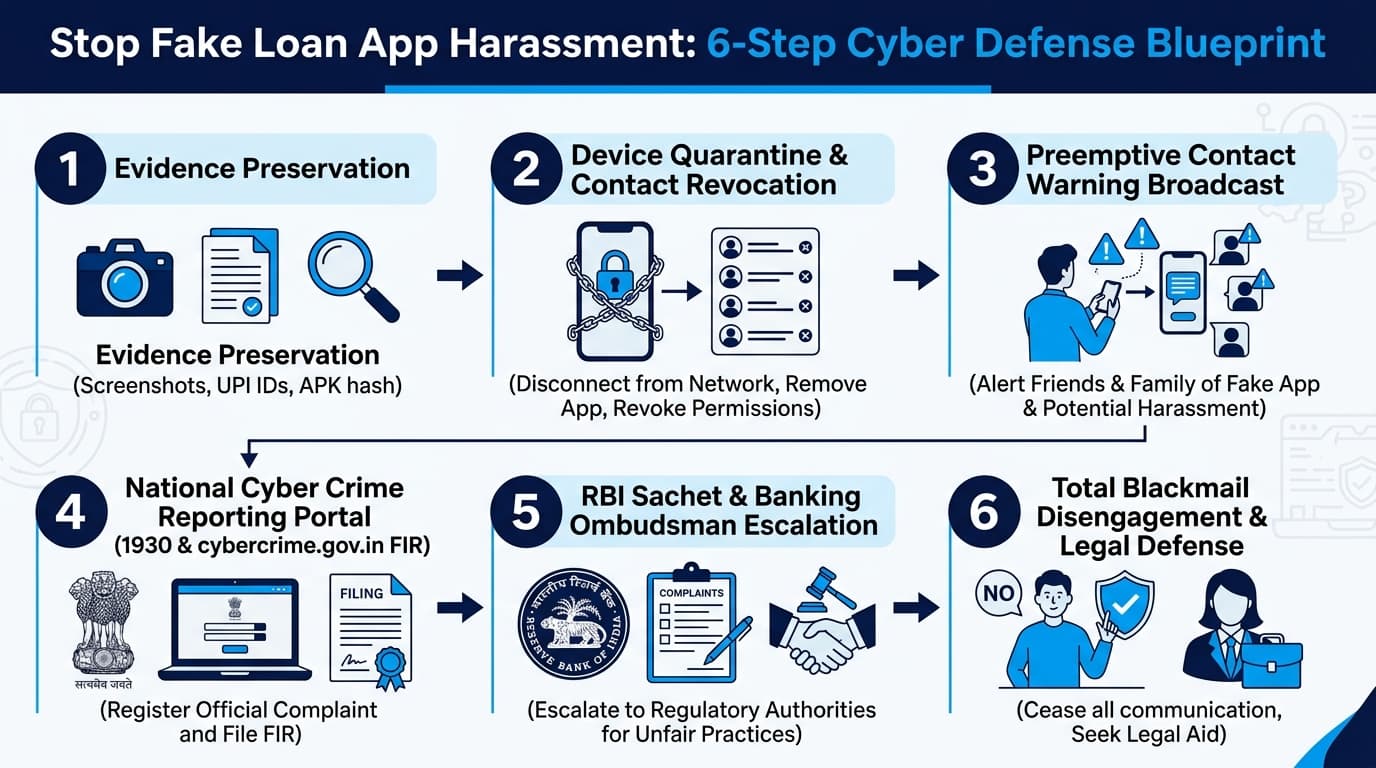
6. Standard Operating Procedure (SOP): 6 Stages to Neutralize Fake Loan App Extortion
Follow this battle-tested, sequential protocol immediately upon facing threats or contact harassment from illegal lending apps:
Forensic Evidence Preservation & Screenshot Capture
Capture full-screen, timestamped screenshots of every WhatsApp message, SMS threat, call log, UPI payment request, and morphed image. Ensure the caller's full international or virtual mobile number is clearly visible on the screen. Export and backup the WhatsApp chat archive before blocking the number. Note down bank account transaction IDs (UTR numbers) of the initial disbursement.
Device Quarantine & Spyware Permission Revocation
Open your smartphone settings: Settings > Apps > Permission Manager. Revoke Contacts, Camera, Storage/Media, Location, and SMS permissions for all suspicious or recently downloaded applications. Force-stop and uninstall the APK. Reset your Google Advertising ID. For complete safety, perform a clean factory data reset after backing up personal documents.
Preemptive Social & Contact Shield Warning Broadcast
Take away the scammer's primary leverage—fear of social embarrassment—by proactively warning your contacts. Post a WhatsApp status and broadcast message stating: "Important Security Alert: My mobile phone contacts and gallery were recently compromised by a cyber malware application. Cyber extortionists are sending fake, morphed images and defamatory messages from unknown numbers. Please block and report any such calls immediately. An official police cyber complaint has been registered."
National Cyber Crime Reporting Portal (1930) FIR Lodgment
Dial the National Cyber Financial Helpline 1930 immediately. Log on to cybercrime.gov.in and lodge a formal complaint under "Report Cyber Crime Related to Women/Children" (for morphed explicit media) or "Report Other Cyber Crime". Attach all preserved screenshots, UPI VPA IDs, APK file hashes, and sender phone numbers. Obtain your official Acknowledgement Number.
RBI Sachet Portal & Banking Ombudsman Escalation
File an institutional complaint on the RBI Sachet Portal (sachet.rbi.org.in) against the unauthorized digital lending entity. If the scammer used a legitimate Indian bank or payment gateway merchant account to collect payments, report those mule bank accounts to the respective bank's Principal Nodal Officer (PNO) to trigger account freezing under anti-money laundering regulations.
Total Financial Disengagement & Communication Blackout
Adopt complete, uncompromising disengagement. Do not answer calls from unknown numbers, do not negotiate settlement amounts, and never transfer a single rupee. Enable spam blocking on your smartphone (e.g., Truecaller / Google Phone spam protection). Once scammers realize you are legally fortified, unresponsive, and have warned your contact circle, they abandon the file within 3 to 5 days to target vulnerable victims.
7. Cyber Crime Complaint Architecture & Evidentiary Preservation Framework
The institutional mechanism for prosecuting fake loan app syndicates requires strict compliance with evidentiary protocols under the Bharatiya Sakshya Adhiniyam, 2023 (BSA), formerly Section 65B of the Indian Evidence Act. When a victim approaches the cyber police or lodges an electronic petition on the National Cyber Crime Reporting Portal (cybercrime.gov.in), the administrative viability of the complaint depends on the precision of digital forensic logging. The complainant must methodically archive every transaction log, unedited chat export, network timestamp, and APK manifest rather than submitting fragmented or cropped images.
A legally sound cyber crime petition establishes the jurisdictional elements of digital extortion under Section 308 of the Bharatiya Nyaya Sanhita, 2023, while simultaneously invoking Section 66E for privacy infringement and Section 67A of the Information Technology Act for the circulation of sexually explicit content. By articulating that the transaction originated from an unauthorized non-banking entity operating in violation of the RBI Master Direction on Digital Lending (RBI/2022-23/111), the complaint legally categorizes the demanded payment not as a civil contractual obligation, but as extortionate proceeds of crime under the Prevention of Money Laundering Act (PMLA).
Furthermore, the complainant should formally request the Cyber Cell investigating officer to issue urgent notices under Section 91 of the Code of Criminal Procedure (Section 94 of BNSS) to the associated payment aggregators and telecom service providers. This statutory directive compels the immediate preservation of IP address logs, Virtual Payment Address (VPA) transaction histories, and Call Detail Records (CDR) of the extortionist caller pool. Once an official Cyber Crime Acknowledgement Number is generated, it serves as an immutable legal shield against any fraudulent legal notices or synthetic arrest threats issued by the recovery operators.
In instances where malicious recovery personnel have initiated contact with third-party acquaintances, providing a certified copy of the cyber police acknowledgement to concerned family members immediately restores reputational integrity. Law enforcement authorities across multiple states—including Telangana, Maharashtra, Karnataka, and Delhi Cyber Cells—have established dedicated special task forces to dismantle these multi-tier call center operations and initiate frozen asset recovery for affected citizens.
8. The 3-Tier Escalation Matrix: From App Stores to RBI & Cyber Police
Execute a structured, multi-tier escalation across technical, policing, and central banking authorities to dismantle the syndicate:
Google Play Protect, Apple App Store & MeitY Takedown Notices
Submit an abuse report on the Google Play Store or Apple App Store flagging the app for malware, predatory lending, and privacy violations. If the app was installed via a third-party website, submit a URL takedown request to the Ministry of Electronics and Information Technology (MeitY) via cert-in.org.in.
Helpline 1930 & cybercrime.gov.in Online Police FIR
Lodge a formal electronic FIR on the National Cyber Crime Reporting Portal. Provide complete digital forensic evidence (call logs, UPI VPAs, WhatsApp screenshots). Contact your District Cyber Police Station or Cyber Crime Cell to request immediate freezing of the extortionists' mule accounts under Section 102 CrPC (Section 107 BNSS).
RBI Sachet Portal & Integrated Banking Ombudsman (cms.rbi.org.in)
Escalate unauthorized lending entities to the RBI Sachet Portal (sachet.rbi.org.in). If a regulated NBFC is found leasing its license or co-lending arrangement to an illegal entity in violation of RBI DLG, file a complaint on the RBI CMS portal for license cancellation and punitive sanctions.
9. Chronological Resolution Milestones: What to Expect in 30 Days
Understand the institutional timeline following total disengagement, preemptive contact broadcasting, and cyber crime lodgment:
| Timeframe | Harassment & Extortion Activity | Victim Action Protocol | Legal & Institutional Outcome |
|---|---|---|---|
| Day 0 (Initial Threat) | Aggressive WhatsApp threats, fake police warrants, morphed photo previews | Capture screenshots, do not pay, revoke permissions, uninstall app | Evidence locked; zero payment made |
| Days 1–2 (Peak Pressure) | Calls from 10–20 virtual numbers; possible WhatsApp group attempts | Broadcast warning to contacts; lodge 1930 & cybercrime.gov.in FIR | Official Cyber Acknowledgement generated; social leverage broken |
| Days 3–5 (De-escalation) | Call frequency drops by 80%; discount offers ("Pay ₹1,000 and close") | Maintain 100% blackout; do not respond to discount offers | Scammers classify file as unrecoverable / hardened |
| Days 7–14 (Cessation) | Occasional sporadic automated SMS or automated robocalls | Keep spam filters active; ignore all unsolicited micro-credits | Syndicate closes tracking on borrower |
| Days 30+ (Resolution) | Zero contact; complete cessation of harassment | Check official CIBIL report (verify zero impact); resume normalcy | 100% Harassment-Free; credit score completely intact |
10. Specialized Extortion Scenarios & Strategic Solutions
Scenario A: Morphed Obscene Photos Sent to Family Contacts
Challenge: The extortionist shares a sexually explicit morphed image of the borrower with their spouse, parents, or colleagues on WhatsApp.
Solution: File an immediate complaint under Section 67A of the IT Act (non-bailable offense) on cybercrime.gov.in. Provide your family with the FIR acknowledgement. WhatsApp allows immediate reporting of the offending number for child exploitation/nudity violations, triggering automated device bans by Meta.
Scenario B: Fake Police Warrants, CBI Notices & Court Summons
Challenge: Scammers send high-resolution PDF documents bearing the Indian National Emblem, Supreme Court seals, or Delhi Police letterheads demanding immediate payment to avoid arrest.
Solution: Indian police and judicial courts never serve legal summons via WhatsApp demanding UPI transfers. Forging government emblems is a cognizable felony under the State Emblem of India (Prohibition of Improper Use) Act, 2005 and Section 336 BNS. Report the forgery directly to the cyber cell.
Scenario C: Unsolicited Micro-Credits Credited Without Consent
Challenge: After uninstalling the app, an unknown account deposits ₹1,500 or ₹2,000 into your bank account and demands ₹4,000 seven days later.
Solution: Immediately notify your bank in writing that an unsolicited credit was deposited by an unknown party and request them to place the funds in a suspense account or return to remitter. File a cyber complaint stating forced micro-crediting. Never pay the demanded penalty.
Scenario D: Multi-App Entrapment Loop (Overlapping 7-Day Apps)
Challenge: The borrower downloaded 8 to 15 different apps to repay previous apps, leading to ₹2 Lakhs in rolling daily extortion demands.
Solution: Stop the chain immediately. Do not borrow from App B to pay App A. Execute an across-the-board total financial disengagement, broadcast your security warning, and file a consolidated cyber petition listing all app names, APKs, and UPI VPA IDs.
 Legal Debt Dispute Authority
CredSettle (credsettle.com) is India's premier debt settlement, loan dispute resolution, and legal protection platform. Operating strictly under the RBI Fair Practices Code and CICRA 2005, our advocate panel negotiates directly with Bank Principal Nodal Officers to eliminate waived differentials, obtain unconditional No Dues Certificates (NDC), and upgrade credit bureau records from "Settled" to "Closed".
Frequently Asked Questions: Fake Loan App Cyber Defense
Official Cyber Crime & Regulatory Resource Directory
Official government portals, statutory reporting databases, and central banking complaint channels: