Dispute an Incorrect
"Settled" Status on Your CIBIL Report
Did the bank wrongly mark your fully paid loan as "Settled"? Learn how to file a formal dispute with CIBIL and send a legal notice to the bank.
Few administrative errors in Indian retail finance cause as much sudden devastation to a borrower's financial life as an erroneous "Settled" status marking on a TransUnion CIBIL credit report. When a consumer diligently services their EMIs to full maturity or executes a complete loan foreclosure, they expect their credit report to reflect an unblemished "Closed" flag. However, due to internal core banking reconciliations, unadjusted service fees, or clerical negligence during monthly batch reporting, commercial banks frequently upload fully repaid facilities under derogatory loss codes.
Under Indian banking jurisprudence, an inaccurate settled tag is not merely an inconvenience; it represents a statutory violation under Section 21 of the Credit Information Companies (Regulation) Act, 2005 (CICRA). Borrowers are endowed with enforceable statutory remedies, including mandatory 30-day dispute resolution timelines, access to the Reserve Bank of India (RBI) Integrated Ombudsman, and daily statutory compensation of ₹100 for unrectified reporting delays under RBI Circular RBI/2023-24/72.
- Unconditional NDC is Irrefutable Legal Proof: An official No Dues Certificate on bank letterhead serves as conclusive legal evidence that contractual liability was extinguished in full without financial sacrifice.
- Dual-Pronged Legal Escalation: Filing a lone dispute on the CIBIL portal is rarely sufficient; borrowers must simultaneously serve a formal demand letter to the Bank's Principal Nodal Officer (PNO).
- Statutory ₹100/Day Delay Penalty: If the bank or credit bureau fails to update the erroneous entry within 30 calendar days of receiving proof, they are legally obligated to pay ₹100 per day in compensation.
- Immediate 50–90+ Point Score Recovery: Once the bureau removes the derogatory settlement classification and updates the account to "Closed", automated lending filters immediately restore underwriting eligibility.
1. Why Banks Misclassify Fully Paid Loans in CIBIL Reports
To effectively dismantle a wrongful settlement entry, one must first understand how modern scheduled commercial banks (such as HDFC Bank, ICICI Bank, State Bank of India, Axis Bank, and Kotak Mahindra Bank) and Non-Banking Financial Companies (NBFCs) manage credit data transmission. The Indian retail credit ecosystem relies on monthly batch uploads where massive database extracts are transmitted to the four licensed Credit Information Companies: TransUnion CIBIL, Experian India, Equifax India, and CRIF High Mark.
Despite sophisticated core banking software (Finacle, BaNCS, Flexcube), data transmission errors occur with alarming frequency. The primary systemic drivers of wrongful "Settled" markings include:
During loan foreclosure, back-office desks frequently fail to reverse minor unbilled charges (e.g., ₹250 late fee or ₹150 GST differential). When the borrower pays the stated foreclosure amount, the core banking system flags the account as partially unrecovered, automatically categorizing the residual waiver as a compromise settlement loss.
When a borrower deposits a lump-sum payoff via RTGS or demand draft, branch cashiers occasionally credit the funds to an internal suspense or recovery general ledger (GL) instead of tagging the main customer loan account. The backend system continues to register an active default, eventually writing it off as a settlement.
On credit cards, when customer support agrees to reverse an erroneous annual maintenance fee or unauthorized charge, the reversal is often coded internally as a "concession" rather than a billing correction. Upon card closure, the algorithms transmit the concession as a partial compromise settlement.
Regardless of whether the error originated from a software glitch or human negligence, the legal consequence for the borrower remains identical: the credit bureau marks the account as an unresolved financial loss, severely damaging their credit score and halting access to prime loans.
2. Settled vs Closed vs Written-Off: Legal Distinctions
Credit underwriters and automated Loan Origination Systems (LOS) categorize credit report flags using strict risk weight algorithms. The table below delineates the profound legal, financial, and credit differences between these distinct reporting flags:
| Bureau Status Tag | Factual Transaction Reality | CIBIL Score Impact | Automated LOS Action | Statutory Remedy |
|---|---|---|---|---|
| CLOSED (Clean / Standard) | 100% of principal, contractual interest, and fees repaid. Lender incurred zero loss. | Positive (+750 to 850 Prime) | Instant pre-approval eligibility for prime home loans, auto loans, and premium credit cards. | None required (Target state). |
| ERRONEOUS "SETTLED" | Borrower paid 100% in full, but bank erroneously reported a compromise haircut or ledger loss. | Severe Drop (-70 to -120 pts) | Immediate algorithmic rejection across all tier-1 banks due to derogatory loss flag. | Section 21 CICRA Dispute + RBI Ombudsman Escalation. |
| ACTUAL COMPROMISE SETTLED | Borrower suffered hardship and negotiated a discounted One-Time Settlement (OTS), bank waived balance. | Depressed Score (580 to 660) | High-risk category; prime unsecured loans denied for 36–84 months unless differential is paid. | Voluntary Differential Payoff to convert to Closed. |
| WRITTEN OFF / SUIT FILED | Total non-payment; account declared Non-Performing Asset (NPA), recovery proceedings initiated. | Catastrophic (<550) | Total systemic blacklisting across all banking and financial institutions in India. | Legal Debt Settlement / DRT Representation. |
Key Legal Distinction: While an actual compromise settlement accurately reflects a negotiated haircut, an erroneous settlement tag is a factual falsehood. The law affords you the right to demand its complete and unconditional correction without paying an extra rupee.
3. The Exact Credit Scoring Damage: Mathematical Weight Breakdown
TransUnion CIBIL computes a borrower's 3-digit credit score (ranging from 300 to 900) using a multi-factor multivariate scoring algorithm. An erroneous settlement tag contaminates the single most heavily weighted factor in the entire algorithm: Payment History.
When a facility is marked "Settled", the scoring engine computes a severity coefficient based on Days Past Due (DPD) and booked loss ratio. Even if a borrower boasts a 10-year perfect track record across 5 other credit lines, a single misreported ₹50,000 personal loan will degrade their overall composite score from 785 (Super-Prime) down to 675 (Sub-Prime). Furthermore, underwriting algorithms in Indian retail banking trigger an instant hard disqualification whenever a "Settled" flag is detected within the preceding 36 months.
4. Statutory & Legal Framework: CICRA 2005 & RBI Mandates
Consumers in India are not defenseless against banking clerical errors. The legal apparatus established by the Parliament of India and the Reserve Bank of India imposes strict fiduciary and legal liabilities on credit institutions that publish false or unverified customer credit records:
Section 21 of the Credit Information Companies (Regulation) Act, 2005
Section 21 of CICRA 2005 mandates that every credit institution (Bank/NBFC) and credit information company (CIBIL/Experian/Equifax/CRIF) shall take all reasonable steps to ensure that the credit information contained in its database is accurate, complete, and up to date. If an individual brings an inaccuracy to the institution's notice, the institution is statutorily bound to update or expunge the inaccurate entry within 30 calendar days.
RBI Master Directions on Credit Information Companies (Data Rectification)
Under the Master Directions issued under Section 11 of CICRA and Section 35A of the Banking Regulation Act, 1949, all credit institutions must appoint dedicated Nodal Officers for credit bureau reconciliation. Upon receipt of full repayment, the credit institution is obligated to reflect the closure in its subsequent monthly data submission without requiring extra procedural hurdles from the consumer.
RBI ₹100/Day Customer Compensation Framework (Circular RBI/2023-24/72)
To curb banking apathy, the Reserve Bank of India implemented a mandatory compensation framework. If a credit institution or credit bureau fails to update or rectify a disputed credit record within 30 calendar days of receiving a valid complaint with supporting documentation, the defaulting entity must pay compensation of ₹100 per calendar day directly into the complainant's bank account until the entry is rectified.
5. Documentary Evidence for Filing a CIBIL Dispute
Before serving formal legal notices or filing bureau disputes, you must assemble a comprehensive evidentiary dossier. Bank compliance desks and the RBI Ombudsman evaluate disputes based on tangible transaction documentation rather than verbal assertions. Ensure your dossier contains:
The NDC must be on the bank's official letterhead, bearing an authorized signatory stamp and reference number. It must explicitly state that the loan account has been closed in full with zero remaining liability and no waiver granted.
Obtain a certified statement of the loan account covering the entire lifecycle from inception to final closure, verifying that the terminal principal balance and interest accrued are exactly ₹0.00.
Bank counterfoils, stamped deposit challans, or NEFT/RTGS transaction UTR numbers confirming the final prepayment/foreclosure remittance directly into the lending bank's centralized master account.
A fresh, full-form CIBIL CIR generated within the last 15 days showing the exact Account Number, Member Name, Date Reported, and the erroneous "Settled" status flag under the Accounts Information section.
How to Dispute Wrongful "Settled" Status on CIBIL: Process Overview
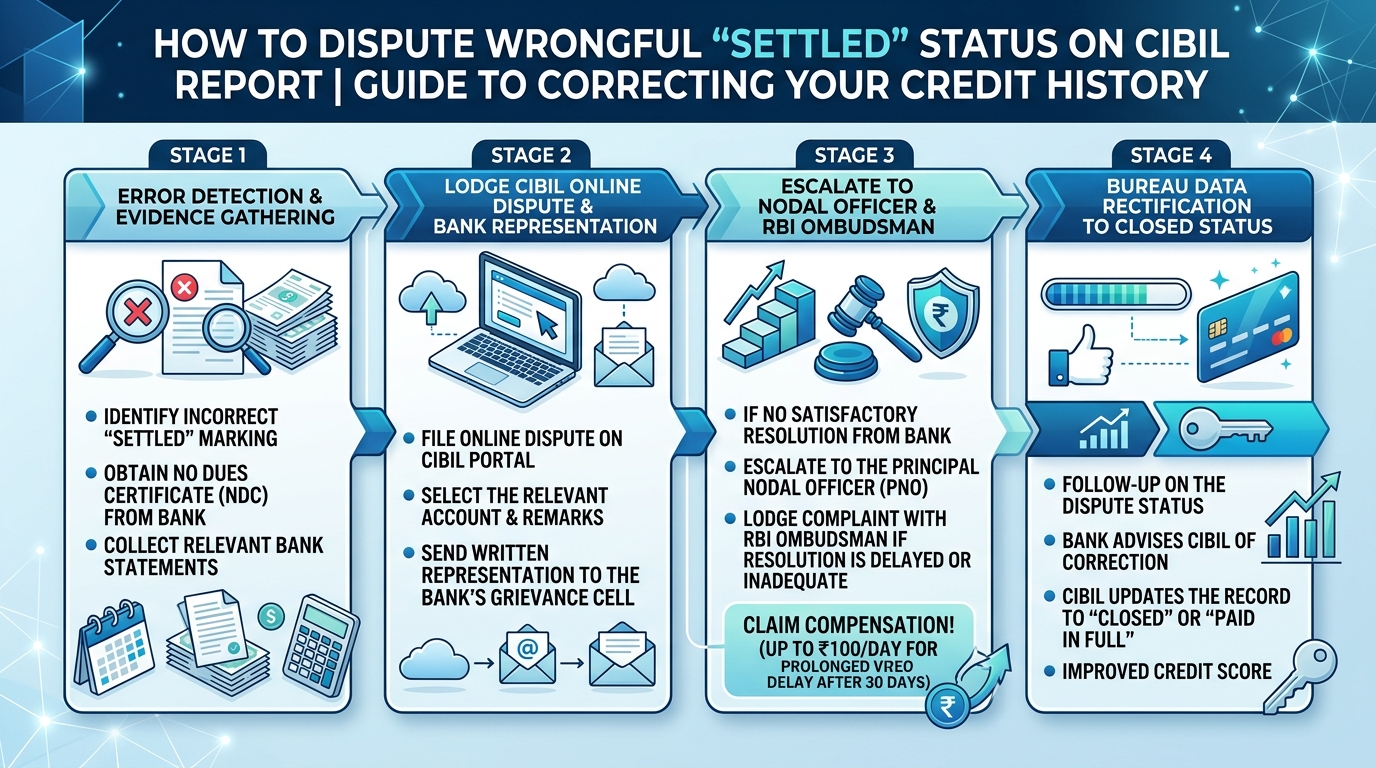
6. 6-Stage Dispute & Rectification SOP: Step-by-Step Execution
Follow this sequential 6-stage Standard Operating Procedure to enforce your statutory rights and ensure full bureau correction across CIBIL, Experian, Equifax, and CRIF High Mark:
Step 1: Download CIR & Identify the Exact Control Number (ECN)
Log in to the official TransUnion CIBIL portal and obtain your updated Credit Information Report. Record the 9-digit Enquiry Control Number (ECN) printed on the top header of the report. The ECN is mandatory for lodging an electronic dispute ticket.
Step 2: Lodge an Official Online Dispute on the CIBIL Dispute Portal
Navigate to CIBIL's Online Dispute Resolution section. Select the disputed loan account, choose "Account Details Dispute", and select "Incorrect Status / Loan Paid in Full - Status should be Closed". Enter your remarks citing the NDC reference number and date of issuance.
Step 3: Serve Formal Written Representation to the Bank Principal Nodal Officer
Simultaneously dispatch a formal written representation via Registered Post AD and official email to the bank's Principal Nodal Officer (PNO) and Credit Bureau Operations Desk. Attach certified copies of the NDC, foreclosure statement, and payment receipts, referencing Section 21 of CICRA 2005.
Step 4: Monitor the Statutory 30-Day Inter-Institutional Verification Loop
Under CICRA rules, CIBIL forwards the dispute query directly to the lending bank's automated verification gateway. The bank has a statutory maximum of 30 calendar days to verify internal records and upload an amended data feed confirming full closure.
Step 5: Escalate to the RBI Integrated Ombudsman on Day 31 (If Unresolved)
If the bank fails to rectify the status within 30 days or issues an evasive denial, immediately lodge a statutory complaint on the RBI Complaint Management System (cms.rbi.org.in). Cite failure of CICRA Section 21 compliance and demand ₹100/day statutory compensation under RBI Circular RBI/2023-24/72.
Step 6: Confirm Cross-Bureau Rectification & Score Rebound
Upon resolution, verify that all four credit bureaus (CIBIL, Experian, Equifax, CRIF) reflect "Closed" status with ₹0 Current Balance and zero overdue amounts. Download the updated CIR and observe the immediate 50–90+ point credit score restoration.
7. Legal Notice for CIBIL Rectification Under CICRA §21
Use this battle-tested formal legal notice template when serving representation to the Principal Nodal Officer and Central Credit Bureau Operations desk of the lending bank:
To,
The Principal Nodal Officer / Central Grievance Redressal Authority,
[Name of Lending Bank / NBFC],
[Registered / Corporate Office Address],
Email: [nodal.officer@bankname.com]

CC: The Head of Operations, TransUnion CIBIL Limited, One World Center, Mumbai.

SUBJECT: STATUTORY DEMAND FOR IMMEDIATE RECTIFICATION OF ERRONEOUS "SETTLED" STATUS TO "CLOSED" IN CREDIT BUREAU RECORDS AND CLAIM FOR COMPENSATION FOR LOAN ACCOUNT NO: [INSERT LOAN A/C NO.]

Respected Sir/Madam,

I, [Borrower Full Name], residing at [Complete Residential Address], holding PAN: [Insert PAN] and Aadhaar: [Insert Aadhaar], do hereby state and demand as follows:

1. That I was the sole borrower of the captioned Loan Facility [Account Number: XXXXXXXX] sanctioned and disbursed by your esteemed institution.
2. That I diligently paid all equated monthly installments and completely paid off the entire loan obligation in full on [Insert Date of Final Payment / Foreclosure], resulting in a ₹0.00 terminal balance.
3. That your institution duly acknowledged full satisfaction of all dues and issued an official, unconditional No Dues Certificate (NDC / NOC) bearing Reference No. [Insert NDC Ref No.] dated [Insert Date of NDC] (enclosed herewith as Annexure A).
4. That notwithstanding the unconditional liquidation of all liabilities, your institution has unlawfully and negligently reported the said account to TransUnion CIBIL, Experian India, Equifax India, and CRIF High Mark under the derogatory classification "SETTLED" / "POST-WRITE-OFF SETTLED" instead of "CLOSED".
5. That this wrongful reporting represents a gross breach of Section 21 of the Credit Information Companies (Regulation) Act, 2005 (CICRA), which mandates credit institutions to maintain authentic, accurate, and up-to-date data.
6. That as a direct consequence of your wrongful reporting, my CIBIL credit score has suffered an artificial degradation of [Insert Score Drop, e.g., 85 points], leading to unjust rejections of subsequent credit applications and severe reputational injury.

IN LIGHT OF THE AFOREMENTIONED FACTS, YOU ARE HEREBY CALLED UPON TO:
a) Immediately transmit a corrected electronic data tape to TransUnion CIBIL, Experian, Equifax, and CRIF High Mark updating Loan Account No. [Insert Account No.] from "Settled" to "CLOSED" with ₹0 overdue within 15 days of receipt of this notice.
b) Provide a written confirmation along with the internal Bureau Rectification Request Reference Number to the undersigned.

TAKE NOTICE that if you fail to rectify the credit records within the statutory 30-day window prescribed under RBI guidelines, I shall be constrained to escalate this matter to the Reserve Bank of India Integrated Ombudsman under the Reserve Bank - Integrated Ombudsman Scheme, 2021, and claim statutory compensation of ₹100 per day of delay under RBI Circular RBI/2023-24/72, alongside filing appropriate claims for damages before the competent Consumer Disputes Redressal Commission entirely at your risk and consequence.

Yours faithfully,

___________________________
[Signature]
[Borrower Name]
[Contact Mobile Number]
[Email Address]
Date: [DD/MM/YYYY]
Place: [City, State]

Enclosures:
1. Copy of Unconditional No Dues Certificate (Annexure A).
2. Copy of Final Foreclosure Account Statement (Annexure B).
3. Copy of Payment Confirmation Challan / RTGS Receipt (Annexure C).
4. Copy of Recent CIBIL Credit Information Report (Annexure D).
8. 3-Tier Escalation Matrix for Unresolved Banking Disputes
When dealing with commercial banks, frontline branch personnel often claim inability to modify historical credit feeds due to archived core banking ledgers. Do not get trapped in endless branch visits. Execute this structured 3-tier regulatory escalation:
Branch Manager & CRM Desk
Submit a formal written letter with NDC copy to the Home Branch Manager and log a formal service request on the bank's centralized internet banking grievance portal. Demand an internal CRM Service Request (SR) number.
Principal Nodal Officer (PNO)
If the branch fails to rectify within 10 days, escalate to the apex Principal Nodal Officer. The PNO possesses executive administrative override authority to initiate manual off-cycle bureau corrections directly with CIBIL.
RBI Integrated Ombudsman
File an online petition at cms.rbi.org.in. The Ombudsman operates with quasi-judicial powers to order immediate status restoration and enforce mandatory ₹100/day customer compensation for statutory delays.
9. Chronological Resolution Timeline: What to Expect at Every Stage
Rectifying an erroneous credit bureau marking follows a predictable institutional lifecycle. The table below outlines key procedural milestones and expected credit score recovery:
| Timeline Stage | Institutional Action | Bureau State | Credit Score Impact |
|---|---|---|---|
| Phase 1: Days 1–15 | Dispute lodged on CIBIL portal; Legal Notice served to Bank PNO with NDC proof. | Account tagged as "Under Dispute" by CIBIL; automated query sent to bank gateway. | Temporary freeze on derogatory weighting during active investigation. |
| Phase 2: Days 16–30 | Bank Credit Operations verifies internal ledger, approves correction, and uploads revised tape. | Status updated from "Settled" to "CLOSED"; Amount Overdue set to ₹0. | Immediate score jump of +50 to +80 points upon tape processing. |
| Phase 3: Days 31–60+ | Escalation to RBI Ombudsman (if delayed); Ombudsman awards ₹100/day penalty & orders immediate refresh. | All 4 credit bureaus (CIBIL, Experian, Equifax, CRIF) synchronized to clean Closed status. | Full restoration to 750–800+ Super-Prime band; 100% prime loan eligibility restored. |
10. Complex Scenarios: Credit Cards, ARCs & Fintech Apps
Certain retail lending structures involve third-party entities, securitization, or digital intermediaries that complicate the dispute resolution pathway:
Credit Card Annual Fee Disputes
Card issuers frequently charge unauthorized renewal or inactive fees, subsequently reporting the card as settled when the customer pays only the actual purchase spends. Under RBI Credit Card Directions, banks cannot report disputed charges to credit bureaus while investigation is pending.
Loans Assigned to ARCs
If the bank assigned your loan portfolio to an Asset Reconstruction Company (ARC) under SARFAESI Section 5 before you paid it off, the ARC holds all legal creditor rights. You must obtain the NDC from the ARC and compel both the originating bank and the ARC to submit synchronized bureau updates.
Digital Fintech Lending Apps
For instant app loans (Lending Service Providers / LSPs), the frontend digital platform does not report to CIBIL. You must identify the underlying RBI-registered NBFC balance sheet lender, serve notice to their compliance desk, and obtain the closure confirmation directly from the regulated NBFC.
 Legal Debt Dispute Authority
CredSettle (credsettle.com) is India's premier debt settlement, loan dispute resolution, and legal protection platform. Operating strictly under the RBI Fair Practices Code and CICRA 2005, our advocate panel negotiates directly with Bank Principal Nodal Officers to eliminate waived differentials, obtain unconditional No Dues Certificates (NDC), and upgrade credit bureau records from "Settled" to "Closed".
Frequently Asked Questions on Disputing Wrong Settled Status on CIBIL
Click on any question below to view detailed legal and banking answers verified by our debt dispute and CIBIL rectification experts:
All dispute procedures, compensation frameworks, and banking rights detailed on this page are grounded in official Indian statutory enactments: