Does Family Have to Repay a Personal Loan After Death?
If a borrower passes away, who pays their unsecured personal loan? Discover the legal liability of legal heirs under Section 50 CPC, Indian Succession Act, and how to stop recovery agent harassment.
- Zero Personal Liability for Family: Surviving family members, spouses, children, and parents are NOT personally liable to pay an unsecured personal loan or credit card debt out of their personal salary, independent savings, or self-acquired assets.
- Section 50 & 52 CPC Estate Limitation: Under Sections 50 and 52 of the Code of Civil Procedure (CPC), 1908, a lender's recovery claim against legal heirs is strictly capped to the net asset value of the inherited estate. If the deceased left zero tangible assets, the legal heir liability is strictly ₹0.
- Loan Protection Insurance Priority: Many personal loans have embedded credit life or loan protection insurance. Upon submission of the Death Certificate, the insurer must settle the outstanding debt directly with the bank, fully protecting the estate and family.
- Criminal Proceedings Abate Upon Death: Any pending or threatened proceedings under Section 138 of the Negotiable Instruments Act (Cheque Bounce) or Section 25 of the Payment and Settlement Systems Act (NACH / ECS Bounce) legally extinguish upon the borrower's death and cannot be initiated against family members.
- Absolute Protection from Harassment: Third-party recovery agents have zero right to visit, call, or intimidate grieving family members. Threatening family members violates the RBI Fair Practices Code and attracts criminal penalties for extortion and intimidation under Bharatiya Nyaya Sanhita (BNS) and IPC.
1. What Happens to an Unsecured Personal Loan After the Borrower Dies?
The sudden loss of a family member is a devastating emotional crisis. In the midst of bereavement, receiving aggressive phone calls, intimidating WhatsApp messages, or unannounced doorstep visits from bank recovery agents demanding immediate repayment of an unpaid personal loan can push families into extreme psychological and financial distress.
Under Indian commercial jurisprudence and contract law, it is essential to understand the fundamental legal nature of an unsecured personal loan. A personal loan is granted purely on the basis of the individual borrower's creditworthiness, income profile, and personal repayment covenant. It creates no mortgage, hypothecation, pledge, or statutory charge over any family property.
Under the Indian Contract Act, 1872, the loan contract exists strictly between the lender and the borrower. Family members who never signed the agreement are total third-party strangers to the contract.
Indian law does not recognize hereditary personal debt bondage. Debts do not automatically pass from deceased parents or spouses to surviving family members.
A lender can only seek recovery through a civil claim against the deceased's estate. No criminal offense can be framed against non-signatory surviving relatives.
Section 37 of the Indian Contract Act provides that promises bind the representatives of the promisors in case of the death of such promisors before performance, unless a contrary intention appears from the contract. However, Indian courts have uniformly established that this representative obligation is not an unlimited personal liability—it binds legal representatives solely to the extent of the assets inherited from the deceased.
2. The Section 50 & 52 CPC Shield: How the Law Protects Legal Heirs
When banks threaten to attach family assets or demand that a widow or children repay a deceased person's debt, they deliberately conceal the protective provisions of the Code of Civil Procedure, 1908 (CPC). Sections 50 and 52 of the CPC represent an unyielding statutory firewall protecting legal heirs:
Execution of Decrees Against Legal Representatives
Section 50(1) provides that if a judgment-debtor dies before a decree is fully satisfied, the decree-holder may apply to execute against the legal representative. However, Section 50(2) strictly restricts execution: "Where the decree is executed against such legal representative, he shall be liable only to the extent of the property of the deceased which has come to his hands and has not been duly disposed of."
Immunity of Self-Acquired Assets of Surviving Family
Under Section 52(1), where a decree is passed against a party as the legal representative of a deceased person, it can only be executed by the attachment and sale of any property of the deceased. The personal salary, independent savings, jewelry purchased by the spouse, and self-acquired property of legal heirs are 100% legally immune from court attachment.
In recurring landmark rulings across various High Courts, the judiciary has held that a creditor cannot touch a single rupee of a legal heir's personal earnings. The burden of proving that the deceased left an estate and that such estate reached the hands of the heirs lies squarely upon the lending bank. If the bank fails to prove the existence of inherited assets, the claim fails completely.
3. Critical Legal Distinction: Co-Borrowers, Guarantors vs. Non-Signatory Family Members
To evaluate your family's exact legal exposure, you must identify whether any surviving relative signed the loan documents as a co-applicant or guarantor, or whether they are simply non-signatory legal heirs. The law treats these categories completely differently:
100% Contractual Liability
If a spouse or child signed as a co-applicant, their liability is joint and several. The death of the primary borrower does not extinguish the co-borrower's independent contractual obligation to pay EMIs.
Section 128 Contract Act
Under Section 128 of the Indian Contract Act, the liability of a surety is co-extensive with that of the principal debtor. The guarantor remains liable even after the borrower dies, unless covered by insurance.
Zero Personal Liability
Family members who did not sign any loan documents have zero personal liability. They cannot be sued personally, cannot be arrested, and their own assets cannot be touched under Section 50 CPC.
Abatement of Cheque / NACH Criminal Proceedings: Under Section 394 of the Code of Criminal Procedure (CrPC) / Section 435 of the Bharatiya Nagarik Suraksha Sanhita (BNSS), all criminal proceedings for cheque bounce (Section 138 NI Act) or NACH bounce (Section 25 PSS Act) automatically abate and are dismissed upon the death of the drawer. A bank cannot file cheque bounce cases against a deceased borrower's family.
4. Debt Liability Comparison Grid: How Different Loans Are Handled After Death
How a lender recovers debt upon a borrower's death depends entirely on whether the loan is unsecured, secured by property, or covered by third-party guarantees. This comprehensive grid outlines family exposure across all debt categories:
| Debt Category | Collateral / Security Type | Legal Heir Personal Liability? | Can Bank Attach Heir's Assets? | Court Execution Limit | Strategic Resolution Pathway |
|---|---|---|---|---|---|
| Unsecured Personal Loan | None (Purely Unsecured) | NO (Zero Personal Liability) | NO (Immune under Sec 52 CPC) | Capped strictly to Inherited Estate NAV | Claim Loan Insurance or execute No-Asset Closure / OTS |
| Credit Card Outstanding | None (Revolving Credit) | NO (Zero Personal Liability) | NO (Immune under Sec 52 CPC) | Capped strictly to Inherited Estate NAV | Submit Death Certificate; bank writes off balance as loss asset |
| Home Loan / Mortgage (LAP) | Equitable Mortgage on Real Estate | NO (Personal), YES (Asset level) | Only Mortgaged Property under SARFAESI | Auction proceeds of mortgaged property | Claim Home Loan Life Insurance or refinance/transfer property |
| Auto / Vehicle Loan | Hypothecation of Vehicle | NO (Personal) | Only Hypothecated Vehicle can be repossessed | Resale value of hypothecated vehicle | Surrender vehicle or pay outstanding to transfer RC book |
| Joint Personal Loan | Co-Signatory Covenant | YES (Surviving Co-Borrower is 100% Liable) | YES (Co-Borrower's personal assets) | Entire outstanding loan balance | Negotiate structured restructuring or compromise One-Time Settlement |
| Education Loan (Parent Guarantor) | Personal Guarantee of Parent | YES (Student Borrower remains liable) | Depends on whether parent or student passed away | Parent estate / student future income | Apply for CSIS government subsidy / moratorium waiver |
Visual Defense Blueprint: 6-Step Legal Heir Debt Resolution Process
Review this high-level visual roadmap illustrating how Indian statutory law protects bereaved families, how to handle unlawful recovery harassment, and how to reach complete debt closure:
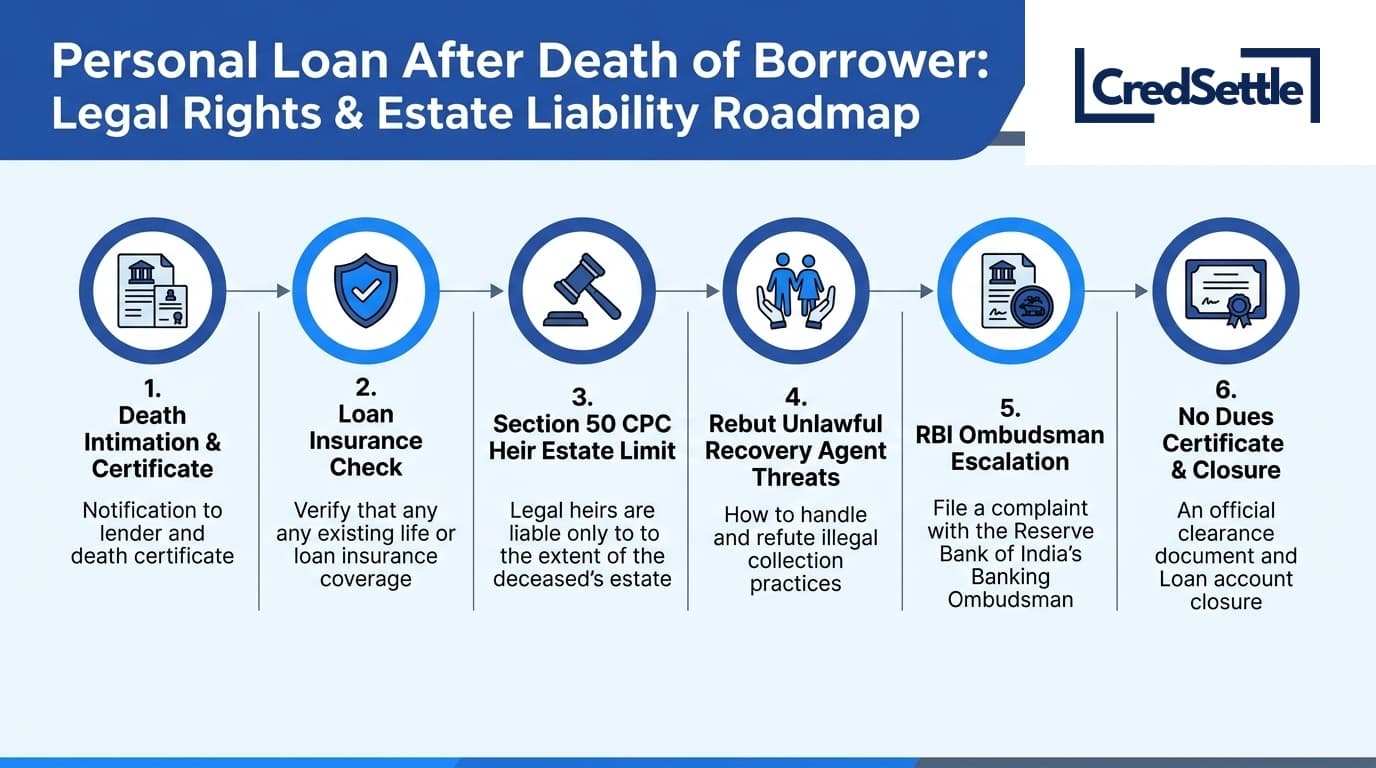
6. 6-Stage SOP for Legal Heirs Facing Personal Loan Claims After Death
If your family is confronted with loan recovery demands following the demise of a loved one, execute this structured, legally backed 6-stage Standard Operating Procedure to protect your rights:
Stage 1: Formal Death Intimation & Interest Freezing Notice
Immediately send a formal written letter along with a notarized copy of the municipal Death Certificate to the lender's home branch via registered Speed Post with Acknowledgment Due (AD) or official email. Request the bank to freeze all ongoing penal interest, late payment fines, and NACH/ECS mandate debits immediately.
Stage 2: Loan Protection Insurance & Credit Shield Audit
Audit the original loan sanction letter, loan agreement, and initial bank disbursement statements. Check if an insurance premium (Credit Shield, Group Credit Life, or Loan Suraksha) was deducted from the disbursed loan amount. If insured, submit the official claim form along with medical records to ensure the insurer settles the outstanding loan balance.
Stage 3: Estate Valuation & Legal Heir Limitation Assessment
Catalog all assets that were registered solely in the name of the deceased. Establish clearly whether any inheritable estate exists. If the deceased had zero assets in their personal name or if the debt exceeds the estate value, calculate the Section 50 CPC estate limit to prepare a solid legal defense.
Stage 4: Rebuttal of Recovery Agent Harassment (Citing Section 50 CPC & RBI Rules)
If third-party collection agencies make threatening calls or home visits, do not pay under panic. Issue a stern written notice citing Section 50 CPC and RBI Recovery Master Directions. Remind them that harassing bereaved family members constitutes an offense of criminal intimidation and extortion under Sections 351 and 308 of the Bharatiya Nyaya Sanhita (BNS).
Stage 5: Representation Before Bank Settlement Committee (OTS / Debt Write-Off)
Present the legal heir position directly to the bank's Principal Nodal Officer or Special Settlement Committee. For uninsured loans with zero estate, request a formal accounting write-off. For partial estate cases, negotiate a heavily discounted compromise One-Time Settlement (OTS) with a 50% to 80% waiver on accrued interest and penalties.
Stage 6: Securing Unconditional No Dues Certificate & Credit Bureau Demise Update
Once the insurance claim or settlement payment is processed, obtain a formal, unconditional No Dues Certificate (NDC) on the bank's official letterhead. Ensure the bank reports the loan account status as "Closed / Settled Due to Demise" to CIBIL, Experian, CRIF High Mark, and Equifax, permanently closing the file.
7. Formal Cease & Desist Legal Notice Draft for Bereaved Families
Below is a formal legal response template engineered to stop unlawful recovery harassment and assert legal heir protections under Section 50 CPC, Indian Contract Act, and RBI Recovery Master Directions:
TO: The Principal Nodal Officer / Head of Customer Grievance Redressal
LENDER: [Name of Commercial Bank / NBFC Institution]
LOAN ACCOUNT NUMBER: [Enter Deceased Borrower's Loan No.]
DECEASED BORROWER: Late [Full Name of Borrower] (Demised on [Date of Death])
SUBJECT: Formal Intimation of Borrower Demise, Demand to Freeze Interest Accrual, and Cease & Desist Notice Against Unlawful Recovery Harassment of Non-Signatory Legal Heirs
Sir / Madam,
1. Please be formally notified that the primary borrower referenced above sadly passed away on [Date of Death]. A certified copy of the municipal Death Certificate (Registration No: [Enter Number]) is annexed herewith for your official records.
2. Take notice that third-party recovery agents representing your institution have been continuously contacting and visiting the residential premises of the surviving family members, issuing unlawful threats of asset seizure and demanding that non-signatory legal heirs pay the outstanding debt out of their personal funds.
3. You are explicitly reminded that under Section 37 of the Indian Contract Act, 1872 and Sections 50(2) and 52(1) of the Code of Civil Procedure, 1908, surviving legal heirs hold zero personal liability for an unsecured personal loan. A legal heir's liability is strictly limited to the value of the inherited estate. The surviving family members are non-signatory third parties and own only self-acquired assets which are completely immune under Indian law.
4. Furthermore, under RBI Master Direction DOR.ORG.REC.65/21.04.158/2022-23 (Fair Practices Code), lenders and their recovery agents are strictly prohibited from intimidating, threatening, or contacting bereaved family members in violation of statutory privacy standards.
5. You are hereby called upon to immediately: (a) Freeze all interest, penal charges, and NACH debits as of the date of death, (b) Halt all third-party recovery agent calls and home visits, (c) Verify and process the embedded Credit Shield / Loan Life Insurance policy, and (d) Issue a formal Statement of Account to the undersigned for final settlement / closure.
8. 3-Tier Institutional Grievance Redressal Matrix
If a lender refuses to honor the Death Certificate, ignores loan insurance coverage, or deploys aggressive recovery agents against your family, escalate through the statutory 3-tier grievance mechanism:
Branch Manager & Bereavement Desk
Submit the Death Certificate and formal intimation letter to the Branch Head. Request a formal Complaint Docket / Service Request Number confirming receipt and account freeze.
Principal Nodal Officer (PNO)
If the branch ignores the intimation or recovery calls continue, escalate to the bank's Principal Nodal Officer and Internal Ombudsman to recall recovery agencies and enforce Section 50 CPC limits.
RBI Integrated Ombudsman & Police
File an online complaint on the RBI CMS Portal (cms.rbi.org.in) for unfair practices and harassment. For criminal threats, lodge an FIR with the local Police / Cyber Cell.
9. Chronological Resolution Timelines & Post-Death Settlement Milestones
The institutional lifecycle of handling a deceased borrower's loan account follows a standard banking trajectory. Here is what family members should expect at each stage:
| Timeline Stage | Bank Internal Status | Recovery Actions Encountered | Family Legal Strategy | Expected Outcome |
|---|---|---|---|---|
| Days 1 – 15 | Demise Intimation Pending | Automated SMS, missed EMI reminder calls | Submit Death Certificate; demand NACH cancelation | Account flagged as Demised in Core Banking System |
| Days 16 – 45 | Insurance & Estate Review | Collection call center outreach | Submit insurance claim; assert Section 50 CPC limits | Insurance claim initiated; penal charges frozen |
| Days 46 – 90 | NPA / Loss Classification | Agency assignment, unauthorized home visits | Issue Cease & Desist notice to PNO citing RBI norms | Recovery calls halted; file transferred to settlement desk |
| Days 91 – 180 | Special Recovery Committee | Formal legal settlement offer letters | Negotiate OTS compromise or prove zero estate assets | Sanction of 50% to 80% waiver or complete debt write-off |
| Post-Settlement | Account Extinguished | Zero recovery activity; all harassment halted | Collect unconditional No Dues Certificate (NDC) | CIBIL updated to "Closed / Demised"; complete legal peace |
10. Specialized Real-World Scenarios: Credit Cards, Fintech Apps & Insurance Nominees
Different financial products and lending channels present distinct challenges upon a borrower's death. Here is how to navigate complex scenarios:
Add-On Cardholders vs. Primary Deceased Cardholder
Credit card debt is 100% unsecured. If the primary cardholder passes away, the debt does not pass to surviving family. However, if a family member holds an Add-On card, banks sometimes claim the add-on user is liable. Legally, add-on cardholders are merely authorized users, not primary debtors. The debt remains bounded strictly by the deceased primary cardholder's estate under Section 50 CPC.
Illegal Harassment of Contact Lists Post Demise
Rogue digital lending apps often harvest contact lists and send threatening messages to relatives even after being informed of the borrower's death. This is a severe violation of the RBI Digital Lending Directions (2022) and the Information Technology Act. Immediately file a complaint on the National Cyber Crime Portal (cybercrime.gov.in) and RBI Sachet portal to trigger regulatory sanctions against the digital lender.
Can Banks Forcefully Deduct Loan From Term Life Insurance Proceeds?
Banks often attempt to seize term life insurance payouts received by the widow or children (nominees) to clear unpaid personal loans. Under Section 39(7) of the Insurance Act, 1938 (as amended in 2015), beneficial nominees (spouse, children, parents) hold absolute beneficial ownership of policy proceeds. Furthermore, policies under the Married Women's Property (MWP) Act, 1874 are statutorily protected from all creditors and cannot be attached.
 Legal Debt Dispute Authority
CredSettle (credsettle.com) is India's premier debt settlement, loan dispute resolution, and legal protection platform. Operating strictly under the RBI Fair Practices Code and CICRA 2005, our advocate panel negotiates directly with Bank Principal Nodal Officers to eliminate waived differentials, obtain unconditional No Dues Certificates (NDC), and upgrade credit bureau records from "Settled" to "Closed".
Frequently Asked Questions About Personal Loans After Borrower Death
Review exhaustive legal answers to the most critical questions regarding family liability, estate succession, and recovery agent restrictions under Indian banking law:
Official Statutory & Regulatory Citations
The legal principles, statutory exemptions, and precedents detailed in this guide are anchored directly in official Indian statutes and regulatory directives: