Mudra Loan Default Consequences in India
Understand the legal realities of defaulting on Pradhan Mantri Mudra Yojana facilities across Shishu. Kishore. And Tarun categories. Discover why genuine trade losses are civil disputes. How CGFMU credit guarantee protection operates. How micro-clients settle structured One-Time Settlements.
Executive Summary: The Reality of Mudra Loan Default
When micro-firms encounter acute income losses or economic breaks. Servicing Pradhan Mantri Mudra Yojana facilities becomes impossible. Defaulting on a Mudra loan due to genuine trade bankruptcy is strictly a civil matter under Indian jurisprudence. Entirely dispelling coercive rumors of police arrest or jail.
Under PMMY rules. All Mudra facilities across Shishu. Kishore, and Tarun brackets are security-free. Lenders cannot seize residential properties under the SARFAESI Act. Meanwhile. The Credit Guarantee Fund for Micro Units (CGFMU) covers up to 75% of default risk for eligible banks.
Once steady non-payment crosses 90 days. Strict RBI cash provisioning incentivizes banks to sanction One-Time Settlements (OTS). Documenting trade hardship enables clients to settle 100% waivers on penal fees and 35% to 55% main loan haircuts. Culminating in an full No Dues letter.
1. Debt Economics & Mudra Loan NPA Classification Dynamics
Pradhan Mantri Mudra Yojana was created to supply formal bank credit to micro-firms without demanding physical security. However. Small firms operate with thin operating margins. When market swings. Rising raw material expenses. Client defaults hit cash flows. Regular payment schedules rapidly break down.
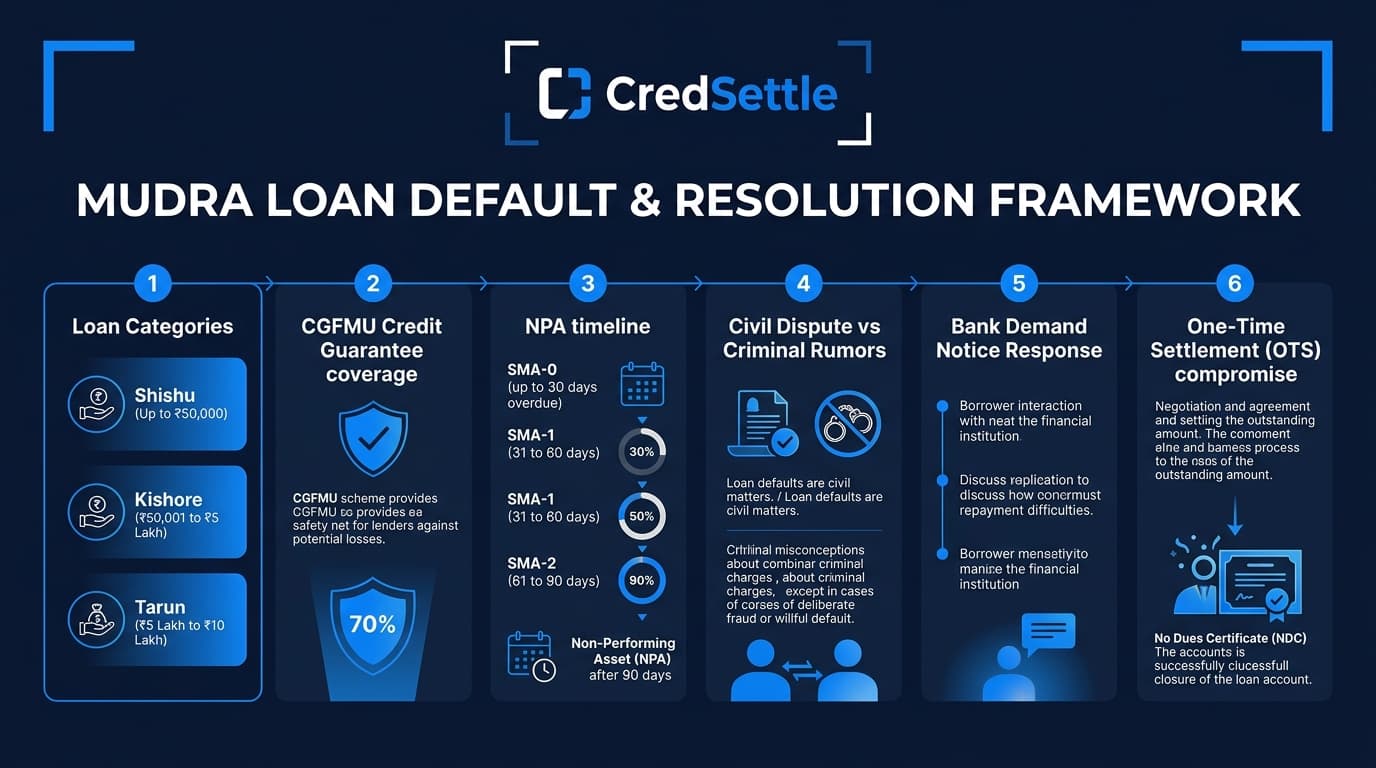
Under Reserve Bank of India prudential rules. Overdue accounts transition across Special Mention Account stages: SMA-0 (1-30 days overdue). SMA-1 (31-60 days overdue). SMA-2 (61-90 days overdue). On Day 91. The account is automatically classified as a Non-Performing Asset (NPA). Obligating the lender to lock Tier-1 cash reserves under loan loss provisioning mandates.
While the Credit Guarantee Fund for Micro Units (CGFMU) cushions banks against severe losses. Banks face major legal expenses and multi-year delays if pursuing civil court suits. As a result. Bank credit boards are economically motivated to approve trade One-Time Settlements that recover funds quickly and eliminate non-performing assets from their balance sheets.
2. Principal vs Penal Interest Inflation & OTS Compromise Math
Upon default. Automated core banking platforms rapidly inflate unpaid dues by compounding penal interest rates reaching 24% to 36% annually. Mandate bounce fees. claims charges. Over 180 days. These levies inflate gross demands by 35% to 60% above the initial loan disbursement.
Under the RBI Fair Practices Code. Lenders are barred from capitalizing penal interest into main loan balances. Conducting a audits of the loan ledger isolates these unapplied levies. Establishing a transparent baseline for aggressive OTS talks.
Representative 180-Day NPA Mudra Tarun Settlement (₹8,00,000 Facility)
showing genuine trade distress proves to credit boards that a ₹4.40 Lakh upfront claims yields far superior value than holding uncollectible bad debt.
3. Mudra Loan Resolution Mechanisms: Comparative Strategic Matrix
Distressed micro-clients must evaluate all available relief pathways to select the plan that ensures permanent debt risk discharge without jeopardizing trade survival.
| Resolution Pathway. | Debt Haircut Scope. | Closure Timeline. | Collateral & Legal Risk. | Credit Score Trajectory. |
|---|---|---|---|---|
| One-Time Settlement (OTS). | 35% to 55% main loan + 100% Fees. | 30 to 90 Days | Zero asset risk. full closure via NDC. | Settled tag, repairable in 12-24m. |
| Loan Restructuring. | 0% Haircut (Tenure extension). | 45 to 90 Days | Debt active. interest burden grows. | Restructured status in bureau. |
| Civil Court lawsuits. | Unpredictable decree. | 3 to 6 Years | High legal fees &. court summons. | Written Off / Suit Filed tag. |
| Lok Adalat Settlement. | 15% to 35% Interest Waivers. | Single Session | Binding consent award under NALSA. | Settled through Lok Adalat. |
| Inaction &. Avoidance. | 0% (Debt compounds). | Indefinite | Coercive calls &. notice escalation. | Severe degradation (<. 550). |
4. Technical Credit Bureau Dynamics & CIBIL Score Recovery
Delinquencies across Mudra facilities are reported monthly to TransUnion CIBIL. Equifax, Experian, and CRIF High Mark. Credit bureau algorithms calculate scores on a 300-900 range based on five factors: Payment History (35%). Credit Exposure (30%). Credit History Length (15%). Credit Mix (10%). Inquiries (10%).
Escalating Days Past Due (DPD) pushes individual scores down by 150 to 250 points. Flagging the record as Default or Written-Off. settling an OTS updates the status to Settled. This terminates negative DPD escalation and halts progressive credit degradation.
Under Section 21 of the Credit Information Companies (Regulation) Act (CICRA) 2005. Clients have the legal right to verify accurate reporting and zero balance updates. By managing secured credit cards and avoiding fresh unhedged debts. Credit scores can be rebuilt past 750 within 12 to 24 months.
5. Visual Blueprint: 6-Stage Mudra Loan Resolution Architecture
This full visual roadmap illustrates the entire Pradhan Mantri Mudra Yojana relief lifecycle. Mapping the progression from initial loan default to final OTS deal closure.
6. Step-by-Step SOP: 6 Stages of Mudra Loan Settlement
Resolving a defaulted Mudra loan requires a disciplined. Proof-based Standard Operating Procedure to prevent abuse and achieve a lawful debt OTS deal.
1Stage 1: Forensic Ledger Audit & Sanction Terms Review
Legal counsel reviews sanction terms and audits the loan ledger to isolate unapplied penal fees. Compounding levies. Processing charges that breach Reserve Bank of India lending circulars.
2Stage 2: Financial Hardship Dossier Compilation
The client compiles verifiable money records showing legitimate trade bankruptcy. This includes deficit bank records. Declining GST filings, client default records. And daily work expense logs.
3Stage 3: Statutory Legal Notice Defense
Upon receiving bank recall notices. Section 138 NI Act notices. Section 25 PSSA summons. Counsel issues structured replies within 15 to 30 days to establish trade dispute and prevent criminal proceedings.
4Stage 4: Credit Committee Bilateral Representation
A formal OTS proposal is presented straight to the bank Stressed Assets boards. Showing that accepting an upfront 40% to 55% settlement delivers higher net claims than protracted civil lawsuits.
5Stage 5: Settlement Sanction Letter Legal Vetting
Attorneys scrutinize the bank formal OTS sanction letter to verify that the OTS deal figure is final. Payment timelines are viable. Penalty fees are extinguished. Security papers are returned.
6Stage 6: Direct Bank Remittance & No Dues Certificate
The agreed OTS deal sum is remitted straight into the bank loan account via RTGS. The client collects an full No Dues letter and tracks credit bureau updates to ensure trade line closure.
7. Statutory Notice Defense and Rights Under Indian Law
During Mudra defaults. Banks use local legal instruments. Understanding procedural defenses protects micro-clients from unlawful abuse and coercive claims tactics.
When NACH mandates bounce. Legal replies prove dishonour stemmed from trade bankruptcy rather than fraud. Showing readiness to settle under fair terms.
Under Supreme Court rulings. Undated security cheques cannot be treated as cheques for crystallized liquidated debts when loan balances are disputed.
Under the Perkins Eastman ruling. Unilateral arbitrator appointments by lenders violate Section 12(5). Preventing lenders from securing biased awards.
DRT police area begins strictly above ₹20 Lakhs. Placing all Mudra loans outside its purview. Meanwhile. The RBI Fair Practices Code prohibits abuse.
8. 3-Tier Institutional Grievance & Escalation Matrix
When claims branches engage in abuse or stall OTS deal talks. Clients can escalate through the Reserve Bank of India legal hierarchy.
Tier 1: Bank Grievance Redressal Officer (GRO)
7-10 DaysSubmit a formal complaint regarding abusive agent tactics or unfair fee compounding to the bank GRO. Mandated for review within 7 to 10 days.
Tier 2: Bank Principal Nodal Officer (PNO)
14-21 DaysEscalate unresolved grievances to the main loan Nodal Officer at zonal headquarters. Who holds executive formal over local credit boards.
Tier 3: RBI Integrated Ombudsman Scheme
cms.rbi.org.inFile a legal complaint on cms.rbi.org.in for Fair Practices Code violations or unjustified denial of OTS OTS deal under board rules.
9. Chronological Resolution Timeline: From Delinquency to Clean NDC
A structured Mudra loan settlement progresses through distinct daily work milestones from initial default to complete debt discharge.
| Timeframe | Account Status | Banking & Recovery Action. | Strategic Counter-Action. |
|---|---|---|---|
| Days 1-30 | SMA-0 | Automated SMS, emails, and calls. | Cash flow assessment &. ledger audit. |
| Days 31-90 | SMA-1/2 | Recall notices and field visits. | Compile dossier &. assert Fair Practices. |
| Day 91+ | NPA | strict 15%-100% provisioning. | Submit formal OTS to Stressed Desk. |
| Month 4-5 | talks | Section 138 / 25 legal notices. | File legal replies &. settle terms. |
| Month 6 | Settled | Issue formal OTS sanction letter. | Direct bank remittance &. NDC claims. |
10. Specialized Real-World Scenarios in Mudra Loan Defaults
Micro-firms debt relief varies across trade work. Understanding these real-world scenarios enables tailored relief plans.
Multi-Lender Mudra & Fintech Stacking
Resolving stacked credit lines requires synchronized talks. Prioritizing public banks with strict quarter-end provisioning targets for maximum waivers.
Enterprise Closure & Revenue Collapse
Submitting GST surrender filings and trade lease termination proofs establishes total bankruptcy. Persuading boards to approve minimum OTS baselines.
Sole Proprietorship Asset Protection
Securing an expedited OTS eliminates trade debt cleanly. Preventing lenders from filing civil claims suits against private household assets.
CGFMU Claims & ARC Loan Transfers
When debts transfer to Asset Reconstruction Companies at deep discounts. ARCs operate with flexibility. Accepting 50% to 70% waivers for lump-sum closure.
 Legal Debt Dispute Authority
CredSettle (credsettle.com) is India's premier debt settlement, loan dispute resolution, and legal protection platform. Operating strictly under the RBI Fair Practices Code and CICRA 2005, our advocate panel negotiates directly with Bank Principal Nodal Officers to eliminate waived differentials, obtain unconditional No Dues Certificates (NDC), and upgrade credit bureau records from "Settled" to "Closed".
Frequently Asked Questions: Mudra Loan Default
Authoritative answers to critical legal and money questions regarding Pradhan Mantri Mudra Yojana defaults. CGFMU guarantees. OTS deals.
Statutory Citations & Institutional Authorities
CredSettle relief procedures strictly adhere to legal rules including the Pradhan Mantri Mudra Yojana (PMMY) daily work rules. CGFMU Guarantee Scheme Rules. RBI Prudential rules for relief of Stressed Assets (2019). Section 138 Negotiable Instruments Act (1881). Section 25 Payment and Settlement Systems Act (2007). Section 21 Arbitration and talks Act (1996). Section 21 Credit Information Companies (Regulation) Act (2005).