Mental Harassment by Recovery Agents:
Legal Action & Compensation
Facing extreme mental trauma, abusive calls, or public shaming by recovery agents? Understand your legal rights under RBI Master Directions, BNS/IPC criminal provisions, and how to sue your bank for emotional distress.
- Vicarious Liability of Commercial Banks: The Supreme Court of India has firmly established that commercial banks and NBFCs cannot evade responsibility for third-party collection agencies. The lending institution is vicariously liable under both civil tort law and criminal jurisprudence for any harassment, extortion, or intimidation perpetrated by its contracted agents.
- Strict Criminal Sanctions under BNS & IPC: Verbal threats, late-night calls, public shaming, and doorstep intimidation constitute cognizable offenses under Bharatiya Nyaya Sanhita (BNS) Section 351 (Criminal Intimidation), Section 308 (Extortion), Section 329 (Criminal Trespass), and Section 356 (Defamation), punishable by imprisonment and substantial fines.
- RBI Master Direction Compliance Mandates: Under RBI Master Direction DOR.ORG.REC.65/21.04.158/2022-23, agents are strictly prohibited from calling outside 8:00 AM to 7:00 PM, contacting borrowers' relatives, colleagues, or HR departments, making unannounced workplace visits, or using abusive or defamatory language.
- Civil Damages for Emotional Distress & Mental Agony: Borrowers subjected to coercive debt collection can claim extensive financial compensation through District Consumer Disputes Redressal Commissions (DCDRC) and Civil Courts for deficiency in service, loss of reputation, medical distress, and intentional infliction of mental trauma.
- Strategic Leverage for Complete Debt Resolution: Initiating formal legal proceedings, lodging RBI Ombudsman complaints, and serving statutory Cease & Desist notices compels banks to withdraw aggressive collection agencies, waive accumulated penal interest, and agree to favorable compromise One-Time Settlements (OTS).
1. Supreme Court Rulings: Banks Cannot Harass Borrowers
Defaulting on a bank loan, credit card balance, or personal finance installment in India is fundamentally a civil contractual dispute, never a criminal offense. However, commercial banks, Non-Banking Financial Companies (NBFCs), and predatory fintech apps routinely outsource recovery operations to aggressive third-party agencies that employ coercion, verbal abuse, workplace visits, and unlawful public shaming to force repayments.
The Hon'ble Supreme Court of India and various High Courts have delivered landmark rulings condemning these "strong-arm" tactics and establishing the strict legal accountability of lending institutions.
The Supreme Court held that banks cannot deploy musclemen or goons to recover loans. Loan recovery must follow due civil process, and institutions employing abusive agents face criminal proceedings.
Lending institutions cannot wash their hands of third-party recovery misconduct. Under the principal-agent relationship, the bank is vicariously liable for all torts and crimes committed by collection agencies.
National Consumer Disputes Redressal Commission (NCDRC) affirmed that sending musclemen and creating a public scene constitutes gross deficiency of service, awarding exemplary damages to the borrower.
In the nine-judge constitutional bench judgment Justice K.S. Puttaswamy (Retd.) v. Union of India (2017), the Supreme Court declared that the Right to Privacy and human dignity is an inalienable fundamental right under Article 21 of the Constitution. Calling a borrower's colleagues, contacting elderly parents, or posting defamatory statements online represents an egregious constitutional violation that entitles the victim to pursue both criminal prosecutions and constitutional writ remedies.
2. Criminal Penalties for Abusive Debt Collection Under BNS & IPC
When debt collection crosses the line from polite institutional reminders into threats of violence, social humiliation, unauthorized home intrusions, or cyber blackmail, it ceases to be a civil matter. Under the Bharatiya Nyaya Sanhita, 2023 (BNS) and the corresponding provisions of the Indian Penal Code, 1860 (IPC), recovery agents and bank executives commit severe, cognizable criminal offenses:
Criminal Intimidation & Threats of Bodily Harm or Ruin
Threatening a borrower with physical injury, destruction of property, social shaming, or criminal framing if they do not pay money immediately constitutes Criminal Intimidation. If the threat is to cause death, grievous hurt, or destruction of property, the offense is punishable by rigorous imprisonment for up to seven years.
Extortion by Putting Borrower in Fear of Injury
Intentionally putting any person in fear of any injury to that person or to any other, and thereby dishonestly inducing the person so put in fear to deliver any property, valuable security, or cash constitutes Extortion. Demanding immediate transfer of funds under threat of home seizure or workplace confrontation meets the statutory definition of extortion.
Unauthorized Entry into Residential Premises or Office
Entering into or upon property in the possession of another with intent to commit an offense or to intimidate, insult, or annoy any person in possession of such property is Criminal Trespass. Recovery agents barging into your living room, refusing to leave when asked, or blocking your gate commit a direct criminal offense.
Workplace Defamation, Social Shaming & Digital Contact Harassment
Publishing imputations concerning a person intending to harm their reputation before neighbors, employers, or relatives constitutes Criminal Defamation. For fintech apps accessing phone contacts without consent, sending morphed photographs, or broadcasting debt notices on WhatsApp groups, Sections 66E, 67, and 67A of the Information Technology Act, 2000 apply directly with non-bailable arrest warrants.
3. RBI Master Directions: Strict Boundaries Governing Recovery Agents
The Reserve Bank of India has issued comprehensive regulatory directions governing commercial banks, NBFCs, and digital lenders under Master Direction DOR.ORG.REC.65/21.04.158/2022-23 and circulars on Outsourcing of Financial Services. These rules are legally binding on all regulated entities:
Mandatory Timing & Communication Protocols
- Strict Calling Window (8:00 AM to 7:00 PM): Agents are strictly barred from telephoning borrowers before 8:00 AM or after 7:00 PM under any circumstances.
- Calling Frequency Limits: Repeated, persistent calling that borders on harassment or nuisance is strictly prohibited.
- Identification Disclosure: Agents must disclose their full identity, agency affiliation, and produce official bank authorization letters upon request.
Privacy Protection & Third-Party Immunity
- Absolute Ban on Third-Party Contact: Agents cannot disclose the borrower's debt to friends, family members, neighbors, or co-workers who are not co-borrowers or guarantors.
- Workplace Visitation Restrictions: Unannounced visits to the borrower's workplace are strictly prohibited unless the borrower has explicitly requested it in writing.
- Prohibition of Verbal Abuse: Use of vulgar language, derogatory insults, shouting, or psychological bullying is punishable by regulatory sanctions.
DRA Certification Requirement: Under RBI mandates, every recovery agent deployed by a bank must undergo mandatory 100-hour training conducted by the Indian Institute of Banking & Finance (IIBF) and obtain Debt Recovery Agent (DRA) certification. Deploying uncertified musclemen or street agents is a direct regulatory breach that invites heavy RBI penalties on the bank.
4. Lawful Recovery vs Harassment: Remedies & Penalties
This comprehensive matrix highlights the exact boundary between lawful banking communication and illegal recovery harassment, along with the precise legal remedies available to borrowers:
| Collection Tactic / Incident | Legal Status under RBI / Law | Applicable Statutory Violation | Borrower's Legal Action & Remedy |
|---|---|---|---|
| Calling between 8:00 AM – 7:00 PM with official ID | LAWFUL (Permissible Recovery) | RBI Master Direction Compliance | Request written settlement proposal; verify loan statement |
| Calling late at night (after 7 PM or before 8 AM) | ILLEGAL HARASSMENT | RBI Master Direction Sec 2.1 & Nuisance | Save CDR call logs; file RBI Ombudsman petition for damages |
| Calling relatives, friends, or workplace HR | STRICTLY ILLEGAL & DEFAMATORY | Sec 356 BNS / 499 IPC & Art 21 Privacy | Issue Defamation Legal Notice; file Consumer Forum suit |
| Verbal abuse, foul language & death threats | COGNIZABLE CRIMINAL OFFENSE | Sec 351 & 352 BNS / Sec 506 & 504 IPC | Record audio; file immediate Police FIR against bank & agency |
| Doorstep visit with bouncers & forceful entry | CRIMINAL TRESPASS & EXTORTION | Sec 329 & 308 BNS / Sec 441 & 383 IPC | Call 112 emergency; preserve CCTV footage; file criminal case |
| Morphing photos & WhatsApp group shaming | CYBER CRIME & EXTORTION | IT Act Sec 66E, 67, 67A & Sec 308 BNS | Report to cybercrime.gov.in & file non-bailable cyber FIR |
| Sending fake police summons or fake court warrants | FORGERY & IMPERSONATION | Sec 336 & 204 BNS / Sec 465 & 170 IPC | Verify CNR on ecourts.gov.in; file criminal complaint for fraud |
5. Suing for Damages: Compensation for Mental Agony
When filing a lawsuit before a District Consumer Commission (DCDRC) under Section 35 of the Consumer Protection Act, 2019 or a Civil Suit under the Law of Torts for Intentional Infliction of Emotional Distress (IIED), Indian courts utilize an objective multiplier framework to assess monetary compensation:
Statutory Tort & Mental Agony Damage Formulation
Civil Jurisprudence# Mathematical Claim Valuation Formula:
Total_Compensation = Direct_Loss + (Base_Trauma_Index * Severity_Multiplier * Duration_Factor) + Exemplary_Damages + Legal_Costs
Why Banks Prefer Settlement over Defending Harassment Suits: In court, a proven harassment incident triggers adverse media exposure, brand damage, and heavy judicial strictures. In over 85% of cases where borrowers present solid audio and telecom evidence, banks choose to waive all penal interest and close the debt via an amicable One-Time Settlement rather than face court-ordered punitive damages.
6-Stage Roadmap to Sue Banks & Claim Compensation
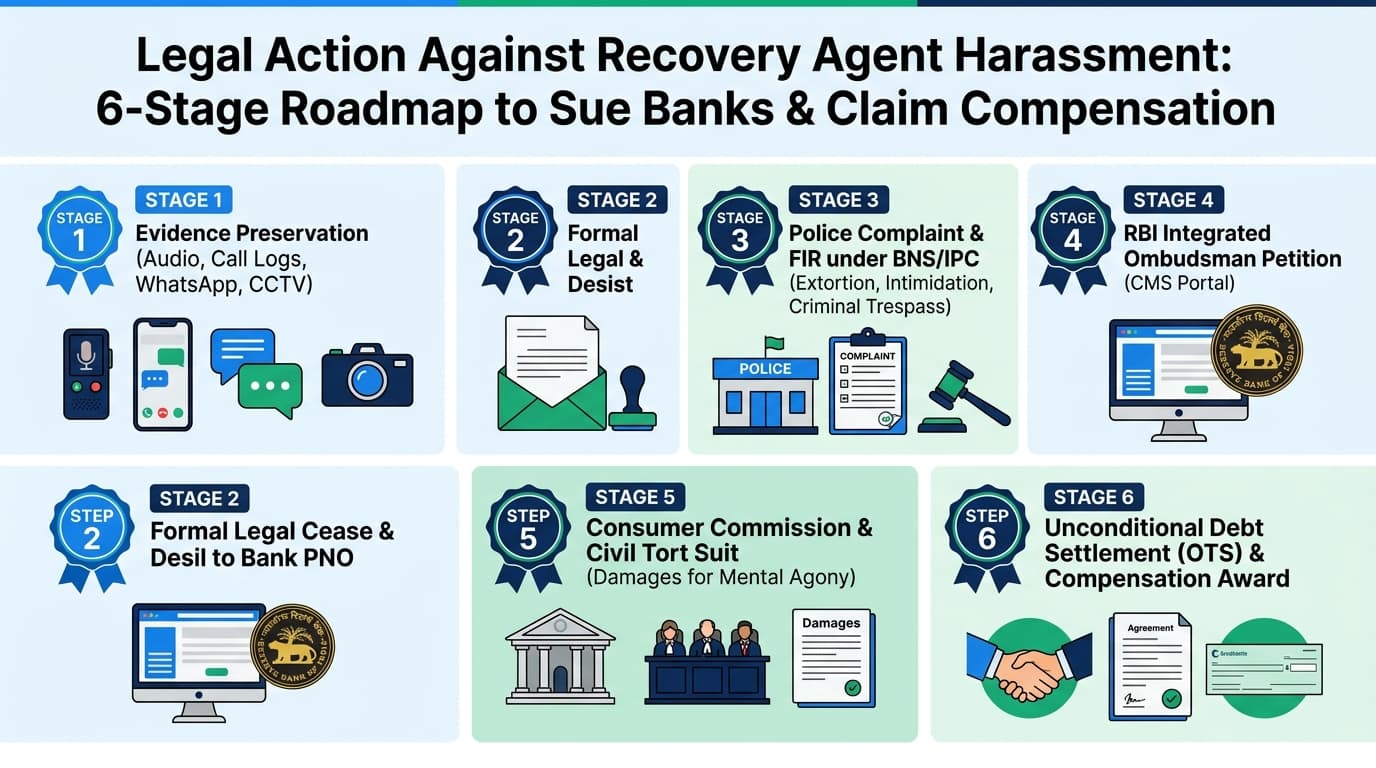
Review this high-level visual roadmap illustrating the complete legal procedure to preserve evidence, serve statutory notices, register police complaints, petition the RBI Ombudsman, and obtain a debt waiver or damages:
6. 6-Stage SOP for Borrowers Facing Recovery Agent Mental Harassment
If you or your family members are experiencing relentless calls, verbal threats, workplace visits, or digital harassment, follow this step-by-step Standard Operating Procedure:
Stage 1: Evidence Preservation (Audio, CDR, WhatsApp & CCTV)
Enable automatic call recording on your smartphone. Save all abusive WhatsApp messages, SMS, and emails with timestamps. Request Call Detail Records (CDR) from your telecom provider to prove incessant calling outside permitted hours (8 AM–7 PM). Backup any doorstep CCTV footage or smartphone video recordings.
Stage 2: Formal Cease & Desist Legal Notice to Bank PNO
Issue a formal legal Cease & Desist notice addressed to the bank's Principal Nodal Officer (PNO) and Managing Director via Registered Speed Post with Acknowledgment Due (AD) and email. Detail the exact instances of agent harassment, cite RBI Master Directions and BNS criminal provisions, and demand immediate recall of the external recovery agency.
Stage 3: Police Complaint & FIR Registration (BNS / IPC / IT Act)
If agents threaten physical violence, trespass on your property, or send morphed photos, lodge an immediate written complaint at your local police station under Sections 351 (Intimidation), 308 (Extortion), 329 (Trespass), and 356 (Defamation) of the BNS, as well as the IT Act. If police hesitate to register an FIR, file a complaint before the Magistrate under Section 175(3) of the Bharatiya Nagarik Suraksha Sanhita (BNSS) / 156(3) CrPC.
Stage 4: Petition before the RBI Integrated Ombudsman (CMS Portal)
If the bank fails to resolve your harassment complaint within 30 days, file an online grievance on the RBI Complaint Management System (cms.rbi.org.in). Attach call recordings and evidence. The Ombudsman has the statutory power to penalize the bank, mandate corrective steps, and award compensation for harassment.
Stage 5: Consumer Commission (DCDRC) & Civil Tort Claim
File a consumer complaint on the e-Daakhil portal (edaakhil.nic.in) against the bank for deficiency of service, unfair trade practices, and severe mental agony under Section 35 of the Consumer Protection Act, 2019. Claim monetary compensation for emotional trauma, reputational injury, and litigation expenses.
Stage 6: Negotiating a Compromise OTS & Obtaining No Dues Certificate
Leverage pending regulatory complaints and consumer court proceedings to initiate direct One-Time Settlement (OTS) negotiations with the bank's senior dispute committee. Secure a 40% to 75% waiver on total outstanding amounts, make direct payments to the bank loan account, and collect your unconditional No Dues Certificate (NDC).
7. Formal Cease & Desist Legal Notice Draft
Below is a battle-tested legal notice draft designed to stop unlawful recovery agent harassment, assert your constitutional rights, and establish a formal paper trail for regulatory escalation:
TO: The Principal Nodal Officer / Managing Director & CEO
REGULATED ENTITY: [Name of Commercial Bank / NBFC Institution]
LOAN / CREDIT CARD ACCOUNT NO.: [Enter Account Number]
SUBJECT: Formal Cease & Desist Notice for Criminal Intimidation, Workplace Defamation, Right to Privacy Violations, and Gross Non-Compliance with RBI Recovery Master Directions
Sir / Madam,
1. The undersigned borrower availed a credit facility bearing the account number referenced above. Owing to genuine financial setbacks [job loss / medical emergency], monthly installments experienced default.
2. Take notice that over the past [Number] days, third-party recovery agents acting under your authorization have subjected the undersigned and family members to egregious harassment, including: (a) Persistent calls between 8:00 PM and 11:30 PM, (b) Verbal abuse, foul slurs, and death threats, (c) Contacting unauthorized third parties including employer HR and relatives, and (d) Unlawful doorstep trespass.
3. Under the doctrine of Vicarious Liability established by the Hon'ble Supreme Court in ICICI Bank Ltd. v. Prakash Kaur (2007), your institution is directly responsible for all unlawful and criminal acts committed by your outsourced agents.
4. The actions of your agents constitute cognizable criminal offenses under Bharatiya Nyaya Sanhita (BNS) Section 351 (Criminal Intimidation), Section 308 (Extortion), Section 329 (Criminal Trespass), and Section 356 (Defamation), as well as direct violations of RBI Master Direction DOR.ORG.REC.65/21.04.158/2022-23 and the Fundamental Right to Privacy under Article 21.
5. You are hereby called upon to immediately CEASE AND DESIST all unauthorized collection activities, recall the recovery file from the third-party agency, and initiate formal grievance redressal. Failure to comply within seven (7) days shall constrain the undersigned to initiate criminal FIR proceedings, lodge a petition before the RBI Integrated Ombudsman, and file a claim for damages before the Consumer Commission at your institution's sole risk and cost.
8. 3-Tier Grievance Redressal & Institutional Escalation Matrix
Follow this structured institutional hierarchy to escalate harassment complaints systematically for maximum legal impact:
Branch Manager & Customer Care Desk
Submit a formal written grievance with call recordings and transcripts to the Branch Head and Customer Care Desk. Demand an official Complaint Ticket Number.
Principal Nodal Officer (PNO)
Escalate unresolved complaints to the bank's Principal Nodal Officer and Internal Ombudsman. The PNO holds executive authority to recall third-party collection agencies and freeze recovery actions.
RBI Ombudsman, Police & Consumer Court
File a complaint on cms.rbi.org.in, register an FIR with local police or Cyber Crime Cell, and file a compensation suit before the District Consumer Disputes Redressal Commission.
9. Chronological Resolution Timelines & Legal Milestones
From the moment harassment begins to the final resolution and award of compensation, here is what the legal journey looks like:
| Timeline Stage | Harassment Encountered | Borrower Legal Action | Institutional Response | Expected Resolution Outcome |
|---|---|---|---|---|
| Days 1 – 7 | Abusive calls, late-night WhatsApp messages | Preserve call recordings, export chats, obtain CDR | Agency continues aggressive recovery | Airtight evidentiary dossier established |
| Days 8 – 15 | Threats to visit workplace or contact relatives | Serve Cease & Desist Notice to Bank PNO & MD | Bank logs formal complaint ticket | Immediate drop in abusive calls; agency cautioned |
| Days 16 – 30 | Unresolved grievance or persistent visits | File Police Complaint / FIR & RBI CMS Portal petition | RBI issues formal show-cause notice to bank | Bank recalls recovery file from third-party agency |
| Days 31 – 60 | Bank legal team enters negotiation mode | File Consumer Forum suit (DCDRC) for damages | Bank Senior Settlement Committee reaches out | Waiver of 50% to 75% offered to settle matter |
| Post-Settlement | Zero harassment; permanent safety | Pay agreed OTS sum directly to bank account | Bank issues unconditional No Dues Certificate (NDC) | Debt fully extinguished; CIBIL updated to Closed |
10. Special Scenarios: App Blackmail & Doorstep Threats
Different loan products and lenders employ distinct pressure points. Here is how to handle complex real-world situations:
Morphed Photos & WhatsApp Group Harassment
Chinese-origin and unregulated digital loan apps secretly harvest your phone contacts and photo gallery upon installation. When payments are delayed, rogue operators create WhatsApp groups with your family and colleagues, sharing morphed images with defamatory text. Action Plan: Do not pay ransom extortion money. File an immediate complaint on cybercrime.gov.in and the RBI Sachet portal (sachet.rbi.org.in). Inform your contacts that your phone data was hacked, and file an FIR under IT Act Sections 66E and 67A.
Recovery Agents Showing Up at Your Office or Contacting Superiors
Recovery agents sometimes visit the borrower's workplace, speaking to security guards, HR managers, or team colleagues to create panic and jeopardize employment. Action Plan: This is a severe breach of RBI Master Directions and constitutes criminal defamation under Section 356 BNS / 499 IPC. Inform your building security that unauthorized agents are trespassing. Obtain CCTV footage and colleague statements, and issue an urgent legal notice demanding immediate compensation for workplace defamation.
Bouncers Claiming to be Police Officers with Fake Arrest Warrants
Collection agencies sometimes dispatch aggressive men wearing safari suits who pose as police inspectors or court bailiffs, brandishing fake "Arrest Warrants" or "Property Seizure Notices". Action Plan: Demand their police ID card and station assignment. Real court summons contain a 16-digit CNR number verifiable on ecourts.gov.in. Dial 112 immediately to report criminal impersonation of a public servant under Section 204 BNS / Section 170 IPC.
 Legal Debt Dispute Authority
CredSettle (credsettle.com) is India's premier debt settlement, loan dispute resolution, and legal protection platform. Operating strictly under the RBI Fair Practices Code and CICRA 2005, our advocate panel negotiates directly with Bank Principal Nodal Officers to eliminate waived differentials, obtain unconditional No Dues Certificates (NDC), and upgrade credit bureau records from "Settled" to "Closed".
FAQs About Recovery Agent Harassment & Legal Action
Review exhaustive legal answers to the most critical questions regarding suing banks, criminal complaints, and statutory borrower rights in India:
Official Statutory & Regulatory Citations
The legal frameworks, statutory penalties, and precedents referenced in this guide are anchored directly in official Indian legislation and regulatory master directions: