What Does Full and Final Settlement Mean?
Legal & CIBIL Guide.
Understand the legal definition of a Full and Final (F&F) debt settlement, what it means for your CIBIL. The exact steps to finalize it.
- Absolute Legal Debt Extinguishment: A Full and Final (F&F) Settlement—legally classified as a Compromise Settlement or One-Time Settlement (OTS)—is a bilateral contract under Section 63 of the Indian Contract Act, 1872. When executed properly, the creditor accepts a discounted lump sum and irrevocably relinquishes all future legal claims against the borrower.
- Settlement Letter vs. No Dues Certificate: A settlement sanction letter is merely an. offer of accord; it does not close the loan. Complete satisfaction occurs only when the lender receives the agreed funds and issues an unconditional. No Dues Certificate (NDC) / No Objection Certificate (NOC). on official letterhead.
- CIBIL Bureau Reporting Dynamics: Settleing debt stops compounding interest, halts aggressive recovery harassment, and eliminates accumulating Days Past Due (DPD). However, the credit bureaus record the trade-line as "Settled". (reflecting the lender's financial sacrifice), requiring proactive credit rebuilding or subsequent differential payoff to convert to "Closed".
- Strict RBI 30-Day Document Release Mandate: Under RBI Directive RBI/2023-24/60, all regulated banks and NBFCs must issue the final NDC and return all original security/property deeds within. 30 calendar days. of receiving settlement remittance, under penalty of ₹5,000 per day of delay.
1. Legal Definition & Banking Taxonomy of a Full and Final Settlement
In Indian banking jurisprudence, the phrase. "Full and Final Settlement" (F&F Settlement). refers to a formal compromise agreement entered into between a distressed borrower and a regulated lending institution (Scheduled Commercial Bank, NBFC, Housing Finance Company. Asset Reconstruction Company). Under this accord, the lender formally agrees to accept an amount lower than the total contractually outstanding liability (which encompasses unpaid principal, accrued regular interest, penal interest, late fees. Legal charges) in complete and absolute discharge of the underlying loan contract.
Borrowers frequently conflate different loan closure states. To understand where a Full and Final Settlement sits within the banking spectrum, examine the five distinct legal states of loan resolution in India:
| Resolution Mechanism. | Legal Mechanism & Financial Payoff. | CIBIL Status Tag. | Lender Financial Loss. | Future Legal Liability. |
|---|---|---|---|---|
| Standard Full Payoff (Regular Closure). | Borrower satisfies 100% of the contractual principal, interest, and applicable foreclosure charges without any waiver. | CLOSED / REGULAR. | ₹0 (Zero Loss) | Fully Extinguished. |
| Full & Final Settlement (Compromise / OTS). | Bilateral agreement where lender accepts discounted lump-sum consideration; balance is written off as a commercial sacrifice. | SETTLED / POST-WRITE-OFF SETTLED. | Waived Amount Written Off. | Extinguished via Estoppel (§63). |
| Loan Restructuring / Rescheduling. | Tenure extension, interest rate reduction, or EMI moratorium without principal write-off; contract remains active. | RESTRUCTURED | Zero Principal Loss (Deferred Yield). | Active ongoing debt debt. |
| Unilateral Bank Write-Off (Bad Debt). | Internal accounting transfer to provision for NPA. Lender retains active legal rights to recover and assign to ARCs. | WRITTEN OFF | 100% Provisioned. | Active legal recovery & arbitration. |
| Willful Default Classification. | Borrower has capacity to pay but defaults or siphons funds. Penalized under RBI Master Circular on Willful Defaulters. | SUIT FILED / WILLFUL DEFAULT. | Total Loss | Criminal prosecution & civil recovery. |
Key Takeaway: A Full and Final Settlement is NOT a unilateral default or write-off. It is a legally enforceable compromise sanctioned by the bank's competent authority under the doctrine of accord and satisfaction.
2. Settlement Sanction Letter vs No Dues Certificate (NDC)
One of the most catastrophic mistakes borrowers make is assuming that receiving an OTS Sanction Letter means their debt is closed. In legal reality, the Settlement Sanction Letter and the No Dues Certificate occupy diametrically opposed positions in the debt resolution lifecycle:
The settlement letter is a. conditional proposal. issued by the bank specifying the exact terms under which they are willing to discharge the loan. It outlines the negotiated settlement sum, the installment tranches, and the hard validity cut-off date.
The No Dues Certificate (NDC) or No Objection Certificate (NOC) is the. absolute legal deed of release. issued after the settlement funds are cleared. It formally certifies that all settlement dues have been satisfied in full and the account balance is ₹0.
Never accept a verbal assurance from a collection executive, a payment receipt stamped "Subject to realization,". Or an informal WhatsApp confirmation as proof of loan closure. Unless the bank issues an official NDC on physical or digitally verified corporate letterhead, your loan account remains active on the bank's Core Banking System (CBS) ledger.
3. What Happens Immediately After Paying the Settlement Amount?
When you execute your payment according to the approved settlement sanction letter, a complex chain of backend banking, accounting. Regulatory compliance events is initiated across multiple departments:
Stage 1: Central Operations (COPS) Remittance Reconciliation
Your payment (remitted via RTGS/NEFT directly into the bank's centralized collection or NPA pooling account) is matched against your Loan Account Number by Central Operations. The remittance is credited to your ledger to clear the negotiated principal portion.
Stage 2: Passing the Loss / Sacrifice Provisioning Voucher
Because you paid less than the total contractual balance, the remaining unpaid balance (the "waiver") must be written off through a formal internal accounting voucher approved by the Credit Committee or Zonal Sanctioning Authority. This voucher zeroes out the remaining ledger balance.
Stage 3: Core Banking System (CBS) Status Transition
Once the sacrifice voucher is posted, the loan account status in Finacle, BaNCS. Flexcube flips from "Active NPA / Sub-Standard". To "Settled / Compromise Closed". This prevents automated accrual of daily interest and stops automated SMS/calling queues.
Stage 4: Execution & Dispatch of the No Dues Certificate
Under RBI Directive RBI/2023-24/60, the bank is statutorily obligated to generate, sign. Deliver the unconditional No Dues Certificate within. 30 calendar days.. For secured loans, all original property deeds and Form 35 documents must be handed over simultaneously.
Stage 5: Monthly Batch Tape Transmission to Credit Bureaus
At the close of each calendar month, the bank compiles its member data feed and transmits it to TransUnion CIBIL, Experian, Equifax. CRIF High Mark under Section 21 of CICRA 2005. The account trade-line is updated to reflect zero current balance and marked with the "Settled" status.
4. Credit Scoring Math: How an F&F Settlement Impacts Your CIBIL Score
Credit Information Companies (CIBIL, Experian, Equifax, CRIF) calculate your credit score between 300 and 900 based on weighted multivariate mathematical models. Understanding how a full and final settlement interacts with each component of the scoring algorithm is vital:
DPD counts, settlement flags, write-offs.
Revolving CUR & total overdue amount.
Vintage of established trade-lines.
Secured vs. unsecured credit balance.
Hard credit inquiries in last 12 months.
Monthly DPD increments (+30, +60, +90, +180). Overdue balances inflate with compound penal interest. CUR remains pegged at 100%+. Score drops continuously to the sub-580 zone, triggering automated loan application rejections across all scheduled banks.
Overdue balance drops to ₹0 immediately. Ongoing DPD accumulation is frozen permanently. Revolving exposure is eliminated. Score stabilizes in the 620–680 range, establishing an active runway for score restoration to 750+ within 12–18 months.
Full and Final Debt Settlement Process Roadmap
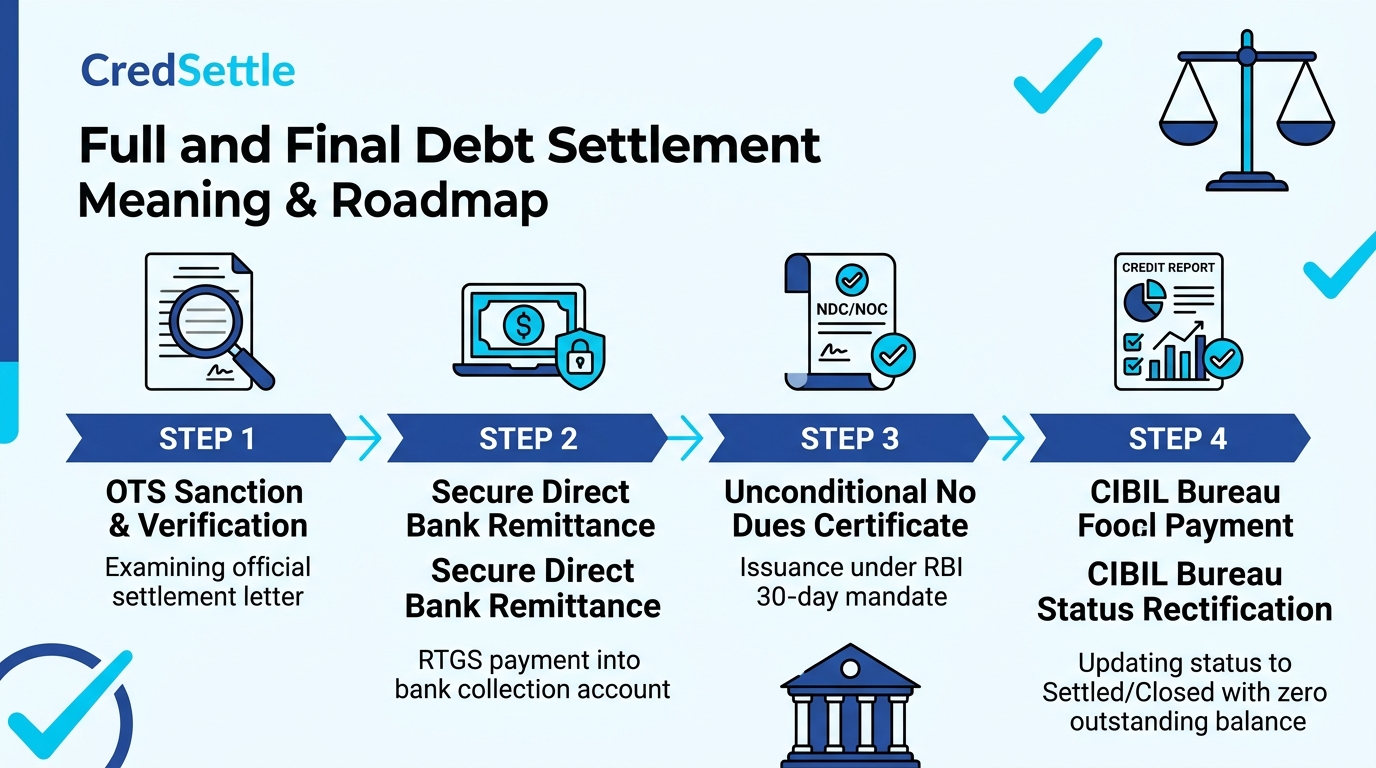
5. 6-Stage SOP to Execute a Full and Final Settlement
To prevent post-settlement legal disputes, unauthorized balance revival. Perpetual bureau default tags, follow this strict 6-stage operational protocol developed by CredSettle debt resolution professionals:
Stage 1: Financial Hardship Assessment & Formal Settlement Petition
Compile verifiable documentary evidence of genuine financial hardship (e.g., job loss, medical catastrophe, business insolvency). Submit a formal settlement representation to the bank's Central Collections and Retail NPA Committee proposing a realistic lump-sum or structured compromise figure based on the principal balance.
Stage 2: Comprehensive Audit of the OTS Sanction Letter
Scrutinize the bank's settlement sanction letter to confirm it is issued on physical letterhead bearing the bank's CIN, branch seal. Authorized signatory signature. Verify that the letter explicitly contains the phrase. "accepted in full and final settlement of all claims against Loan Account No. XXXXXXXXX"..
Stage 3: Traceable Direct Bank Remittance (RTGS / NEFT / Demand Draft)
pay the exact sanctioned settlement amount before the validity cut-off date directly into the bank's designated collection account. Never pay through personal UPI IDs, third-party payment gateways, or cash handed to collection agents. Secure timestamped RTGS UTR receipts.
Stage 4: Demand & Verification of the Unconditional No Dues Certificate
Immediately upon remittance clearance, file a written request demanding issuance of the physical/digital No Dues Certificate (NDC). Inspect the certificate to ensure it certifies zero remaining balance, confirms complete discharge. Contains no conditional reservation clauses.
Stage 5: Collateral Retrieval & Auto-Debit Mandate Revocation
For secured loans, collect all original title deeds, share certificates. Signed Form 35 (for RTO vehicle hypothecation removal). Instruct your savings bank to revoke and cancel all active NACH/ECS mandates. Demand written confirmation that all post-dated cheques (PDCs) have been destroyed.
Stage 6: Credit Bureau Validation & Long-Term Score Rebuilding
Download your updated CIBIL and Experian reports after 45 days. Verify that the overdue balance reflects ₹0 and the status is updated to "Settled". If the bank fails to update bureau records within 30 days, raise an online dispute with your scanned NDC attached.
6. Section 63 Contract Act: Why Lenders Cannot Revive Settled Debt
Many borrowers fear that years after settling a loan, the bank or an aggressive collection agency might resurface to demand the waived balance. Under Indian jurisprudence, a properly executed Full and Final Settlement is fortified by foundational statutory protections that legally extinguish the creditor's claims.
Section 63 of the Indian Contract Act, 1872 (Doctrine of Remission).
Section 63 of the Indian Contract Act establishes that. "Every promisee may dispense with or pay, wholly or in part, the performance of the promise made to him. May extend the time for such performance. May accept instead of it any satisfaction which he thinks fit.". In the context of debt settlement, once a bank accepts a lesser sum under an OTS agreement, the original contract is discharged by operation of law. Unlike English Common Law, Indian law requires no fresh consideration for remission to be legally valid and permanent.
The Doctrine of Accord & Satisfaction and Promissory Estoppel.
In banking jurisprudence, the sanction letter represents the. Accord (agreement to settle for a specific sum), and the payment of funds constitutes the. Satisfaction (performance of the agreed compromise). Once accord and satisfaction are completed, the legal doctrine of. Promissory Estoppel. strictly prohibits the lender, its recovery agents. Assignee Asset Reconstruction Companies from reviving the waived debt or initiating legal proceedings under Section 138 of the Negotiable Instruments Act or Section 25 of the Payment and Settlement Systems Act.
RBI Directive RBI/2023-24/60 (₹5,000/Day Delay Penalty).
Lenders failing to issue the No Dues Certificate and release original property/movable documents within 30 days of settlement payment must pay the borrower ₹5,000 compensation for every day of unexcused delay.
RBI Circular RBI/2023-24/72 (₹100/Day Bureau Penalty).
Lenders and credit bureaus that fail to update or rectify credit bureau reporting within 30 days of receiving valid settlement proof must pay ₹100 per day compensation to the aggrieved borrower.
7. 3-Tier Escalation Matrix for Settlement Compliance
If your lending institution delays issuing your No Dues Certificate, continues recovery harassment post-settlement. Fails to update TransUnion CIBIL, execute this structured 3-tier escalation hierarchy:
Branch Operations & CRM
Submit written representation to the Branch Manager and log a formal service ticket on the bank's central portal attaching your OTS sanction letter and transaction UTR receipt.
Principal Nodal Officer (PNO)
Escalate to the bank's apex grievance desk (PNO). The PNO has administrative authority to approve backend sacrifice vouchers and expedite manual NDC generation.
RBI Integrated Ombudsman
File a statutory complaint at. cms.rbi.org.in. The Ombudsman orders immediate delivery of the NDC and awards statutory daily delay compensation.
8. Chronological Milestone Resolution Table: Institutional Timelines
The institutional timeline from payment execution to clean bureau records follows a defined sequence:
| Timeline Phase | Institutional / Banking Event. | Legal Document Generated. | Borrower Action Required. |
|---|---|---|---|
| Day 0 (Payment Day). | Settlement funds remitted into designated bank collection ledger. | RTGS / NEFT UTR Counterfoil. | Preserve transaction counterfoils; email copies to bank settlement team. |
| Days 1 – 7 | Operations reconciles payment; passes internal sacrifice/loss accounting voucher. | Internal Accounting Voucher. | Download updated loan ledger statement verifying ₹0 outstanding balance. |
| Days 8 – 20 | Authorized signatory generates official physical / digitally signed NDC. | Unconditional No Dues Certificate (NDC). | Collect original certificate; verify all account, name & PAN details. |
| Days 21 – 30 | Security released; Form 35 issued for auto loans; property deeds handed over. | Form 35 / Original Property Deeds. | Submit Form 35 to RTO; cancel all active NACH/ECS mandates with your bank. |
| Days 31 – 45+ | Bank transmits monthly data tape to CIBIL, Experian, Equifax & CRIF High Mark. | Updated Credit Bureau Report (CIR). | Download fresh CIBIL report; raise online dispute with NDC if tape is delayed. |
9. Special Scenarios: Credit Cards, ARCs & Fintech Apps
Credit Card Settlements
Credit cards are unsecured revolving credit lines. Upon settlement, the bank's card operations department must deactivate all physical/virtual cards, extinguish accumulated reward point encumbrances. Issue a dedicated electronic NDC confirming zero current balance on primary and add-on cards.
Debt Sold to ARCs
If the bank assigned your NPA to an Asset Reconstruction Company (ARC) under SARFAESI Section 5, you must negotiate and obtain the NDC directly from the ARC. Ensure the ARC provides a copy of the Assignment Agreement confirming their exclusive legal authority to discharge the debt.
Digital Fintech NBFC Apps
For instant app loans (KreditBee, MoneyView, CASHe), the settlement must be executed with the underlying RBI-registered NBFC lender (the Regulated Entity), not the front-end Lending Service Provider (LSP). Ensure the NBFC cancels e-mandates and revokes app data permissions under RBI Digital Lending Directives.
 Legal Debt Dispute Authority
CredSettle (credsettle.com) is India's premier debt settlement, loan dispute resolution, and legal protection platform. Operating strictly under the RBI Fair Practices Code and CICRA 2005, our advocate panel negotiates directly with Bank Principal Nodal Officers to eliminate waived differentials, obtain unconditional No Dues Certificates (NDC), and upgrade credit bureau records from "Settled" to "Closed".
Frequently Asked Questions on Full and Final Settlement Meaning
Click on any question below to view detailed legal and banking answers verified by our debt resolution experts:
All legal procedures, timelines, and rights described on this page are grounded in official Indian statutory frameworks: