Who Is Liable for Supplementary Credit Card Default?
RBI rules place 100% bill liability on the primary credit card holder. Learn how to protect your CIBIL score, stop agent calls to family, and settle heavy add-on card debt legally.
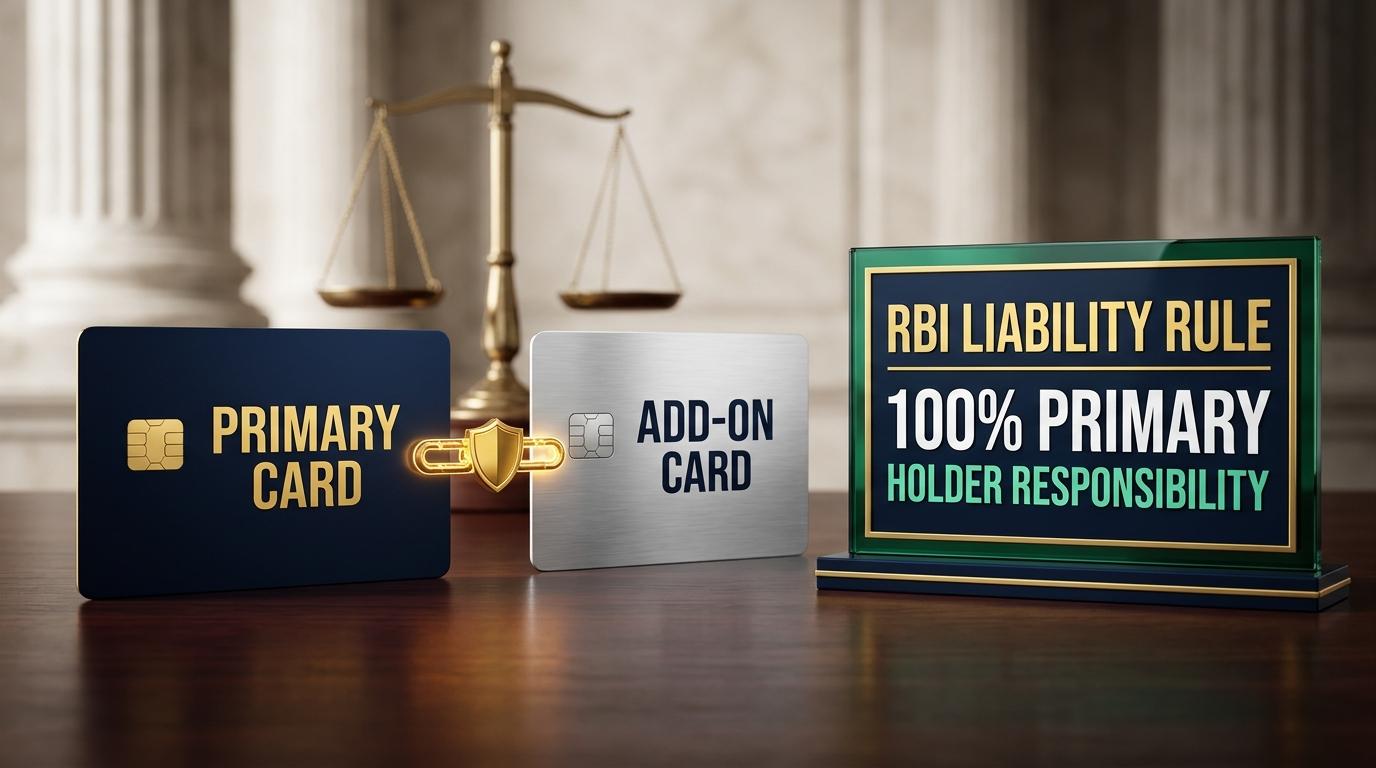
- 100% Primary Holder Debt: Under RBI rules, every swipe, EMI, fee, and interest charge on an add-on card must be paid by the primary cardholder.
- CIBIL Impact & ₹100/Day Rule: Default hits the primary PAN. If a bank wrongly reports an add-on user on CIBIL, delays past 30 days earn ₹100 per day.
- Death of Primary Holder: Add-on users never pay from their own pocket. Under Section 50 CPC, banks can claim dues only from the deceased estate.
- Divorce Does Not Bind Banks: Family court terms do not change your bank contract. Block spouse add-on cards right away to stop fresh debt.
- Single One-Time Settlement: Primary and add-on card dues merge into one account. You can settle the combined bill for 40% to 70% relief via OTS.
1. RBI Master Direction on Add-On Credit Card Liability
Many people in India give add-on credit cards to a spouse, parent, or child. Trouble starts when heavy spending, job loss, or a family fight leads to missed bills. Both users then ask who the bank can legally force to pay.
The Reserve Bank of India answers this in its 2022 Credit Card Master Direction. Circular DoR.AUT.REC.No.27/24.01.041/2022-23 sets binding rules for all banks and card issuers in India. Chapter I, Paragraph 3(a)(i) defines an add-on card in clear terms.
An add-on card is a supplementary card tied to the main credit card. It works strictly inside the credit limit and debt liability of the primary holder. The bank grants this limit based only on the primary holder income and KYC papers.
Because of this rule, the primary cardholder owes 100% of the unpaid bill. Even if your family member spent money without asking you, the bank will claim it from you. RBI rules also require the primary holder written consent before a bank issues any add-on card.
2. Primary vs Add-On Holder: Contract Law and Clauses
Under the Indian Contract Act of 1872, a contract binds only the people who sign it. Lawyers call this privity of contract. For a credit card, only the primary holder signs the main credit contract with the bank.
Some banks add fine print in their Most Important Terms and Conditions (MITC). These lines claim that add-on users share joint liability for swipes on their card. Recovery agents often read out this fine print to scare spouses or young students.
Yet RBI rules and consumer courts treat an add-on user very differently from a loan co-borrower. An add-on user does not own the credit line and gets no separate bill. The table below shows how Indian law treats each person during default.
| Legal Parameter | Primary Cardholder | Add-On Card User | Joint Loan Co-Borrower |
|---|---|---|---|
| Repayment Liability | 100% Principal Debtor | Authorized User Only | 100% Joint & Several |
| Credit Limit Ownership | Owns Sanctioned Limit | Shares Primary Sub-Limit | Co-Owns Loan Sanction |
| PAN & CIBIL Impact | Direct Score Drop on Default | No Score Impact (If Valid) | Both PANs Hit Equally |
| Bank Savings Lien (Sec 171) | Applicable on Own Account | Exempt From Bank Set-Off | Applicable on Co-Owner |
| OTS Settlement Power | Sole Signatory for OTS & NOC | Cannot Settle Alone | Joint OTS Release Needed |
3. CIBIL Score Impact and Wrongful Reporting Remedies
Every swipe on an add-on card uses up the credit limit of the primary holder. When total spending passes 30% of the card limit, the primary CIBIL score starts to drop. If the bill stays unpaid, the default is recorded against the primary holder PAN.
Under the RBI update of March 7, 2024 (Circular RBI/2023-24/132), banks must give a 3-day grace window past the due date. A bank can report a card as past due to CIBIL, Experian, Equifax, or CRIF only after three unpaid days pass.
Normally, an add-on card does not show up on the add-on user credit report. Still, banks sometimes take KYC for an add-on card and wrongly link a default to the add-on PAN. This mistake can block your spouse or child from getting future loans.
Under CICRA 2005 and RBI Circular RBI/2023-24/72, wrong CIBIL entries must be removed within 30 days. The bank gets 21 days to check files, and the bureau gets 9 days to fix the report. Delays past Day 30 earn the victim ₹100 per day in compensation. Read our CIBIL settlement score guide to learn how to rebuild credit.
| Dispute Window | Responsible Entity | Statutory Duty | Compensation to Add-On User |
|---|---|---|---|
| Day 1 to Day 21 | Card Issuing Bank | Verify Add-On Status & Detach PAN | ₹0 (Statutory Window) |
| Day 22 to Day 30 | CIBIL / Credit Bureau | Delete Wrongful Default Entry | ₹0 (Statutory Window) |
| Day 45 (15 Days Late) | Delaying Bank or Bureau | Breach of 30-Day CICRA Rule | ₹1,500 |
| Day 90 (60 Days Late) | Ombudsman Escalation | Mandatory UPI / Bank Credit in 5 Days | ₹6,000 + Tort Damages |
4. Consumer Commission and Court Precedents in India
Indian courts treat credit card debt as a civil money matter. Police cannot arrest the primary holder or the add-on user just because a card bill is unpaid. Check our guide on whether you can go to jail for credit card debt to know your legal shield.
Supreme Court rulings and National Consumer Commission (NCDRC) orders also protect families from rough agents and online card fraud.
The Supreme Court barred banks from sending musclemen or abusive recovery agents. Banks must collect unpaid card dues only through lawful civil court steps.
Under RBI Fair Practices rules, agents cannot call before 8:00 AM or after 7:00 PM. They also cannot shame spouses, parents, or add-on users at home or work.
Under Section 2(11) of the Consumer Protection Act, 2019, consumer courts fine banks that harass non-liable add-on users or harm their CIBIL reports.
If phishing or card cloning hits an add-on card, report it within 3 working days. You get zero liability under RBI rules, and the bank must prove any fault.
5. Visual Blueprint: Add-On Card Default and Liability
This chart shows how RBI rules link an add-on card to the main card account and place 100% repayment duty on the primary cardholder.
6. Divorce, Death of Primary Holder, and Family Disputes
Most add-on card defaults start during hard life events like a death in the family, a divorce, or heavy spending by a child. Here is how Indian law handles each case.
Death of Primary Cardholder (Section 50 CPC)
When a primary holder dies, the spouse or child with an add-on card owes nothing from personal earnings. Under Section 50 and Section 52 of the Code of Civil Procedure, banks can claim dues only from assets left by the deceased. Read our deceased borrower heir rights guide.
Divorce & Estranged Spouse Card Swipes
A family court divorce order does not bind your bank because the bank was not part of your marriage case. The primary spouse must still pay the bank for swipes made before blocking the add-on card. You can then claim that money back in family court.
Bank Set-Off Lien on Savings Accounts
Under Section 171 of the Indian Contract Act, a bank can place a hold only on deposits owned by the primary debtor. The bank cannot freeze or cut money from the add-on user personal salary account. See our Section 171 bank set-off guide.
Unbilled Merchant EMIs on Add-On Cards
If a relative bought phones or tickets on EMI with the add-on card, default cancels the EMI plan. All unpaid principal instalments get added straight to the primary card bill as one combined sum.
7. Blocking Add-On Cards and RBI 7-Day Closure Penalty
Many primary holders make costly mistakes when an add-on card bill grows too large. Never just delete the card app without closing the add-on card. Saved online tokens and app plans will keep charging your monthly bill.
Under RBI rules, either the primary holder or the add-on user can block an add-on card at once. You can use the mobile app, net banking, IVR, or phone helpline. Banks cannot force you to send paper letters by post.
Once all dues are paid or settled, the bank must close a credit card within 7 working days. If the bank delays past 7 working days on a zero-balance card, RBI rules impose a ₹500 per day penalty payable to you.
Also stay clear of the credit card minimum due trap. Paying just 5% Minimum Amount Due leaves 95% of your bill growing at 36% to 45% yearly interest plus 18% GST. That can double your debt in two years.
8. Step-by-Step SOP to Resolve Add-On Credit Card Debt
Follow these six clear steps to stop new add-on charges, shield your family from agent calls, and close heavy credit card bills.
1Stage 1: Block All Add-On Cards and Saved Tokens
Open your bank app or call customer care to close every add-on card for good. Delete saved card tokens on SI-Hub so auto-pay charges stop right away.
2Stage 2: Split Real Spending From Interest and Fees
Download your past twelve card bills. Add up real swipes on both primary and add-on cards, and separate them from 42% interest, late fees, and 18% GST.
3Stage 3: Check Both Credit Reports for Errors
Pull CIBIL and Experian reports for both the primary holder and the add-on user. If the bank marked the add-on PAN in default, send a 30-day CICRA dispute notice.
4Stage 4: Protect Salary Cash and Stop Agent Calls
Keep the primary holder living money in a separate bank to avoid Section 171 hold cuts. Send a legal warning if agents call your family. Learn how to stop credit card recovery calls.
5Stage 5: Request One-Time Settlement (OTS) on Main Account
Once the card crosses 90 days unpaid and turns NPA, ask the bank nodal desk for a single credit card settlement covering both primary and add-on balances.
6Stage 6: Check OTS Letter and Collect Final NOC
Always verify the bank OTS letter before you pay into the card account. Collect your No Dues Certificate and check CIBIL after 15 to 30 days.
9. 3-Tier Escalation Matrix: Bank GRO to RBI Ombudsman
If agents trouble your family, delay card closure, or mark an add-on PAN on CIBIL, use this official three-step RBI complaint path.
| Escalation Tier | Designated Banking Authority | Turnaround Time | Scope of Intervention & Relief |
|---|---|---|---|
| Level 1: GRO | Card Issuer Grievance Redressal Officer | 7 to 10 Working Days | Blocks add-on cards, logs fraud claims, and stops agent calls to relatives. |
| Level 2: PNO | Principal Nodal Officer (Head Office) | 14 to 21 Calendar Days | Removes wrong add-on CIBIL tags, clears OTS terms, and checks ₹500/day delays. |
| Level 3: RBI Ombudsman | Reserve Bank Integrated Ombudsman | 30 Days Post-Complaint | Passes binding orders on cms.rbi.org.in for ₹100/day CIBIL delays and harassment. |
10. Procedural Timeline: Card Default to Debt Closure
Knowing the credit card NPA timeline helps primary holders stay calm at each stage and secure strong fee waivers.
| Days Past Due (DPD) | Account Classification | Bank Action on Primary & Add-On | Recommended Cardholder Action |
|---|---|---|---|
| Day 1 to Day 3 | RBI 3-Day Buffer | No late fee or CIBIL past-due tag allowed during these 3 days. | Pay bill if short delay; block add-on card if misused. |
| Day 4 to Day 30 | SMA-0 Stage | Late fees, 3.5% monthly interest, and reminder alerts start. | Check combined statement and cancel standing instructions. |
| Day 31 to Day 89 | SMA-1 / SMA-2 | Both primary and add-on cards blocked; active EMIs foreclosed. | Keep hardship proof ready and reply to card legal notices. |
| Day 90+ | NPA Classification | Account marked Non-Performing Asset; recall notice sent to primary holder. | Start One-Time Settlement talks with the bank nodal team. |
| Day 120 to 180+ | OTS & Closure | Bank waives added interest and late fees under its OTS policy. | Pay verified OTS sum, collect NOC, and check 15-day CIBIL update. |
 Legal Debt Dispute Authority
CredSettle (credsettle.com) is India's premier debt settlement, loan dispute resolution, and legal protection platform. Operating strictly under the RBI Fair Practices Code and CICRA 2005, our advocate panel negotiates directly with Bank Principal Nodal Officers to eliminate waived differentials, obtain unconditional No Dues Certificates (NDC), and upgrade credit bureau records from "Settled" to "Closed".
Frequently Asked Questions: Add-On Credit Card Default
Simple, verified legal answers on primary holder debt, add-on user CIBIL safety, death of a cardholder, divorce bills, and credit card settlement in India.
Official Regulatory Citations and Statutory References
- RBI Credit Card Master Direction (2022): Circular RBI/2022-23/92, DoR.AUT.REC.No.27/24.01.041/2022-23, Chapter I, Para 3(a)(i), updated March 7, 2024 (RBI/2023-24/132).
- RBI Credit Report Compensation Rule: Circular RBI/2023-24/72, DoR.FIN.REC.49/20.16.003/2023-24 (₹100 per day payout for CIBIL delays past 30 days).
- Credit Information Companies Act, 2005 (CICRA): Section 21, 30-day rule to fix wrong credit report entries.
- Code of Civil Procedure, 1908 & Contract Act, 1872: Section 50 & Section 52 CPC (Estate limit on legal heirs) and Section 171 Contract Act (Banker lien scope).
- Supreme Court & Consumer Law: Manager, ICICI Bank Ltd. v. Prakash Kaur (2007) 2 SCC 711; Consumer Protection Act, 2019, Section 2(11); RBI Circular DBR.No.Leg.BC.78/09.07.005/2017-18 (Zero liability on card fraud).