Corporate Credit Card Default After Leaving Your Job
Who pays an overdue office credit card bill depends on the contract clause you signed. Learn RBI business card rules, guard your CIBIL score, and settle unpaid work card dues the legal way.
- Contract Rules the Debt: Having your firm name embossed on the card does not prove who owes the bill. Your signed form sets Sole Corporate, Individual, or Joint Liability.
- Sole Corporate Shield: On a true Company Liability card, only the firm owes the bank. Defaults hit the firm CIBIL Rank and never touch your own CIBIL score.
- Employee Card Trap: On Individual or Joint cards (used by HDFC, ICICI, Axis, and Amex travel plans), the bank can ask you to pay even when HR delays your payout.
- Right to Expense Payout: Under Section 222 of the Indian Contract Act, your employer must pay you back for every lawful work expense made on duty.
- Wrong CIBIL Penalty: If a bank marks a Sole Corporate card default on your PAN, RBI rules force removal in 30 days or award ₹100 per day.
1. RBI Legal Framework for Corporate Credit Cards
Many staff members in India get an office credit card when they join a firm. They swipe it for flights, hotels, client meals, and software tools. Trouble starts when a worker quits, gets laid off, or works for a firm that stops paying bills.
The Reserve Bank of India regulates these cards under the Credit Card and Debit Card - Issuance and Conduct Directions, 2022, updated in March 2024. Paragraph 7 of this RBI rulebook governs business and corporate cards across India.
Under Paragraph 7, banks can issue business cards as charge cards, corporate cards, or cards linked to cash credit lines. Banks can also give add-on cards to staff members whenever the firm asks for them.
When full debt duty rests with the firm, bill due dates and refunds follow the contract between the bank and the firm. Under the 2024 RBI update, banks must also track end-use of funds so business credit is used only for work spends.
2. Three Corporate Card Liability Models in India
Most workers think a card with a company logo is 100% the firm's problem. That myth causes huge credit score losses. Top banks like American Express, HDFC Bank, ICICI Bank, SBI Card, and Axis Bank issue office cards under three models.
Before you reply to a bank agent, read your Most Important Terms and Conditions (MITC) or Key Facts Statement (KFS). Check which of the three structures below matches your signed form.
| Card Type | Main Legal Debtor | KYC Used at Issue | Can Bank Sue Staff? |
|---|---|---|---|
| 1. Sole Corporate | 100% Employer Firm | Firm GST, CIN, & balance sheet | No (Unless Fraud) |
| 2. Individual Card | 100% Employee User | Staff PAN, Aadhaar, & pay slips | Yes (Full Bill + Fees) |
| 3. Joint & Several | Both Firm & Staff | Firm Master + Staff PAN | Yes (Either or Both) |
On a Sole Corporate card, the bank approves credit based on the firm's money. You only hold the plastic card for work use. If the firm misses due dates, the bank can claim money only from the firm.
On an Individual or Joint and Several card, your own PAN sits on the loan file. Under Section 43 of the Indian Contract Act, a joint promise lets the bank demand 100% of the unpaid bill from you alone if your firm defaults.
3. Personal CIBIL vs Commercial Credit Rank Impact
In India, CIBIL, Experian, Equifax, and CRIF keep two separate credit files. Personal files track people by personal PAN. Business files track firms by Company PAN and give a CIBIL Rank from 1 to 10.
When a Sole Corporate card goes unpaid, the bad mark hits only the firm's business report. Even in joint corporate plans where RBI asset rules map debt solely to the company, your own CIBIL score stays safe.
By contrast, an Individual office card shows up right on your personal CIBIL file. Even a 30-day payout delay by your finance team can cut your score by 80 points. That drop can block your next home or car loan.
Sometimes banks make system errors and post a Sole Corporate card default on a worker's PAN. Under RBI Circular RBI/2023-24/72, raise a written dispute at once. If the bank and bureau do not fix your CIBIL in 30 days, they owe you ₹100 per day.
4. Indian Contract Act & High Court Precedents
Indian courts follow two strict rules in work debt cases: separate corporate identity and privity of contract. Privity of contract means a bank cannot force you to pay a loan if you never signed a personal promise to pay.
At the same time, agency law backs honest workers who spend money on office trips. Below are the four legal pillars that protect staff and directors in India.
Citing Tristar Consultants, the Delhi High Court held that directors and staff owe no personal money for firm debts unless they signed a personal guarantee or committed fraud.
An employer must pay back an agent or worker for all lawful work costs incurred on duty. This includes bank late fees caused when the firm delays your expense payout.
A bank lien works only against accounts owned by the same debtor. A bank cannot pull money from your personal salary account to clear a Sole Corporate card bill.
Unpaid office travel bills are civil money claims, not crimes. Police action under Section 316 or 318 of BNS 2023 applies only to fake bills or theft of funds.
5. Visual Blueprint: Employee vs Company Liability
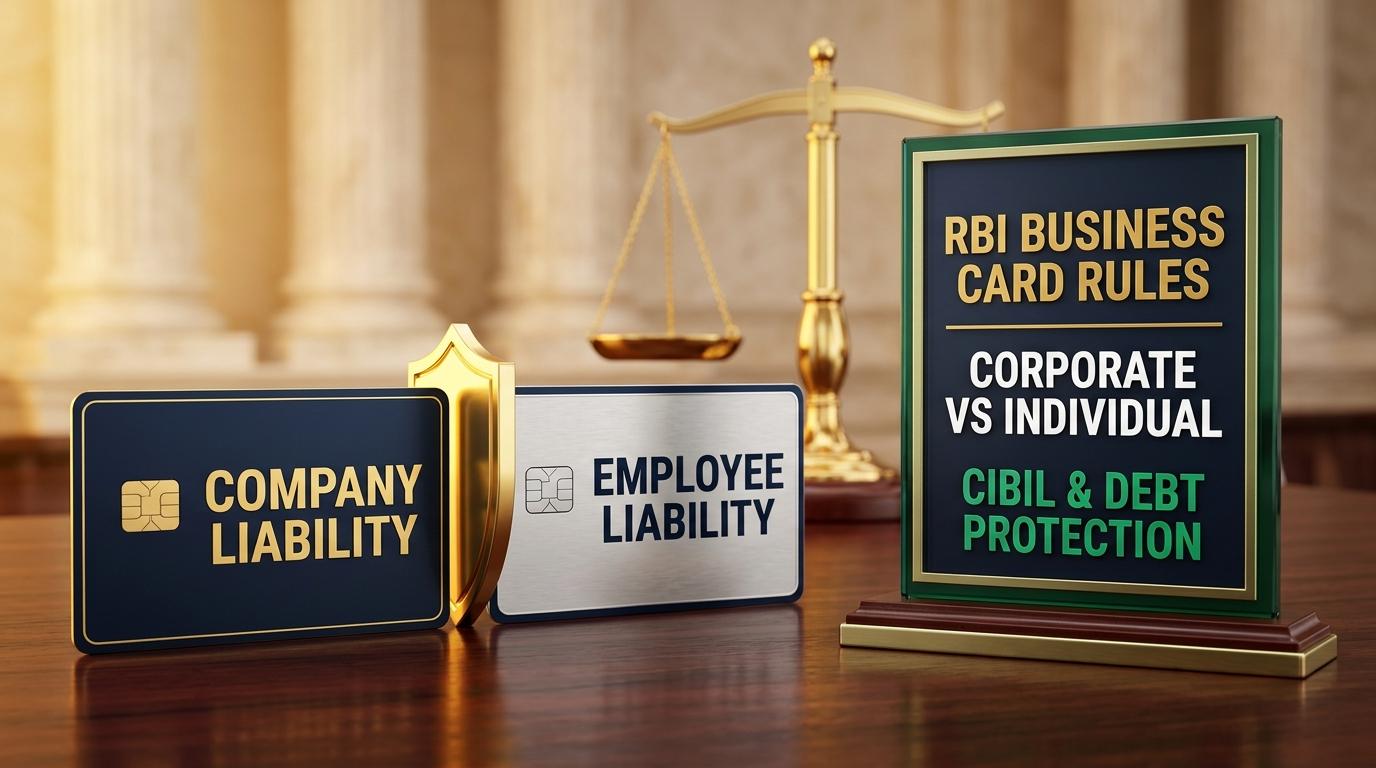
This visual chart shows the clear legal wall between company-paid business cards and staff-liable cards under RBI rules and CIBIL norms.
6. Unpaid Expense Claims, Job Exit & F&F Rules
Most office card defaults happen right after a worker resigns. You submit travel bills before your last day, but HR holds your Full and Final (F&F) pay for 60 days. In that gap, the card bill misses its due date and adds 42% yearly interest plus 18% GST.
If you hold an Individual or Joint card, the bank will not wait for HR. Telling the bank that your ex-firm owes you money does not stop late fees or CIBIL drops. Pay or settle the bank bill to save your score, then send a legal notice to your old firm.
What if a worker swipes a Sole Corporate card for personal items by mistake? The firm can deduct proven personal swipes from F&F dues under job rules. Still, courts hold that HR should not hold back your relieving letter to force disputed money claims.
On your last day at work, hand back the card to HR and get a signed no-dues slip. Under Paragraph 8 of the RBI Credit Card Rules, once dues are zero, the bank must close a card in 7 working days or pay ₹500 per day.
7. Startup Shutdowns & IBC Form D Employee Claims
A tough trap hits when a startup stops paychecks, shuts down, or enters bankruptcy at the National Company Law Tribunal (NCLT). Sales staff often get stuck with ₹2 Lakhs to ₹10 Lakhs in unpaid travel bills on employee-linked cards.
Work Dues Under Section 5(21) IBC
Under the Insolvency and Bankruptcy Code, 2016, unpaid pay and approved work expense claims count as operational debt owed to staff.
Submit Proof of Claim in Form D
Under Regulation 9 of the IBBI Rules, staff must file Form D with the Resolution Professional along with bills, emails, and card statements.
Section 14 Stay Covers Only the Firm
An NCLT stay blocks suits against the bankrupt firm, not against personal cardholders. On Individual or Joint cards, banks can still ask you to pay.
Hardship One-Time Settlement (OTS)
Showing NCLT orders and unpaid salary proof helps you settle an Individual office card at a 40% to 65% waiver under a bank OTS plan.
8. Step-by-Step SOP: Resolving Corporate Card Dues
Follow these six clear steps as soon as you spot an unpaid work card bill or get a recovery call after leaving a job.
1Stage 1: Ask the Bank for Your Signed Card Form
Email bank support and ask for your signed card form and MITC. Check in writing if the card is Sole Corporate, Individual, or Joint.
2Stage 2: Block the Card & Stop Auto-Debits
Block the card at once so team members or cloud tools cannot add new charges. Cancel all standing mandates on SI-Hub.
3Stage 3: Save All Expense Proofs Before Exit
Download approved Zoho, SAP, or Concur sheets, flight tickets, GST bills, and manager emails before HR locks your work email.
4Stage 4: Send Non-Liability Reply on Sole Cards
If your contract shows Sole Corporate Liability, send a legal reply directing the bank to the firm's Finance Head and warning against PAN reporting.
5Stage 5: Serve Section 222 Notice on Old Firm
On Individual or Joint cards, send a legal notice under Section 222 of the Contract Act demanding fast payout of bills plus bank late fees.
6Stage 6: Settle via Bank OTS & Collect NOC
When an ex-employer shuts down and bills grow too big to pay, sign a verified One-Time Settlement (OTS) with the bank and take a No Dues letter.
9. 3-Tier Escalation: Bank PNO to RBI Ombudsman
If bank agents chase you for a Sole Corporate debt, call your new office, or mark your personal CIBIL by mistake, use this three-step RBI ladder.
| Tier Level | Bank or RBI Office | Wait Window | Action & Relief Granted |
|---|---|---|---|
| Level 1: GRO | Grievance Redressal Officer | 7 to 10 Days | Shares signed card contract, stops agent calls, and logs CIBIL fix request. |
| Level 2: PNO | Principal Nodal Officer | 14 to 21 Days | Deletes wrong personal PAN mark, drops unfair fees, or clears OTS terms. |
| Level 3: RBI CMS | RBI Integrated Ombudsman | After 30 Days | Orders CIBIL cleanup via cms.rbi.org.in and grants ₹100/day or ₹500/day fines. |
10. Procedural Timeline: Default to Legal Closure
Knowing how an unpaid office card moves from day one past due to Non-Performing Asset (NPA) helps you act before fees double the debt.
| Days Past Due | Bank Tag | What the Bank Does | Your Best Move |
|---|---|---|---|
| Day 1 to 30 | SMA-0 Stage | Adds late fee, 3.5% monthly interest, and sends SMS alerts. | Check card contract type and push HR to clear pending bills. |
| Day 31 to 60 | SMA-1 Stage | Freezes card swipes and reports late payment to credit bureaus. | Send Section 222 demand to firm or dispute wrong PAN entry. |
| Day 61 to 90 | SMA-2 Stage | Starts recovery calls and sends legal notice to liable parties. | Reply via lawyer showing Sole Corporate clause or job loss proof. |
| Day 91+ | NPA & OTS | Marks card as NPA and opens One-Time Settlement talks. | Close Individual card via verified OTS letter and file Form D. |
 Legal Debt Dispute Authority
CredSettle (credsettle.com) is India's premier debt settlement, loan dispute resolution, and legal protection platform. Operating strictly under the RBI Fair Practices Code and CICRA 2005, our advocate panel negotiates directly with Bank Principal Nodal Officers to eliminate waived differentials, obtain unconditional No Dues Certificates (NDC), and upgrade credit bureau records from "Settled" to "Closed".
Frequently Asked Questions: Corporate Card Default
Clear answers on staff versus company debt rules, personal CIBIL safety, unpaid travel claims, startup shutdowns, and card settlements in India.
Official Regulatory Citations & Legal References
- RBI Master Direction: Credit Card and Debit Card - Issuance and Conduct Directions, 2022 (Updated March 7, 2024), Paragraph 7 (Business Cards) and Paragraph 8 (7-Day Closure & ₹500/Day Penalty).
- Indian Contract Act, 1872: Section 43 (Joint Promise), Section 128 (Surety Debt), Section 171 (Bank General Lien), and Section 222 (Employer Duty to Pay Agent Costs).
- RBI CIBIL Fix Circular: RBI/2023-24/72, DoR.FIN.REC.49/20.16.003/2023-24, ₹100 per day fine for unresolved CIBIL disputes past 30 days under CICRA, 2005.
- Insolvency and Bankruptcy Code (IBC), 2016: Section 5(21) (Work Debt) and Regulation 9 of IBBI CIRP Rules, 2016 (Form D Staff Claim).
- Court Precedents: Mukesh Hans v. Smt. Uma Bhasin (2010, Delhi HC), Tristar Consultants v. Vcustomer Services India (2007, Delhi HC), and ICICI Bank v. Prakash Kaur (2007, SC).